
A workplace safety system can carry substantial documentation and still fail at the moment a worker needs it. Australia recorded 146,700 serious workers' compensation claims in 2023–24, preliminary, and 188 work-related fatalities in 2024, while Safe Work Australia estimates that reducing work-related injuries and illnesses would be worth $28.6 billion each year to the Australian economy (Safe Work Australia). Those figures reframe safety compliance as more than a legal obligation. It's an economic, operational and human-performance issue.
For plant managers and safety officers, the practical question is not whether a procedure exists. It's whether a technician can identify the correct isolation point, read a warning after years of UV exposure, find first-aid equipment quickly, or trace a valve during maintenance. Written WHS systems only work when physical controls remain visible, legible and trusted on the floor.
Why Safety Compliance Starts on the Floor
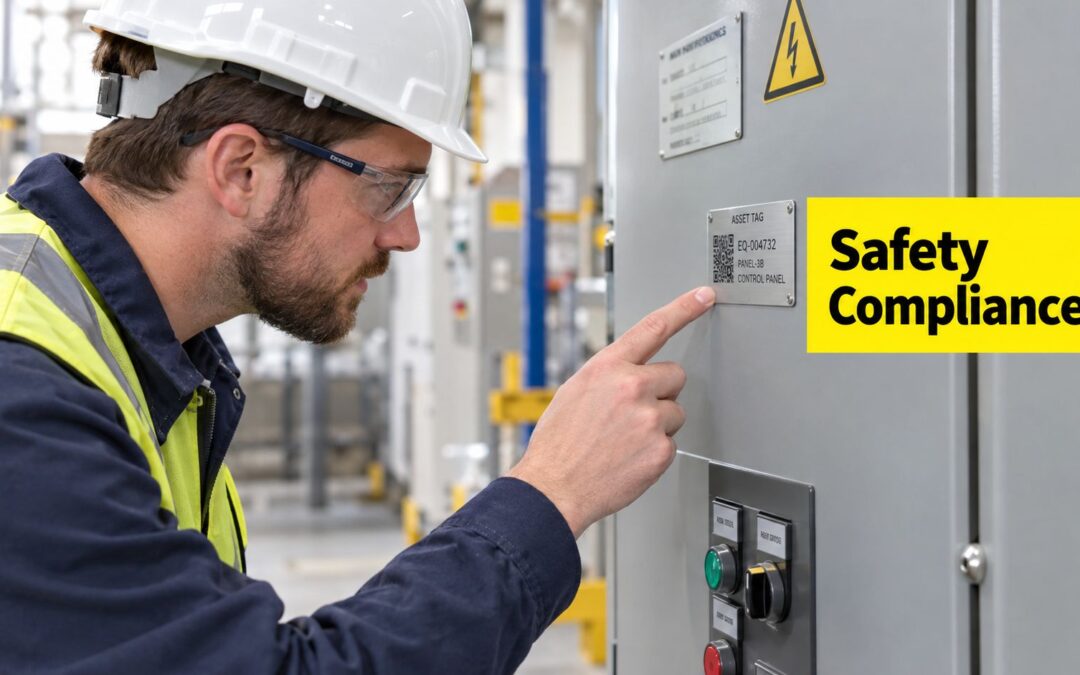
At 2 a.m., a maintenance technician reaches for an isolation point on a switchboard. The permit is printed, but its pages are stained and the sticker beside the breaker is peeling. The technician has seconds to distinguish the correct asset from similar equipment nearby. That decision will be guided by the surfaces in front of them, not by a policy manual stored in an office.
A safety compliance programme succeeds or fails at the point of work. A procedure may specify isolation, verification and authorised access, but the worker still needs a clear asset identifier, a durable warning and an unambiguous instruction at the point of work. If the sign has faded, lifted or become unreadable, the documented control has weakened even if the procedure remains technically correct.
Practical rule: Treat every sign and label as a control that must survive the environment where people use it.
Start with the conditions around the asset. Dust, solvents, washdowns, heat, sunlight, vibration and repeated handling each affect a sign differently. A paper notice may suit a temporary activity, but it's a poor choice for a permanent hazard. A low-cost adhesive label may look acceptable at installation and fail once cleaning chemicals reach its edges.
The same floor-level thinking applies to injury prevention. A resource such as prevent back injuries at work can support worker education, but the physical workplace must also guide safe movement through clear access routes, equipment identification and visible instructions.
Durable signage and asset labels connect the written WHS system to operator behaviour. AS 1319:1994 provides the Australian benchmark for workplace safety signs, while laser-engraved identification can create a more permanent marking for equipment, valves and control panels. The right specification depends on the hazard, substrate and service conditions. The wrong one creates a maintenance problem disguised as a compliance solution.
How Australia's WHS Framework Actually Works
Australia's WHS system operates through Commonwealth, state and territory regulators, rather than one national enforcement authority. Each jurisdiction applies its own legislation and enforcement processes within the shared framework established by model laws developed by Safe Work Australia.
Safe Work Australia develops model Acts, regulations and codes of practice. The law that applies to a site depends on its location, industry and work activities. The primary Act sets broad duties, regulations establish detailed requirements, and approved codes explain practical ways to manage specific risks. Codes may also support enforcement action or help demonstrate how a duty was addressed.
A person conducting a business or undertaking, or PCBU, holds the primary duty to ensure health and safety so far as is reasonably practicable. Officers must exercise due diligence. Workers must take reasonable care and follow reasonable instructions. These duties meet at the point of work. Training does not compensate for an unidentified hazard, and a worker cannot ignore a clear control because another method seems faster.
Enforcement is active, not merely theoretical. The national 2018–19 enforcement summary recorded 229,236 workplace interventions, including 77,632 proactive workplace visits and 67,836 reactive workplace visits. It also recorded 1,187 field active inspectors, 55,568 notices, 23 enforceable undertakings, 307 finalised legal proceedings and $18.6 million in court-issued fines (national WHS compliance and enforcement summary).
Key pillars of Australia's WHS framework
| Regulatory Layer | Example Instrument | What Auditors Expect on Site |
|---|---|---|
| Primary legislation | Jurisdictional WHS Act | Clear accountability, consultation and evidence that duties are managed |
| Regulations | Risk-specific WHS regulations | Controls matched to plant, hazardous substances, electrical work and workplace conditions |
| Approved codes | Codes of practice and technical guidance | Practical controls that workers can understand and apply |
| Site systems | Risk assessments, permits and procedures | Current documents that align with what workers actually do |
| Physical controls | Safety signs, asset labels and isolation identifiers | Visible, legible and durable controls located at the hazard |
Training records support compliance, but competence extends beyond holding certificates. Structured professional development, including systems reflected in nursing CE accreditations, shows how organisations can record learning and accountability. Industrial sites should apply the same discipline to induction, task training, permit authorisation and workers' ability to interpret safety information correctly.
Auditors look for agreement between documentation and conditions on the floor. A risk assessment identifying a chemical hazard should match the warnings, access controls, container or equipment labels, and emergency information at that location. Signage and asset identifiers are therefore part of the control system, not decoration added after the paperwork. If a label is unreadable, detached or missing, the documented control no longer reflects the condition workers face.
The Role of Durable Signage and Asset Labels
Safety signs are not decoration. They communicate a hazard, prohibit an action, require behaviour or direct a worker towards assistance. Under AS 1319:1994, consistent colours, shapes and pictorial conventions help workers interpret signs quickly, including when they move between sites or work around unfamiliar equipment. Safe Work ACT identifies the standard as the foundation for workplace safety signage and places signage within an enforceable safety-management context (Safe Work ACT signage guidance).
The sign's function should determine its design:
- Danger signs identify an immediate hazard with a serious consequence if not avoided.
- Warning signs draw attention to a hazard that requires caution.
- Mandatory signs communicate an action workers must take, such as wearing specified PPE.
- Prohibition signs identify an action or entry that isn't permitted.
- Emergency signs direct people towards first aid, exits or emergency equipment.
- Fire signs identify fire-fighting equipment and related resources.
The hierarchy matters. Elimination remains preferable where practicable. Engineering controls should isolate people from hazards. Administrative controls, including signs and procedures, then communicate the residual risk. PPE and worker behaviour provide important protection, but they're less reliable when used as the only safeguard.

Asset identification supports control integrity
An asset label does more than name a machine. It can connect the physical item to a register, maintenance history, inspection schedule, calibration record or isolation procedure. Valve tags and equipment plates help technicians confirm that the asset in front of them matches the job documentation, which supports lockout and verification activities.
That traceability also assists incident investigation. A clear identifier lets the organisation establish which equipment was involved, what maintenance had occurred and whether a relevant inspection was current. A label that detaches or becomes unreadable breaks that chain.
First-aid readiness shows why visibility matters. A workplace survey reported that only 13% of workplaces complied with all core first-aid code elements, while 43% complied with workplace resources such as first-aid kits and signage and 46% displayed clear, visible signs identifying first-aid locations (St John first-aid readiness report). These findings demonstrate that basic systems can fail through poor implementation, not just through absent policy.
For practical signage specifications, review Evright Industrial's workplace safety signage and assess each sign against its environment, viewing distance, mounting position and required lifespan.
The durability problem is straightforward. A compliant sign on installation day may stop being compliant when its colour fades, its text abrades or its adhesive lifts. Material, finish and marking method determine whether the control remains useful through service conditions.
For a visual example of laser equipment and signage production, this Trotec Laser video shows the type of machine imagery relevant to industrial engraving. The important point isn't the machine alone. It's the relationship between the substrate, the marking depth, the design and the conditions at the installation point.
Materials, Finishes, and the Case for Laser Engraving
Material selection should start with exposure, not appearance. A sign mounted inside a clean electrical room has different requirements from a plate exposed to sunlight, solvents, vibration and repeated washdowns. Choosing a material that looks professional but cannot tolerate the site environment creates avoidable replacement work.
Anodised aluminium suits many equipment plates and general industrial identification applications. It offers a clean finish and can provide useful resistance to outdoor exposure, but the surface treatment and marking depth still matter. Stainless steel is appropriate where strength, corrosion resistance and long service are priorities, especially for asset plates and harsh industrial areas.
Traffolyte, a layered plastic engraving material, can provide strong contrast and is useful for control panels, switchboards and equipment identification. Rigid PVC can suit indoor and sheltered applications, while reverse-printed polycarbonate protects the printed face behind the sheet, making it useful where handling and cleaning could damage a surface print.
| Material | UV Resistance | Chemical Resistance | Abrasion Resistance | Typical Service Life |
|---|---|---|---|---|
| Anodised aluminium | Good when correctly specified | Good for many industrial settings | Good, depending on finish | Long-term, environment dependent |
| Stainless steel | Very good | Very good | Very good | Long-term in demanding conditions |
| Traffolyte | Moderate to good | Good for common indoor uses | Good where the engraved layers remain intact | Long-term indoors, dependent on exposure |
| Rigid PVC | Moderate | Moderate to good | Moderate | Suitable for controlled environments |
| Reverse-printed polycarbonate | Good with suitable construction | Good, with the print protected behind the sheet | Good against surface wear | Long-term where the face and edges are protected |
Where laser engraving earns its place
Laser engraving physically alters the material surface instead of relying only on ink or a separate adhesive film. That makes it valuable for asset ID plates, valve tags, control-panel labels and serial plates that must remain readable through cleaning, abrasion, repainting around the asset and repeated audit cycles.
A Trotec Laser machine can produce detailed, consistent markings across selected substrates. The output still depends on correct material selection, artwork, contrast, mounting and environmental testing. Laser engraving isn't a universal answer, and it shouldn't be specified without considering the substrate's chemical and temperature limits.
Screen printing remains practical for larger runs and designs where strong colour coverage is required. Vinyl decals can be suitable for temporary identification, smooth indoor surfaces or situations where replacement is expected. Thermal-transfer labels have a place in controlled environments and variable-data applications, particularly when the organisation needs frequent updates.
The trade-off is permanence versus flexibility. For guidance on a demanding metal application, review laser-etched stainless steel solutions. For permanent identification, a mechanically fixed engraved plate often provides more dependable service than a sticker. For changing information, a replaceable label may be more practical than a permanent marking.
Sector Differences in Compliance Demands
The same safety compliance principles produce different specifications across sectors. A manufacturing plant, a healthcare facility and an infrastructure corridor may all need hazard communication, asset identification and emergency directions, but their exposure conditions and users aren't the same.
Manufacturing
Manufacturing sites typically concentrate risk around machinery, stored energy, electrical systems, chemicals and moving equipment. Labels must identify isolation points, valves, guards, control panels and equipment boundaries. A machine may be relocated, modified or sold, so the identification system should remain consistent through changes to the plant layout.
Rugged engraved labels work well where operators handle equipment, maintenance teams perform lockout activities and cleaning affects adhesive surfaces. Sign placement matters as much as substrate. A warning hidden behind a guard or mounted below the normal line of sight won't perform its intended function.
Healthcare
Healthcare environments add infection control, patient safety, accessibility and frequent cleaning to ordinary workplace hazards. Facility guidance covers restricted-area identification, disability access requirements, durable materials, reflective and contrasting finishes, non-glare surfaces, and braille or tactile elements where relevant (health facility signage guidance).
Labels on medical gas lines, isolation rooms, plant rooms and mobile equipment must remain cleanable and legible after repeated disinfection. A glossy finish that reflects overhead lighting may look attractive but reduce readability. A safety officer should assess the sign from the user's approach path, not only from a design screen.
Infrastructure
Infrastructure operators deal with outdoor UV, weather, public access, confined spaces, electrical assets, pipelines and remote maintenance. Signs may need stronger mechanical fixing, higher contrast and greater resistance to dirt and weathering. Identification must often work for technicians who arrive infrequently and rely on the label to confirm an asset before starting work.
The same reasoning applies to specialist operational risks. For example, teams managing aerial activities near controlled locations can consult a guide for drone operators near airports, while infrastructure managers should apply equivalent discipline to access, asset and hazard communication on the ground.
Sector differences also affect approval. A manufacturing supervisor may own the equipment register, a healthcare facilities manager may coordinate infection-control requirements, and an infrastructure asset owner may control engineering standards. The label supplier should receive those requirements before production, not after installation exposes a mismatch.
Maintenance, Inspection, and Audit Readiness
Durable signage reduces replacement frequency, but it doesn't remove the need for inspection. Dust can obscure text. Cleaning chemicals can attack finishes. Forklifts can damage mounting points, and equipment changes can leave a sign technically present but functionally wrong.
Build inspection into existing maintenance rounds rather than treating it as a separate administrative exercise. A supervisor or authorised safety representative can check high-risk signs during routine area inspections, while formal audits provide a broader review of consistency, condition and location.
Use three inspection triggers
- Routine visual checks should identify immediate defects, including faded colour contrast, illegible text, lifting edges, corrosion, cracks or missing signs.
- Scheduled compliance audits should compare the site against the signage register, approved designs, asset records and applicable standards.
- Event-triggered reviews should follow equipment relocation, modification, repainting, a near miss, an incident or a change in process.
Replacement criteria must be clear enough that different inspectors reach the same decision. If a worker has to stand close to read a warning that should be visible from an approach route, the sign needs attention. If an engraved plate remains physically attached but the contrast has become too low to identify the asset, it also needs review.
A sign's condition is evidence of control maintenance. Don't wait for an auditor to discover that the control stopped communicating months earlier.
Keep an asset register for permanent signs and labels. Record the identifier, location, hazard or asset function, material, installation date, responsible area and replacement status. A sign-location plan and installation photographs can show where controls were placed, while a replacement log demonstrates that defects are identified and corrected.
For organisations preparing evidence across multiple sites, Evright Industrial's compliance audit readiness resources can help inform the documentation approach. The register should remain useful to the people doing the work, not become a file created only for an external review.
A replacement programme should also account for changes in plant layout and process risk. The most durable label still becomes misleading if the equipment changes and the sign no longer matches the hazard. Accuracy, visibility and physical integrity are separate checks, and all three belong in the inspection cadence.
Implementation Checklist and Closing Guidance
A practical rollout works best when responsibilities and deliverables are assigned before anyone orders material. The following sequence gives a site team a manageable path from discovery to ongoing assurance.
- Weeks 1–2, signage audit. The safety officer and area supervisors inspect every existing sign for visibility, condition, location and relevance. Deliverable: a site signage register with photographs and defect notes.
- Weeks 1–2, AS 1319 gap analysis. The WHS manager compares current signs against applicable AS 1319:1994 conventions and site risk controls. Deliverable: a prioritised gap list.
- Weeks 3–4, label standardisation. The asset owner and maintenance manager define naming rules, identifier formats, warning language and mounting methods. Deliverable: an approved label schedule.
- Weeks 3–4, material selection. The safety officer, maintenance team and supplier match substrates and finishes to UV, chemical, abrasion, temperature and cleaning exposure. Deliverable: a material decision record.
- Weeks 5–6, design approval. Engineering and WHS representatives approve colours, pictograms, text size, contrast and fixing details. Deliverable: controlled artwork files.
- Weeks 5–6, pilot deployment. Install the approved designs in one high-risk area and obtain feedback from operators and maintainers. Deliverable: pilot review with corrections.
- Weeks 7–10, full rollout. The project lead coordinates installation by area, recording each completed location. Deliverable: an updated site register and installation record.
- Weeks 7–10, staff training. Supervisors explain the sign meanings, asset numbering and reporting process during toolbox talks and task training. Deliverable: attendance and competency records.
- From week 10, maintenance scheduling. The maintenance planner adds cleaning, visual checks and defect reporting to existing rounds. Deliverable: a recurring inspection schedule.
- From week 10, audit documentation. The safety team stores approved designs, photographs, registers, inspection records and replacement logs in a controlled location. Deliverable: an audit evidence pack.
- At planned review points, continuous review. The WHS manager reviews changes to plant, processes, jurisdictional requirements and incident learnings. Deliverable: a review record with assigned actions.
- Ongoing, closing assurance. Site leaders confirm that physical controls, written procedures and worker training still align. Deliverable: signed corrective-action closure and management review.

Evright Industrial supplies laser-engraved safety signs, asset labels, equipment identification plates and replacement signage for industrial, healthcare, electrical and infrastructure applications. The team can work from site schedules and environmental requirements to produce durable controls that fit the inspection and audit rhythm established above.
The strongest system links three things: a written WHS requirement, a physical control that communicates it, and a maintenance process that keeps that control accurate. If your site needs a signage audit, AS 1319 review or material recommendation, visit Evright Industrial to discuss the equipment, exposure conditions and labels that need to remain dependable in service.
Recent Comments