

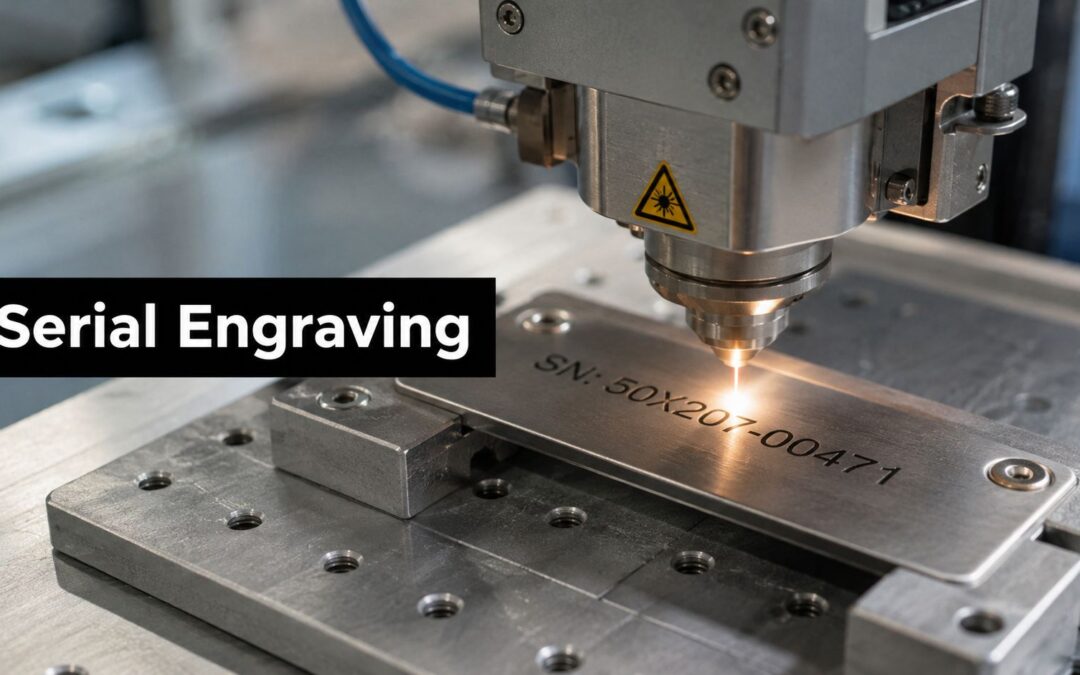
A durable metal plate is the safer choice for regulated or harsh-service assets. After 12 months of outdoor Australian exposure, durable polyester or vinyl labels retained 98% barcode readability, compared with 65% for standard paper labels (Evright Industrial guidance).
The failure usually appears during a maintenance callout. A technician reaches a pump, switchboard, vehicle, or production machine and finds a label that has lifted at the corners, faded under ultraviolet exposure, or turned black after chemical cleaning. The asset still exists, but its identity has become uncertain. That uncertainty can delay repairs, complicate audits, and force someone to compare old drawings, purchase records, and photographs before work can begin.
Serial number plate engraving prevents that problem by treating identification as part of the asset, not as a disposable sticker. Australia has followed that permanence-first principle for generations. Vehicle plates began with state-issued numbers in 1910, early examples used vitreous enamel, and the country moved towards unified embossed steel plates. In 1936, plates were standardised in size and began using standard Australian dies. By 1954, embossed Australian dies were standardised across all states and territories, with the remaining jurisdictions adopting the common embossed format by 1956. The common plate size settled at 372 mm by 134 mm (history of Australian vehicle registration plates).
That history matters because the same design priorities still apply to industrial identification: durability, consistency, contrast, and legibility. A serial plate has to remain readable after heat, moisture, abrasion, cleaning chemicals, vibration, and years of service. It also has to stay attached.
Why Asset Identification Must Survive the Elements
A maintenance crew reaches a remote plant room and finds two visually similar motors, but only one appears on the work order. The register gives the correct serial number. The machine plate has peeled away. Without a reliable physical identity, the crew may have to trace cable routes, check installation drawings, or recover an incomplete digital record. Isolating or servicing the wrong motor can affect safety, downtime, and the accuracy of future maintenance records.

Serial number plate engraving makes identification an integral, permanent feature of the asset. Australian equipment-label guidance describes engraved asset tags as suitable for serial numbers, equipment identification, inventory tracking, and compliance uses. Stainless steel and anodised aluminium tolerate harsh conditions, while industrial labels can combine barcodes, QR codes, serial numbers, and asset numbers for traceability (Australian equipment label guidance).
The hidden cost of a missing identity
A readable plate supports several operating tasks:
- Maintenance accuracy: Technicians can match the physical item with its service history and work order.
- Safety verification: Inspectors can connect ratings, warnings, and instructions to the machine in front of them.
- Audit evidence: The organisation can show that equipment records correspond with identifiable physical assets.
- Replacement control: Procurement teams can order the correct component instead of guessing from an incomplete description.
Paint-only markings and low-contrast printed labels commonly fail under real plant conditions. Cleaning crews scrub them, sunlight changes their colour, and oil or dust reduces the remaining contrast. Adhesive also loses its hold when the substrate is rough, wet, contaminated, or exposed to temperature changes.
Field rule: If the asset operates outdoors, near chemicals, in a washdown area, or inside a vibrating plant, specify the plate and its fixing method as one identification system.
The historical Australian vehicle plate system shows the value of standardisation. A consistent format helps people recognise and read identification quickly when conditions are poor. Modern serial plates apply the same principle through controlled numbering, repeatable layouts, and laser-marked characters that remain part of the metal surface.
Specify for the service life, not installation day. A plate should remain readable after cleaning, nearby repainting, relocation between sites, and years of handling during maintenance. Its fixing method deserves the same attention, because a perfectly marked plate is useless once vibration or corrosion has separated it from the asset.
Choosing the Right Materials for Harsh Environments
A serial plate can look clear at installation and become unreadable after months of UV exposure, chemical contact, washdown, or vibration. Choose the material for those conditions, not for how a sample appears in a showroom. 316 stainless steel and hard-anodised aluminium provide durable surfaces for permanent marking and avoid the early failures associated with paper, vinyl, and ordinary painted metals.
316 stainless is the conservative choice where corrosion resistance matters. It suits exposed infrastructure, wet plant rooms, coastal locations, water assets, and equipment cleaned with aggressive products. South Australia Water's TS0133 asset-labelling standard specifies 1.2 mm 316 stainless steel, rounded corners, bevelled edges, and fibre or YAG laser markability (South Australia Water TS0133 specification). The specification shows how an Australian infrastructure operator converts long service expectations into plate thickness, geometry, and marking requirements. Those choices protect readability when UV, chemicals, and repeated cleaning would otherwise reduce contrast or attack the substrate.
Hard-anodised aluminium suits installations where low weight, corrosion resistance, and clear contrast are important. Its anodised layer supplies the colour and surface protection, while laser marking can remove that layer and expose a contrasting base. Aluminium is easier to handle than a heavier steel plate and can suit panels, cabinets, mobile equipment, and sheltered industrial installations. The trade-off is surface damage. Scratches or impact can affect appearance and contrast, so mounting security and exposure level must be considered together.
Match the plate to the abuse
| Environment | Sensible starting material | Main concern |
|---|---|---|
| Wet, coastal, chemical, or utility service | 316 stainless steel | Corrosion and aggressive cleaning |
| Plant rooms and workshops | Stainless steel or hard-anodised aluminium | Abrasion, oil, and repeated handling |
| Sheltered equipment with weight constraints | Hard-anodised aluminium | Surface damage and mounting security |
| Office or protected indoor equipment | Printed polyester or vinyl may be sufficient | Replacement and environmental exposure |
The marking process matters as much as the substrate. For mixed-content plates, laser marking on anodised aluminium or stainless steel supports crisp detail, repeatability, and machine-readable serials through a non-contact material-removal process.
Check the finished surface before approving production. Paint, powder coating, anodising, and protective treatments change contrast and affect how the mark should be produced. For exposed installations, you can browse corrosion resistant options and compare finishes against the operating conditions.
A supplier should confirm corner treatment, edge safety, hole position, plate thickness, and fixing method. A clear mark is still a field failure if sharp edges injure workers or vibration pulls the plate away from the asset.
Meeting Legal and Regulatory Marking Standards
A missing or unreadable asset plate can delay maintenance, weaken traceability, and create a compliance problem during inspection. Australian vehicle rules offer a useful durability benchmark for industrial identification, even when the equipment is not a road vehicle. The guidance requires durable metal plates to be welded, riveted, or otherwise permanently affixed, with required information embossed, indented, etched, engraved, or printed indelibly (Road Vehicle Identification Marking under the RVS Laws).
The mark and its attachment method must be specified together. An engraved plate secured with weak adhesive can still disappear from a vibrating machine. A mechanically fixed plate with shallow, low-contrast characters may remain attached yet become useless to technicians. Historical marking requirements point to the same practical standard used today: the information must remain legible after exposure, handling, and installation.
Build permanence into the specification
Use this sequence before approving production:
- Identify the governing requirement. Confirm whether the asset falls under a vehicle rule, equipment standard, client specification, or internal engineering standard.
- List the required information. Include serial numbers, ratings, dates, symbols, manufacturer details, and any other information required by the applicable rule.
- Choose the substrate and finish. Select corrosion-resistant metal and verify that the finished surface will accept the proposed marking process.
- Set the layout and character size. Where a standard does not specify another dimension, Australian guidance commonly recommends character heights of at least 3 mm for critical values.
- Specify permanent attachment. Use welding, riveting, or another fixing method that can withstand vibration, weather, and chemical exposure.
- Check the installed position. Keep the plate visible and clear of paint, covers, seals, brackets, and later modifications.
ADR 61/03 applies vehicle marking requirements across vehicle categories from the commencement of the relevant section of the Road Vehicle Standards Act 2018. It also requires information to be permanently affixed and printed indelibly or engraved on the plate (ADR 61/03).
Don't confuse engraving with compliance
Engraving alone does not make a plate legally suitable. Verify the wording, symbols, ratings, applicable standard, position, and attachment method before release. A supplier can manufacture a clean plate, but the asset owner must confirm that the content and installation meet the relevant obligation.
Older Australian vehicle marking material also states that required information should be embossed, indented, etched, or engraved so it is in relief (Australian vehicle marking requirements). Approve a physical sample before ordering a production batch for a critical asset. Test the finished plate after coating, fastening, and installation, rather than judging an unfinished sample on a workbench.
Integrating Serial Numbers with Machine-Readable Codes
A visible serial number and a QR code solve different problems. The serial number lets a person identify an asset when a scanner, battery, network connection, or phone isn't available. A QR code or barcode connects that physical asset to a digital record, making it easier to retrieve maintenance history, inspection forms, manuals, or stock information.
The strongest arrangement is usually both, provided the numbering logic is controlled. The printed or engraved human-readable serial must match the primary asset ID in the ERP or field system exactly. A QR or barcode should point to that same record, rather than creating a second identifier that technicians have to reconcile later.

Compare the two identification layers
| Feature | Human-visible serial | QR code or barcode |
|---|---|---|
| Primary use | Visual confirmation and maintenance records | Automated lookup and digital workflows |
| Failure mode | Faded contrast or damaged characters | Poor scan angle, obstruction, dirt, or damaged modules |
| Best safeguard | Permanent high-contrast marking | Flat, face-on placement with adequate clear space |
| System dependency | Can be read without a device | Depends on a functioning scanning process and linked record |
An operator may need to read a serial number from an awkward angle inside a cabinet. A QR code, by contrast, needs a reasonably flat, face-on presentation for reliable scanning. Mounting brackets, cable trays, paint, dirt, and sealants can interrupt the code even when the plate itself remains intact.
For teams building a digital asset register, define the ID structure before engraving. Decide which number is the primary asset ID, who assigns it, and how replacement equipment is handled. Then use a controlled data file for production. Variable data engraving can place a different serial number on each plate, but the source list must be checked before marking begins.
Manufacturing, healthcare, and infrastructure teams should also decide what happens when scanning fails. The human-readable serial is the fallback, not an optional decoration. A technician should be able to report the physical number and have the system return one unambiguous record.
For projects that need a combined physical and digital approach, review QR code asset tags before finalising the layout. Keep the code away from edges, fasteners, and surfaces likely to be covered during installation, and verify a sample on the actual plate finish.
When to Upgrade from Labels to Permanent Engraving
Engraving is the right answer for assets exposed to UV, abrasion, chemicals, water, heat, or long service intervals. A printed polyester or vinyl label can still suit sheltered indoor equipment that staff can inspect easily and replace without interrupting operations. The failure occurs when a low-risk label is carried into a harsher service environment.
Start with the consequence of losing identification. If an unreadable label only requires an administrator to correct a storage record, a replaceable label may be sensible. If it identifies a pressure-related component, electrical cabinet, lifting asset, vehicle, medical device, or remote infrastructure item, the operational risk rises. A durable plate can prevent inspection delays, incorrect ordering, isolation time, and records being attached to the wrong equipment.
Use the environment as the test
Ask four practical questions:
- What touches the surface? Abrasive dust, tools, hoses, gloves, and cleaning equipment can remove surface print.
- What reaches the surface? Water, solvents, oils, disinfectants, salt, and process chemicals can attack adhesives and coatings.
- How visible must it remain? A plate behind a guard or at an awkward angle needs deliberate placement and sufficient contrast.
- What happens when it fails? Allow for rework, delayed inspections, incorrect parts, and the effort required to rebuild the asset record.
Durable printed materials can outperform ordinary paper outdoors, but the result still depends on the actual Australian service conditions and replacement cycle. A label that survives on a protected cabinet may fail quickly on vibrating machinery exposed to washdown chemicals and abrasive dust.
For mixed-content plates, laser marking on anodised aluminium or stainless steel provides crisp detail, repeatability, and machine-readable serials. Standardise the plate size, symbols, hole pattern, mounting position, and data format before production. Batch manufacture then keeps identification consistent across sites, which matters when technicians must compare plates during inspections or maintenance.
Low-cost office labelling still has a place. For a temporary indoor identifier, you can browse Dymo tape options now. Treat that as a replaceable label, not a permanent industrial marking. For exposed or regulated equipment, review engraved metal labels and specify the material, contrast, fixing method, and final location together. That combination connects older durability expectations with modern laser-marking requirements and reduces the risk of an asset becoming unidentifiable when its record is needed most.
Partnering with Australian Industrial Experts
A plate can look correct at dispatch and still fail in service. Vibration loosens poor fixings, washdown removes weak contrast, and an incorrect serial value can separate the physical asset from its inspection history. The engraver must therefore check the substrate, marking method, variable data, attachment points, character visibility, and conditions after installation.
Evright Industrial is a specialised division of evright.com providing engraving and asset-labelling solutions for equipment identification, safety signage, and related applications. Its production capability includes permanent tags and labels carrying serial numbers, QR codes, and identification data on durable substrates.

Controlled repeatability matters during maintenance. If every plate in a batch uses the same layout and data structure, technicians can find the serial field quickly and distinguish the asset from its motor or replacement component. Agree the material, finish, marking depth, code format, and mounting method before production. Anodised aluminium, stainless steel, laser ablation, deeper engraving, barcodes, QR codes, and human-readable serials each suit different service conditions.
Variable data needs the same discipline as the plate specification. A disciplined data handover should connect the approved production list with work orders, inspection records, and asset registers. Teams that need tighter document coordination can use an order desk automation platform, provided the approved values are validated before they reach the marking queue.
Evright Industrial uses Trotec Laser machinery for detailed, consistent marking. That equipment supports controlled laser work, but it cannot correct poor material preparation, wrong settings, duplicate records, or careless installation. Those checks remain part of the specification and inspection process.
For local technical discussion, review industrial engravers in Australia and request a sample made with the actual plate material and finish. A sample exposes weak contrast or unreadable detail before a batch is fitted to machinery.
Finalising Your Serial Plate Strategy
Treat the serial plate as an operational control, not decoration. It must identify the physical asset, match the digital record, remain readable after service, and stay attached until retirement. An unreadable or non-compliant tag can delay maintenance, complicate inspections, and leave technicians working from the wrong record.
Begin with the asset population and its failure conditions. Define the information each plate must carry, then decide whether the human-readable serial requires a QR code or barcode. Validate the primary ID against the asset register before marking, and prevent alternate numbering from entering production.
Lock down the physical specification:
- Material: Select 316 stainless steel for corrosive conditions and long service, or hard-anodised aluminium where lower weight and finish matter.
- Marking: Use a permanent, high-contrast process that suits the finished surface and remains legible after cleaning and wear.
- Layout: Standardise plate dimensions, symbols, text fields, code placement, and mounting holes.
- Installation: Choose mechanical attachment where vibration, weather, chemicals, or compliance requirements can defeat adhesives.
- Verification: Inspect the finished mark, scan any code, and confirm visibility after installation.
Australian vehicle plates established a practical durability lesson: identification works when standardisation and resistance to service conditions are designed together. Industrial plates apply that principle through controlled laser marking, consistent variable data, and machine-readable formats.
The cheapest label can create the highest operating cost. A failed tag may require a site visit, equipment access, downtime, record reconciliation, and another installation. Specify the plate around its actual environment, then retain the approved material, marking, data, and mounting details as part of the asset documentation.
Evright Industrial can help develop engraved asset tags, data plates, serial IDs, and QR or barcode-ready identification for Australian industrial environments. Provide the material, service conditions, data format, and mounting requirements so the proposed specification reflects how the equipment will be used.
Recent Comments