
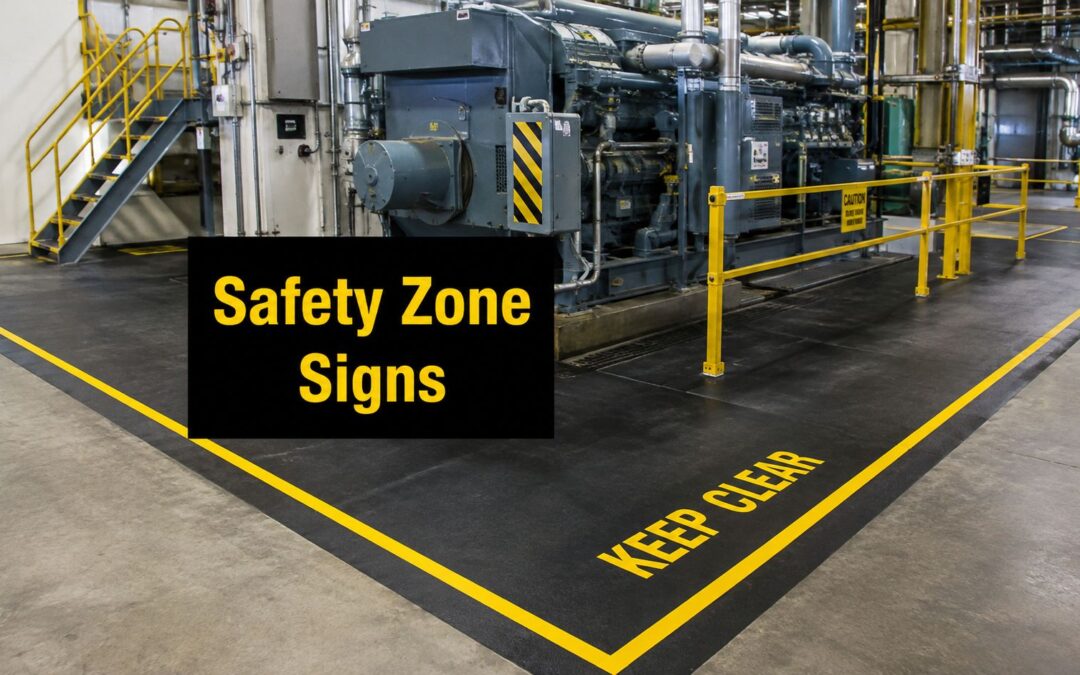
You're standing outside a fenced robotic cell while a maintenance crew prepares to enter. Nearby, forklifts cross the same yard, an electrical switchboard feeds the production line, and a chemical store holds containers that must remain undisturbed. A small, poorly positioned sign may be the only visual instruction between a worker and a stored, moving, electrical, or chemical hazard.
That's why a safety zone sign should be treated as a documented hazard control, not a decorative label or a wayfinding sticker. Australian workplace guidance recognises signs as part of hazard management, particularly where boundaries separate people, vehicles, and dangerous work areas. The practical decision is to identify the zone first, then select the correct sign category, substrate, finish, and fixing method.

A durable sign also depends on the condition of the surrounding surface. In outdoor yards, rust-stained concrete, washdown residue, dust, and vehicle impact can undermine otherwise sound mounting. Guidance on Water Works Power Washing concrete care can help facilities teams understand why surface preparation matters before installing posts, anchors, or adhesive-backed panels.
Why a Safety Zone Sign Matters on an Industrial Site
Treat the boundary as a control
A crew entering a fenced robotic cell needs more than a gate. The perimeter must communicate that the area is restricted, identify the hazard, and tell authorised workers what action applies before they cross the boundary. The same principle applies to a switchboard room, a confined chemical store, a plant-room access point, or a temporary maintenance area.
Australia's foundational framework is AS 1319-1994, which sets out the design and use of safety signs in occupational environments. Safe Work Australia's workplace materials also require signs where a workplace must control an identified hazard. Its traffic-management guidance specifically identifies signs for exclusion and safety zones, parking areas, speed limits, vehicle crossings, and forklift areas. ACT WorkSafe's signage guidance still identifies AS 1319-1994 as the governing standard for workplace safety signs.
Practical rule: A sign should answer the worker's decision at the boundary, not provide general information somewhere along the access route.
The hierarchy of controls matters here. Signage is an administrative control, so it shouldn't replace guarding, isolation, barriers, lockout procedures, ventilation, or other physical controls. It does, however, make the control visible at the point where a person decides whether to enter, stop, wear protective equipment, or seek authorisation.
Resolve three procurement questions
Before ordering a panel, confirm:
- Which meaning applies? The phrase may refer to a road-traffic zone, an electrical hazard boundary, or an occupational exclusion zone.
- Which category is required? Colour, shape, pictogram, and wording must match the instruction, warning, prohibition, or emergency information being communicated.
- Which construction will last? Indoor panels, outdoor traffic signs, washdown areas, chemical stores, and electrical infrastructure each place different demands on the material and fixing.
A poorly specified sign creates a compliance gap. A panel can have the right words and still fail operationally if glare obscures it, the legend is too small, the mounting is loose, or the sign is installed before the boundary rather than at the point of action.
The Three Meanings of a Safety Zone Sign
The phrase safety zone sign doesn't describe one universal sign. Australian content often merges three different uses, and that confusion can lead a buyer to select the wrong colour, wording, or mounting system.
Road-traffic safety zones
In road law, a safety zone is a defined road area associated with tram stops. Under the Australian Road Rules as adopted in jurisdictions such as South Australia, drivers must not drive on the safety zone. Road works and incident areas also use cones, barriers, and reflective delineators to control traffic movement, but those controls belong to the road environment.
A road-facing sign must be selected for traffic conditions, approach speed, visibility, and the relevant road authority's requirements. It shouldn't be transferred into a factory because the words appear similar. A depot entrance that interfaces with a public road may need traffic signage outside the workplace boundary and occupational signage inside it.
Electrical hazard zones
An electrical zone surrounds exposed conductors, switchboards, overhead lines, or other energised equipment. The sign warns people away, identifies live apparatus, and supports the controlled approach required by electrical safety procedures. Barriers are equally important. Safe Work Australia's model code on managing electrical risks explains that barriers and signs should warn others and direct people away from dangerous work areas.
The distances and controls vary with voltage, task, and authority status. Western Australian guidance identifies a danger zone within 3 metres for overhead lines up to 33 kV and 6 metres for lines above 33 kV. Those figures apply to the specified overhead-line context, not to every electrical room or switchboard. A sign alone cannot create a safe electrical boundary.
Occupational exclusion zones
This is the category most factory, electrical, and essential service teams usually mean. It marks a workplace perimeter around moving machinery, falling-object risks, chemicals, radiation, confined spaces, stored energy, or restricted maintenance work.
Safe Work Australia's model WHS regulations provide a compliance benchmark for hazardous chemicals. Where a sign is required to control an identified chemical risk, the person conducting a business or undertaking must display a sign warning of the hazard or stating responsibilities related to the chemicals.

AS 1319 Categories That Govern Safety Zone Signage
AS 1319 uses colour and shape to help workers recognise the sign's purpose quickly. Australian guidance identifies separate categories for danger, prohibition, mandatory action, warning, emergency or safe condition, fire, and hazardous chemicals or dangerous goods. A safety zone may need more than one category because the sign may need to identify the hazard, prohibit entry, and state the required protective action.
A danger sign communicates the serious hazard inside or beyond a boundary. A mandatory sign tells an authorised worker what to do, such as wearing eye protection, hearing protection, or a respirator. A prohibition sign forbids a specific act, while an emergency or safe-condition sign identifies an exit, first-aid point, rescue location, or other safe facility.
The colour system carries much of the meaning:
- Red and white circular signs communicate prohibition.
- Red on yellow triangular signs communicate danger, with black pictograms.
- Blue circular signs communicate mandatory actions.
- Green on white rectangular signs communicate emergency information or safe conditions.
- Yellow and black boundary tape or striped markers can supplement a sign, but they don't replace the required sign category.
| Category | Colour and Shape | Pictogram Standard | Role in a Safety Zone |
|---|---|---|---|
| Danger | Red on yellow triangle | Applicable standard pictogram, including ISO 7010 where adopted | Identifies the serious hazard within or beyond the boundary |
| Prohibition | Red and white circle | ISO 7010 where adopted | Prohibits entry, access, smoking, operation, or another defined act |
| Mandatory | Blue circle | ISO 7010 where adopted | States PPE or behaviour required at the point of entry |
| Emergency or safe condition | Green and white rectangle | ISO 7010 where adopted | Marks exits, rescue equipment, first aid, or safe facilities |
| Supplementary boundary marker | Yellow and black stripes or tape | Not a substitute for a sign pictogram | Reinforces the physical limit of an exclusion area |
The Australian safety-signage category guide is useful when a team needs to compare category, colour, material, and installation location before approving artwork.
Text alone is not enough. A worker may approach from an angle, read the sign under glare, or have only a moment to interpret it. Standardised pictograms reduce dependence on language, but the symbol still needs the correct colour, shape, contrast, and placement.
Materials and Finishes Built for Industrial Environments
A sign's substrate should follow the environment, not the artwork. Indoor production areas, outdoor traffic routes, chemical stores, washdown rooms, and electrical infrastructure expose panels to different combinations of ultraviolet light, abrasion, solvents, moisture, dust, glare, and impact.
Match substrate to exposure
Anodised aluminium suits many indoor panels and equipment labels. The laser removes the anodic surface to reveal a contrasting underlying layer, creating a crisp legend without relying on a printed overlay. This is particularly useful where workers handle the panel, where cleaning is frequent, or where the sign must remain legible after surface abrasion.
For outdoor roads and vehicle yards, UV-stable reflective films from suppliers such as 3M or Avery can improve visibility in changing light. A reflective aluminium construction can provide both a rigid backing and a traffic-oriented face, subject to the requirements that apply to the particular road or site.
Marine-grade stainless steel is appropriate for demanding washdown and chemical environments. It resists corrosion more effectively than ordinary steel, although the grade, finish, edge treatment, fixings, and cleaning chemicals still need to be assessed together. For cost-driven indoor or sheltered zones, UV-stable plastics can provide a practical option where impact and chemical exposure remain within the material's limits.
| Material | Finish | Durability | Best Environment |
|---|---|---|---|
| Anodised aluminium | Laser-engraved face | Permanent, abrasion-resistant legend when correctly specified | Indoor factories, plant rooms, asset and exclusion labels |
| Reflective aluminium | UV-stable 3M or Avery film | High visibility with outdoor exposure resistance | Vehicle yards, road interfaces, outdoor traffic zones |
| Marine-grade stainless steel | Engraved or chemically resistant marked finish | Strong corrosion and washdown resistance | Chemical sites, wastewater facilities, food and hygiene areas |
| UV-stable plastic | Printed or engraved finish | Practical resistance in controlled exposure | Sheltered indoor zones and cost-sensitive applications |
Laser engraving is different from sublimation and vinyl. Sublimation places colour into a coated surface, while vinyl applies a separate film that can lift, peel, or wear at exposed edges. Laser engraving creates the legend through controlled material removal. A Trotec Laser machine can cut and engrave compatible sheet materials with accurate repeatability, helping preserve the intended contrast and pictogram detail without damaging the anodic layer around the engraved area.
The standards still govern the sign's purpose and visual system. AS 1319 applies to occupational safety signs, AS 1742 is relevant to traffic-sign contexts, and ISO 7010 may apply where internationally recognised hazard pictograms are adopted. Material selection supports compliance, but it doesn't correct a wrong category or an unreadable design.
For corrosive or wet sites, compare the sign construction with the requirements of stainless steel signs for industrial use before choosing a low-cost printed alternative.
Placement, Mounting, and Sizing for Real Workspaces
A safety zone sign works when a person sees it before making the decision to cross, operate, climb, enter, or approach. AS 1319 placement principles support installing mandatory signs at the point where the required action applies, commonly at a work-zone entrance or hazard boundary. A sign placed far down a corridor may be technically visible yet operationally late.
Set the viewing position first
In pedestrian areas, mount the sign so the centreline sits between 1400 mm and 1700 mm above the floor. Keep at least 600 mm of clear height beneath overhead signage so people and vehicles don't strike the panel. For text, allow approximately 25 mm of letter height per metre of viewing distance, then check the result against site lighting, traffic speed, glare, and the complexity of the legend.
Indoor mandatory signs commonly use diameters from 300 mm to 600 mm, while outdoor and vehicle-accessible zones may require larger formats. Evright Industrial's workplace safety signage guidance can help teams compare size, material, category, and installation location for a specific work area.
The infographic below presents practical installation checks, but site conditions and applicable requirements must still be reviewed by the responsible safety or engineering team.

Mount for the actual traffic pattern
Face a sign towards the approach path rather than towards a wall, guardrail, or competing light source. Check it from the position where a worker, contractor, forklift driver, or emergency responder will first encounter the boundary.
Use these checks during a site walk:
- Line of sight: Remove pallets, stored equipment, cables, and temporary barriers that hide the face.
- Lighting: Check daylight glare, artificial reflections, shadows, and night visibility at the time of expected work.
- Point of action: Put the mandatory or danger sign at the entrance or boundary, not only at the corridor end.
- Mounting strength: Match anchors, posts, brackets, and fasteners to the substrate and exposure.
- Boundary consistency: Align the sign with the fence, barrier, painted line, or exclusion perimeter it describes.
Reflective backing is especially useful where vehicles approach from changing directions or where the zone operates outside normal daylight hours. The sign should reinforce the physical boundary, not pretend to be the boundary itself.
Real-World Examples From Manufacturing and Essential Services
A bottling plant has a robotic palletiser cell beside a forklift route. The cell fence provides the physical barrier, while a red exclusion sign tells people not to enter the operating area. At the access gate, a blue mandatory sign can state the PPE or controlled-entry action required for authorised personnel. The panel needs enough contrast and size to remain readable from the approach path, not merely from directly in front of the gate.

For a robot cell, an indoor anodised aluminium panel with laser-engraved wording can suit the repetitive contact and cleaning common around production equipment. The installer should position it at the access point, keep the face clear of fence members, and check that the warning remains visible when pallets or maintenance tools are staged nearby. A facility team reviewing broader manufacturing H&S compliance can use the same boundary logic across machine guarding, access control, and contractor communication.
A regional water utility faces a different problem around overhead electrical infrastructure. A yellow and black boundary marker can reinforce the physical buffer, while a reflective aluminium safety sign warns workers and contractors before they bring vehicles, ladders, or lifting equipment near the lines. A Trotec Laser machine can cut the panel accurately and produce consistent legends across replacement batches, but the sign must still work with barriers and site controls. The electrical danger distances described by the relevant authority must determine the actual zone.
At a wastewater pump station, the sign may need to communicate both a live electrical hazard and a prohibited action. A danger pictogram identifies the risk, while a prohibition pictogram can forbid unauthorised entry or contact. Marine-grade stainless steel may suit the wet, corrosive environment, with fixings selected to avoid creating a weak point during washdown.
A confined-space entry at a manufacturing plant calls for another combination. An AS 1319 mandatory sign can state the required entry controls, while a separate danger sign identifies the confined-space hazard. Mount the panels where the worker stops to check authorisation and equipment, not at an office doorway several metres away.
The video below shows the type of industrial production imagery teams can use when reviewing how engraved and cut signage fits into a working facility.
Compliance Proof and Sourcing Durable Engraved Signs
A safety committee or auditor will usually want more than a photograph of a sign. Build an evidence pack that connects the selected sign to the hazard assessment and the installation:
- Conformance information: Record the applicable AS 1319 category and any relevant traffic, electrical, chemical, or site requirement.
- Material records: Keep the substrate and finish datasheets, including corrosion, UV, cleaning, or reflective performance information where relevant.
- Fixing details: Document the bracket, post, adhesive, anchor, fastener, and mounting surface.
- Installation evidence: Photograph the sign from the approach direction and record whether the legend is visible under expected lighting.
- Production consistency: Confirm that repeat batches use the same artwork, colour, pictogram, substrate, and hole pattern.
Laser-engraved signs can retain their legends through abrasion and repeated cleaning because the information isn't dependent on a loose overlay. That durability supports the compliance case, but only when the material, engraving depth, contrast, and environment are matched correctly. Procurement teams should also confirm custom legends, batch consistency, replacement availability, and lead times for electrical hazard and exclusion-zone signage.
Evright Industrial connects Trotec laser production with industrial-grade substrates for equipment identification, safety signage, and asset labelling. Its relationship with Evright Industrial gives facilities teams a direct way to discuss sign artwork, materials, and production requirements, while its broader work includes laser engraving and durable identification solutions for manufacturing, essential services, healthcare, and infrastructure environments. For buyers comparing options, evright.com explains how the laser engraving process works, from preparing the design to producing a consistent engraved result on a suitable material.
Evright Industrial offers custom safety zone signs, hazard and mandatory PPE signage, restricted-access panels, and durable equipment labels produced with Trotec laser systems and industrial substrates. Visit Evright Industrial to discuss the zone type, material, mounting environment, artwork, and production requirements for your next signage project.
Recent Comments