

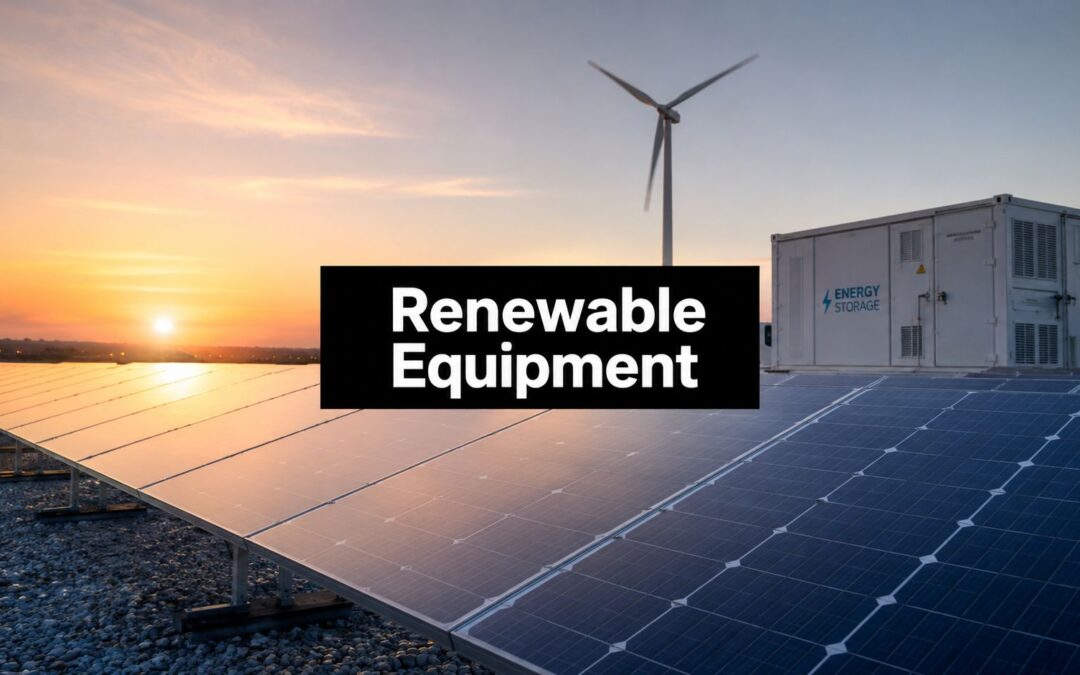
The renewable energy equipment market is no longer a collection of pilot projects and isolated purchases. IRENA's 2025 statistics cover renewable power capacity across 2015 to 2024 for more than 150 countries and areas, and the IEA projects global renewable power capacity will rise by almost 4,600 GW between 2025 and 2030 in its 2030 outlook, which is the scale that turns hardware selection into a procurement discipline, not a buying exercise (IRENA 2025 renewable energy statistics).

That shift matters in Australia because buyers are no longer comparing single panels or a few small inverters. They're specifying fleets of components with long asset lives, site-specific risks, and compliance obligations that have to hold up in harsh conditions, often long after the installer has left site. In practice, the winning procurement strategy is rarely the cheapest line item, it's the one that survives weather, inspection, maintenance, and warranty scrutiny without turning into rework.
The Scale of Renewable Equipment Deployment
The first mistake buyers make is treating renewable energy equipment like a commodity catalogue. The market has outgrown that mindset. When global renewable power capacity is projected to rise by almost 4,600 GW between 2025 and 2030 (IRENA 2025 renewable energy statistics), procurement stops being about picking a panel model and starts being about keeping a very large installed base serviceable for years.
From project purchases to fleet management
That scale changes the job on the buying side. A utility project, a commercial rooftop rollout, and an off-grid installation all depend on the same core hardware families, solar modules, inverters, transformers, mounting systems, and related balance-of-system gear. The difference is that modern buyers are often managing many similar assets across multiple sites, which means consistent identification, traceability, and replacement planning matter more than one-off specification tweaks.
Practical rule: If a component can't be identified clearly after installation, it's already a maintenance problem.
Australia's national data sits inside the broader IRENA country datasets, which is a reminder that the local market is part of a much larger transition rather than a separate niche. That has consequences for procurement language too. Teams that still write loose specs for “solar gear” or “wind equipment” usually end up with variation in fittings, labels, manuals, and spare parts that becomes expensive later.
The most useful mindset is industrial, not promotional. Renewable assets need to be procured, tagged, inspected, and serviced like long-life infrastructure. If the equipment can't be traced back to a verified bill of materials, the support burden shifts onto the owner, and that cost tends to show up when the site is already in the field and hard to access.
Core Equipment Categories and Critical Specifications

The equipment list looks straightforward until the procurement schedule has to hold up in the field. Solar PV modules, inverters, battery storage, wind turbines, charge controllers, and balance-of-system items fail in different ways, so the specification has to separate real durability from brochure language and short-term pricing.
What to verify before you sign
For solar PV modules, nameplate output is only one part of the decision. Require documented compliance evidence, traceable model numbers, and enough mechanical strength for the site environment, because weak laminates, poor frames, and inconsistent labelling create maintenance problems long before the module is retired. For inverters, thermal management, enclosure protection, and the vendor's service model matter more than a small efficiency difference, since heat and downtime usually cost more than marginal performance gains.
For battery storage systems, the main questions are fault handling, enclosure design, and how the supplier documents safe operation under load and during maintenance. For wind turbines, buyers need to look past brochure power curves and into the structural package, including foundations, control logic, and the machine's response when weather shifts quickly. Charge controllers sound minor, but they can shorten battery life if charging behaviour is poorly matched to the array and storage bank.
For outdoor equipment, procurement teams should specify IP65 or better where the application demands it, along with documented thermal, fault, and insulation ratings and clear evidence of standards testing (Solar technical specification template). That matters because moisture ingress, weak junction boxes, and poor enclosures do not usually show up at handover, they show up after the first bad season, when access is already awkward and the owner pays for the callout.
Small off-grid kits need a different level of discipline. IEC TS 62257-9-8 is the right reference point for quality and truthful performance claims in stand-alone renewable energy products used off-grid, because it sets a technical envelope of ≤350 W peak PV/generator rating (IEC TS 62257-9-8). That does not make a product good by itself, but it does help prevent underspecification in remote areas where weak batteries and poor charging behaviour become field-support headaches.
A maintenance-minded checklist still belongs in the contract pack, but it needs to be concrete. South Mountain Window Cleaning's solar panel maintenance checklist is a useful reminder to include items such as access clearances, cleaning methods, inspection intervals, and a requirement for UV-resistance testing on all outdoor rating plates before the array is installed. That kind of detail is what keeps labels legible, parts identifiable, and service visits predictable.
Suppliers love to talk about peak output. Owners live with enclosure failures, heat derating, and the cost of access.
When Orientation and Mounting Matter Less Than You Think
A lot of renewable energy equipment is sold with an obsession over perfect angles. That can be useful, but it's not always the lever that changes the economics. In some layouts, chasing a theoretical “best” orientation adds engineering effort without delivering a meaningful operational gain.
The roof or site often decides first
A 2024 one-year field study in an equatorial setting found that east- and west-facing PV produced less than 1% difference in cumulative annual yield at a fixed 10° tilt (field study on east-west orientation). That doesn't mean orientation never matters. It means the value of perfect orientation depends on latitude, shading, roof geometry, and the practical question of whether a slightly better angle costs you usable area, safe access, or structural simplicity.
In Australian projects, that distinction matters because procurement teams often inherit buildings and sites that weren't designed around solar geometry. The right answer is often to use the available area cleanly, avoid shade, and keep mounting safe and maintainable instead of paying for structural work that only improves output on paper.
Mounting decisions are part of performance
Mounting choices also affect day-to-day reliability. A rigid racking layout that is simple to inspect usually beats a more aggressive geometry that looks efficient but creates awkward maintenance paths or extra fastener loads. When buyers evaluate mounting systems, they should ask one direct question, does this design make the array easier to live with for the next decade, or just prettier in the proposal?
If an installer needs unusual access gear just to service a row of modules, the site design probably pushed too hard on theoretical yield.
The most durable projects are usually the ones where roof constraints, access, and structural safety were accepted early. That's not a compromise, it's a procurement decision that protects lifetime output better than a marginal azimuth gain.
Structural Realities Wind Loading and Foundation Requirements
Renewable energy equipment lives or fails on the structure beneath it. I have seen projects look sound on the purchase order and then struggle in service because the site wind regime, anchoring, and concrete work were treated as secondary details instead of part of the equipment spec.
Wind loading on solar arrays is not symmetrical
Recent CFD research published in 2025 found that for fixed double-row PV arrays, 45° and 135° oblique winds are the most unfavorable conditions, especially for edge modules, while 90° is the optimal condition in the simulation results (wind loading research). On one storm-exposed rooftop project, that kind of oblique loading changed the procurement call. The team moved away from a layout that looked acceptable on paper, because the edge rows had a history of lifting and clamp movement under angled gusts. The lesson is straightforward, the mounting design has to match the local wind profile, not just the module count.
That is where field conditions matter more than catalogue assumptions. If the site sees turbulence from parapets, nearby plant, or terrain, the array can face very different uplift and edge effects than a clean test scenario suggests. Buyers should treat wind exposure, shutdown behaviour, and racking detail as one package, because a weak point in any one of them can shorten service life.
Wind foundations are built for mass, not convenience
Wind-energy infrastructure is even more obviously civil-heavy. A U.S. Department of Energy source notes that adding steel bars to concrete greatly increases the fatigue capacity and operational life of wind turbine foundations and towers compared with unreinforced concrete structures (DOE on reinforced concrete foundations). That is a procurement reminder, because the turbine is only one line item. The foundation, steel, geotechnical work, and long-term structural performance belong in the same decision.
The material demand is substantial. An AAP FactCheck article summarising industry and technical sources reports that modern wind turbines typically require between 1,500 and 2,560 tonnes of concrete and 470 to 1,309 tonnes of iron ore, depending on turbine size and output (AAP FactCheck on turbine materials). Those figures are a practical warning to procurement teams. Wind equipment is not just machinery on a pad, it is a heavy civil asset with a service life that depends on what is poured, reinforced, and inspected at ground level.
For buyers, the test is whether the supplier has accounted for the site wind condition and the foundation design in the offer, not as afterthoughts but as part of the equipment package. If they have not, the specification is incomplete. A serious procurement file names the structure that keeps the equipment standing as clearly as it names the equipment itself.

Compliance Labelling and Asset Identification Requirements
A technician opening a coastal switchboard after a few seasons of salt spray cannot rely on a label that has faded, lifted, or corroded. Once the marking fails, the site loses the link between the physical asset, the commissioning file, the spare parts record, and the maintenance history.
The label has to survive the site
The same durability logic that sits behind IEC TS 62257-9-8 should carry through to asset labels, rating plates, warning signs, and identification tags. That standard ties stand-alone renewable products to quality, durability, and truthful performance claims in off-grid settings. On a working site, that means the marking has to stay legible through UV exposure, rain, dust, cleaning chemicals, and handling by contractors who were not there at commissioning.
For outdoor installations, the label material has to suit the environment. Stainless steel, anodised aluminium, and carefully specified laser-marked products are common because they hold up better than consumer-grade adhesive labels. The issue is continuity, not appearance. A legible asset tag lets a technician match the installed component to the drawings, the parts list, and the service record without guessing what was fitted.
For buyers writing specifications, stainless steel equipment tags are worth checking because the same wear and corrosion problems show up across electrical gear, switchboards, and exposed site equipment.
What should be on the mark
At minimum, the label system has to support clear equipment identity, hazard warning, and traceability back to the installed asset. That means rating plates that stay readable under UV, rain, dust, and cleaning chemicals, along with sign-off records that show the correct label was fitted to the correct asset.
Practical rule: If maintenance staff cannot read it from normal working distance, it is not a field-ready label, it is decoration.
The contract value is just as real. Clear identification supports warranty claims, inspection records, and change control when components are replaced. Anyone who has had to reconcile a mixed site after contractor handover knows that weak labelling turns a simple service call into a document chase. It also creates avoidable risk when crews need to isolate equipment quickly and the mark on the panel no longer matches the asset register.
Material Choices and Lifecycle Emissions Considerations
Renewable energy equipment carries a materials footprint that buyers cannot ignore. Concrete, steel, glass, coatings, and even label stock all sit inside the procurement decision, so the buying brief has to cover embodied carbon as well as operating output.
Concrete grades and foundation design affect emissions
A study on concrete mix design found that using 32 MPa class concrete instead of 40 MPa can reduce concrete-generated emissions by at least 11% (concrete mix design study). The same study also reported that for a 5 MW wind unit, a concrete gravity foundation averaged about 2,480 tonnes of CO2, while a steel jacket solution was estimated at about 2,770 tonnes of CO2 for the same capacity. Those comparisons do not tell you which foundation is right for every site, but they do show that material and structural choices have measurable emissions consequences.
The broader supply-chain picture is larger still. Carbon Tracker says that for 1.5°C-compatible scenarios, average wind turbine deployment requires over 140 Mt of steel and 360 Mt of concrete cumulatively to 2050, while solar PV requires 209 Mt of steel, 186 Mt of concrete, and 142 Mt of glass over the same period (Carbon Tracker materials brief). For buyers, that scale makes lifecycle thinking a procurement requirement, not a sustainability slogan.
Why lowest price often loses over time
Cheap materials can look attractive on day one and expensive by year five. Heavier maintenance, faster corrosion, weak fastening systems, and replacement cycles all add cost, and they also make sustainability reporting harder because the original specification was too loose.
A better sourcing brief asks suppliers to explain their material choices, not just their efficiency claims. It should also align with the site's durability expectations, especially where structural concrete, steel, and long-life markings all need to survive for decades. Label selection matters here as well, because poor tags and rating plates often fail long before the hardware does. Buyers who want labels that can hold up in exposed environments should review weather-resistant label options alongside the rest of the bill of materials.
Building a Procurement Workflow That Prevents Costly Mistakes
In one solar-plus-storage project, a team approved inverters before compliance verification was complete, then faced a site inspection failure and a costly rework when the equipment labels and certification pack did not line up with the installer's records. That sort of failure starts long before commissioning. It usually begins when procurement treats paperwork as an afterthought instead of part of the specification.
A procurement sequence that holds up in the field
Start with a technical schedule that defines the equipment, enclosure expectations, environmental exposure, and service access. For a wind or solar site, that schedule should also state how the equipment will be labelled, where serial numbers will sit, and how maintenance staff will identify each asset after the handover team leaves. Then verify certification, test evidence, and compatibility with the project's electrical and structural requirements before anyone starts negotiating price. If a supplier cannot show the paperwork cleanly, the risk stays with the buyer, not the installer.
A strong traceability process matters just as much. The internal guide on asset tracking best practices is relevant because renewable projects often fail at the handover stage, where serial numbers, maintenance records, and installed locations drift apart. I have seen that drift turn a routine inverter service into a half-day search through spreadsheets, site photos, and contractor emails. It also makes future servicing expensive, because no one is sure which unit is which.

Here is the workflow I would trust on a serious project, and the mistake each step is meant to stop.
- Technical evaluation. Match the specification to the actual site, not a generic template. On one battery installation, this step would have stopped a mismatch between enclosure clearance and the planned service route, which otherwise would have forced panels to be moved after delivery.
- Compliance verification. Confirm standards, test reports, and safety markings before award. In the solar-plus-storage job that failed inspection, this is the step that was skipped, and it led to expensive rework when the inverters did not present the right documentation and labelling at site.
- Supplier assessment. Check warranty scope, service response, spare parts access, and past delivery quality. A supplier with good pricing but slow parts support can turn a minor fault into a long outage, especially where the nearest service visit depends on lead time rather than local stock.
- Lifecycle planning. Plan inspection, replacement, and decommissioning while the project is still on paper. That is where durable labels, maintenance intervals, and replacement access should be fixed, so the asset remains readable and auditable long after commissioning.
A supplier proposal should be judged on the documents behind the price, because the cheapest quote is often the most expensive failure later.
The common mistakes are predictable. Teams accept vague warranty terms, ignore maintenance access, or leave durable labelling to the contractor after installation. That order is backwards. If you specify long-life identification, traceability, and serviceability up front, the site is easier to operate, easier to audit, and less likely to lose value when equipment needs replacement or end-of-life removal.
Recent Comments