

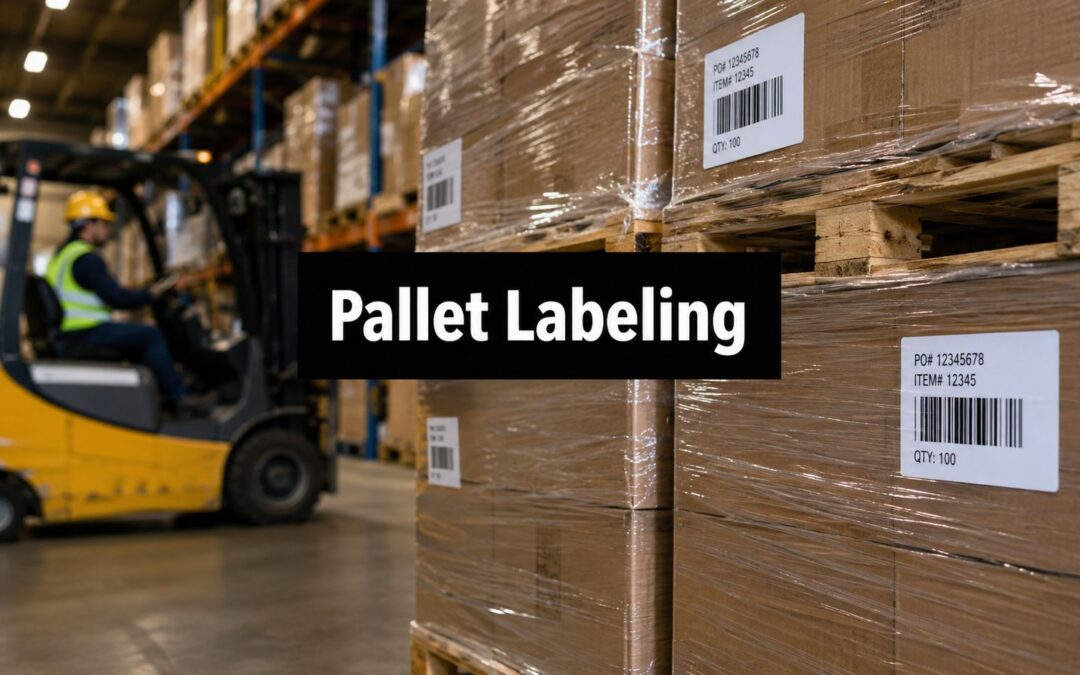
You're usually not shopping for pallet labeling systems on a quiet day. You're doing it after a receiving dispute, a scan failure at dispatch, or a customer complaint that traces back to one small rectangle of print that nobody thought would cause a major problem.
In Australian warehouses, the issue is rarely just “we need a label printer”. It's more often that pallets are moving through mixed environments, through stretch-wrap, under forklifts, into cold rooms, onto trucks, and across compliance checkpoints where a label has to do several jobs at once. It has to identify, communicate, survive handling, and scan first time.
That's why the best buying decisions start with actual operating conditions, not the brochure.
The True Cost of a Bad Pallet Label
A bad pallet label doesn't fail politely. It fails at the worst point in the workflow, when the truck is loaded, the booking window is fixed, and the receiving site won't make allowances.
A common scenario goes like this. The pallet leaves your site looking acceptable. The text is visible. The barcode appears clean. Then it arrives at a major distribution centre and the label won't scan, or it's placed outside the accepted zone, or the data on the face doesn't match what the receiver expects. One pallet gets pulled aside. Then several. Suddenly a routine delivery becomes manual handling, exception processing, and a call nobody wants to make.

What the damage actually looks like
The visible cost is the easiest one to spot. Labour gets redirected. Forklift time gets wasted. Dispatch staff start investigating what should already be closed.
The harder cost sits behind it:
- Re-handling pressure: Teams have to identify, relabel, separate, or restack freight under time pressure.
- Customer friction: A receiver doesn't care that the label looked fine in your warehouse. They care that their system couldn't accept it.
- Flow-on delays: One failed pallet can hold up putaway, receipt confirmation, and downstream inventory availability.
- Charge exposure: Freight classification and accessorial issues often sit alongside labelling errors, so operations managers should also understand practical guidance on preventing Class 55 reclassification fees when reviewing outbound compliance.
Practical rule: If a label only works in your own building, it isn't a good pallet label.
Why managers underestimate the risk
Many teams still treat pallet labelling as a finishing task. Print it. Stick it on. Move on. That mindset breaks down in high-volume logistics because the label is part of the control system, not packaging decoration.
When the label fails, the pallet becomes harder to identify, harder to route, and harder to receive. That puts compliance, efficiency, and customer confidence under pressure all at once. Good pallet labeling systems prevent that by making correct output repeatable, not dependent on whoever happens to be on shift.
Decoding Pallet Labelling Systems
A pallet labelling system is best understood as the pallet's passport. Without it, the pallet can still move physically, but it can't move cleanly through modern supply chains.
The passport idea matters because a pallet label isn't just a sticker. It carries identity, destination, contents, compliance details, and tracking information in a form that people and machines can both use.

The four parts that have to work together
A buyer who only focuses on the printer usually ends up solving half the problem. Reliable pallet labeling systems depend on four connected parts.
Hardware
This is the physical layer. It includes printers, print-and-apply units, scanners, sensor points, and in some sites, fixed verification equipment.
Hardware choice depends on where the label enters the workflow. A station at the end of a production line has different needs from one at an outbound dock. A hand-applied label might be enough in a lower-volume environment. In a faster operation, inconsistency in placement usually becomes the limiting factor, so applicators start to make sense.
Software
Software decides whether your data arrives cleanly at the print engine. If the WMS, ERP, or dispatch platform sends incomplete, mismatched, or late data, even a premium printer will produce a poor result.
That's why operations teams evaluating pallet labeling systems should also pay attention to broader thinking around software for logistics efficiency. The label only reflects the process behind it.
Consumables
Labels, adhesives, ribbons, facestocks, protective overlays, and tag materials all affect field performance. Many implementations go wrong when teams buy a machine and then treat the label stock as a commodity purchase.
It isn't. The wrong adhesive, the wrong surface finish, or the wrong face material can turn a technically correct label into an unreliable one.
Data
This is the part most businesses assume they already have under control. Often they don't. Data has to be complete, formatted correctly, and mapped consistently.
A clean barcode printed from dirty master data is still a bad label.
What a good system actually does
Strong pallet labeling systems create repeatability. They make it easier to print the same correct structure every time, at the right point in the process, with less operator judgment required.
That means the system should answer five operational questions every time:
- Who is this pallet? Its unique identifier.
- Where is it going? Receiver and routing details.
- What's on it? Product and batch information.
- Does it meet the rules? Customer and industry formatting.
- Can we track it later? Traceability through the chain.
When those answers line up, receiving gets faster, exception handling drops, and the label stops being a weak point in the operation.
Comparing Core Labelling Technologies
Not every warehouse needs the same tool. The right choice depends on throughput, surface conditions, compliance pressure, and how long the marking must last.
For pallet work, most buyers end up comparing three options. Print-and-apply, laser engraving, and RFID. Each solves a different operational problem, and each has trade-offs.
Australian pallet labelling standards require labels to include both human-readable text and scannable symbols such as the SSCC, product GTIN, batch number, and supplier details, typically on a standard A6 size of 105 mm × 148 mm for consistent scanning across logistics networks, as outlined in this Australian pallet labelling guide.
Print-and-apply in day-to-day warehousing
Print-and-apply systems are the default choice in many logistics environments because they handle variable data well. If every outbound pallet needs a fresh identifier, route detail, or batch reference, this method is practical.
Its weakness is durability. Adhesive labels can tear, smear, lift, wrinkle, or lose readability depending on handling and environment. The equipment also needs routine attention. Applicators drift out of alignment, print quality degrades, and poor media selection causes failures that operators often blame on the machine.
Laser engraving for long-life identification
Laser engraving fits a different use case. It isn't the answer for every disposable logistics label, but it becomes highly attractive when the identification needs to last and remain legible in harsh environments.
That's where Trotec Laser equipment stands out. A Trotec laser machine can mark metal plates, rigid tags, and durable identification components with high precision. In practice, that suits reusable assets, industrial equipment identification, and fixed pallet-related infrastructure where peel-off labels are a weak option.
For operations dealing with returnable transport items, asset pools, or harsh washdown and outdoor conditions, engraved identification can remove a lot of recurring label maintenance. It also avoids common problems linked to adhesive failure and surface contamination.
A useful reference point for these applications is durable asset tracking labels, especially where the label itself needs to behave more like a long-life asset marker than a short-cycle shipping label.
RFID where line-of-sight is the problem
RFID solves a different problem again. It's helpful when you need non-line-of-sight reads, faster bulk identification, or reduced dependence on exact scan positioning.
The trade-off is complexity. RFID needs compatible readers, middleware, testing, and site discipline. It can be powerful, but many businesses overbuy it when their real issue is inconsistent barcode execution, not the limits of barcode technology itself.
Buyer check: Don't choose the most advanced technology. Choose the one that removes your current failure mode.
Pallet Labelling Technology Comparison
| Technology | Initial Cost | Durability | Best For |
|---|---|---|---|
| Print-and-apply | Lower than specialised permanent-marking systems in many standard deployments | Moderate, depends heavily on label stock, adhesive, and handling conditions | Outbound shipping labels, variable data, routine warehouse dispatch |
| Laser engraving | Higher upfront investment, especially where permanent marking infrastructure is needed | High, suited to long-life identification on durable substrates | Reusable assets, industrial environments, metal tags, harsh conditions |
| RFID | Higher system complexity with tags, readers, and integration | Varies by tag type and environment | Non-line-of-sight tracking, bulk reads, specialised traceability workflows |
What usually works best
For most Australian warehouses, this isn't an either-or decision. Print-and-apply handles live dispatch labels. Laser-marked components support permanent asset identification around the operation. RFID only earns its keep when the workflow benefits from it.
That mix tends to be more practical than trying to force one technology into every labelling task.
Mastering Australian Compliance and Standards
A pallet can leave dispatch with the right GTIN, the right SSCC, and a clean print, then still get rejected at a customer site because the label sits outside the expected scan zone. That happens more often than many teams expect in Australian distribution, especially in grocery, liquor, and other high-volume receiving environments where scanners are set up around fixed pallet presentation rules.
For many warehouse operators, compliance starts with label position. In the Australian grocery and liquor industry, pallet labelling systems need labels placed within a 400 mm to 800 mm vertical zone from the pallet base on both fork-entry sides, with the top of the SSCC barcode targeted at 600 mm from ground level for automated scanning, according to the GS1 logistics labelling document.

Why the placement zone matters
The placement band exists for a practical reason. Receivers want predictable scans without rehandling pallets.
Labels placed too low can be blocked by pallet timber, feet, or fork pockets. Labels placed too high can sit outside the scanner's normal read window, particularly in fast-moving compliance zones where pallets are not being stopped and manually turned to suit a poor application. A readable barcode in the wrong spot still slows receiving, increases manual intervention, and can trigger chargebacks or relabelling requests.
Australian warehouses also deal with a floor-level problem many generic guides miss. Pallets rarely leave the line in the same visual condition they had at application. Stretch-wrap, corner boards, mixed load heights, and last-minute restacks all affect whether the label remains usable by the time it reaches a customer DC.
A practical compliance checklist
Use a floor check that matches the way pallets are built and shipped:
- Confirm both fork-entry faces: Apply labels on the sides the receiver expects to scan, not just the side that was easiest to reach on the line.
- Control the height: Give operators a fixed placement standard, or better yet, a mechanical guide or applicator setting that removes guesswork.
- Match barcode and text data: SSCC data, human-readable fields, and shipment records need to line up every time.
- Inspect after final wrap: Wrapping can shift, cloud, or partly cover a label that looked fine before load completion.
- Account for customer rules: Large retail and beverage networks often add receiving requirements beyond baseline GS1 guidance.
Automation proves cost-effective. A manually applied label can meet the standard, but only if the process stays disciplined across every shift. Print-and-apply systems reduce variation. Fixed application points reduce arguments about where “roughly right” is.
Hazardous goods and workplace substances raise the bar
Pallets carrying hazardous goods or workplace substances need tighter control over durability, legibility, and placement on the outer face. The label has to stay readable under actual storage, transport, and handling conditions. In practice, that means choosing materials, adhesives, print quality, and mounting methods that hold up to abrasion, moisture, chemicals, and repeated touchpoints.
This is also where permanent marking has a role around the wider operation. Evright's Trotec laser systems are not a substitute for every shipping label, but they are effective for durable identification on metal tags, asset plates, location markers, and reusable handling equipment that support compliant workflows around hazardous or tightly controlled environments. That matters when temporary stickers fail but the identification still needs to remain clear.
Where warehouses usually slip
The failure point is usually execution, not awareness. One operator applies to the wrap. Another places labels to suit carton height. A third follows the template, but the pallet has shifted by the end of wrapping and the barcode ends up on a crease line.
Good compliance systems remove those variables. Clear work instructions help. Applicator stops help more. Verification checks at dispatch catch errors before the truck leaves. In sites with stricter traceability or asset-control needs, laser-marked identifiers on racks, stillages, or returnable transport items can also reduce mix-ups around the pallet labelling process itself.
The practical goal is simple. Make every pallet easy to scan, easy to receive, and hard to reject.
Solving Real-World Labelling Failures
A label can be compliant on paper and still fail in operation. That's the gap many standard guides leave out.
The biggest example is stretch-wrap. Teams often assume that if the barcode is visible through the wrap, the job is done. It isn't. In Australian grocery and liquor supply chains, suppliers commonly run into failures because labels applied over stretch-wrap suffer from glare, distortion, or misalignment that pushes scan performance below 100%, and the wrap itself introduces optical noise that can trigger barcode rejection in automated systems, as explained in this industry white paper on pallet labelling failures.
Why visible isn't the same as scannable
A human eye is forgiving. A high-speed scanner is not.
A barcode behind wrinkled film can still look readable to an operator standing nearby. But scanners read edges, contrast, and geometry. Stretch-wrap changes all three. Reflections create glare. Film tension bends the code. Wrinkles break the clean pattern the scanner expects.
That's why operations teams get frustrated by “random” scan failures. They aren't random. The barcode has been optically degraded.
What works on the floor
The practical fix isn't complicated, but it does require discipline.
- Place with scan path in mind: Don't choose the neatest-looking area. Choose the flattest, most stable scan surface.
- Control wrap interaction: If your process puts labels in contact with film, test for glare and distortion, not just adhesion.
- Match material to environment: A dry ambient warehouse, a cold room, and an outdoor staging area don't treat label stock the same way.
- Test after full pallet build: Verification before wrapping tells you very little if the final pallet is wrapped, moved, and chilled.
Material failure is usually a selection problem
When labels peel, curl, absorb moisture, or abrade, the root cause is often poor material matching rather than poor staff performance.
Cold storage needs facestocks and adhesives that stay stable in low temperatures. Outdoor yards demand resistance to moisture, dirt, and UV exposure. Rough timber, dusty surfaces, and returnable packaging all create attachment challenges.
A good procurement decision asks these questions early:
- What surface are we labelling?
- What happens to that surface after application?
- What scans it, from what angle, and at what point in the journey?
- What environmental stress does the label face before receipt?
The best label in the catalogue is the wrong label if it hasn't been tested on your actual pallet build.
The hidden trade-off
Many facilities prioritise adhesion because a missing label is obvious. Optical clarity gets less attention because a bad scan often appears later, somewhere else, under somebody else's control.
That's a mistake. A firmly attached but optically degraded label can be more disruptive than one that falls off early, because the fault stays hidden until the receiving system rejects it. The better approach is to specify for both attachment and scan performance, then test under finished-pack conditions.
Workflow Integration and Implementation Steps
A common warehouse failure looks like this. The pallet is built, wrapped, scanned at dispatch, then rejected at the customer site because the wrong SSCC, batch, or destination data was printed from an upstream system mismatch. The printer did its job. The workflow did not.
That is why implementation starts with data ownership and decision points, not with the print engine or applicator frame.
Start with the data path
Map the full label trigger from order release to pallet confirmation. In many Australian warehouses, ERP holds item and batch data, WMS controls pallet creation, and freight software adds carrier and route fields late in the process. If any of those systems can overwrite the others without a clear rule, errors will keep recurring.
Before rollout, pin down four points:
- Which system owns each label field
- What event triggers print and apply
- Who can edit or override live data
- What happens when a field is blank, delayed, or inconsistent
This work matters most in mixed environments, where production, warehousing, and dispatch all touch the same pallet record. Teams dealing with that kind of complexity often need outside system integrations expertise to stop duplicate data entry and reduce manual relabelling.
Put the station where the pallet becomes final
The best station location is the point where pallet identity is settled and the label still has the best chance of surviving handling, wrap, and scanning. In practice, that is often later than teams expect.
An end-of-line print point works if SKU, quantity, and destination are locked before wrapping. A post-wrap station makes more sense when scan quality through film is a known issue, which is common in Australian sites using heavy stretch-wrap for long-haul freight or export loads. A dock-side station suits operations where routing changes late, but only if the process avoids forklift queues and last-minute hand application.
The trade-off is straightforward. Early application reduces dock pressure. Later application reduces rework and catches more exceptions.
For operations tying pallet labels into wider traceability, returns control, or equipment identification, this guide to asset tracking best practices is a useful reference.
Build the SOP around repeatable decisions
A usable SOP does more than tell operators where to stick the label. It sets the rule for placement, scan verification, reprint approval, rejected stock handling, and consumable changeover. It should also state what to do with pallets that are rebuilt, partially picked, rewrapped, or held in quarantine.
Compliance zones need extra care. If the pallet carries dangerous goods, chemicals, or other regulated materials, label content, position, durability, and legibility need to match the applicable Australian requirements already covered earlier in this article. The practical point for implementation is simple. Do not leave those decisions to shift-by-shift judgement.
Train for the problems that actually stop freight
Normal flow is easy to teach. Exceptions are where sites lose time.
Train operators and supervisors to recognise the conditions that break the label process: over-height pallets, damaged corners, poor wrap coverage, substituted product, manual consolidation, and urgent carrier changes. Give them a clear hold-and-fix rule. A two-minute stop inside the warehouse is cheaper than a rejected pallet in a strict compliance zone or a chargeback from a customer who cannot scan on receipt.
This is also where Evright's capability matters. For operations that need more than disposable carton labels, Trotec lasers can produce durable identification plates, tags, and fixed-location markers that support pallet workflows around staging, asset tracking, and regulated handling areas. That helps where printed labels do the shipment identification, but permanent marking supports the wider process around it.
Vendor Selection and Measuring True ROI
A vendor decision usually shows up at 4:30 pm on a Friday. Dispatch is trying to close out loads, a wrapped pallet will not scan through the film, and the carrier will not wait while the team reprints labels and rewraps freight. That is the test. The supplier you choose needs to handle live warehouse conditions in Australia, not just produce a clean sample in a showroom.

What to look for in a supplier
Start with site reality. Ask the vendor how they deal with stretch-wrap glare, cold-room condensation, mixed pallet heights, dirty environments, and customer sites that reject freight if barcodes fail first scan. If they stay at the level of print speed and DPI, keep looking.
A good supplier should be able to answer five practical questions:
- Do they understand Australian compliance pressure? They should know that some sites have strict receiving rules on label position, legibility, and durability, especially in regulated handling areas.
- Can they specify the right substrate and attachment method? Paper labels, synthetic labels, metal tags, and fixed plates all have a place. The right choice depends on moisture, abrasion, chemicals, UV exposure, and whether the pallet ID is temporary or permanent.
- Can they connect to your workflow? They should ask where print data originates, how scans are verified, what happens during rework, and how exceptions are logged in WMS or ERP systems.
- Do they offer more than one marking method? Warehouses often need disposable shipment labels in one part of the process and permanent identification in another.
- What happens after go-live? Significant problems start once forklift traffic, wrap changes, and operator shortcuts enter the process.
For permanent identification, Trotec laser systems are a strong fit. They produce precise marks on tags, plates, and other durable ID components that need to stay readable after heavy handling, washdown, chemical exposure, or long storage periods. That suits operations where printed labels handle shipment data, while laser-marked components support staging, pallet asset control, return loops, or fixed compliance zones.
A practical way to compare suppliers is to ask them to assess your actual handling conditions and review their method for performance benchmarking for industrial identification.
How the process works in practice
Laser-based identification creates the mark directly on a durable substrate. It does not rely on ink adhesion to survive the job. In pallet and warehouse applications, that usually means engraved metal tags, plates, or markers that stay legible after repeated contact, cleaning, or outdoor exposure.
That distinction matters when pallets are reused, rebuilt, staged for long periods, or moved through areas where peel-and-stick labels routinely fail. Evright applies Trotec laser capability to those harder-duty identification tasks, where the cost of losing the mark is higher than the cost of producing it properly in the first place. The broader capability of evright.com supports that industrial marking approach.
Here's a closer look at industrial laser marking in action.
ROI is broader than label spend
The cheapest label system on paper often becomes the most expensive one on the floor.
Measure ROI across the failure points your team already deals with. Count reprints caused by wrap interference. Track how often operators leave forklifts to relabel freight. Review chargebacks tied to unreadable or non-compliant labels. Check delays at dispatch and receiving. In Australian warehouses, these costs build quickly because many customer sites and transport partners work to tight scan and compliance tolerances.
The better investment usually reduces manual touchpoints, first-scan failures, and avoidable holds. It also gives operations managers clearer rules about where to use standard print-and-apply labels and where to use permanent marking instead. That is where suppliers with both logistics knowledge and durable identification capability stand apart.
If your team needs pallet labelling that stands up to real industrial conditions, Evright Industrial can help you evaluate durable identification options, including precision marking produced with Trotec laser technology. Their team works with Australian operations that need compliant, hard-wearing labelling and asset identification that won't peel off, fade, or become unreadable when the environment gets tough.
Recent Comments