
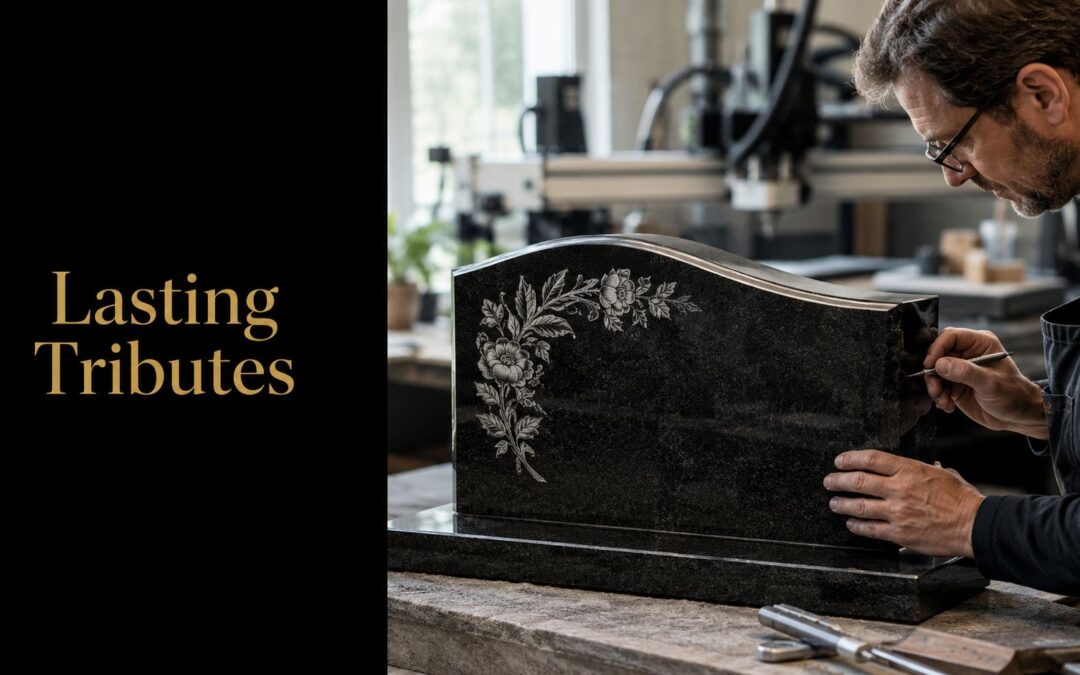
A lot of people arrive at this decision in a tired, tender state. They've just lost someone they love, or a family pet who was woven into daily life, and now they're trying to choose something that won't feel temporary six months from now.
That's where memorial stone work becomes more than a purchase. It becomes a promise. You want a name that stays sharp, a photograph that still reads clearly, and a tribute that doesn't look tired after a few hard Australian summers.
Laser engraved memorial stones suit that need better than most older methods because they allow very fine detail without relying on paint, surface prints, or broad mechanical cuts. Done properly on the right stone, the result looks calm, deliberate, and lasting. Done poorly, it can look flat, weak in contrast, or unsuited to the setting. The difference comes down to material choice, machine quality, image preparation, and the operator's judgment.
Creating a Permanent and Personal Tribute
Families rarely ask for “a plaque” in the abstract. They ask for a way to hold onto a person. Sometimes that means a simple name and date in a garden. Sometimes it means a polished black stone with a portrait, a short line of text, and an emblem that meant something only to that family.
In Australia, nearly 60% of pet owners who lose a pet seek a permanent outdoor memorial within the first three months, with engraved stone markers the preferred option for that purpose, according to this overview of personalised memorial garden stones. That rings true to what many in the trade see. People don't want a tribute that feels temporary. They want something they can return to.
Older methods still have their place. Hand carving carries character. Sandblasting gives strong, traditional lettering. But when a client wants a faithful photograph, fine halftones, small script, or a clean combination of portrait and text on a compact plaque, laser work usually offers the sharper result.
What makes a tribute feel right
A good memorial doesn't need to be elaborate. It needs to feel resolved.
That usually comes down to a few choices:
- The right level of detail. A formal cemetery plaque often benefits from restraint. A private garden stone can carry more personality.
- A material that suits the message. Some stones support photographs beautifully. Others are better for text and symbols.
- A design with breathing room. Crowding too much onto a memorial is one of the most common mistakes.
A memorial stone should read clearly from a respectful distance, then reward a closer look with finer detail.
If you're still working out what form of remembrance feels appropriate, Stobbe Design's resource on dedication plaques is a useful reference for how wording, purpose, and placement shape the final piece.
Why laser engraving suits modern memorials
Laser engraving gives families options that weren't practical with many traditional methods. Portraits, handwriting-style text, emblems, paw prints, florals, and highly controlled layouts can all be prepared digitally before the stone is touched. That means fewer surprises and much better proofing.
Value, though, isn't novelty. It's control. A permanent tribute deserves precision.
How Laser Engraving on Stone Works
A memorial stone has to survive more than the day it is installed. It has to hold detail through heat, rain, UV exposure, salt air in coastal areas, and years of cleaning. Laser engraving suits that job because it alters the stone itself. It does not rely on a surface print or a film that can peel away.
On suitable stone, a CO2 laser directs concentrated energy into the polished face and creates thousands of microscopic marks. Those marks change how light reflects off the surface, which is what produces the image and text. On black granite, that contrast can be precise enough for portraits, fine lettering, and delicate linework, provided the artwork and machine settings are handled properly. Planet Engraving's memorial plaque guide gives a useful plain-language description of that surface effect.
The key point is control.
A good operator is not trying to make a deep cut into the stone. The work is in managing focus, power, speed, resolution, and the character of the material in front of the machine. Too much energy can frost the surface harshly and lose mid-tones. Too little can leave a weak, grey image that disappears in strong sun. In Australian conditions, where bright light exposes every flaw, that balance matters.

The process in the workshop
A proper workflow is methodical because stone gives you very little room to recover from poor setup.
- Artwork is prepared digitally. Photographs are adjusted for tone, contrast, and background noise. Text is checked at the actual viewing size, not just on a screen.
- The stone is inspected and positioned. Polish consistency, flatness, and surface cleanliness all affect the final result.
- Focus and alignment are set. Even a small focus error can soften detail or create uneven contrast across the plaque.
- Test settings are confirmed. Experienced engravers match the settings to the exact stone, because two pieces that look similar can still react differently under the beam.
- The engraving is cleaned and examined under proper light. Residue can mask fine detail until the surface is fully cleared.
Machine quality matters here, but repeatability matters more. A well-configured Trotec Laser gives stable motion, accurate focus control, and consistent output across long runs and detailed jobs. That is what allows an engraver to reproduce a proof faithfully instead of approximating it. For clients comparing finishes and finished results, our granite plaque engraving process for memorial applications shows how those technical choices appear in the final stone.
Practical rule: The laser makes the mark. The setup, artwork, and operator decide whether that mark still reads cleanly years later.
A video also helps make the process more tangible than any written explanation alone:
Choosing the Right Material and Finish
If the design is the heart of the memorial, the stone is the body. The wrong material can limit detail, reduce contrast, or age in a way that doesn't suit the tribute.
For photo engraving, premium black granite is usually the strongest choice. According to Forevershining's black granite plaque specification, laser etching on premium black granite achieves photographic-quality halftone images at 200 DPI, creating microscopic indentations through the hardest minerals in the granite matrix, including Corundum, Quartz, and Feldspar. In plain terms, that's why a portrait on polished black granite can look crisp and luminous rather than muddy.
Material trade-offs that matter
Marble can be elegant, especially for classic inscriptions and softer visual styles. Bluestone can suit architectural settings and understated memorials. But if a client brings a treasured photograph and wants that image to hold together cleanly, black granite is the benchmark material.
Finish matters too.
- Polished finish gives the strongest visual contrast for laser photo work.
- Honed finish produces a softer look and can suit text-heavy pieces.
- Natural or textured faces can be attractive, but they usually reduce precision for detailed imagery.
Memorial Stone Material Comparison
| Material | Durability | Photo Engraving Quality | Typical Cost |
|---|---|---|---|
| Black granite | Very strong outdoor performer | Excellent, especially for portraits and halftones | Higher |
| Marble | Good, but more style-dependent outdoors | Good for selected artwork, less contrast than black granite | Moderate to higher |
| Bluestone | Solid for text and simpler designs | Fair to moderate, depending on finish | Moderate |
If you want to see how this looks in a production context, granite plaque engraving examples from Evright Industrial show why granite is so often chosen for memorial work.
The stone should match the job. A simple inscription allows more flexibility. A photographic memorial does not.
What doesn't work well
Highly detailed portraits on low-contrast stone rarely satisfy families. Busy designs on small plaques also tend to fail. The memorial may contain all the requested elements, but it won't read cleanly. In this craft, restraint usually improves dignity.
Ensuring Durability in the Australian Climate
Australia is hard on outdoor memorials. Strong sun, salt air in coastal areas, dust, rain, and heat cycles all test a plaque over time. That's why I'm careful with any claim about permanence. Some methods are durable. Some only look durable when they're new.
With laser-etched granite, the critical advantage is that the mark is part of the stone's surface, not a printed layer sitting on top. That means UV exposure doesn't affect it the way it affects inks, paints, or applied films.

What the durability evidence does support
According to Forevershining's explanation of laser etching durability, laser-etched granite memorial stones in Australia are estimated to have a 500-year life expectancy, because natural wind erosion would take that long to wear the stone down to the depth where the etching becomes invisible. That matters because it describes the engraving as being as durable as the stone's outermost layer itself.
That's a very different proposition from painted lettering or surface-applied imagery.
Where clients should be cautious
There is still an important distinction between broad permanence claims and specific long-term visibility under Australian UV exposure. Mackay Monumental Masons notes a lack of transparent, data-backed guidance on long-term fading rates of laser-etched photos on granite in Australia's UV climate, particularly for neutral comparisons over many years. So the honest answer is this: granite laser etching is a strong durability choice, but anyone promising exact long-term photo contrast outcomes under every local condition is claiming more certainty than the public data supports.
If you want a memorial for harsh outdoor conditions, choose a method that changes the stone itself rather than adding a decorative layer onto it.
Practical climate decisions
These choices help a memorial hold up well:
- Use premium granite for exposed sites. It handles weather better than softer decorative options.
- Choose contrast over complexity. A clear portrait and short inscription usually outlast fussy layouts visually.
- Consider placement carefully. Sprinklers, runoff, and constant salt exposure affect appearance over time even when the engraving remains intact.
Good memorial work respects the Australian climate instead of pretending it doesn't exist.
Best Practices for Design and Customisation
The strongest memorial designs usually feel effortless. In reality, they are carefully edited. The family may supply a favourite photograph, a line of wording, a symbol, and perhaps a date format with personal meaning. The engraver's job is to turn those pieces into something balanced and readable on stone.
Preparing artwork that engraves well
Start with the clearest image you have. A photo with strong lighting, distinct facial definition, and a simple background will nearly always engrave better than a dim snapshot with clutter behind the subject.
Keep wording disciplined. Stone rewards clarity.
- Names and dates come first. They're the anchor of the memorial.
- One short sentiment often works better than several lines. Crowding weakens impact.
- Fonts should suit the setting. Decorative scripts can be beautiful, but they become difficult if reduced too far.
A common mistake is trying to preserve every idea. Clients worry that removing an extra line or emblem means losing meaning. Usually the opposite is true. A well-edited design gives the important elements room to breathe.
Combining image and text
Portrait memorials need visual hierarchy. The face usually carries the emotional weight, so the inscription should support it rather than compete with it. Spacing, margins, and tonal balance matter as much as the image itself.
If you're still shaping the wording, these memorial plaque wording examples from Evright Industrial can help you narrow the tone from formal to personal without overcrowding the layout.
Leave empty space on the stone. Silence has a place in memorial design too.
Approval and regulation checks
There's also a practical issue many families don't hear about soon enough. There is regulatory and ethical ambiguity around controversial or non-traditional imagery in Australian memorial stones, and authorities are testing boundaries with new image scales, while no clear Australian funeral industry report or government guidance spells out what imagery is routinely rejected, as discussed in Letters, Lines, and Lasers.
That means it's wise to check with the cemetery authority, memorial park, or local council before finalising artwork if the design includes unusual imagery, large photographic compositions, or highly personalised motifs.
A simple pre-approval step can prevent expensive redesigns and delays.
The Evright Industrial Process and Promise
A memorial order usually starts at a difficult time. The process should reduce uncertainty, not add to it. Good engraving work comes from clear approvals, careful setup, and disciplined checking before any stone is marked.

The production sequence matters. Artwork is reviewed for contrast and legibility, the stone or plaque material is confirmed, a proof is approved, engraving parameters are tested, and the finished piece is inspected against the approved file. On memorial work, those checks protect against the problems families notice immediately: weak portrait tone, crowded text, spelling errors, and layouts that look balanced on screen but feel cramped on stone.
What disciplined production looks like
For stone engraving on Trotec equipment, Trotec's stone engraving guidance gives recommended starting settings for hard stone. In practice, any experienced shop treats those as a baseline, then adjusts for the exact surface, colour, density, and finish of the piece in front of them. That is especially important for memorials destined for Australian conditions, where glare, dust, heat, and weathering can flatten a design that looked acceptable in a workshop proof.
Machine quality helps, but process control matters just as much. Consistent focus, stable power delivery, proper jigging, and a test pass on comparable material are what keep lettering crisp and photographic engraving readable. If you want to see who handles that side of the work, Evright Industrial's engraving crew gives a useful look at the people behind the production process.
Evright Industrial sits within a broader engraving operation with decades of trade experience. That matters for memorial work because established production systems tend to be better at proof control, repeatability, and final inspection. Clients approve the design first. The job is then set up on Trotec laser equipment, run to suit the material selected, and checked against the approved artwork before it leaves production.
A look at the machinery in action helps make that process concrete:
Lead time and cost vary for sensible reasons. Stone choice, plaque size, artwork cleanup, mounting method, and whether the design includes a portrait all change the amount of preparation and testing required. A simple text plaque can move quickly. A photo memorial intended to hold its contrast through years of sun and weather needs more prepress work, more careful parameter setting, and a stricter final check.
Installation Care and Choosing Your Supplier
A well-made memorial still needs sensible installation. The stone should sit level, remain secure, and suit the environment around it. In a garden, that means thinking about irrigation spray, lawn equipment, and whether the plaque will be viewed from standing height or close up. In a cemetery or formal memorial site, it means following site rules exactly.
Care is usually straightforward. Gentle cleaning with a soft cloth and mild methods is enough for most engraved stones. Aggressive scrubbing, harsh chemicals, and unnecessary coatings often do more harm than good.
Supplier checklist that actually matters
When you compare suppliers, ask direct questions.
- What stone are you using. If a photo is involved, ask whether the material is suitable for high-contrast engraving.
- What machine produces the work. A supplier using Trotec Laser equipment for stone work should be able to explain why that matters.
- Can I see memorial examples. You want to inspect lettering, portrait clarity, and layout restraint.
- How is artwork proofed. A memorial should never move into production from a vague verbal description.
- Who checks site or cemetery constraints. This matters if the design includes custom imagery or unusual sizing.
Choose the supplier who answers plainly, shows real work, and explains trade-offs without overselling them.
Good laser engraved memorial stones come from disciplined choices. The right stone, the right artwork, the right machine, and a careful hand at every step.
If you're planning a memorial plaque and want a clear, practical starting point, Evright Industrial provides information on materials, engraving methods, and custom plaque options for durable outdoor remembrance.
Recent Comments