
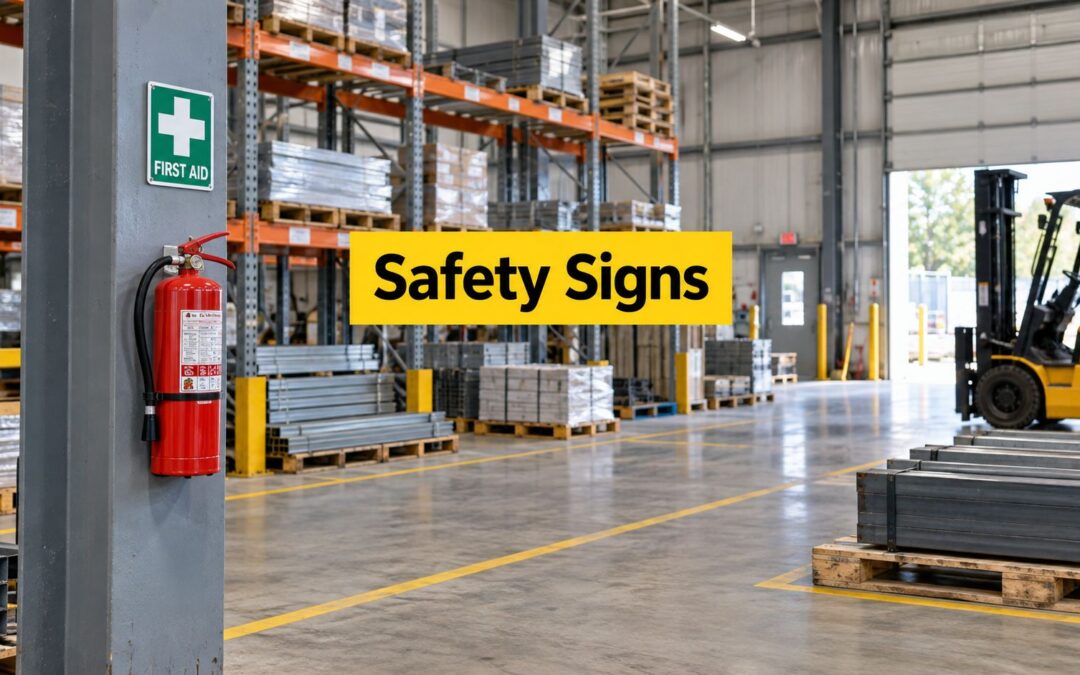
A wet-floor sign is easy to ignore when it's faded, curled, or hidden behind a pallet. On a busy Australian factory floor, that small failure can put a contractor in the path of a forklift, leave a chemical bund poorly identified, or send a worker towards the wrong isolation point. The sign may still be present, but it no longer performs its job.
Industrial safety signs only work when people can recognise, read, and act on them under real operating conditions. That means selecting the right sign class, substrate, mounting method, size, and maintenance routine for the environment. A sign that performs well inside a clean office may fail quickly in a washdown area, loading bay, hospital service corridor, or coastal infrastructure site.
Australia's core workplace framework is AS 1319, supported by the industrial colour principles in AS 1318. The practical challenge isn't knowing what a danger, warning, mandatory, prohibition, or emergency sign looks like. It's specifying signage that remains visible through dust, glare, chemicals, vibration, cleaning, weather, and changing site layouts.
Why Industrial Safety Signs Are a Frontline Control
The forklift driver sees the pallet before seeing the sign. The contractor steps into the bund because the warning panel has bleached into the background. A vehicle clips the load, stock shifts, and people nearby react to an event that a clear, correctly positioned sign should have helped prevent.
That scenario isn't a reason to blame signage for an incident. Signs are an administrative control, lower in the hierarchy than elimination, substitution, isolation, and engineering controls. A barrier, interlock, guard, segregated traffic route, or automatic shut-off should carry the primary protective load wherever practicable.
Signs still matter because workplaces don't operate in perfect conditions. Guards are opened during maintenance, temporary access routes appear, contractors arrive unfamiliar with the site, and people lose concentration during a long shift. A clear sign supplies a fast behavioural cue when a worker must decide whether to enter, stop, wear PPE, isolate equipment, or follow an emergency route.
Where the pressure is greatest
The need for context-specific signage is especially clear in the industries where serious harm is concentrated. Safe Work Australia reports that 80% of traumatic fatalities and 61% of serious workers' compensation claims occur in six industries, including manufacturing, construction, transport, and health care. Those figures are set out in Safe Work Australia's latest key WHS statistics.
Each setting creates different sign failures:
- Manufacturing: oil, dust, vibration, impact, and dense equipment layouts can obscure or damage signs.
- Food processing: repeated washdown and cleaning chemistry can attack adhesives, printed faces, and exposed edges.
- Transport: moving vehicles create short decision windows, so a sign must be visible before the conflict point.
- Health care: visitors, patients, contractors, and staff may interpret the same corridor differently, particularly during an emergency.
A useful site plan can combine physical signage with digital orientation and location information. For teams mapping complex facilities, Mappedin's smart workplace solutions provide relevant context on how indoor mapping can support safer navigation and operational awareness.
Practical rule: A sign isn't compliant in any meaningful operational sense if workers can't see it, understand it, or trust that it still describes the hazard in front of them.
The rest of the specification follows that principle. Start with the standard, then test the material, location, viewing distance, mounting, and inspection routine against the actual site.
The Australian Standards That Govern Industrial Safety Signs
A Monday-morning signage review should begin with two questions. What behaviour must the sign regulate, and what colour system identifies that instruction or hazard?
AS 1319 is Australia's foundational framework for safety signs in occupational environments. It covers signs used to regulate safety-related behaviour, warn about hazards, and provide emergency information, including fire protection information. The framework was first issued in 1983, revised in 1994, and reconfirmed in 2018 as AS 1319-1994 (R2018), as outlined by WorkSafe ACT's signage guidance.
AS 1319 gives specifiers a common design basis for sign formats and meanings. AS 1318, the SAA Industrial Safety Colour Code, governs the use of colour for marking physical hazards and identifying industrial equipment. It identifies red, yellow, green, and blue as principal safety colours, with associated industry swatches described in the technical AS 1318 reference.
Read the sign by colour and shape
The following reference translates the core conventions into a working selection tool.
| Colour | Shape | Sign Type | Typical Use |
|---|---|---|---|
| Red | Oval in a black rectangle, or red annulus with a slash | Danger or prohibition | Immediate danger, fire protection information, or an action that isn't permitted |
| Yellow | Triangle with black border | Warning | Hazard warning, such as moving equipment, chemicals, or a physical obstruction |
| Blue | Circle | Mandatory | Required PPE, operating action, or behaviour |
| Green | Rectangle or square | Emergency or safe condition | First aid, emergency information, or safe-condition guidance |
| Black and white | Rectangle | Supplementary information | Explanatory text, directions, or supporting detail |
The sign should communicate through pictogram, colour, shape, and concise wording, not through a paragraph that workers must stop and study. A blue mandatory circle for hearing protection should be recognisable before the worker reaches the noisy area. A yellow warning triangle should stand out from surrounding plant labels and production graphics.
Check the boundary with other standards
AS 1319 specifically excludes internal EXIT signs covered by AS 2293.1. That carve-out matters in factories, hospitals, warehouses, and infrastructure buildings because a general emergency or safe-condition sign isn't automatically a substitute for the required internal exit signage system. This Australian AS 1319 document describes that exclusion.
The standards don't operate in isolation from workplace law. A risk assessment identifies the hazard and required control, the applicable WHS duties and regulations establish the legal context, and AS 1319 provides the recognised signage framework. For a practical supplier reference covering Australian workplace applications, see industrial safety signage in Australia.
Don't select a sign solely because its colour looks familiar. Confirm the hazard classification, required message, pictogram, location, illumination, size, and whether another standard governs the specific application.
Choosing Materials That Survive Demanding Environments
The attractive sign is not necessarily the durable sign. In industrial work, substrate selection should follow the environment, not the artwork. A printed label can look excellent at installation and still fail after chemical exposure, abrasive cleaning, ultraviolet radiation, or repeated contact with equipment.
Stainless steel and anodised aluminium suit permanent identification where corrosion resistance and long service matter. Stainless steel is particularly useful around chemical handling, washdown, marine, and coastal conditions, although it adds weight, cost, and installation demands. Anodised aluminium offers a useful balance of light weight, rigidity, and surface durability, especially when the legend is engraved rather than printed.
Match the substrate to the stress
| Environment | Key Stressors | Recommended Substrate | Notes |
|---|---|---|---|
| Chemical plant or bund | Chemical splash, moisture, cleaning, impact | Stainless steel or anodised aluminium | Place the hazard sign next to the hazard and verify chemical compatibility before production |
| Outdoor infrastructure | UV, rain, temperature changes, wind | UV-stabilised polypropylene, polyester, anodised aluminium | Use stable finishes and inspect for fading, edge lift, and fixing damage |
| Food processing washdown | Water, detergents, sanitising chemistry, repeated cleaning | Stainless steel or suitable rigid plastic | Use sealed edges and mounting that doesn't trap residue |
| Abrasive manufacturing | Dust, friction, vibration, knocks | Anodised aluminium or stainless steel | Engraved legends avoid dependence on a surface print layer |
| Marine or coastal facility | Salt air, moisture, corrosion | Stainless steel or anodised aluminium | Select corrosion-resistant fasteners as well as a suitable face material |
| Temporary indoor marking | Relocation, short service life, smooth surfaces | High-tack industrial vinyl or polypropylene | Treat as temporary unless inspection confirms continued legibility |
For a permanent metal option, stainless steel signs for industrial applications explain the type of product commonly selected where corrosion resistance and identification are priorities.
Why engraving changes the failure mode
Printing places the legend on top of the substrate. That can be appropriate for short-term indoor marking, but it leaves the message dependent on ink, laminate, adhesive, or a protective coating. Laser engraving removes or alters the surface to create the legend within the material itself, so ordinary rubbing can't lift the message away.
Trotec Laser equipment is useful when a project needs repeatable detail across engraved aluminium, stainless steel, or industrial plastics. The machine choice doesn't remove the need for correct specification. A laser-engraved sign can still become unreadable if it is mounted behind a pipe rack, exposed to glare, or allowed to collect a layer of process residue.
Vinyl remains practical for curved machinery, temporary barriers, and short-term indoor changes. Polypropylene can suit lightweight applications and cable-tied temporary hazards. The right decision balances chemical resistance, UV stability, impact strength, cleanability, weight, fixing method, replacement frequency, and the consequences of failure.
Placement, Viewing Distance, and Mounting That Actually Work
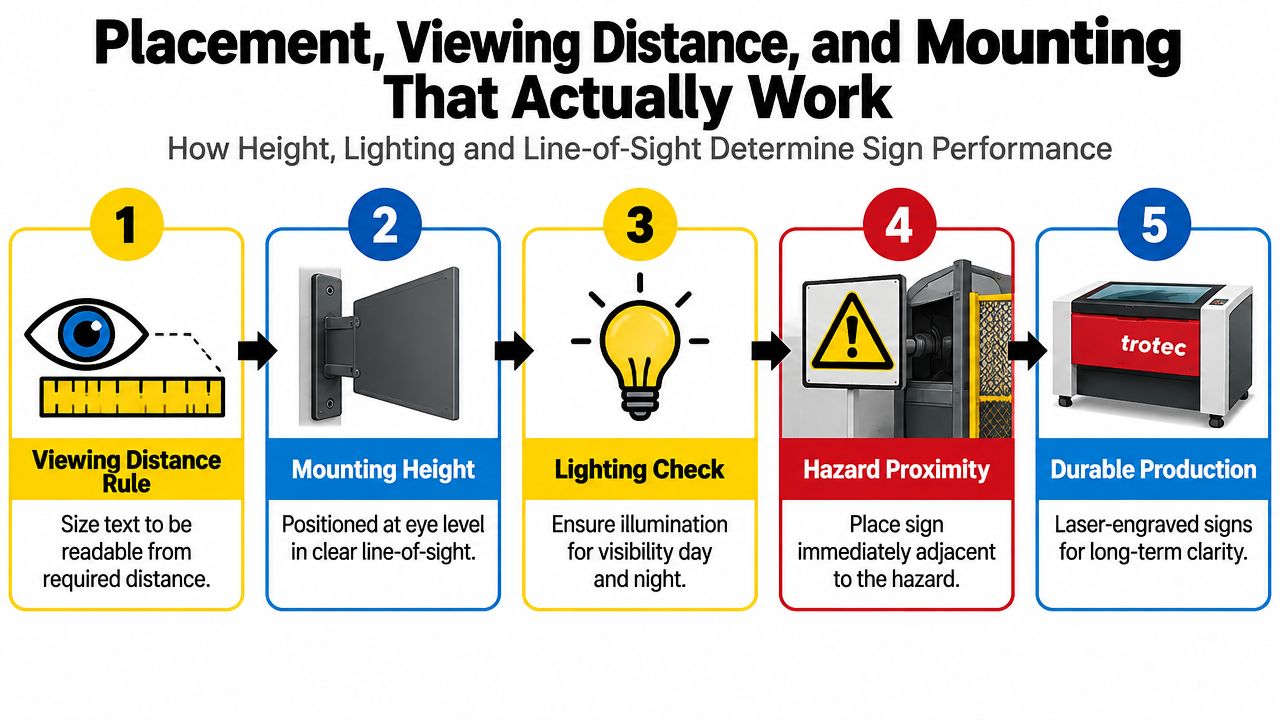
A sign should meet the worker before the hazard does. Mounting it on the far side of a machine, behind a swing gate, or beside an isolation point that can't be seen from the approach turns a technically present sign into a late warning.
AS 1319 uses a practical relationship between letter height and viewing distance, commonly expressed as roughly one millimetre of letter height for each metre of required viewing distance, subject to the limits of the sign system and the conditions at the site. A sign intended for a five-metre forklift aisle can therefore be much smaller than one intended to be read from a twenty-metre loading-bay approach, but the final size should also account for pictogram scale, background clutter, lighting, and worker speed.
Build the sight line before choosing the bracket
Walk the approach from the worker's perspective. Check whether racking, pipework, stacked product, parked vehicles, doors, or mobile plant block the face. A sign at eye level is useful only when the worker's line of sight reaches it early enough to support a decision.
For fixed steel structures, riveted aluminium provides a durable connection when the structure and access method allow it. Stainless stand-offs suit washdown areas where the face needs separation from a wet wall. Adhesive-bonded polypropylene can work on smooth, clean walls when drilling isn't desirable. Cable-tied polycarbonate is practical for temporary hazards, fencing, and changing work zones.
Placement test: Stand at the furthest point where a worker must decide. If the sign isn't immediately recognisable there, increase the sign size, improve contrast, relocate it, or add a supplementary sign.
Put supplementary signs at decision points
A chemical hazard sign belongs next to the hazard and must be clearly visible to approaching workers. A single sign at the entrance may not be enough where a worker can approach from several routes. Add a second sign at the turn, crossing, gate, or vehicle conflict point when the route creates a separate decision.
Apply the same discipline to emergency exits, isolation points, and PPE issue cupboards. Workers shouldn't have to search behind a door or walk past an access obstruction to find the instruction that prevents the next mistake.
The video below demonstrates laser production equipment and gives useful visual context for how engraved signage is made.
Customising Signs for Manufacturing, Construction, and Health Care
A standard sign doesn't mean an identical sign. The colour, shape, and meaning must remain consistent, but the size, supporting wording, language, pictogram detail, mounting, and finish should respond to the site.
Consider a heavy-industry plant with chemical storage beside a vehicle route. A large-format panel, potentially 600 x 600 mm, may provide the visual area needed for a hazard symbol, concise instruction, and multilingual supporting text. The challenge is preventing the extra wording from reducing the pictogram's impact or making the panel too dense.
A hospital corridor creates a different problem. Staff may know the building, while patients, visitors, tradespeople, and delivery workers don't. Clear wayfinding, tactile elements where appropriate, cleanable coatings, and controlled colour contrast can support navigation without allowing decorative branding to compete with emergency information.
Customisation by sector
| Sector | Typical Customisation | Compliance-Safe Approach |
|---|---|---|
| Manufacturing | Large panels, equipment-specific pictograms, multilingual instructions | Preserve AS 1319 colour and shape conventions, then add concise site detail |
| Construction | Reflective temporary signs, hoarding messages, induction information | Use high-visibility materials without changing the meaning of the safety symbol |
| Health care | Cleanable faces, tactile wayfinding, service-area restrictions | Separate emergency, clinical, visitor, and staff messages so each remains legible |
| Transport and rail | Lockout, traffic separation, access control, equipment labels | Use unmistakable pictograms at approach and isolation points |
| Essential services | Asset identification, restricted access, emergency directions | Keep identifiers auditable and ensure replacement signs match the approved original |
Construction hoarding often benefits from reflective material, especially where crews work around vehicles and changing light conditions. Floodlights can create glare on reflective finishes, though, so the face must be checked at night from the driver's approach rather than approved under office lighting.
Corporate branding needs restraint. A logo may identify the operator, but it shouldn't dominate a danger panel. Multilingual wording can improve access to the instruction, but oversized pictograms and multiple language blocks can compete for space. A compliance-safe custom sign keeps the standard signal feature prominent and treats added content as support.
Teams reviewing the wider management system can also browse their safety management page for broader context. Sign customisation belongs inside that system, alongside induction, training, risk assessment, traffic management, and emergency planning.
A legitimate customisation changes dimensions, material, mounting, language, or supporting detail because the site requires it. A compliance-breaking departure changes the recognised colour, shape, pictogram meaning, or hazard classification for aesthetic reasons.
Maintenance and Inspection Routines That Keep Signs Compliant
A sign can be correctly specified and still fail months later. Dust settles on the face, a forklift bends the bracket, ultraviolet exposure fades the warning, or a new rack blocks the sight line. Maintenance protects the original safety decision.
Use a simple rhythm that matches exposure and traffic rather than waiting for an annual compliance review. High-traffic zones need a regular visual sweep. Outdoor and washdown areas need closer attention to corrosion, edge condition, fasteners, and surface damage.
A workable inspection cycle
A monthly visual sweep suits busy approaches, pedestrian crossings, vehicle routes, production entrances, and emergency equipment locations. Inspect from the actual approach, not just from directly in front of the sign. Look for obstruction, fading, peeling, impact, graffiti, missing fixings, poor illumination, and changes to the hazard or route.
Quarterly checks should focus on substrate integrity in exposed areas. Inspect outdoor signs, washdown zones, chemical rooms, loading bays, and coastal installations for corrosion, edge lift, cracking, distortion, and movement. An annual full audit can align the signage review with WHS reporting cycles and site risk-assessment updates.
Clean carefully and replace decisively
Use isopropyl alcohol or mild detergent on anodised aluminium, with a soft, non-abrasive cloth. Avoid aggressive solvents on polypropylene and polycarbonate because they can soften, cloud, craze, or otherwise damage the face. Cleaning should remove residue without damaging the legend or surface finish.
Replace a sign when it is no longer legible at its design viewing distance, when fading changes the recognised colour, when edges peel, when graffiti can't be removed safely, or when mechanical damage affects pictogram recognition. Don't keep a damaged sign because the substrate still appears attached to the wall.
A basic asset register should record:
- Sign ID: Use a unique identifier that can be matched to drawings and work orders.
- Location: Record the approach, hazard, room, bay, or isolation point.
- Substrate: Note stainless steel, aluminium, polypropylene, vinyl, polyester, or another approved material.
- Install date: Keep the original installation detail available for replacement planning.
- Photo baseline: Store an image showing the approved condition and sight line.
- Inspection action: Record cleaning, repair, relocation, or replacement decisions.
That register supports incident investigation and helps demonstrate due diligence during a regulator visit. Trotec Laser production can also reproduce engraved replacements accurately when the original artwork, substrate, and sign ID are retained.
Bringing It All Together With the Right Production Partner
Industrial safety signage works as an operational loop, not as four disconnected purchasing decisions. The risk assessment identifies the hazard. AS 1319 determines the sign function and visual convention. The environment determines the substrate, while viewing distance, lighting, and traffic flow determine the size and mounting position. Inspection then confirms that the installed sign still performs as specified.
A practical project sequence looks like this:
- Define the hazard and behaviour. Decide whether workers must stop, keep out, wear PPE, isolate equipment, follow a route, or identify an emergency resource.
- Select the standard sign class. Use the recognised colour, shape, and pictogram rather than creating a branded variation.
- Assess the operating environment. Consider chemical contact, washdown, UV, dust, impact, vibration, temperature, glare, and cleaning methods.
- Set the viewing requirement. Measure the approach distance and check whether workers need to read text or only recognise a symbol.
- Specify mounting and replacement. Choose fixings that suit the structure and retain the artwork, substrate, and installation record for future matching.
Production details decide long-term consistency
A local producer should be able to discuss more than artwork. Ask whether the team can laser-engrave anodised aluminium, stainless steel, and UV-stable traffolyte, produce custom pictograms, maintain approved files, and reproduce an exact replacement when a sign is damaged years after installation.
Trotec Laser machinery supports controlled, repeatable engraving for detailed legends and asset labels. The production method should still be selected against the site requirement. A laser-engraved metal sign may suit a permanent chemical-area label, while a temporary construction marker may justify a lighter, relocatable material.
Mounting matters too. For projects using acrylic in controlled indoor applications, this guide to mounting options for acrylic signs provides useful background on fixing approaches. Acrylic isn't automatically the right choice for a harsh industrial location, but understanding its mounting options helps avoid selecting a face material without considering installation.
Evright Industrial is one Australian option for industrial engraving services, producing safety signage and asset labels for industrial, infrastructure, health-care, and essential-service applications. The important outcome isn't the supplier name on the purchase order. It's a controlled result that links compliance, material durability, placement discipline, and maintainable records.
Evright Industrial can help specify and produce AS 1319-aligned safety signs, engraved equipment labels, and durable site identification across chemical plants, food lines, transport yards, and hospital service areas. Visit Evright Industrial with your hazard list, environment details, viewing distances, and replacement requirements so the signage can be designed for the conditions where it must perform.
Recent Comments