

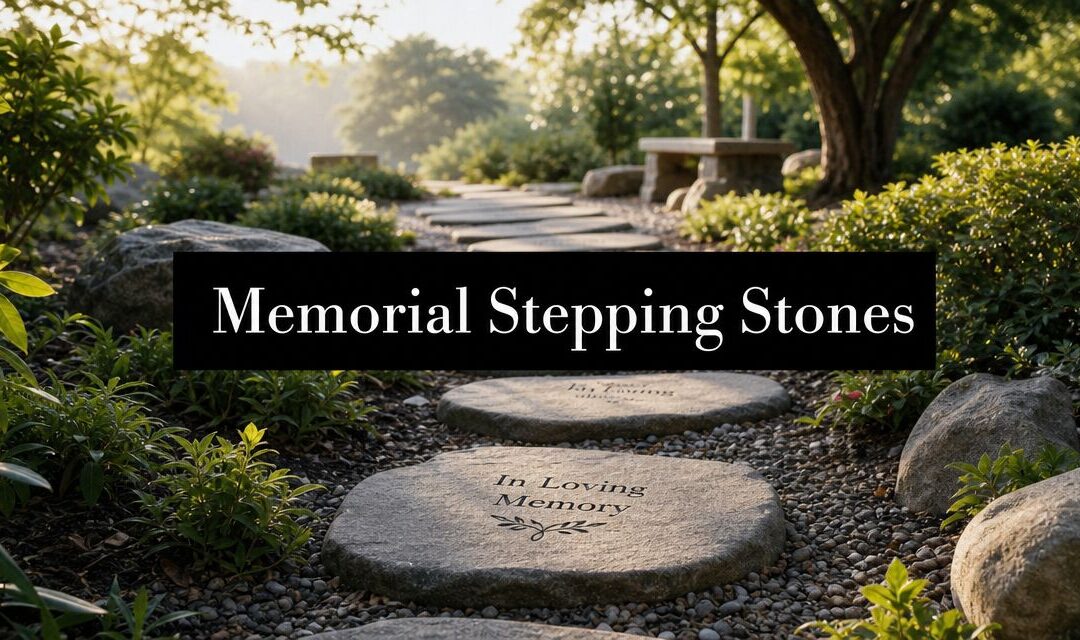
A family has chosen cremation, but they don't want remembrance to end with an urn on a shelf or a temporary marker that disappears into its surroundings. They want something personal. Something that sits in a garden, near a rose bed, beside a bench, or in a quiet corner of a memorial space where people will surely pause.
That request lands on funeral directors more often than many suppliers admit. Families aren't only asking for inscription ideas. They're asking whether the stone will fade, whether it will crack in heat, whether it will become slippery after rain, and whether the lettering will still be readable years from now. Those are practical questions, and they deserve practical answers.
Too much content around personalized memorial stepping stones stops at decoration. It shows pretty layouts, sentimental wording, or simple craft methods. It rarely deals with the harder issue: what survives outdoors in Australia. That durability gap matters. Guidance on this category often explains how to make or buy a stone, but rarely addresses which materials and finishes hold up best against UV, heat, and water exposure in Australian conditions, as highlighted in this discussion of long-term outdoor durability concerns for memorial stones in Australia's climate in this background reference.

For funeral homes, it is with memorial stepping stones that good service becomes expert service. A stepping stone can be a meaningful memorial. It can also become a disappointment if the wrong substrate, finish, or installation method is chosen. If your team also advises on other forms of outdoor commemoration, it helps to explore dedication plaque solutions alongside stone markers so you can guide families to the right format for the setting.
Creating a Lasting Tribute in a Changing World
The strongest memorial products do two jobs at once. They honour the person being remembered, and they remain serviceable in the setting where grief lives. In many cases, that setting isn't a formal monument line. It's a garden path, an ashes interment area, or a family property where people return repeatedly.
What families are really asking for
When someone asks for a memorial stepping stone, they're often asking for a physical focal point. They want a marker that feels grounded, not temporary. They also want flexibility. A stone can sit flush in a lawn, nest into gravel, or become part of a small remembrance garden in a way a taller monument cannot.
That versatility matters because memorial practice has shifted. In Australia, the annual death count reached 190,939 in 2023, and cremation has become the dominant disposition, with rates above 70% in several jurisdictions, according to the market context cited in this memorial garden stone overview. For funeral homes, that means more families need memorial options beyond a conventional headstone.
Practical rule: A memorial stepping stone works best when it gives families a place to return to, not just a product to purchase.
Why this category belongs in a funeral home offering
Personalized memorial stepping stones fill a useful space between a full cemetery monument and a purely decorative keepsake. They can mark a gravesite, a garden of remembrance, or a private setting where ashes have significance. That makes them easier to recommend when a family wants permanence without the formality or scale of a traditional upright memorial.
They also help you serve a wider range of preferences. Some families want names and dates only. Others want a symbol, a short line of wording, or a simple motif that feels less institutional. If you need examples of inscription structure before finalising artwork, these memorial plaque wording examples are a useful reference point for keeping wording concise and readable outdoors.
A second benefit is communication. Families often understand engraving in broad terms, but not the difference between a durable recessed inscription and a decorative surface treatment. That's where your advice matters. If they're comparing vendors or formats, it can also help to review broader memorial engraving services so they can see how process and material choices affect the final result.
Where stepping stones add the most value
These stones are especially effective in three settings:
- Cremation memorial areas where a full monument may be unnecessary or impractical.
- Home gardens where families want a private place of remembrance.
- Shared outdoor memorial spaces where a low-profile tribute suits the setting and maintenance requirements.
For funeral directors, the category isn't niche. It's a practical response to how memorial choices now work.
The Role of Personalised Memorial Stepping Stones
A memorial stone that lasts outdoors starts with the substrate. If the material is wrong, the engraving method won't save it. If the material is right, even a simple design can age gracefully.
Australia's outdoor memorial culture has always demanded durable materials. The country experiences some of the world's highest ultraviolet exposure, with very high and extreme UV conditions common in summer across much of the country, a climate reality reflected in the product expectations described in this engraved memorial stone reference. In practice, that means soft decorative finishes and fragile composite surfaces are poor choices for permanent outdoor remembrance.
How common materials behave outdoors
Natural stone, cast concrete, and slate all appear in the market, but they do not perform the same way.
| Material | UV Resistance | Durability/Hardness | Best Use Case |
|---|---|---|---|
| Granite | Excellent | High | Permanent outdoor memorials, high-detail engraved work |
| Bluestone | Strong | High | Garden settings with a more natural, muted appearance |
| Cast concrete | Strong when properly made | Moderate to high | Larger-format stepping stones and cost-conscious memorial programs |
| Slate | Good, but varies by grade | Moderate | Decorative memorials in sheltered or lower-wear settings |
Granite and bluestone
Granite is usually the safest recommendation when a family wants the least maintenance and the sharpest long-term inscription. It's dense, stable, and takes engraving cleanly. It also suits funeral homes that need consistency across repeat orders.
Bluestone gives a softer visual character and often sits well in designed memorial gardens. It can be an excellent choice, but finish selection matters. A rougher face may suit the setting, while a honed inscription panel can improve readability.
Cast concrete
Concrete is more variable. A well-made cast concrete stone can perform well outdoors and suits stepping-stone formats nicely because it can be produced in practical shapes and thicknesses. A poor mix, weak curing, or decorative topcoat will shorten its life quickly.
That's why it helps to think like a specifier, not just a buyer. If you want a plain-language refresher on how mix quality affects weathering and surface integrity, this article on choosing durable concrete for driveways is useful because the same durability logic applies to outdoor memorial pieces exposed to sun and water.
Surface decoration often fails long before the substrate does. That's why the material and the marking method have to be selected together.
What usually doesn't hold up
Several failure patterns show up again and again:
- Painted lettering on exposed surfaces fades and loses edge definition.
- Thin decorative stone pieces can shift, rock, or crack after installation.
- Low-density cast products absorb moisture more readily and weather unevenly.
- Highly polished decorative coatings can become maintenance-heavy in outdoor gardens.
If the project calls for a harder-wearing stone with a crisp engraved finish, reviewing examples of granite plaque engraving can help clarify what durable execution looks like before artwork is approved.
The best buying decision usually comes down to intended location. For a public memorial garden or cemetery environment, prioritise mass, stability, and engraving clarity. For a private home garden, you may have more freedom with shape and aesthetic finish, but durability still needs to lead the brief.
Customisation with Precision Laser Engraving
The memorial industry still uses the word “engraving” loosely. That causes problems. Printing, blasting, routing, and laser marking all get grouped together, even though they age very differently outdoors.
For personalized memorial stepping stones, the critical distinction is simple. If the inscription sits only on the surface, weather will eventually take it with it. If the inscription is recessed into the material, it has a much better chance of remaining legible.

Why recessed engraving matters
For outdoor durability, engraved recesses of 1/16" to 1/8" deep are a practical benchmark because that depth preserves legibility as the top surface weathers, as noted in this memorial garden stone product guidance. That's the difference between a tribute that still reads clearly after years outdoors and one that looks tired far too early.
Mechanical routing can create depth, but it has limitations. Fine scripts, small symbols, and detailed artwork can lose sharpness depending on tool size and edge chipping. Surface printing gives good initial contrast, but it remains a coating. In Australian conditions, coatings are the first thing to be tested by sun and moisture.
Laser engraving gives you tighter control over detail. On suitable memorial materials, a precision laser can produce cleaner edges, finer image work, and more consistent repeatability than broad mechanical methods.
Why Trotec Laser systems suit memorial work
Trotec Laser systems are well suited to memorial production because they prioritise control. That matters when the layout includes delicate flourishes, compact line spacing, or image elements that need to remain clear at a small scale. For funeral homes, it also matters when consistency across multiple orders is part of the job.
At custom laser engraving, the process used for permanent engraved products is built around advanced Trotec laser systems that remove material with precision rather than relying on surface-only decoration. In practical terms, that means the inscription becomes part of the stone itself. It supports fine script, symbols, and detailed artwork while aiming for the permanence required in an outdoor memorial setting.
The best memorial engraving doesn't call attention to the technology. It lets the name, the dates, and the design remain clear without constant maintenance.
A lot of buyers ask whether laser is only for indoor plaques or lighter materials. It isn't. The result depends on the material chosen and the specification given to production. On hard-wearing substrates, laser-based precision can be a strong advantage because repeatability matters just as much as depth.
Here's a look at laser engraving in action on stone-style memorial work:
What to specify before approving artwork
Before production begins, funeral homes should confirm:
- Letter weight and spacing so text remains readable outdoors, not just on a screen proof.
- Image simplification because high-detail artwork often needs tonal reduction for clean engraving.
- Margin around the inscription so weathering at the edges doesn't crowd the text.
- Recessed marking rather than applied graphics for any piece intended to live permanently outside.
If the piece is meant to honour a family for years, precision isn't a luxury. It's part of the memorial standard.
Sizing Installation and Maintenance Guidance
A well-made memorial stone can still fail in service if it's installed badly. The common problems are ordinary ones. The base isn't compacted, the stone rocks underfoot, water sits around the edges, or the piece is placed proud of the surrounding surface and becomes a trip point.

Size should follow use
Small-format memorial stones are often used as markers within garden beds or beside pathways. Wider stepstone formats suit remembrance gardens and flush-to-ground placements where visual presence matters. The right size isn't only an aesthetic choice. It affects stability, readability, and safety.
If the stone will be viewed from a standing position, keep the inscription brief and visually open. Dense wording that reads well at arm's length often becomes difficult in a garden setting.
Curing and handling matter more than most buyers realise
For cast stones, a stiff mix is important because it helps lettering retain crisp edges. The piece should cure in its mould for at least 24 hours before demoulding, with several more days of cure time for final strength, according to these memorial stone making instructions. That curing period reduces fragility, moisture ingress, and later cracking.
A supplier who rushes handling can damage the exact part the family cares most about. Once an inscription edge crumbles, it doesn't come back.
Installation basics that prevent callbacks
Use a simple process and insist on it:
- Choose a level location with decent drainage. Avoid hollows where water regularly sits.
- Excavate slightly beyond the stone footprint so there's room for a stable base and edge support.
- Lay and compact a granular base such as gravel or sand suited to the setting.
- Set the stone flush or near-flush with the surrounding surface where foot traffic is possible.
- Check for rocking and ponding before leaving the site.
A memorial stepping stone should feel settled into the landscape, not perched on top of it.
Low-effort maintenance that works
Outdoor memorial stones don't need aggressive cleaning. In fact, harsh products often do more harm than good.
- Use mild soap and water for routine cleaning.
- Avoid abrasive pads on polished or honed faces.
- Re-level if the ground shifts rather than letting one corner sit proud.
- Keep edging growth under control so the inscription remains visible.
This is one of the easiest products to maintain when it has been specified correctly. Most long-term problems come from poor placement, not from the concept itself.
Navigating Compliance and Ordering Logistics
A memorial stone may be beautifully designed and perfectly manufactured, but it still has to suit the site where it will be placed. That's where many orders go wrong. Families assume a personalised stone can go anywhere. Funeral homes know better.
Compliance and placement rules are a real consideration in Australia. Cemetery and memorial garden requirements are usually set by local authorities, and accessibility guidance for public-facing outdoor areas reinforces the importance of safe, level surfaces. In practical terms, that makes low-profile placement a key decision for memorial stepping stones, as reflected in this memorial stepping stone market reference.
Questions to settle before you order
Don't leave these until artwork approval:
- Is the site public, private, or cemetery-managed? Each setting carries different expectations.
- Are there restrictions on height or profile? Many shared spaces prefer flush markers.
- Who is responsible for installation and upkeep? That should be clear before supply.
- Does the site permit symbols, photos, or custom shapes? Some locations are stricter than families expect.
A practical ordering workflow
A smooth ordering process usually follows this sequence:
- Collect final wording early. Names, dates, and inscriptions need sign-off before layout starts.
- Request artwork suited to the process. Fine image files and simple vector-ready artwork reduce proofing delays.
- Approve one production proof carefully. Check line breaks, punctuation, symbol placement, and edge margins.
- Confirm the intended placement. Garden bed, path edge, cemetery lawn, and remembrance wall surrounds all affect the spec.
- Align packaging and transport to the substrate. Heavier stones need different handling expectations than lightweight decorative pieces.
This is also where an experienced supplier adds value. The right production partner won't just take the order. They'll ask where the piece is going, how it will sit, and whether the chosen finish suits the site.
The hidden issue is often safety
In a private garden, a family may accept a more decorative shape or a raised profile. In a shared memorial area, that can become a risk. Uneven edges, rocking placement, and proud installation all create avoidable problems.
That's why low-profile geometry matters so much. A memorial should invite approach, not create a hazard.
Ask the site manager for written placement rules before production starts. It's far easier to change a proof than to remake a stone that doesn't comply.
For funeral directors, this is one of those categories where logistics and compassion overlap. A clear proofing process, realistic placement advice, and early compliance checks spare families stress at a time when they don't need another complication.
Conclusion A Partner in Lasting Remembrance
A good memorial stepping stone isn't defined by decoration alone. It's defined by how well the material, engraving method, and installation work together once the piece is exposed to real weather and real use.
For funeral homes, the strongest recommendation is usually the simplest one. Choose a substrate that can handle outdoor exposure. Specify recessed, permanent marking rather than surface-only decoration. Make sure the stone is sized for legibility and installed safely for the setting. When those decisions are right, personalized memorial stepping stones become what families hoped for in the first place: a steady place to remember.
If you need a production partner for durable memorial plaques and engraved stone-style tributes, Evright Industrial brings together precision laser capability, practical material knowledge, and the backing of evright.com's long-standing engraving expertise. Their team uses advanced Trotec Laser systems to produce permanent, high-quality engraving for demanding Australian conditions, with a process built around clear proofs, reliable turnaround, and durable results for funeral homes and memorial planners.
Recent Comments