

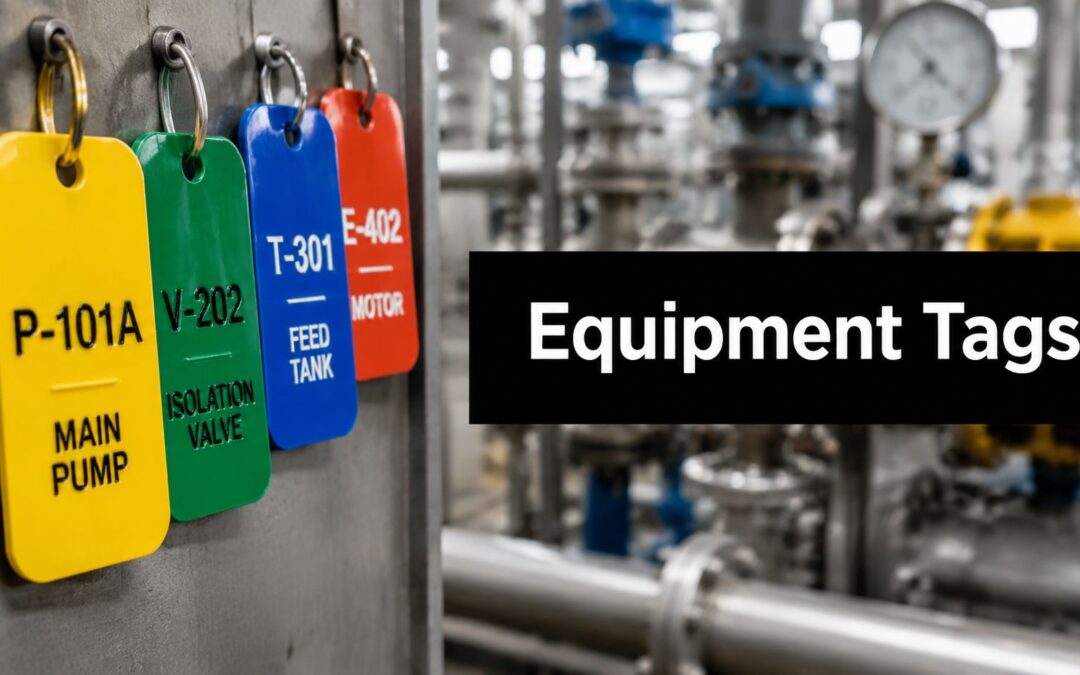
You've got a tag problem if you've ever stood on a floor, opened a plant room, or checked a switchboard and found the label half gone, sun-bleached, or hanging off by one corner. The equipment is still there, the asset register still says it exists, but the tag no longer tells anyone what it is, when it was last inspected, or whether the next person to touch it is about to create a safety issue. In Australian worksites, that's not a small inconvenience, it's a maintenance, compliance, and risk-control problem.
Engraved plastic equipment tags solve that problem because the identification is built into the material, not sitting on top of it. Industry references describe engraved plastic as a permanent identification method used for part numbers, serial numbers, model information, and compliance details, with markings designed to resist wear, fading, moisture, heat, and chemicals.[^1] For Australian sites, that matters because weather, cleaning chemicals, and mechanical handling all work against surface-only labels, and a tag that survives the equipment's service life is worth more than a cheap label that only looks fine on day one.

Why Engraved Plastic Equipment Tags Matter in Australian Worksites
A maintenance supervisor I'd trust more than any brochure once described the same scene in two different buildings. In one plant room, the breaker tags were crisp and readable, so the electrician could isolate the right circuit without a second guess. In the other, the label on the panel had faded to a pale blur, which slowed the inspection and forced a manual check against old drawings.
That's the difference with engraved plastic equipment tags. Printed labels rely on the integrity of ink, adhesive, or overlaminate, while engraved plastic uses the material itself as the identifier, so the text remains readable after cleaning, handling, and environmental exposure.[^1] The practical result is simpler than the terminology suggests, the tag still tells the truth when surface labels have started to fail.
What makes them different from stickers
A sticker can be fine for packaging or short-life information. It is a poor match for a compressor skid, a pump station, or a switchboard that needs durable identification across years of use.
A proper engraved tag is chosen for the same reason you'd choose a stainless fastener over a decorative clip. It is made for retention, not decoration. Industrial suppliers also note that engraved plastic is used for valve tags, asset IDs, branding, model information, and safety labels across facilities and systems.[^2]
Practical rule: if the tag needs to survive washdown, sunlight, or repeated handling, surface print is usually the weak point, not the fixings.
Why Australian conditions change the spec
Australian worksites don't fail labels politely. They expose them to UV, humidity, dust, cleaners, vibration, and sometimes direct washdown. That makes tag choice a compliance decision as much as a materials choice, especially where workers depend on clear identification to operate safely.
The key takeaway is straightforward. Engraved plastic equipment tags pay back over the life of the asset, not just at installation. If a tag remains legible through maintenance cycles, inspections, and environmental exposure, the site keeps its records aligned with the physical equipment, and that's where the operational value sits.
How Laser Engraving Creates Permanent Identification
Laser engraving creates permanent identification by removing material layers rather than applying ink on the surface. The visible contrast comes from the tag itself, not from a coating that can wear away. That is why a laser-engraved mark stays readable long after a printed label starts to fade or rub off.
Industrial sources describe laser engraving, laser etching, embossing, screen printing, and rotary engraving as ways to create markings that resist wear, fading, moisture, heat, and chemicals.[^1] For compliance-grade work, laser engraving matters because it turns a blank tag into a lasting identifier, not a temporary sticker with a date on it. In Australian plants, that difference shows up during shutdowns, audits, and maintenance handovers, when the tag has to still match the asset register and the QR or barcode workflow attached to it.
The material does the work
The most useful industrial tags are usually built from phenolic or multilayer laminate substrates. Suppliers specify those materials because the laser removes the top layer and exposes a contrasting colour underneath, which creates a high-contrast, permanently legible mark.[^3] That contrast is what keeps the tag readable after repeated handling, routine cleaning, and exposure to the kind of dust, moisture, and UV load common across Australian sites.
This is also why engraved plastic works so well for serial numbers, model plates, and asset IDs. The identification does not depend on a coating staying intact. It is part of the tag's structure, so the information stays with the equipment rather than living on top of it.
Why the method matters for small text and codes
Industrial marking suppliers also note that engraved plastic tags can be made in custom sizes and shapes and can support fine-detail text and graphics without sacrificing readability.[^4] That matters when you need to fit a serial number, a barcode or QR code, and a site-specific asset ID onto a compact tag, while still leaving enough clear space for scanning and quick visual checks.
The production logic is straightforward.
- Choose the substrate that matches the environment.
- Set the contrast layer so the text remains clear.
- Engrave the data with enough spacing for scanning and human reading.
- Fix the tag securely so the marking reaches the service life of the equipment.
A tag only earns its place if the next person can read it quickly during a fault, shutdown, or inspection.
Laser engraving stays dominant in industrial identification because it makes the mark part of the material. That gives you permanence without relying on ink, and in Australian conditions, that permanence is what keeps equipment labels useful in the field. For sites setting up engraved plastic equipment tags, Evright Industrial plastic engraving services fit that practical requirement directly.
Choosing the Right Plastic and Engraving Method for the Job
A materials spec works the same way whether you're choosing a panel, a guard, or a tag. You don't pick the toughest-looking thing on the rack, you pick the one that fits the environment. Decorative acrylic can be perfectly acceptable in a dry indoor location, but it's the wrong call for a washdown area or an exposed plant asset.
Match the tag to the exposure
For indoor plant rooms, switchboards, and general asset IDs, multilayer laminate or phenolic-style engravable plastic is usually the practical starting point. For outdoor assets, UV resistance and fixings matter more, so the tag should be specified for weather exposure rather than indoor display. For chemical zones, the conversation shifts to the substrate and the attachment method, because the tag has to survive both the environment and the cleaners used on site.
The table below gives a working selection lens, not a marketing list.
| Environment | Recommended Material | Recommended Method | Why |
|---|---|---|---|
| Indoor plant room | Multilayer laminate | Laser engraving | Clear contrast, good readability, compact layout |
| Switchboard or control panel | Phenolic or similar engravable plastic | Laser engraving | Durable identification for asset and compliance labels |
| Outdoor asset | UV-conscious engravable plastic | Laser engraving | Better suited to weather exposure than printed labels |
| Washdown area | Durable multilayer laminate with secure fixing | Laser engraving | Marking stays legible after cleaning and handling |
| Chemical-exposed zone | Industrial engravable plastic matched to chemical regime | Laser engraving | Material choice matters more than surface print |
Compare the methods honestly
Laser engraving gives permanent contrast. Rotary engraving also produces a physical mark, but it's generally used where different fabrication workflows suit the job. UV printing can be useful for colour or visual branding, but it depends more on the printed layer remaining intact. Embossing has its place, yet it doesn't always suit dense data or small mounting footprints.
For equipment tags, I'd treat the rule like structural engineering. You wouldn't specify a decorative finish for a corrosive environment and expect it to behave like a protective system. The same logic applies here.
If you want a production starting point, Evright Industrial's plastic engraving services are set up around that kind of environment-led specification rather than one-size-fits-all ordering.
Compliance, Durability, and Australian Conditions
On an Australian site, a tag is not just a label. It sits inside a WHS system, and that system depends on information workers can read quickly during isolation, inspection, maintenance, and fault finding. Australian WHS law places the duty on the person conducting a business or undertaking to ensure, so far as is reasonably practicable, the health and safety of workers and others.[^5] If identification is hard to read or fails early, the control measure has already weakened.
The environment then decides how long that control stays useful. A tag on a coastal site has to handle UV, salt air, cleaning chemicals, and repeated handling. A tag in the north has to cope with heat, dust, and weathering. A tag in a washdown area faces those pressures plus frequent cleaning and contact.
What durability really means on site
Durability is not only about whether the tag stays in one piece. It is about whether the information remains legible when someone needs it for an inspection, a shutdown, an isolation, or a maintenance check. Industry guidance on engraved plastic points to resistance against wear, fading, moisture, heat, and chemicals, which matches the exposure mix seen across Australian worksites.[^1]
A tag can still be physically attached and fail its job. Faded text, cracked fixing holes, or a loose mount all reduce the tag's value long before it falls off. That matters in plant rooms, switchboards, washdown zones, and outdoor assets where people rely on the label to make the next decision safely.
For plant managers comparing identification methods against site exposure, weather-resistant label options are a useful reference point alongside engraved plastic, especially where the environment is doing more than one kind of damage at once.
A useful comparison point
Contractors who already manage test and tag programs often need asset labels to sit inside the same inspection rhythm. AdVoltage Electrical test and tag rates can help frame labour planning when you are budgeting tagging upgrades and inspection work together. The rate itself is not the main issue. The practical point is that identification and inspection are usually handled as one job on site.
If the asset also needs to be tracked in a register, the label should support that workflow rather than fight it. Many Australian manufacturers and essential-services operators now tie equipment IDs to fixed-asset systems, and that is where a clean scan field or durable human-readable code matters. For a closer look at how that pairing is handled in practice, see fixed asset management in Australian operations.

If a tag cannot stay readable through cleaning, heat, and handling, it stops supporting the control system.
Industry-Specific Selection Checklist for Australian Operators
Different sites ask different things from a tag. A manufacturer wants fast scanning, clean numbering, and a layout that fits a production asset register. An electrical contractor wants clear circuit and panel identification that supports safe access. A hospital wants traceable equipment IDs that stand up to hygiene routines. A government site wants auditable labels that can survive long asset cycles.
Manufacturing and industrial operations
For manufacturing, the data on the tag should do the minimum job cleanly. That usually means asset ID, serial number, machine name, and a QR or barcode if the register is being scanned in the field.
- Data fields: serial number, asset ID, line or bay code, barcode or QR.
- Material choice: multilayer laminate or phenolic-style engravable plastic.
- Fixing method: screws, rivets, or a mounting method that matches vibration and access.
- Layout note: keep the scan field clear and the human-readable line short.
Electrical contractors and essential services
Electrical work needs tags that support fast recognition and reduce the chance of misuse. The identification should match the circuit, board, or device in a way that is readable during isolation and maintenance.
- Data fields: panel ID, circuit reference, breaker number, inspection date where needed.
- Material choice: non-conductive engravable plastic suited to panel environments.
- Fixing method: drilled holes or a fixing method approved for the surface.
- Layout note: leave room for future inspection marking without crowding the tag.
Healthcare facilities
Healthcare teams usually need a tag that stays legible through cleaning and supports equipment traceability. For mobile assets, readability and hygiene routines matter more than visual branding.
- Data fields: equipment ID, department code, barcode or QR, inspection reference.
- Material choice: durable plastic that can tolerate cleaning regimes.
- Fixing method: secure attachment that won't peel under handling.
- Layout note: keep the label easy to scan when the equipment is in use.
Government and infrastructure agencies
Government assets often live across sites, contractors, and maintenance cycles, so the tag needs to be auditable for the long term. Standardisation matters more than style.
- Data fields: asset number, site code, owner entity, verification code.
- Material choice: durable engravable plastic matched to indoor or outdoor exposure.
- Fixing method: mechanical fixing for permanence where access allows.
- Layout note: standard sizes help reduce rework across fleets.

When teams are formalising an asset register, a fixed-assets workflow tool such as the Hinawi Software fixed assets module is useful context because it shows why the tag data, the register, and the site inspection record have to match. If those three disagree, the field team ends up doing reconciliation work instead of maintenance.
Ordering, Lead Times, and What Drives the Price
A Victorian food manufacturer re-tagging 600 plant-room assets usually doesn't need a complex buying process, but it does need clean inputs. The slowdowns I see most often come from messy asset lists, undecided fixing methods, and artwork that has to be redone because no one agreed on the layout before the order went to production.
Start with the data file. A simple spreadsheet or CSV is usually easier to manage than a string of emails, because the engraver can map asset IDs, serial numbers, and tag sizes without retyping them. Proofing matters here, especially when tags must match existing panels or line names.
What speeds up the order
- Standardised sizes: fewer unique dimensions usually means less production friction.
- Clean data delivery: one source file with agreed columns saves back-and-forth.
- Simple fixing choices: adhesive, screws, rivets, or cable ties each change prep time.
- Clear artwork: logos, small text, and scan codes need checking before release.
What drives the cost
Pricing is shaped by material grade, tag size, hole or drilling requirements, quantity, and turnaround targets. A small trial run and a site-wide rollout won't have the same unit economics because setup work is spread differently, and custom finishing can add handling time. Standardising a few common tag sizes across a site usually helps the budget over the long term because fewer variants mean fewer production steps and less procurement complexity.
If the specification includes drilled holes, unusual shapes, or mixed tag families, say that early. That's the easiest way to avoid rework. It also helps the supplier plan a realistic production slot instead of assuming a generic label job.
Asset Tracking Integration, Sustainability, and Working with Evright Industrial
A tag only earns its keep when it matches the register behind it. Engraved plastic equipment tags should carry the same asset ID, serial number, and scan logic used in the inspection app or fixed-asset system, so the person on site can verify the item without a second lookup. Good asset records reduce confusion, missed entries, and the tidy-up work that follows a bad handover.
The workflow matters as much as the material. If your team uses QR codes, serial numbering, or location-based checks, the tag needs to be built for field verification first and visual neatness second. For a practical framework on that side of the job, asset tracking best practices are worth lining up with the specification before you place the order.
For operations teams building out a digital register, the Hinawi Software fixed assets module is a useful reminder that the physical tag is only one part of the record chain. The asset tag, the database, and the inspection routine need to say the same thing, or the system becomes harder to trust on the floor.
Sustainability is part of the conversation too, but it has to be practical rather than decorative. Choosing the right plastic grade, cutting waste through cleaner data files, and ordering to a defined tag family all help reduce rework. In Australian sites, that usually matters more than chasing a material label that sounds green but does not suit heat, UV, chemical exposure, or maintenance cycles.
Evright Industrial produces industrial identification through laser-driven processes that support consistent quality and quicker turnaround, while also focusing on responsible material sourcing and energy-aware production to reduce waste and carbon footprint. If you're scoping a rollout, the team can help shape the material, fixing, and data format around your plant conditions and register structure.
If you're planning a tagging refresh for plant, switchboards, or mobile assets, talk to Evright Industrial about the material, fixing, and data format before you order. They can help align engraved plastic equipment tags with your register, your environment, and your compliance needs, and you can start that conversation at Evright Industrial.
Recent Comments