
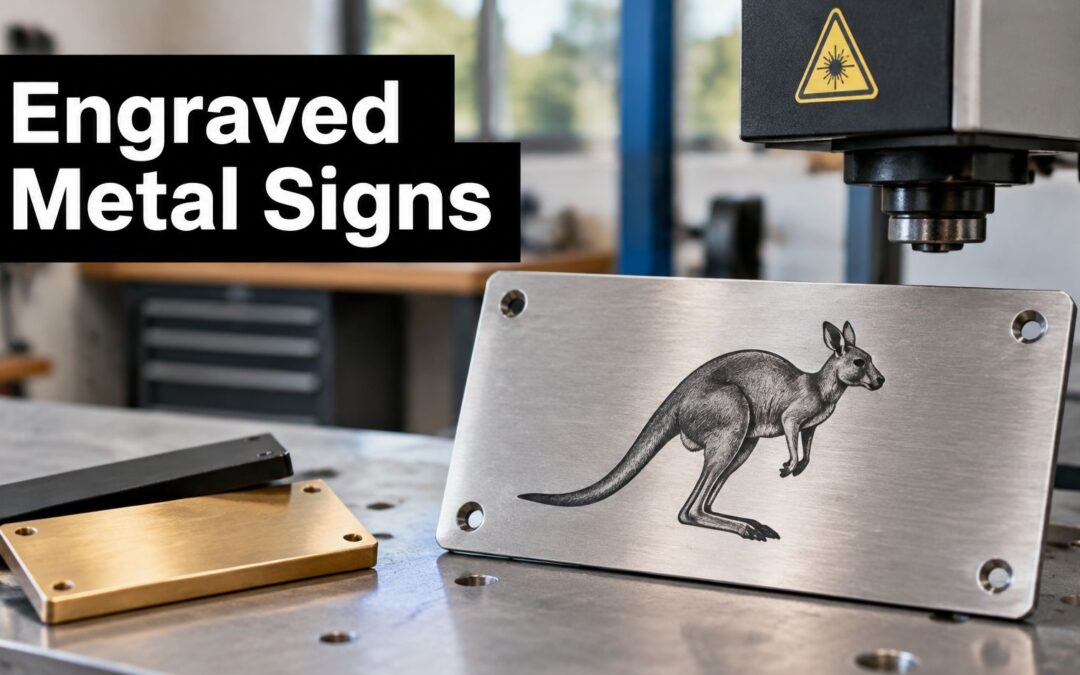
Say you're isolating a pump at 6.40 am and the switchboard legend has curled at the edges, lifted from the heat, and taken half its lettering with it. You're not short of skill. You're short of certainty, and that's the moment a cheap label stops being cheap. An engraved metal plate is meant to prevent that pause.
What an Engraved Metal Sign Actually Is
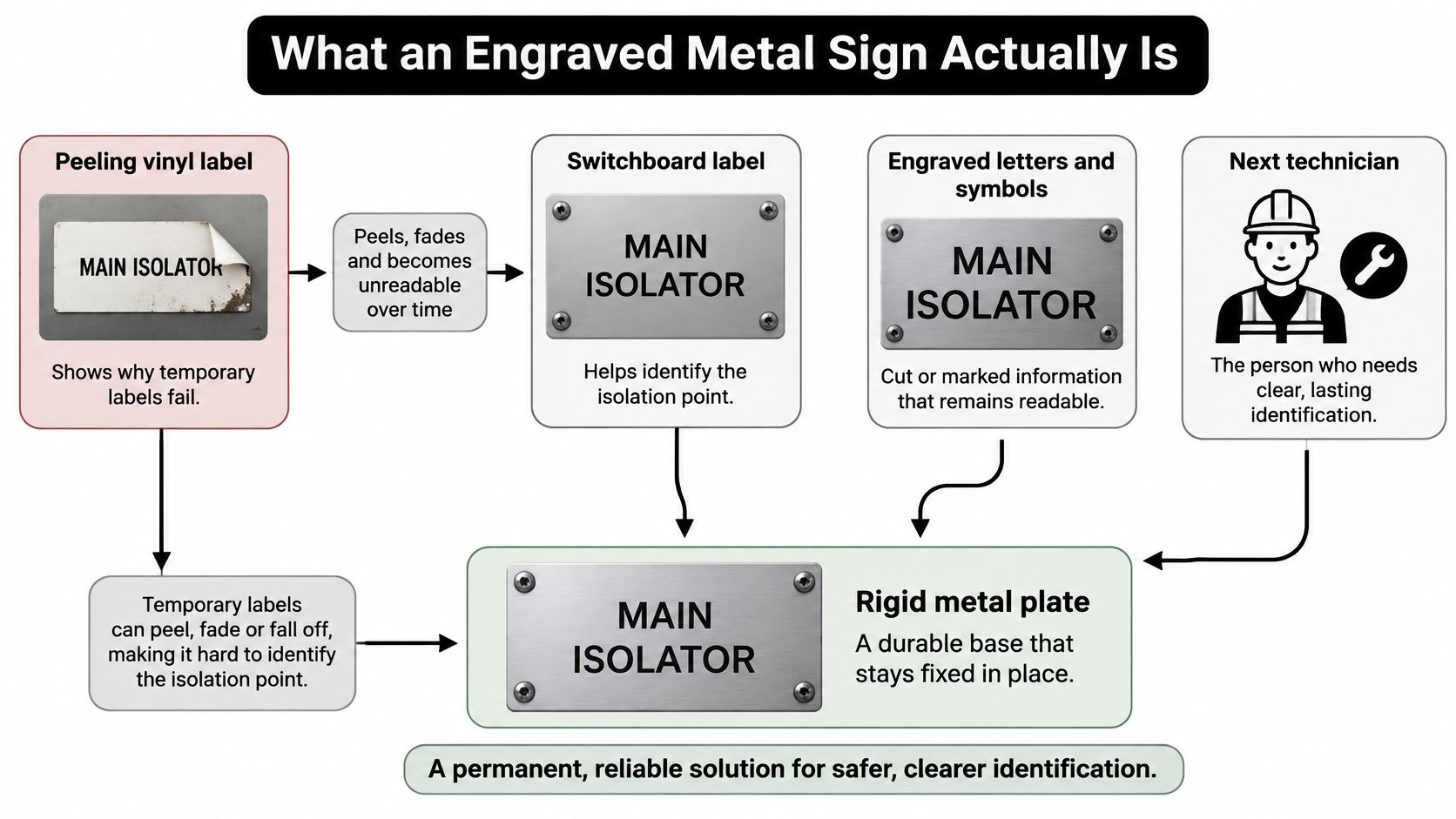
Open that switchboard door again in your mind. A vinyl label once named the isolation point. Now it's peeling, the adhesive has let go, and the next technician has to trace the circuit by hand, call the last crew, or guess. None of those options belongs in a lockout procedure.
An engraved metal sign is different in kind, not just in price. It's a rigid plate, usually aluminium, stainless steel or brass, with letters, symbols or codes cut, annealed or colour changed into the metal itself.
Printing is paint on the skin. A laser mark changes the metal, so abrasion and cleaning can't simply lift the message away.
That distinction matters after weather, gloves, solvent wipes and years of vibration. A printed film sits on top and can tear or detach. A recessed or annealed mark is part of the plate, so even when the face is scratched, the wording usually stays identifiable.
Signs That Control Risk and Plates That Name Things
Buyers in Australia order these plates for quite different jobs. The same workshop might produce a switch legend on Monday, a stainless asset plate on Tuesday, and a brass memorial plaque before the week ends.
- Safety warnings: tell people what not to touch, enter or breathe near
- Asset plates: tie a machine to its number, rating and maintenance record
- Wayfinding and room plates: guide people through a building without staff help
- Switch legends: name circuits, valves and isolation points at the point of use
- Memorial plaques: carry an inscription that's expected to outlast paint and timber
Don't blur two terms that look similar on a purchase order. A safety sign controls a risk. It warns, prohibits or directs behaviour. A nameplate identifies equipment. It may carry a serial number, a rating or a maker's name, but it doesn't by itself manage the hazard beside it.
That difference changes what you specify. The safety sign needs the right symbol, colour, wording and placement. The nameplate needs durable identity and a fixing that won't let it wander from its asset.
The First Two Questions
Before artwork, answer where the plate will live and from how far it must be read. A legend read at arm's length inside a dry electrical room is a different job from a rating plate on a washdown skid read through safety glasses in full sun.
Choose the environment first, then the metal and laser method, then check the Australian rules that apply. Finally, plan for the day the data on the plate changes, because permanence is only an advantage while the message stays true.
Metals and Laser Methods Worth Specifying
Say a site manager is replacing a control panel label. A light plate may suit a dry room, while a plate beside a washdown line faces a different job. Match the metal and marking method to the location, then consider whether the information could change before the plate wears out.
| Metal | Typical Use | Laser Approach | Environment Note | Common Finish |
|---|---|---|---|---|
| Anodised aluminium | Wayfinding, panels, light labels | Surface mark or colour change | Indoor or light outdoor use; fix securely | Silver, anodised colour, dark infill |
| Stainless steel | Asset plates, safety signs, rating plates | Engrave or anneal on a matt face | Weather, chemicals, washdown | Matt, brushed, colour changed |
| Brass | Plaques and interior nameplates | Engrave with optional infill | Sheltered; tarnishes if fully exposed | Polished, lacquered, paint filled |
| Coated metal | Switchboards and branded panels | Mark through or beside the coating | Durability depends on the coating | Coating colour plus contrast mark |
| Titanium or high alloy steel | Instruments and defence markers | Anneal or shallow mark | May suit items exposed to sterilisation, acids and cleaners | Dark anneal, no loose ink |
Aluminium for Clean Indoor Work
Anodised aluminium suits wayfinding, control panels and lighter labels where weight matters and the face is sheltered. A laser can produce a sharp surface mark or colour change. Dark lettering against a silver or coloured ground can make panel legends easy to pick out under office and factory lighting.
The plate can be screwed, riveted or bonded to a flat panel. For a forklift route, pressure-washed area or coastal gate post, specify a material and fixing suited to that exposure rather than relying on a light indoor plate.
Stainless Steel for Weather and Washdown
Stainless steel is often specified for outdoor asset plates, safety signs and rating plates. SA Water's asset labelling specification describes plates that identify assets and connect them to supporting plans used for energy isolation planning. It also calls for mechanical fixing with screws or rivets, and notes that small stainless steel tags may be engraved on both sides.
The specification recommends corrosion-resistant, preferably stainless steel, pins or screws for labels mounted externally on switchboards, control panels and other equipment. Outdoor labels are typically specified in matt stainless steel with clearly legible lettering. A matt face helps limit glare; secure fixing keeps the plate with the asset.
A plate can outlast the load, chemical or isolation point it names. If equipment changes, update the marking and its supporting records through a change-control process. A durable but outdated label can misdirect maintenance or isolation work.
Brass, Coatings and Specialty Alloys
Brass suits plaques and sheltered nameplates. It engraves crisply and takes paint infill, but can tarnish when fully exposed. Choose whether that patina is acceptable, or specify a finish and maintenance approach suited to the location.
Coated metals require attention to the layer around the mark. A laser mark through paint or powder coat may remain clear while chips, rust creep or repainting affect the surrounding surface.
Titanium and high-alloy steel are among the materials used for instruments and defence markers. Evright Industrial offers laser engraving and marking projects, can advise on materials, and uses Trotec Laser machines in production. For a closer comparison of laser marking and engraving methods, consider how the required mark and substrate affect the specification. To explore laser engraving for promotional products, see how the process can also be used beyond industrial plates.
Practical rule: Match the material and marking method to the exposure, check the contrast, then sample the mark before committing to a production run.
Finishes That Survive Weather and Cleaning
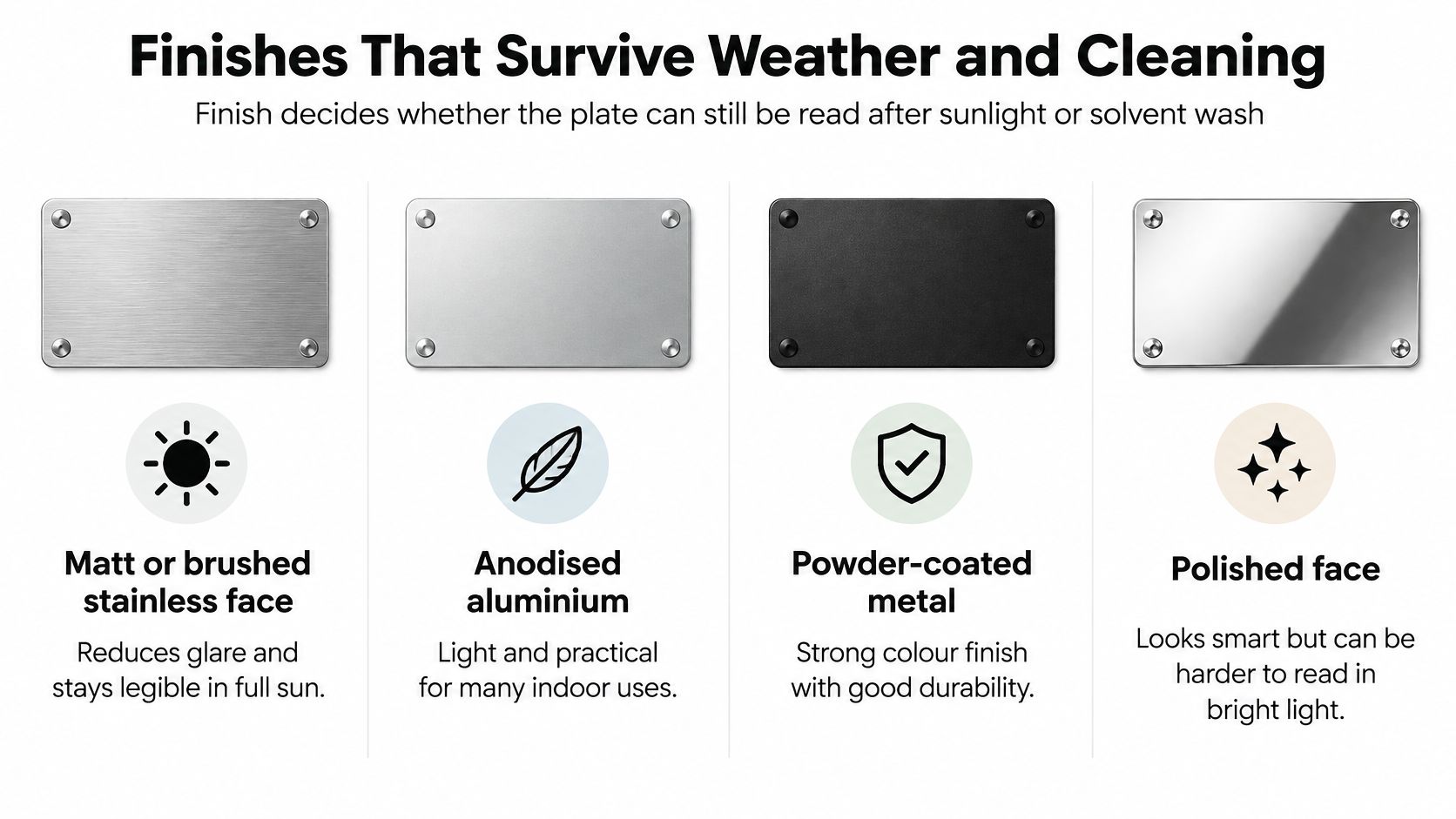
A correct plate can still fail at 7 am if the sun turns its face into a mirror. Finish decides whether a technician reads the rating in two seconds or shades it with a hand, tilts their head and still isn't sure.
Four Finishes in Plain Terms
A matt or brushed stainless face cuts glare on outdoor rating plates and switchboards. It's the workhorse where sunlight, wet concrete and floodlights compete with your lettering.
A polished brass or stainless face looks ceremonial on an interior plaque. Beside a roadway or a wet process line, that shine becomes the problem. Reflections hide lettering exactly when conditions are already poor.
Paint or enamel infill restores signal colours such as red, yellow, green and white. It works when the recess is deep and clean enough that the fill sits protected in the groove rather than proud of the face, where scrapers and pads can catch it.
A laser colour change on stainless recolours the metal without a film that can peel. We use stainless steel colour change as a longer lasting alternative to sublimation, which suits legends that must survive repeated cleaning. If you're comparing that approach with adhesive options for exposed sites, our guide to weather resistant labels helps you judge where a rigid plate earns its cost.
Think of infill as ink held in a groove. Annealing is closer to a bruise in the metal. Cleaners can attack fill at the edges. They can't wipe off a colour change that sits in the surface structure itself.
| Finish | Best Environment | Contrast | Cleaning Limit |
|---|---|---|---|
| Matt or brushed stainless | Outdoor rating plates and switchboards | Strong dark or light mark by anneal or engraving | Mild detergent, avoid pads that burnish the face |
| Polished brass or stainless | Sheltered interior plaques | High reflectance, poor glare control | Avoid abrasives, do not site near roadways |
| Paint or enamel infill | Safety signal colours, red, yellow, green, white | Strong only when recess is deep and clean | Solvents and harsh pads can lift cheap fill |
| Laser colour change on stainless | Legends that must survive repeated cleaning | Set by the anneal colour, no film | Survives routine wash, test site chemicals first |
| Lacquered brass | Sheltered brass nameplates | Keeps the brass tone | Yellows when exposed outdoors |
Edge Cases That Catch Buyers Out
- Dark on dark: a dark anneal on a dark coating may look subtle on screen and vanish on site
- Outdoor lacquer: clear coats on brass can yellow, cloud and peel in sun
- Aggressive pads: scouring can burnish a matt face back toward a mirror and reduce contrast
- Untested chemicals: a cleaner that's safe on stainless may soften infill or printed colour
Specify the finish, the contrast pair, and the cleaning chemical on the same drawing. Then approve a physical sample under natural light, not a screen proof. Hold it at the mounting height, wet it, wipe it with the site cleaner, and read it while wearing the eye protection your crew uses.
Australian Safety and Access Rules
Engraving a plate doesn't make it compliant. Metal is a substrate. Compliance comes from the whole sign system working for the person who approaches the hazard.
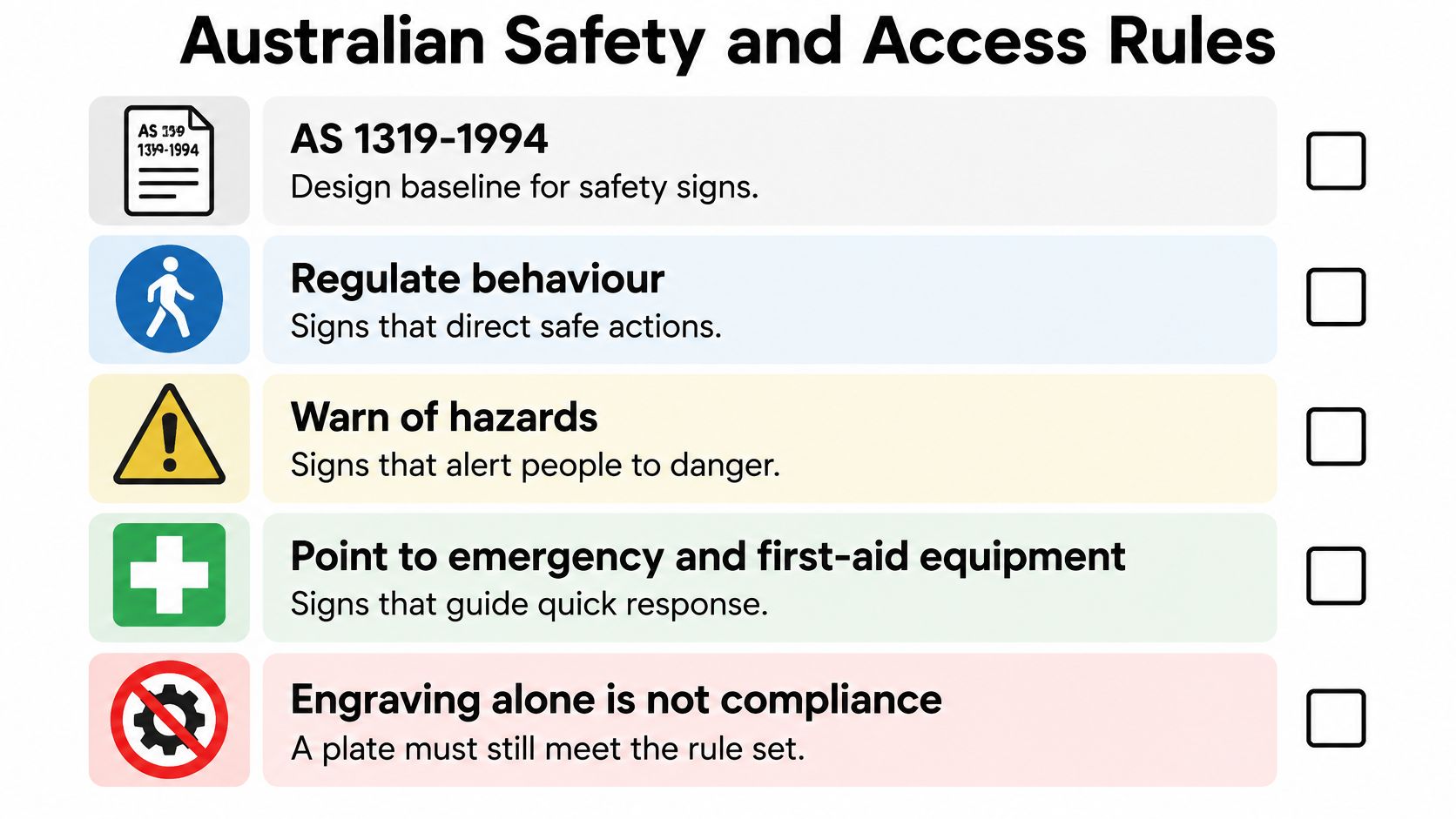
The Design Baseline
AS 1319-1994 from Standards Australia governs the design and use of signs for regulating safety behaviour, warning of hazards, and providing emergency or fire protection information. It doesn't prescribe one universal substrate or nominal sign size. Material and dimensions must suit the intended application, viewing conditions and workplace risk.
That means you size lettering and contrast for the required viewing distance rather than picking whatever plate is in stock. You also check signal colour, symbol, wording, contrast, placement, illumination and employee understanding together. A deep engraving on the wrong colour or in the wrong place is still the wrong sign.
For hazardous chemicals, the Work Health and Safety Regulations 2011 apply under Regulation 353 when a safety sign is needed to control an identified risk associated with using, handling, generating or storing hazardous chemicals. The sign must warn of the particular hazard or state relevant responsibilities, sit next to the hazard and be clearly visible to people approaching it.
The regulation distinguishes a safety sign from a placard. Don't treat the words as interchangeable on an order. One controls a risk at the hazard. The other flags larger stored quantities for emergency response.
Where traffic and work zones overlap with plant movements, a work zone signage reference can help your team align temporary traffic signs with the permanent plates on gates and compounds. For the fixed signs inside the workplace, our overview of workplace safety signage is a useful starting point before you brief artwork.
| Sign Job | Design Baseline | Size or Lettering | Placement |
|---|---|---|---|
| Hazardous chemical warning | Warn of the hazard or state the duty | Size letters to viewing distance | Next to the hazard, visible on approach |
| Outer HAZCHEM placard | Mandatory above placard quantities | 120 mm high by 600 mm wide, letters 100 mm, red on white or silver | Each entrance emergency services may use |
| Asbestos area sign | AS 1319 layout, identify the material | Weatherproof and adequately secured | Main entrances if items cannot be labelled directly |
| Confined space | AS 1319, part of access control | Warn off anyone not on the entry permit | Each relevant entry, with barriers |
| First aid | AS 1319, site wording allowed | Construct to suit the facility | Where people look for equipment |
| Accessible room or amenity plate | AS 1428.1 tactile and Braille provisions | Raised characters, Braille, contrast, symbols | Consistent accessible placement |
Walking the Table on a Real Site
The outer HAZCHEM placard is the most prescriptive row. Safe Work Australia's hazardous chemicals signs and placards guidance states that if chemicals exceed the placard threshold quantities in Schedule 11 of the model WHS Regulations, additional placards are mandatory, with outer warning placards 120 mm high by 600 mm wide, red HAZCHEM lettering on a white or silver background and letters 100 mm high at each entrance where emergency services may enter.
Asbestos signs sit at main entrances when the material itself can't be labelled. Confined space signs form part of access control at each entry, not decoration beside it. First aid signs may use site specific wording if they still meet the baseline.
Accessible room plates belong to a different regime. They need tactile characters, Braille, contrast and consistent placement, not just durable engraving.
Write five things on the order every time. Note the hazard class, viewing distance, mounting face, chemical exposure and whether the item is a sign or a placard. Those five lines prevent most expensive remakes.
Where Engraved Metal Signs Earn Their Keep
Start on a manufacturing floor where a press, a conveyor and a chemical store share one noisy aisle. The image below shows the sort of close inspection that decides whether an identity plate still earns trust.
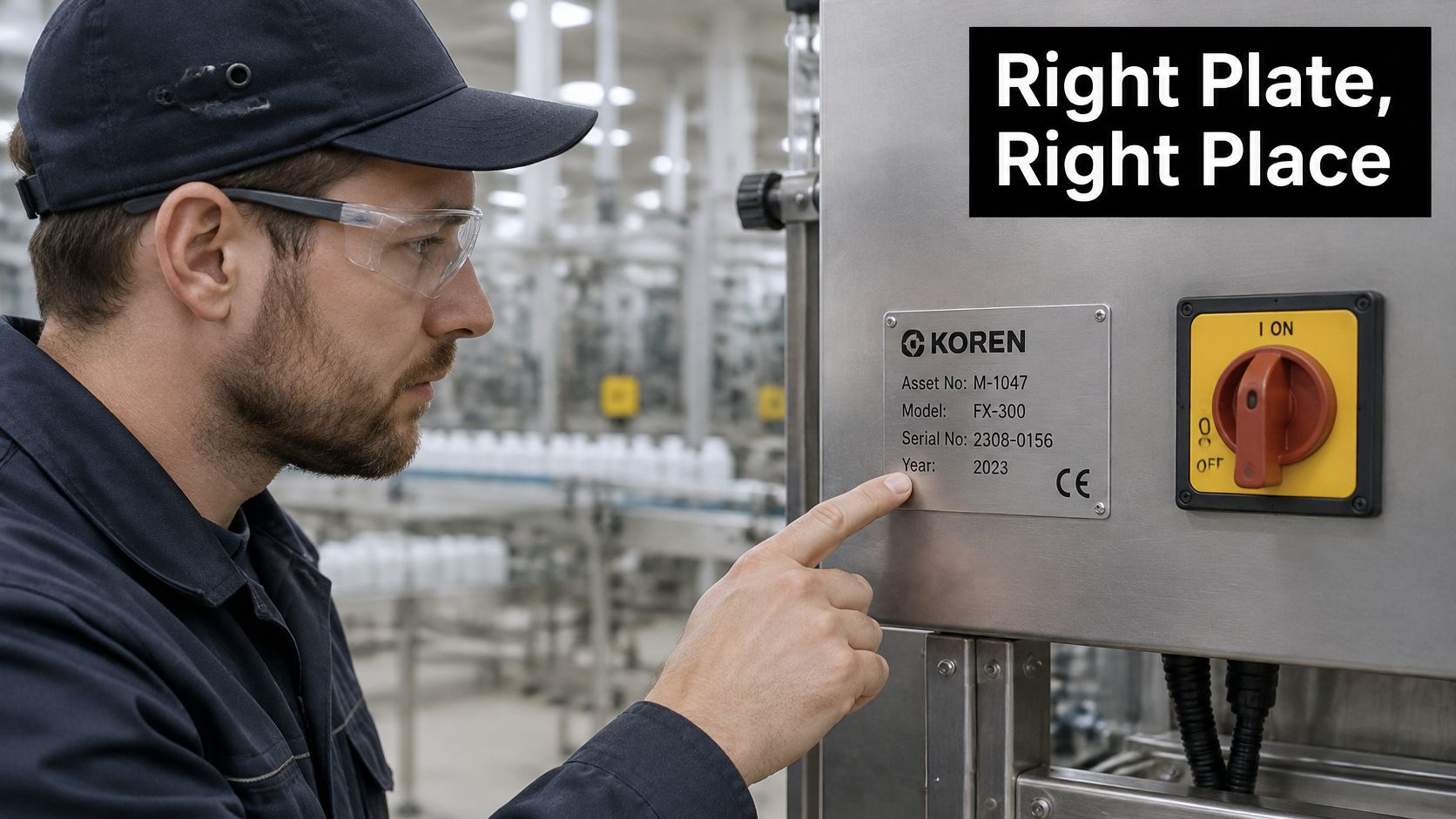
Asset plates and switch legends tie that machine to its isolation plan. A single attractive plate is often the wrong answer when one item carries several risks. Say a mobile plant unit needs hearing protection, a safe working load, an electrical hazard warning and a rollover warning. Cramming those messages together helps nobody who is standing in mud with gloves on.
Utilities and Essential Services
Utilities work outdoors, at height, in pits and beside live equipment. Matt stainless tags, including tags marked on both sides, stay readable after weather and handling. That reduces the chance that a crew opens the wrong breaker because the label detached during the last storm season.
We produce identifying markers for defence and essential services items, where the same logic applies. The mark has to remain attached to the item, not to a film that can be scraped off during transport.
Healthcare With No Room for Loose Films
Healthcare proves durability in a different way. Marks on instruments, implants and coated or titanium parts must never detach. They also have to resist acids, cleaners, bodily fluids and sterilisation.
That's why a laser anneal beats a glued label on medical items. There's no edge to lift in a steriliser and no ink layer to worry about during cleaning. Typical medical materials include stainless steel, titanium, high alloy steel and coated metals, each needing a mark setting that respects the part.
Watch a Trotec Laser mark metal in the clip below and notice the absence of a cutter throwing swarf or a label being applied afterwards.
Construction, Public Buildings and Memorials
Construction and plant yards need weatherproof hazard signs at entrances because direct labelling of every component is often impractical. Safe Work Australia's asbestos guidance requires signs and labels for asbestos containing materials including plant, equipment and components, and states that when direct labelling is not practical, warning signs must comply with AS 1319-1994 and be placed at all main entrances to affected work areas.
The same guidance says labels should clearly identify the material as containing asbestos, while signs should be weatherproof, made from lightweight material and adequately secured. A rigid engraved plate suits that job where handling, weather or repeated cleaning would destroy print.
Offices and public buildings use metal room plates and amenity signs where tactile reading and long service matter. Memorial and opening plaques are quieter work. Brass or stainless sits sheltered, with room for a longer inscription and no need to shout.
The pattern is simple. The harsher the cleaners, the weather or the consequence of a wrong identity, the stronger the case for metal over print. Before combining messages, list every message one asset needs. You may find it needs three small signs, not one crowded plate.
Design Choices That Stay Readable
Good engraving can't rescue a layout that fights the eye. Say a contractor stands three metres from a tank, rain on their glasses, looking for one line that says whether the contents are safe to drain. Your design either answers in seconds or it doesn't.
Seven Checks Before Artwork Is Approved
- Set letter height from viewing distance: a reader at three metres needs far larger characters than one at arm's length, so size from the required distance, not the offcut in the rack
- Choose a matt face in glare: sun and fluoro light wipe out polished surfaces, especially outdoors
- Use one contrast pair: light on dark or dark on light, and never rely on colour alone for a safety message
- Give a safety plate one job: don't crowd a safe working load figure with a logo, a slogan and three other warnings
- Put stable identity in metal: asset number, serial or isolation name belongs on the plate, while a QR or barcode bridges to a register that can change
- Protect the letterforms: set depth to shelter infill without turning small letters into blobs, and leave margins so screws or rivets don't punch through text
- Supply the full brief together: vector artwork, exact wording and the finish callout should arrive as one package
Notice what's missing from that list. There's no instruction to make the branding bigger. On a safety sign, the hierarchy is hazard first, action second, identity third and branding last, if it belongs there at all.
Read the proof at the real distance, then cover the logo with your thumb. If the safety message disappears, the design is serving the brand instead of the risk.
Tactile Reading Is a Specification
Accessible signs add a fingertip test to the visual one. AS 1428.1 2021 from Standards Australia is the current edition listed by Standards Australia and is referenced by the National Construction Code and the Disability (Access to Premises Buildings) Standards.
Its scope expressly covers signage, symbols indicating access for people with disabilities, and tactile ground surface indicators, and the 2021 edition specifies tactile and Braille requirements. The progression from AS 1428.1-2009, amended in 2017, to AS 1428.1 2021 shows why raised tactile characters, Braille, contrast, symbols and consistent placement are specification requirements rather than optional enhancements.
For a room plate, that means the designer, builder and engraver need the same drawing. A durable metal face helps only when the tactile characters, Braille and mounting position already meet the project documentation. Check the proof by touch as well as by eye, with the door open and closed, because placement that looks centred on paper can be awkward to reach in a corridor.
When a Permanent Plate Becomes Wrong
Permanent isn't always safer. That's the uncomfortable truth behind a lot of tidy plant rooms.
Say a lifting beam is rerated after an engineering review in year three. The stainless plate from year one still looks perfect. It also still states the old load. A new operator trusts the metal because metal feels official, and the plate has become the hazard.
Ownership Beats Good Intentions
Main Roads WA's minimum WHS control standards specifies distinct signage for mobile plant, including hearing protection, safe working load, electrical hazards, safe working distances, and seat belt or rollover warnings, with requirements linked to AS 1319. One machine can need several separate messages, each with its own update path.
Name an owner for the label register. Not a department. A person or a role with authority to order replacements, remove obsolete plates and update the record that links a QR code or serial number to current data.
Trigger a review when any of these changes occur.
- Maintenance alters the asset: a motor, valve, guard or control is replaced with a different specification
- Engineering approves a modification: load, capacity, contents, pressure or operating distance changes
- A risk assessment changes: a new chemical, process or access pattern creates a different hazard
- A regulation or standard updates: wording, symbols or placement no longer match current requirements
Remove or cover obsolete plates rather than leaving two conflicting messages on one machine. Two plates don't create choice. They create doubt at the exact moment someone needs certainty.
Use several single purpose signs when one multifunction plate would hide a hazard. It's easier to replace the load plate after a rerating than to remake a large combined panel that also carries electrical and rollover warnings.
Hybrid Plates and Honest Cleaning
Prefer a hybrid system for assets that change. The metal carries the stable identity, such as the asset name, serial and isolation point. The QR or work order system carries data that moves, such as inspection dates, current contents or the latest procedure revision.
Engrave what should not change. Link to what will.
Longevity also depends on matching cleaning to the finish. Mild detergent and a soft cloth preserve matt stainless and infill. Steel wool and strong solvents can polish the face, lift cheap fill and blur the contrast you paid for.
Inspect plates after repainting, relocation or contamination. Paint over a plate is a silent failure because the asset looks freshly maintained while its identity disappears. Check fixings at the same time. Loose rivets let a correct plate vanish into a drain, a skip or another workshop.
Write three triggers into your maintenance procedure today, covering modification, risk review and regulatory change. Add the name of the person allowed to order a replacement plate. That short paragraph turns permanence from a liability into a controlled advantage.
Order Samples Before You Lock the Run
A good brief sounds boring. That's why it works. Say you send one note that lists the environment, viewing distance, exact wording, plate size, fixing method and quantity. The workshop can quote and sample without three rounds of guessing.
What Moves Lead Time and Price
Lead time follows practical levers, not optimism.
- Material availability: stock sheet moves faster than a mill order or specialty alloy
- Size and thickness: larger plates take longer to cut, finish and handle safely
- Quantity and setups: one design repeated is faster than forty unique legends
- Holes and fixings: drilled holes, countersinking and stainless hardware add operations
- Tactile and Braille work: accessible plates need extra processes and checks
- Mark type: colour infill, second side engraving and deep recesses take longer than a straight anneal
- Approval speed: wording changes after sampling restart the clock
Price follows the same levers. There's no sensible single rate per letter. Metal grade, plate area, mark time, number of setups, second side work, paint fill, stainless fixings and freight all shape the quote.
A small replacement set can move faster than a site wide relabel. We can scale production up or down for large and small runs, which avoids splitting one asset register between workshops that use different finishes. Customer supplied parts need their own quote because handling and fixturing differ from cutting a new plate, and we will mark customer supplied items when the project manager has quoted that handling.
Sample Like a Site Manager
Before the production file is locked, compare two metals and two finishes on coupons. Read them in real light. Wipe them with the site cleaner. Scratch the edge of a sample, not the finished sign, and see whether the message survives the abuse you expect.
We offer a sampling service where customers can test different materials and marking finishes, and customers can be invited onsite to see our production facility. Production uses laser machines from Trotec Laser. Our imagery and videos show that Trotec Laser work because that's the process making the mark.
Evright Industrial is the industrial arm of evright.com. At evright.com, laser engraving works by focusing a Trotec Laser beam to recess or recolour the metal so the message becomes part of the plate, not a film that peels. You can bring us a new plate design or a supplied item, test the finish, and lock the file only when the sample reads correctly where it will live.
Start by calling, completing the contact form or dropping in to the office with the environment, viewing distance, wording and quantity in one note. That single note is the difference between a plate that looks right in an email and one that still reads clearly after years of sun, gloves and washdowns.
Bring us your environment, viewing distance, exact wording and quantity, and we will sample engraved metal signs in the metals and finishes that suit your site before locking the production run. We mark new plates and customer supplied items on Trotec Laser machines for asset labels, safety signage, switch plates, panels and plaques. Visit Evright Industrial to start with a sample you can read, wipe and test in real light.
Recent Comments