

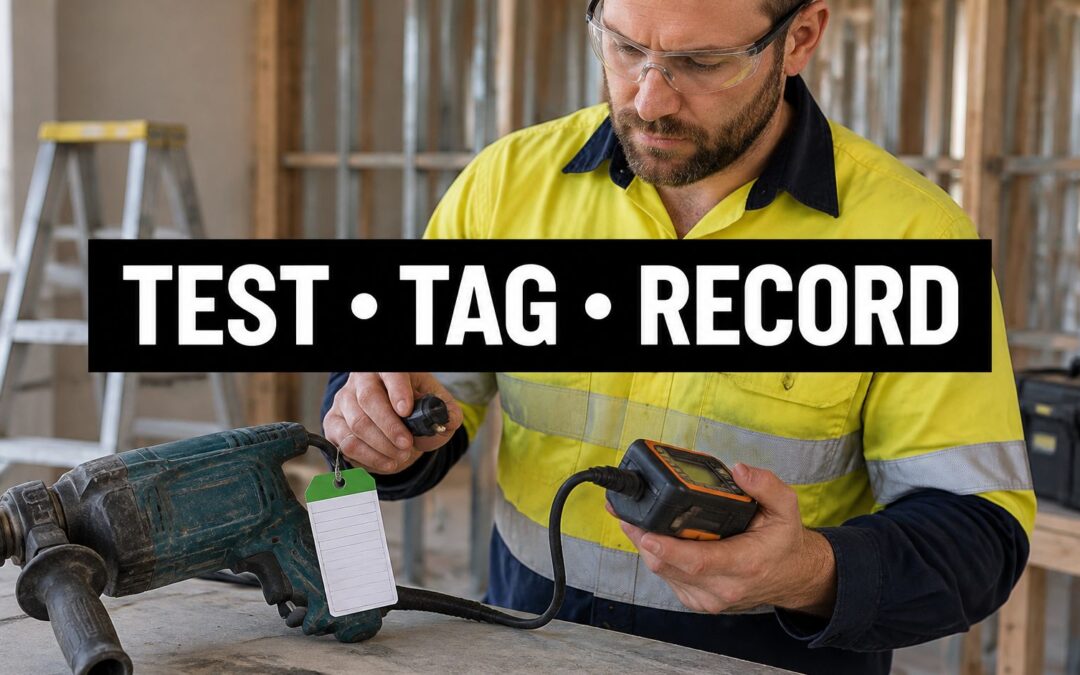
41% is the number that should change how you run a Monday toolbox talk. It's not the share of tools missing a sticker. It's the share that hadn't been properly tested by the right person at all, which means the tag on the next tool you pick up may tell you far less than you think. Electrical tagging and testing only works when the decision to test, the interval, the tester and the record all line up.
Why Tagging Still Matters on Australian Worksites
41% of flexible cords, power tools and portable outlets had not been tested and tagged by a competent person, according to SafeWork NSW's 2024 electrical safety in construction findings report. That review covered the previous decade. It also reported more than 500 major workers' compensation claims involving "contact with electricity" and 16 fatalities.
The same review found 24% of construction wiring, switchboards and transportable structures had not been inspected and tested by a licensed electrician. Read those two figures together. The failure isn't usually a missing sticker. It's an inspection done by the wrong person, or repeated too late, or not repeated after the gear moved sites.
What a supervisor actually sees
On a Monday morning you'll see leads dragged across wet concrete, a power board borrowed from another crew, and a grinder that's been in three utes since Friday. Those are the items most exposed. Cords and portable tools get flexed, crushed and abraded. Temporary wiring and transportable structures get shifted, reconnected and knocked around. Dust, moisture and heat shorten the life of insulation and strain reliefs.
A durable tag gives you a visual signal at the point of use. It doesn't replace the inspection, the electrical test or the record behind it. If you want the wider compliance picture first, our guide to electrical safety standards in Australia sets out how the standards fit together. What follows here is the working sequence. Which equipment is in scope, how often you test it, how you test it, what you record, and what you do when it fails.
Which Equipment Needs Testing at All
Sites often start from the wrong assumption: that every plug-in item needs an annual sticker. They book a contractor once a year and call it done. That isn't how the duty works.
Safe Work Australia's guidance on WHS duties for electrical safety says higher-risk workplaces must regularly inspect, test and tag socket-powered equipment, while lower-risk workplaces generally do not require routine testing. That same guidance identifies intervals such as before each hire or every three months in some circumstances. The ACT regulator limits mandatory testing and tagging to equipment used where normal operating conditions could cause damage or shorten expected life, and points to AS/NZS 3760:2022 for the technical method.
Scope it by risk, not by habit
Start with what sits in your work area, then sort it by how it is used.
- Portable tools and cords: grinders, drills, extension leads, power boards and cord sets that move daily and take knocks.
- Fixed and transportable equipment: transportable structures, construction wiring and switchboards that get relocated or reconnected.
- Portable RCDs: forgotten because they're protective devices rather than tools, but they belong in the same program.
- Hired, loaned and brought-in equipment: contractor gear and hire items arriving with someone else's tag, or no tag you can verify.
Then weigh the decision factors. Is the cord exposed to moisture, dust or heat? Does it move between jobs or stay bolted to a bench? Is there construction activity around it? Is it hired out repeatedly? How likely is cord damage in normal use?
Keep four things separate. Visual inspection is the pre-use check anyone handling the gear should do. Electrical testing is the measured check by a competent person. Tagging is the label recording the result. The documented risk-control duty is the employer's obligation sitting over all three.
More frequent tagging isn't automatically better risk control. A documented risk assessment, a competent pre-use inspection and prompt isolation of damaged gear can achieve more than one identical schedule applied to every asset.
I'd take a short, honest risk assessment per work area over a wall of identical tags. Before you lock in an interval, confirm the current state or territory rule and its review date. Several jurisdictions set requirements that differ from AS/NZS 3760, so generic national advice can mislead you if you don't check your own regulator first.
How Often Each Workplace Needs Testing
Use the table below to set a maximum interval for each work type, then shorten it where your site risk assessment, the manufacturer's instructions or your state rule demand it.
| Work type or equipment | Testing interval | Source |
|---|---|---|
| Construction and demolition, plug-connected portable equipment | Every 3 months | Queensland; risk-based default |
| Other construction equipment | Every 3 months | Queensland |
| Construction: transportable structures, fixed and transportable equipment, construction wiring | Every 6 months | Queensland; South Australia |
| Manufacturing and workshops, equipment not double insulated | Every 6 months | Queensland; South Australia |
| Manufacturing, double-insulated equipment | Every 12 months | Queensland |
| Service work, no safety switch installed | Every 12 months | Queensland |
| Office work, no safety switch installed | Every 5 years | Queensland |
| Higher-risk workplaces, general default | At least every 12 months, shorter if AS/NZS 3760, manufacturer or risk assessment requires | Risk-based default |
The two rows most sites get wrong
Construction is the first. Queensland's published testing and tagging schedule sets every 6 months for transportable structures, fixed and transportable equipment, and construction wiring, and every 3 months for other construction equipment. Crews often apply the longer cycle to everything because the site shed was tested on it. Your portable leads and tools don't get that allowance. They're the items taking the damage.
Manufacturing is the second. The same schedule sets a maximum 12-month interval for double-insulated equipment and a maximum 6-month interval for equipment that is not double insulated. South Australian guidance for factories, workshops, manufacturing, assembly, maintenance and fabrication also works to six months, with visual inspection daily or before each use. If you can't tell at a glance which of your tools are double insulated, the register needs to record it, because the whole interval turns on that distinction.
One site, two clocks
A fabrication workshop with a small install crew is the clearest case. The crew's leads, power boards and portable tools move daily, work around other trades and get run across driveways. They sit on a 3-month construction interval. The office computers and the lunchroom kettle don't move and don't get damaged. Under the Queensland schedule, office work where no safety switch is installed is listed at 5 years, and service work where no safety switch is installed is listed at 12 months.
I don't read that as inconsistency. It's the risk-based model working, and it assumes someone classified each asset instead of copying a number off a template. The general default for higher-risk workplaces is at least every 12 months, shorter where AS/NZS 3760, manufacturer instructions or a site risk assessment say so.
Treat the table as a ceiling, not a target. If cords are failing visual checks well before the due date, the interval is too long for that environment, whatever the table permits. State rules govern the final choice, so record which rule you applied to each asset class and when you last checked it.
How to Test and Tag Equipment Step by Step
Before you start, know what you're holding. Class I appliances have earthed metal enclosures and rely on the protective earth to keep exposed metal safe if internal insulation fails. Double-insulated equipment relies on two layers of insulation instead, and it has no earth connection to test. That distinction decides which tests apply, so identify the class from the rating plate before you connect anything.
The four stages below summarise the flow before the detailed sequence.
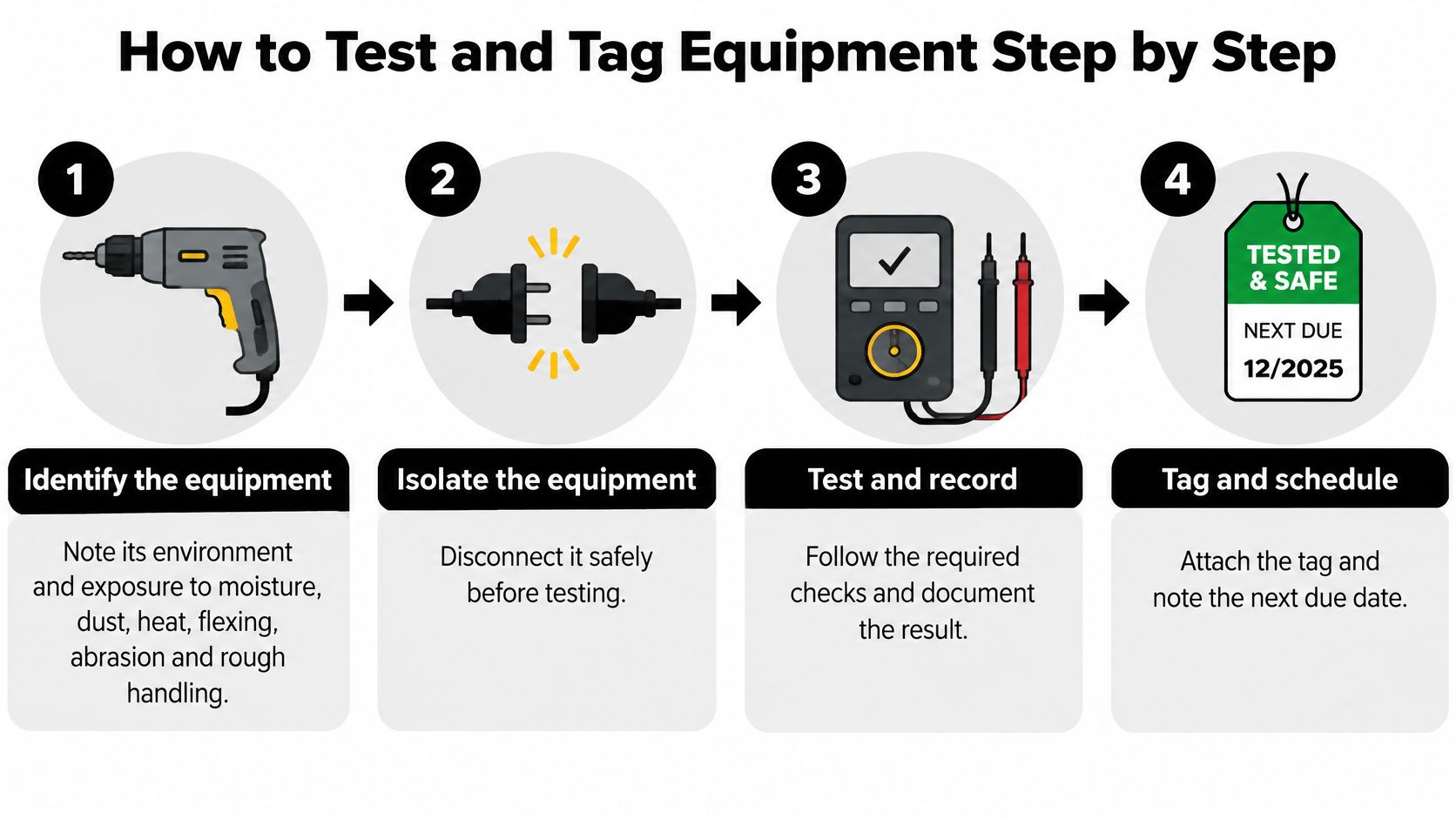
Work through the sequence aligned with AS/NZS 3760:2022 as described in WorkSafe ACT's guidance on electrical equipment, which covers visual inspection, protective-earth continuity, insulation-resistance or leakage-current testing, and polarity checks.
- Identify the equipment and its environment. Note exposure to moisture, dust, heat, flexing, abrasion and rough handling. This sets the interval and tells you where damage is most likely. The common slip is testing to a generic schedule without recording where the item works.
- Isolate it, then inspect before energising. Check the enclosure, plug, flexible cord, strain relief and accessories. Look for cuts, crushed sections, exposed conductors, bent pins and heat damage. Don't skip this because the existing tag is current. The tag records the last test, not damage since.
- Test protective-earth continuity on Class I gear. This applies to Class I appliances, power boards and cord sets. You're confirming the earth path is intact from plug to enclosure. A tool can look fine and still have a broken earth conductor inside a flexed cord.
- Test insulation resistance or leakage current. These are the two methods named in AS/NZS 3760 for checking that live parts are properly separated from accessible parts. The method you use must match the equipment and your test instrument's procedure, so follow the instrument process for that item rather than defaulting to whichever test is quicker.
- Verify polarity where it applies. Check rewireable plugs and extension sockets so active, neutral and earth land where they should. This catches the plug someone replaced in the field and wired by guesswork.
- Include portable RCDs in the same run. Test them as part of the program, not as an afterthought when someone remembers. If a portable RCD protects the lead you're testing, its own status matters just as much.
- Record the result straight away. Write down the tester, test date, outcome and next due date against the asset identifier. Batching paperwork for later is how results get attached to the wrong tool.
- Tag only compliant equipment. After a pass, attach a durable, non-reusable, non-metallic tag. If you're using colour rotation to spot due dates at a distance, check electrical tagging colours so your scheme matches what your crews expect.
- Quarantine failures. Remove failed items from service, then repair or dispose of them. Retest before any return to service, and recheck the strain relief and cord after a repair, not just the electrical readings.
This short video shows the testing workflow in practice.
Testing must be done by a licensed electrician or a person demonstrably competent under your state or territory rules. Demonstrably is the word that matters. You need evidence of competence you can show an inspector, not just a long-serving employee who's always done it.
A pass means the item met the test requirements on that day, in that condition. It says nothing about the forklift that runs over the cord tomorrow.
Building a Register That Makes a Tag Mean Something
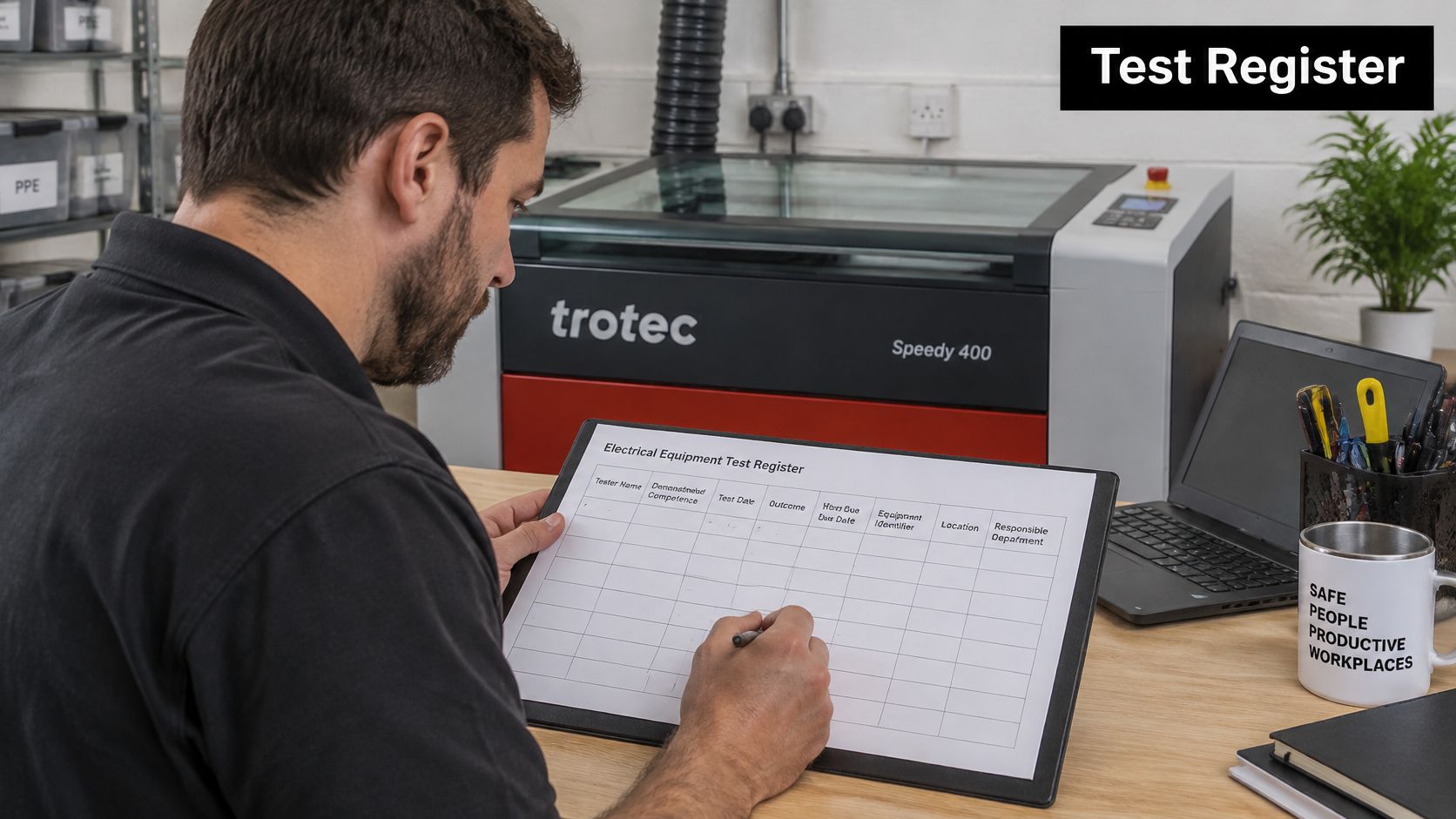
A tag without a register is a claim nobody can check. The sticker is the last link in the chain. The risk-based decision to test, the interval you set, the competence of the tester and the register behind the sticker decide whether the tag means anything. SafeWork NSW's guidance on electrical work sets the record fields: tester, test date, next due date and outcome. It also requires records to be retained until the equipment is retested, removed or disposed of. The register is what makes those fields auditable.
Fields every record needs
- Equipment identifier: A unique asset number that matches the physical label on the item.
- Tester and competence: The tester's name and how their competence is demonstrated.
- Dates and outcome: Test date, pass or fail result, and the next due date.
- Location and owner: Where the item lives and which department is responsible for it.
- History and status: Repairs, cord or plug replacements, and disposal status when it leaves service.
History and status are where registers usually fail. A tool gets a new cord, goes back into service, and the register still shows last year's pass. The tag alone cannot prove the correct asset was tested, or that a later repair did not invalidate the result. A durable identifier helps only if it survives harsh use and links to a controlled paper or digital register. Keep the distinction clear too. An electrical test tag records a test event. A broader asset label or isolation label does a different job, and muddling them confuses crews.
The photo shows register work alongside laser marking, the step that produces durable identifiers.
Three setup actions for this week
- List everything in scope. Walk each work area and record every portable and fixed item with its location, work type and how often it moves. Assign each item its interval from the table. The asset tagging template gives you a starting structure if you're building from zero.
- Confirm your testers. Check each tester is licensed or demonstrably competent under state rules, and record their names against the register. If external contractors handle bookings and after-hours callouts, Mercateer for electrical contractors keeps those calls answered while testers are on site.
- Build the register and set reminders. Load tester, test date, outcome, next due date and identifier for every item, then set a reminder ahead of each due date so nothing drifts past its interval.
For the physical identifier, Evright Industrial produces laser-engraved durable asset labels and tags on advanced laser equipment. The process etches the mark into the surface rather than printing on top of it, so the identifier stays legible in demanding conditions. Evright Industrial is the industrial division behind evright.com. You can talk through materials and marking finishes, Evright Industrial runs a sampling and testing program before full production, and if you are supplying your own items to be marked, request a quote through your project manager. Start by calling, completing the contact form, or dropping in to the office.
A tag is only as good as the record behind it.
Common Tagging Failures and How to Fix Them
Most audit findings come from a short list of repeat failures. Start with the symptoms you'll see on site.
| Symptom | Likely cause | Fix |
|---|---|---|
| Tag is current but cord is cut or crushed | Damage after the last test | Isolate, remove from service, repair and retest before retagging |
| Tag date has passed | Missed interval or gap in the register | Quarantine the item until it is retested |
| Tag shows no tester or next due date | Incomplete tagging | Retest and retag with full details |
| Plug replaced or enclosure opened | Previous result no longer valid | Retest after every repair |
| Failed item still in use | No isolation step | Tag out, quarantine, then repair or dispose |
| Contractor tools on site without a record | No sign-in check | Test before first use or refuse entry |
Behind those symptoms sit four pitfalls that cause the most trouble. Testing by an unqualified person invalidates the whole exercise, however neat the tag looks. An out-of-date due date means the item is effectively untested. A tag missing the next-test date or tester identity can't be audited. And untested equipment left available for use is the failure that turns paperwork problems into injuries.
The power board that passed on Monday
Say a power board passes its test on Monday and gets a fresh tag. On Wednesday a forklift runs over its cord. Nobody reports it because the board still works. On Friday it's still in use, tag current, cord crushed, insulation compromised inside a sheath that looks mostly intact.
The fix isn't complicated, but it has to happen in order. Whoever spots the damage isolates the board and tags it out, so it can't be grabbed by the next crew. It goes to quarantine, not back on the shelf. Then someone competent decides whether it's a repair or a disposal. A cord crushed along its length, where you can't be confident about internal conductor damage, should be treated as a failed item, not a cosmetic visual defect. If it's repaired, it gets retested and re-recorded before it returns, and the register shows the repair. If it's disposed of, the register closes the record so the asset number doesn't linger as a phantom pass.
A start-of-shift checklist
- Scan the work area: Look for expired tags and obvious cord or plug damage before work starts.
- Check quarantine: Confirm failed and tagged-out items are still isolated, not back in circulation.
- Verify new arrivals: Make sure hired, loaned and contractor gear has a record before first use.
- Flag due dates: Pull anything due this week into the testing run now, not on the due date itself.
Run that for two minutes each shift and you'll catch most failures while they're still cheap to fix.
If your register is solid but your asset labels keep peeling, fading or tearing off in the workshop, we can fix that side of the chain with laser-engraved tags and labels produced on Trotec Laser equipment for electrical, manufacturing, construction and essential services work. Tell us what you're marking and where it works, and we'll advise on materials and sampling before production. Start your project today at Evright Industrial.
Recent Comments