


Australian WHS authorities issued 43,025 notices in 2015–16, according to Safe Work Australia's comparative performance monitoring report. That puts a safety compliance audit in its proper context: it's a way to identify deficiencies, require corrective action and prove that someone has addressed the risk, not just complete an internal checklist.
The practical test is straightforward. Can a worker identify the correct asset, understand its hazard and use the control under actual operating conditions? A tidy register won't answer that. Your audit needs to connect the document, the physical control and the worker's understanding, then preserve enough evidence for someone else to check the conclusion.
Audit Evidence Checklist by Control Area
Use this table to assemble the evidence before anyone walks the site.
Audit evidence and field tests by control area
| Control area | Evidence to collect | Field test | Standard or interval |
|---|---|---|---|
| Plant and machinery | Manufacturer manual, maintenance log, last inspection date | Compare last inspection date with the manual interval | Manufacturer recommendation, then competent person, then annual fallback |
| Asset and isolation labels | Asset register with label IDs and dated photos | Walk the site and confirm each label is visible and legible | Every critical asset and isolation point in scope |
| Safety signage | Sign schedule and placement map | Check placement, legibility and condition after cleaning | Replace any sign that is faded or obscured |
| Training | Training records and worker sign-off sheets | Ask a worker to explain a control in their own words | Recorded for each worker and role |
| Health monitoring | Confidential monitoring reports linked to each worker | Confirm authorised staff can retrieve records | Statutory retention period, detailed below |
| Permits and maintenance | Sampled permits and service records | Match sampled permits to work actually performed | Sample across each audit period |
| Corrective actions | Action log with owners and due dates | Verify closure on site, not just in the log | Closed and verified, with repeat findings tracked |
Start with the plant inspection hierarchy
Under the model WHS Regulations, plant maintenance, inspection and testing follow manufacturer recommendations where available, then competent-person recommendations where manufacturer guidance is absent; where neither inspection route is reasonably practicable, inspection must occur annually. Confirm the legislation applying to your jurisdiction before adopting that hierarchy as your legal criterion.
Don't treat the fallback as permission to disregard a shorter manufacturer interval. Pull the relevant manual revision, identify the equipment model and compare the actual inspection date with the prescribed interval. A populated register can still contain overdue equipment or the wrong maintenance schedule.
Make the file request usable
For labels and signage, request photographs that show context as well as close-up detail. A readable label photographed on a bench doesn't establish that workers can see it after installation.
For training and permits, select records yourself rather than accepting only the site manager's preferred examples. Include changed roles, unusual maintenance work and activities performed outside normal production.
Use the table as the document request list for each site, sent out a week before the walk-through. Specify file names, responsible contacts and access arrangements, especially for confidential records. That preparation leaves field time for testing controls rather than searching shared drives.
How to Run the Audit and Avoid Common Failures
A useful audit follows a risk-based evidence cycle. Safe Work Australia's assurance and verification review supports systematic evidence collection and evaluation, including observations, interviews, measurements and operational records, rather than completed checklists alone.
Use the process below to keep fieldwork connected to decisions.
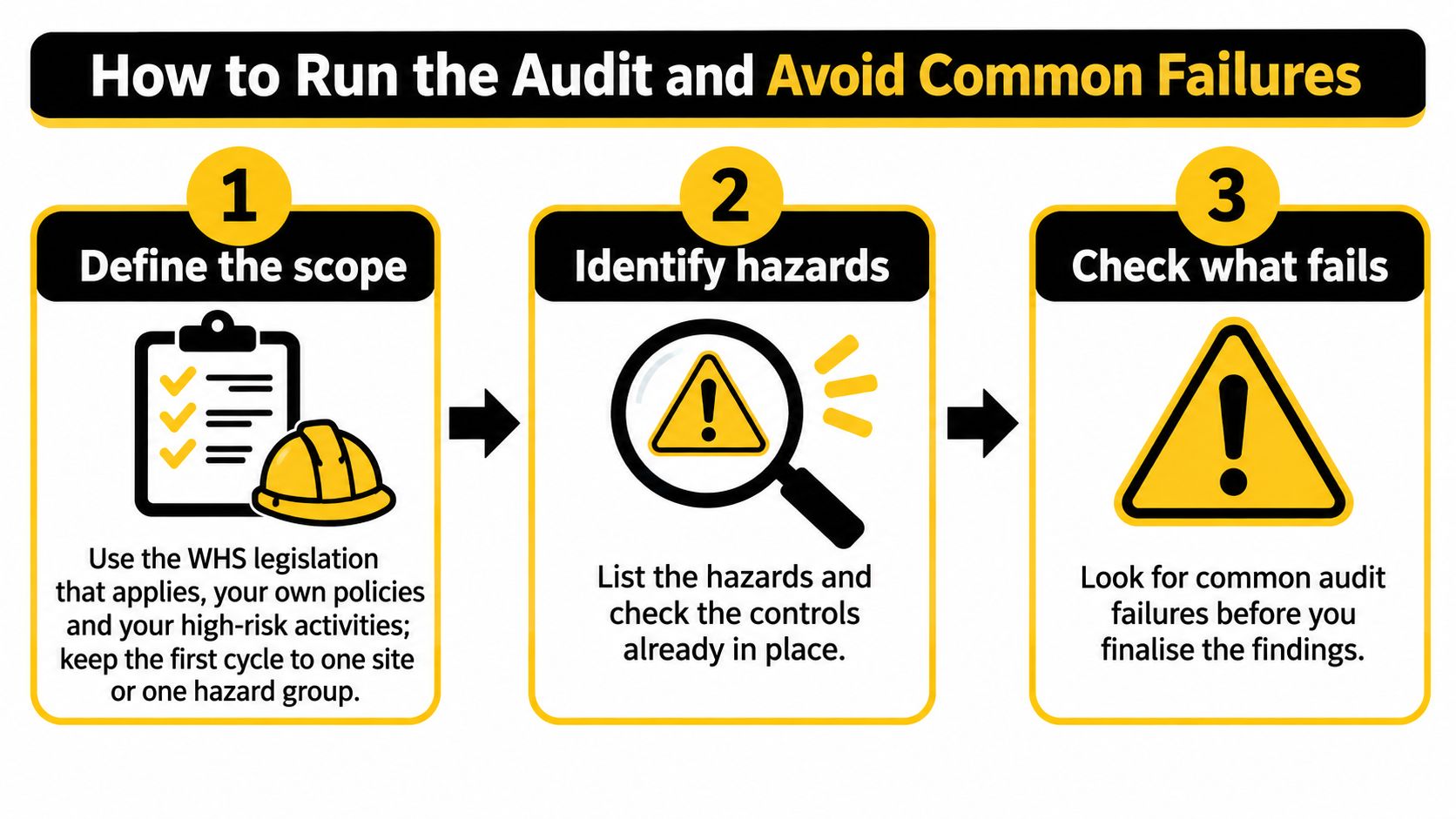
Run the evidence cycle
Define the scope. Identify applicable WHS legislation, organisational policies and high-risk activities. Keep an initial cycle manageable by choosing a site or hazard group, but state exclusions so nobody mistakes a limited review for whole-business assurance.
Identify hazards and controls. Start with the risk register and recent incident reports. Ask operational staff what has changed, including equipment, contractors, cleaning products and work schedules.
Test existence and effectiveness. Combine worker interviews, direct observations, sampled permits, maintenance records and photographs. The common slip is auditing from the register without walking the site. A checklist tick records an answer, not necessarily evidence.
Determine residual risk. Explain each rating in a sentence describing the potential consequence, exposure and control weakness. Avoid unexplained colour codes that leave action owners guessing.
Assign corrective actions. Name an accountable owner and agree a due date with that person. Specify the required outcome, including interim protection where permanent work cannot happen immediately.
Verify closure. Revisit the affected work area and test the changed control before closing the finding. The common slip is accepting a purchase order or completion email as proof that the risk has been addressed.
Use a defined set of safety compliance standards to organise criteria, but record the actual requirement against each finding. Broad references to compliance aren't precise enough for corrective work.
Recognise weak audit patterns
Common audit symptoms, causes and fixes
| Symptom | Likely cause | Fix |
|---|---|---|
| Every item ticked, no photos on file | Desk-based audit only | Sample physical controls and photograph each one |
| Zero findings in every cycle | Sample too narrow or workers not speaking up | Widen the sample and interview workers away from supervisors |
| Very few complaints | Under-reporting or low trust | Compare with near-miss, consultation and complaint-time records |
| Actions closed but recurring | Closure checked on paper only | Verify closure on site and track repeat findings |
| Labels illegible after months | Wrong material or finish for the environment | Run a sample test on materials and finishes before rollout |
Zero findings deserve scrutiny, not automatic congratulations. Widen the sample and give workers a private opportunity to describe workarounds. Don't assume an absence of findings proves the sample was representative.
Low complaint counts need context. Compare complaints with near-miss reports, consultation minutes, staffing pressures and resolution times. Protect confidentiality, and don't convert silence into a favourable culture score.
Recurring findings need a different closure test. Check whether someone corrected the underlying cause or merely removed the visible symptom. A replacement sign won't solve repeated obstruction by stored pallets.
Early label deterioration needs material testing. Repeating the same specification reproduces the defect. Test the proposed substrate, finish and attachment method against the actual exposure before rollout.
Finish with a scope statement, evidence index, findings and closure proof. Keep unresolved actions visible rather than disguising them as recommendations.
Testing Physical Controls Where Workers Actually Use Them
A technically complete audit can still fail in the field if workers can't find the right isolation point, chemical store, vehicle route or emergency asset under pressure. Safe Work Australia's national WHS data portal records 222 work-related traumatic fatalities in 2025, with vehicle incidents accounting for 41% of deaths. Interfaces like that need observation during live traffic, because the traffic plan on file rarely matches what happens at shift change.
Isolation points carry the same risk. The register may list them correctly while a worker under time pressure still can't locate the right one.

Walk the loading dock when it's busy
Say a loading-dock route sign looks clear in the placement-map photograph. At shift change, a pallet stack hides its lower half, and arriving drivers can't see the instruction before reaching the crossing.
The sign exists. The control doesn't work as intended.
Walk the approach during the busiest operating period, from the driver's and pedestrian's actual viewpoints, using safe observation positions. Record the obstruction and the operating conditions. Moving the sign may help, but changing the storage boundary is often the more reliable correction. One busy-period observation is worth more than three quiet-shift photographs, because this kind of failure only appears under load.
A workplace safety signage review should cover the whole route rather than isolated signs. Check that directions stay consistent at junctions and that temporary work hasn't changed the safe path.
Test identification without creating exposure
Link every sampled critical asset or hazard control to a unique identifier. Take a context photograph and a detail photograph, then check visibility after normal cleaning, chemical exposure or weathering. Never improvise destructive exposure tests on an installed safety-critical label.
Ask a supervisor to have a team member point to the nearest relevant isolation point and explain what it controls. This check covers identification and understanding only; operating electrical equipment and verifying isolation stay with a competent person.
Record:
- Item and location. Asset ID, control function and exact position.
- Condition. Legibility, contrast, attachment and obstruction.
- Inspection details. Inspector, date and operating conditions.
- Response. Defect notification, interim protection and replacement completion.
For laser-marked labels, request the producer's durability test results and compare the test conditions with the site's cleaning regime and chemical exposure. I treat a durability report covering milder conditions than the site sees as an open finding until the producer shows evidence for the actual exposure. Laser marking alone isn't evidence that a substrate and finish suit a particular chemical.
Field rule: Identification supports a control. It doesn't replace guarding, separation, isolation or competent work.
Every field walk should answer three questions: Can workers find it? Can they interpret it correctly? Will it remain usable in this environment?
Scoring Findings and Measuring Audit Performance
An 83% average safety-inspection conformance figure can conceal materially different problems; Safe Work Australia's measurement guidance illustrates that figure alongside 95% of planned inspections completed on schedule and a 13% inspection non-conformance rate. Treat them as example benchmarks, not universal acceptance thresholds.
Example audit performance benchmarks
| Indicator | Example benchmark | What it tells you |
|---|---|---|
| Planned inspections completed on schedule | 95% | Whether the audit program runs as planned |
| Inspection non-conformance rate | 13% | How often checks find gaps in controls |
| Average safety-inspection conformance | 83% | A combined trend figure across cycles |
| Corrective actions overdue | Track against agreed due dates | Whether actions are being owned and closed on time |
| Repeat findings | Track each cycle | Whether closed actions actually fixed the problem |
Read the indicators together
If scheduled inspections slip, check whether the problem is access, auditor availability or an unrealistic program. Repeatedly carrying missed inspections forward makes the schedule look active without improving coverage.
If non-conformances rise, examine the sample before declaring deterioration. Auditors may have inspected a neglected work area or run a tougher field test on the same control. A falling rate can mean the same thing in reverse: a narrower sample rather than better controls.
Weight severity by what fails in the field. A documented procedure workers cannot follow at the machine deserves a higher rating than an untidy register. A combined conformance score still helps summarise trends, but don't average away a serious defect: an accessible crushing point stays unacceptable even when every housekeeping check around it passes.
Build an action-focused dashboard
Track these measures each cycle:
- Coverage. Audits completed against plan and the percentage addressing regulatory requirements.
- Compliance. Average legal-compliance score, with the scoring method recorded.
- Findings. Number and severity of non-conformances.
- Delivery. Overdue corrective actions and time to verified closure.
- Effectiveness. Repeat findings after previous closure.
Verified closure means someone re-checked the control where it sits, not that a ticket changed status. Keep sample definitions consistent, and use caution when comparing jurisdictional frequency rates, particularly where samples are small. Trends within a site carry more weight when exposure, scope and assessment methods stay comparable.
Use your safety non-compliance register to separate immediate risk-control work from longer-term system improvements. Both need owners, but they shouldn't compete on an undifferentiated task list.
Prioritise recurring high-consequence findings in machinery, crushing and powered mobile plant areas rather than chasing an attractive overall pass rate. A strong quarterly figure means little if the same guarding gap keeps reappearing under a new finding number.
Building a Report and Records File That Holds Up
Write the report so a worker can understand the required correction and a reviewer can trace the conclusion without you present. Start with the scope statement, including the site, activities, criteria and exclusions. Follow with the method and sample, making clear what you inspected and what you didn't.
Next, provide an evidence index that points to photographs, interview records, permits and technical documents. Give each finding an identifier, severity rating, evidence reference, owner and due date. Finish with closure requirements and recommendations for the next cycle.
Make findings reproducible
A weak finding says that equipment identification needs improvement. A defensible finding identifies the asset, describes the unreadable information, records the location and conditions, and states the criterion that wasn't met.
Keep facts separate from inference. If a worker couldn't identify a disconnect, record the question and response without turning that observation into an unsupported conclusion about the entire workforce.
For electronically approved actions and reports, PDFWix's guidance on audit trails for signed documents is useful when deciding what approval history to preserve. Keep the signed version, the approval trail and the supporting evidence together. A signature confirms approval; it doesn't establish that a field correction works.
Test retrieval and confidentiality
Under the WHS Regulations' health-monitoring provisions, relevant reports must be kept as confidential records identified with the worker for at least 30 years after the record is made. Confirm the applicable jurisdictional provisions and any additional requirements for the exposure involved.
Don't attach confidential medical reports to the general audit pack. Record that an authorised reviewer checked the necessary evidence, and maintain restricted access to the underlying records.
Say monitoring reports were stored on a system retired five years earlier. The business has a migration-completion email, but nobody can retrieve a worker's report. That file fails the practical retrieval test, regardless of whether monitoring originally occurred.
Test the archive through the authorised custodian. Confirm that worker identification, access controls, readable formats and migration arrangements will support retention, rather than relying on a folder labelled archive.
Check the release package
Before the report leaves the auditor's desk, confirm:
- Traceability. Every finding points to identifiable evidence.
- Accountability. Each action has an owner, due date and acceptance criterion.
- Closure integrity. Closed findings include verification proof.
- Record protection. Confidential material is restricted and retrievable.
A report is only as strong as the evidence index behind it.
Audit Frequency and Regulator Record Requests
Compliance audits test legal obligations. Verification audits test whether work practices follow the organisation's WHS management system. Define which question you're answering before choosing the sample, because a procedure can be followed consistently and still fail to address an applicable legal requirement.
Both need systematic evidence. Avoid scheduling a document review under one label and assuming it establishes field performance under the other.
Use an annual review without assuming a universal rule
Queensland's prescribed electricity entities must undertake a performance audit every year, according to WorkSafe Queensland's safety-management-system audit guidance. That obligation is specific to those entities, not a blanket annual-audit rule for every Australian workplace.
The model nevertheless provides useful review questions for other sites:
- Implementation. Is the safety management system being used?
- Legal alignment. Does the documentation address applicable obligations?
- Performance. Are objectives and performance criteria being achieved and maintained?
- Internal assurance. Is the internal audit process effective?
- Change control. Have required modification-compliance audits been completed?
Set your broader program around risk, applicable duties and operational change. An annual review doesn't justify postponing an audit after a significant process change or serious control failure.
Distinguish entry powers from routine requests
A WHS entry permit holder isn't the same as a regulator inspector. Under the Work Health and Safety Act's relevant record-inspection provisions, an entitled permit holder may inspect or copy relevant employee records and other directly relevant documents not held by the business operator, with notice generally given during usual working hours at least 24 hours and no more than 14 days before entry.
That notice must comply with the regulations. Don't apply this window to every inspector visit, statutory demand or document request, because different powers and procedures may apply.
Records discipline: Confirm the requester's authority, the relevant power and the scope of documents before arranging access.
Keep the evidence index current, identify the document custodian and confirm which records are directly relevant before entry. Prepare controlled access and obtain appropriate legal advice where the authority or scope is unclear.
Pick Your First Audit Scope This Month
Choose the highest-consequence area you can inspect properly this month. Machinery isolation or powered mobile plant is a better starting point than an easy office checklist if those hazards dominate your operation.
Define the work boundary clearly: the production line, loading area or equipment group, the activities included and the workers involved. Pull the relevant evidence list and send the request a week before the walk-through, then use the final preparation days to chase missing documents and confirm which controls you will test on the floor.
Book a field walk that includes a shift change. That gives you an opportunity to examine handover, temporary storage, traffic movement and access under conditions that a quiet walk-through may miss. I would rather run a short audit on one busy line than a long one on a tidy, empty site, because the first produces findings you can act on.
Use a written scope to keep the inspection focused.

Turn identification defects into a replacement plan
If the audit finds unreadable or incorrectly placed identification, don't order a site-wide replacement from photographs alone. Confirm the wording, mounting position, material, finish and exposure conditions first. A label that looks fine on a spec sheet can wash off under the site's cleaning chemicals or fade where it sits in direct sun.
At Evright Industrial, we produce asset labels and safety signage for industrial sites. We carry out a full sampling and testing program before full production of customer-supplied items, allowing materials and marking finishes to be assessed before committing to a whole-site relabelling project.
For the production review, compare a photo of the finished identifier with the physical sample in your hand. Appearance on screen won't establish cleaning resistance or installed readability, so test the sample against the same wipe-down routine and viewing distance it faces on site.
Approve the sample before the batch
Send artwork and sample materials through evright.com for a quote, review a test run, then approve production once the specification is settled. We offer a sampling service for testing different materials and marking finishes, and customers can be invited onsite to see the production facility.
Keep the approved sample specification with the audit action. Give the replacement work an owner, record the installation check and write the first audit's closure dates into the calendar before leaving the site.
Evright Industrial offers asset labels, safety signage and sampling to help you address identification defects found during a safety compliance audit. Visit Evright Industrial to discuss your artwork, materials and site conditions, and arrange a sample before approving the production run.
Recent Comments