
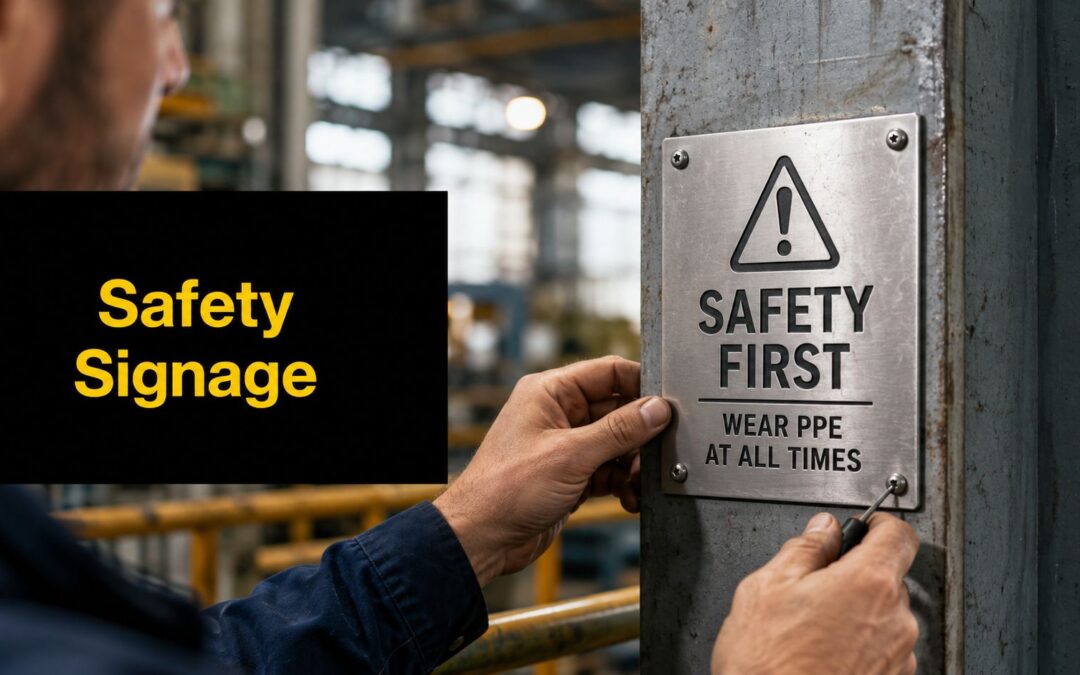
A maintenance worker crosses a concrete pad towards a chemical store just after sunrise. The prohibition sign is faded, the lower legend on the hazchem panel has worn back to bare aluminium, and a roller-door track partly hides the fire-equipment pictogram. The original specification may have been correct. The remaining sign still has to communicate clearly at the point of use.
That is the practical test for safety signage Australia. The regulatory framework sets the requirements, while the substrate, engraving method, viewing distance, fixing system and installation position determine how well a sign performs. Australia's workplace safety-signage system is anchored by AS 1319-1994, reconfirmed in 2018. Harmonised model WHS laws began operating in the Commonwealth, ACT, NSW, NT and Queensland on 1 January 2012. The Safe Work Australia's model WHS history records that broader regulatory context.
The WHS Act 2011 duty to maintain safe systems of work gives these requirements practical weight. A compliant sign that fades, becomes obstructed or sits outside the normal approach path no longer supports the control it identifies. Printed signage may suit a short-term indoor application, but exposed or frequently handled locations often call for a more durable substrate and permanently engraved detail.
The following guidance connects the standard with production decisions for factories, plant rooms, utility assets, healthcare facilities and outdoor infrastructure sites. It focuses on choosing materials, sizing for actual viewing distances, placing signs at hazards and specifying engraved signs from brief to delivery.
Walking Onto an Australian Worksite

A worker approaching a chemical store should read the entrance before crossing into the risk area. In this case, the prohibition sign carries the correct basic message, but ultraviolet exposure has bleached the red circle until its visual authority is weakened. The hazchem panel remains fixed to the wall, yet its missing lower legend removes information that may be needed during an emergency. A fire pictogram is present, although the roller-door track blocks part of it from the normal approach path.
These defects change signage from an active control into background decoration. A worker heading towards a plant room, loading area or confined-space entry needs to recognise the instruction before reaching the hazard. They should not need to stand directly in front of the sign, infer missing wording or search behind stored materials.
The legal framework must reach the point of use
AS 1319 sets out the design and use of signs that regulate safety-related behaviour, warn about hazards and provide emergency information, including fire-protection information. Its history includes AS 1319-1972, revisions in 1979, 1983 and 1994, and reconfirmation of the 1994 edition in 2018. The Standards Australia product record identifies the edition that remains central to Australian occupational safety-signage practice.
Safe Work Australia's model WHS materials connect signage with the hazard being controlled, rather than treating it as a generic wall graphic. For hazardous chemicals, signs may need to control an identified risk, identify the specific hazard or state responsibilities. They also need to remain beside the hazard and clearly visible to approaching workers. The model WHS Regulations help frame the choice between a general warning and a specific entrance placard.
Production decisions determine whether that framework works in practice. Material, engraving method, viewing distance, fixing system and placement all affect whether the message remains readable in sunlight, contamination and regular handling.
Practical rule: If a worker can't see, understand and act on the sign from the normal approach, the sign has failed its operational purpose, regardless of how accurately it was designed.
How AS 1319 Organises Safety Signage

AS 1319 gives a worksite a visual grammar. Colour and shape carry the first message, often before a worker can read the wording. The pictogram then provides a fast visual cue, while the word message reinforces the instruction and removes ambiguity.
A practical way to read the system is to move through the categories in the order a person may encounter them.
Start with the behaviour being controlled
Prohibition signs use a red circle with a diagonal bar. “No smoking” is a familiar example. The format tells people that an action isn't permitted, which makes it suitable for ignition sources, restricted activities and access controls.
Mandatory signs use a solid blue circle. “Eye protection must be worn” tells the worker what action is required before proceeding. The sign doesn't describe the hazard alone. It establishes the protective behaviour.
Danger signs identify a serious hazard that can threaten life. They need to be reserved for that level of risk, rather than used as a stronger-looking version of an ordinary warning. A flammable-liquid hazard at a chemical store may need a danger treatment where the risk assessment supports it.
Warning signs use a yellow triangle with a black border. Forklift traffic, moving equipment and other hazards that require caution commonly sit in this category. The yellow field attracts attention while the triangle distinguishes a warning from a required action.
Finish with response and emergency information
Emergency information signs use a green rectangle with a white pictogram and text. Emergency exits, first-aid locations and safe-condition information rely on this visual family. Fire-control signs use a red rectangle with a white pictogram, directing people to extinguishers, hose reels or other fire equipment.
The standard framework also includes conditional or category B signs and first-aid signs. In workplace use, the broader system includes danger, prohibition, mandatory, warning, emergency or safe-condition, fire, and Hazchem or dangerous-goods signage. Hazchem signs also connect with the ADG Code rather than AS 1319 alone, as outlined in this Australian safety-sign category guide.
SafeWork SA's workplace safety-sign guidance maps the visual system in practical terms, including red prohibition symbols, yellow warning triangles, blue mandatory signs, green emergency signs and red-and-white hazardous-chemical diamonds. For a broader visual reference to visible hazard signs, Storage & Removal Boxes Ltd provides examples of warning formats that can help teams compare messages during a site review.
Sizing Signs for Real Viewing Distances
A sign's size starts with the distance from which a worker must recognise it, not with the size of the available aluminium sheet. Australian guidance aligned to AS 1319 uses 15 mm of pictogram height per metre of viewing distance, 5 mm of uppercase text per metre, and 4 mm of lowercase text per metre. The Australian Safety Signs information guide also states that these dimensions should increase by 50% where lighting is poor or the sign isn't in direct line of sight.
The calculation is straightforward. Measure the longest distance from which the sign needs to communicate, apply the pictogram and text ratios separately, then add space for the border, signal word and supporting legend. A sign can have a large overall panel with lettering that is still too small, so panel dimensions, pictogram dimensions and letter height are separate specifications.
A working sizing table
The table below applies the stated ratios to typical viewing distances. The adjusted figures show the 50% uplift for poor lighting or an obstructed line of sight.
| Viewing distance (m) | Standard sign size (mm) | Letter height (mm) | Adjusted size, poor lighting (mm) | Adjusted letter height, poor lighting (mm) |
|---|---|---|---|---|
| 1 | 150 | 5 | 225 | 7.5 |
| 2 | 300 | 10 | 450 | 15 |
| 3 | 450 | 15 | 675 | 22.5 |
| 4 | 600 | 20 | 900 | 30 |
| 5 | 750 | 25 | 1,125 | 37.5 |
These are working calculations based on the guidance ratios, not a substitute for checking the applicable standard or site risk assessment. Use uppercase sans-serif lettering as the readability baseline, avoid squeezing long legends into a panel designed for a short message, and allow the pictogram to retain its visual clarity.
A well-lit interior aisle isn't the same environment as a shaded canopy, dusty mill or welding bay. Glare can reduce effective readability even when the measured distance hasn't changed. In poor conditions, the 50% uplift applies to the sign and the letter height, so a convenient standard panel may no longer be adequate.
Measure first. Size to the worst-case approach distance and worst-case lighting, not the easiest point on the drawing.
Materials That Survive Australian Industrial Conditions
Material choice determines whether a sign remains useful after exposure to sun, chemicals, washdown, impact and heat. There isn't one universally correct substrate. A printed vinyl label may suit a controlled indoor cabinet, while a laser-engraved two-tone panel is more appropriate where abrasion or cleaning will attack a surface coating.
The key question is not “What is the cheapest sign?” It is “What is the harshest condition this sign must survive?” A sign installed near a boiler, on a coastal structure, beside a washdown bay or in a forklift corridor should be specified for that exposure, not for the average conditions elsewhere on the site.
Comparing common production options
| Material | UV fade resistance | Chemical and washdown | Abrasion | Best suited to |
|---|---|---|---|---|
| Printed vinyl | Variable, depending on face film and ink system | Vulnerable to edge lifting, solvents and repeated cleaning | Low to moderate | Temporary indoor notices and smooth, protected surfaces |
| Screen-printed aluminium or plastic | Moderate to high with suitable coatings | Can perform well, but depends on ink and clear coat | Moderate | Repeated signs where colour matching and batch production matter |
| Anodised aluminium | Good for outdoor use | Suitable for many industrial settings, but chemical compatibility must be checked | Good, with the marking tied to the anodised layer | Outdoor plant, equipment identification and durable general signage |
| Laser-engraved Traffolyte | Good when the selected material is rated for the environment | Strong for many indoor industrial and washdown applications, subject to material compatibility | Strong because the legend is cut into the material | Mandatory, prohibition, warning and equipment signs in demanding interiors |
| Stainless steel | Very good, with grade selection still important | Strong option for harsh, wet or corrosive areas | Very good | Coastal assets, food and healthcare environments, plant rooms and exposed infrastructure |
Printed vinyl is fast and economical for short-term applications, but its adhesive edge, face film and ink layer give the environment several ways to cause failure. Screen printing offers a durable printed surface when the ink and protective finish are correctly selected, yet the legend remains a surface treatment. Heat, solvents, repeated scrubbing and impact can eventually compromise that layer.
Anodised aluminium provides a hard, clean substrate and works well for many exterior applications. It isn't automatically suitable for every chemical environment, and the sign still needs correct edge finishing and fixing. Stainless steel adds strength and corrosion resistance, although its cost, weight and reflective surface may require more careful design.
Why engraving changes the failure mode
Laser engraving physically alters the substrate. On a two-tone Traffolyte panel, the laser cuts through the upper colour layer to expose a contrasting core. On anodised aluminium, it removes or alters the anodised surface to create the legend. The message is therefore not sitting on top as a peelable decal.
That distinction matters in transit corridors, washdown zones and equipment areas where a worker may brush against the sign, clean it aggressively or expose it to airborne contamination. This guide to stainless-steel signs is useful when the specification needs a harder metal option for demanding conditions.
Trotec Laser machinery is well suited to controlled engraving because it can produce repeatable artwork, clean pictograms and consistent legend placement across a batch. The process doesn't make an unsuitable material suitable, so the production method must still be matched to UV, chemicals, abrasion and heat.
Placement and Installation at the Hazard
A sign belongs where the decision is made. For a chemical store, that may mean the entrance, the approach route and the position next to the hazard. For a confined space, it means the entry point where a person can stop before crossing the boundary, not a general noticeboard several metres away.

Check the approach, not just the wall
Stand where a worker, contractor or visitor normally approaches. Check whether racking, pipework, temporary screening, door swings, vehicles or mobile equipment hide the message. A sign mounted behind an open roller door may be visible when the door is closed and invisible when the work area is active, which is the opposite of what the site needs.
AS 1319 provides mounting-height ranges for danger and prohibition signs, so the installer should verify the applicable range rather than selecting a height by habit. Keep the panel clear of door hardware and moving equipment, and use a mounting surface that won't transmit damaging vibration through the fixings.
Safe Work Australia's hazardous-chemical guidance requires placarding to be visible and positioned next to the hazard. The entrance also matters, and the model WHS material addresses placement at store entrances and within five metres of the container. Individual containers inside the store still need their relevant GHS pictograms where the chemical-labelling rules apply.
Treat illumination as part of the sign
A sign that disappears at night or under a canopy needs a lighting solution. Retroreflective substrates can help in low-light areas where vehicle or torch light reaches the face, while emergency egress signage may require illumination under the applicable building and emergency-lighting arrangements. Emergency exit signage requirements should be checked alongside the site's egress design, rather than treated as a separate decorative purchase.
Use this installation checklist before closing the job:
- Sight line: Confirm visibility from every normal approach direction.
- Height and clearance: Check the relevant AS 1319 mounting guidance, door movement and equipment envelopes.
- Illumination: Test the sign during the lowest-light operating condition.
- Fixings: Select anchors, bolts or rivets for the substrate, vibration and corrosion exposure.
- Surface preparation: Remove contamination and ensure the mounting face is sound.
- Condition records: Photograph the installed sign and record its location, material, revision and installer.
- Inspection ownership: Assign someone to check fading, damage, obstruction and loss of contrast during workplace inspections.
Specifying an Engraved Sign From Brief to Delivery
A chemical-store order becomes much easier to control when the supplier receives a usable engineering brief rather than a request for “a compliant hazchem sign”. Start with the hazard class, the ADG Code reference where dangerous goods are involved, the access-road viewing distance and the exact mounting position.
For an outdoor chemical store, the specification might call for an engraved panel with a substrate selected for UV exposure, rain and chemical contact. The fixing pattern should match the wall or frame, and the sign should remain readable from the normal vehicle or pedestrian approach. For a utilities pit, the same logic may produce a confined-space entry sign with a stronger focus on the boundary, entry control and task-specific wording.
Build the artwork around the installation
Supply vector artwork rather than a low-resolution image. Confirm the pictograms against the relevant ISO 7010 or AS 1319 source, check the signal word, and calculate text height against the viewing-distance requirement. The supplier also needs the material thickness, finished dimensions, corner treatment, hole positions and any tolerance that affects the engraving layout.
Laser engraving offers a controlled path from approved artwork to repeatable contrast. It can hold small legends and hazard diamonds consistently across multiple panels, provided the selected material and laser settings are appropriate. Screen printing can still be sensible for some colour-critical or high-volume work, but it leaves the message dependent on the performance of the printed layer.
A supplier such as Evright Industrial's Australian industrial engraving service can translate a prepared specification into an engraved panel, but the buyer still owns the accuracy of the hazard information. Proof approval should happen before production, especially where a small wording change alters the required action.
Hold the dispatch gate
Before shipping, the supplier should verify:
- Legend accuracy: The approved wording, signal word and pictograms match the purchase order.
- Substrate: The material, thickness and finish match the environmental specification.
- Engraving: The legend has consistent depth and contrast across the panel.
- Fixing pattern: Hole positions and edge clearances suit the installation surface.
- Finish: Edges are safe to handle and free from burrs or damage.
- Documentation: The buyer receives the approved artwork or revision reference for future replacement.
A Practical Sourcing Checklist for Durable Safety Signage
Procurement becomes safer when the order follows the risk in a fixed sequence. The person requesting the sign, the WHS coordinator, the supplier and the installer should all be working from the same information. A catalogue image alone won't capture the exposure, viewing distance or access condition that determines whether the finished sign works.

Run the order as a controlled workflow
Confirm the sign category: Identify whether the panel is danger, prohibition, mandatory, warning, emergency, fire or Hazchem-related. Confirm the signal word and the behaviour the sign must control.
Lock down the artwork: Approve the pictogram, wording, colour, shape and revision. Use vector artwork and check the message against the hazard assessment, relevant AS 1319 requirements and the ADG Code where applicable.
Calculate readability: Measure the approach distance. Set pictogram and letter heights using the viewing-distance ratios, then apply the 50% uplift where lighting is poor or the sign isn't in direct line of sight.
Select for the worst exposure: Specify aluminium, Traffolyte, stainless steel or another suitable material according to UV, chemicals, washdown, abrasion and heat. Don't choose a substrate based only on the clean conditions inside the procurement office.
Choose the marking method: Use laser engraving where a legend needs to resist peeling, cracking, scrubbing or surface wear. Use printing where the application, service period and environment make that trade-off reasonable.
Define installation hardware: State the wall, frame or equipment substrate, fixing pattern, corrosion exposure and vibration conditions. A durable panel can still fail if the anchors loosen or the sign flexes.
Approve a proof: Check colour and contrast at the intended viewing distance, not only on a monitor. Confirm the final panel includes every required legend and pictogram.
Plan replacement: Record the supplier, material, artwork revision, dimensions and fixing details. Replacement parts should be available without rebuilding the specification from memory.
Document responsibility: Put the standard reference, revision date, approval record and installer name in the project file. Keep installation photographs and inspection notes with the site's WHS documentation.
Trotec Laser technology is central to the production approach at Evright Industrial, where laser machinery is used for durable industrial engraving and asset labelling. The broader Evright.com laser engraving service provides the production capability behind that approach, turning approved artwork into marked materials through controlled laser processing rather than relying only on surface-applied labels.
For Australian operations, a capable supplier should be able to discuss the sign class, material compatibility, engraving method, proofing process and fixing details in one conversation. Evright Industrial is one Australian option for translating that specification into finished safety signage, while the final selection should remain based on the site hazard, environment and documented requirements.
Visit Evright Industrial with your hazard list, viewing distances and installation conditions, and ask for a material and engraving recommendation rather than a generic sign catalogue. Their team can help turn an approved AS 1319-based brief into durable laser-engraved signage for chemical stores, plant rooms, confined spaces and industrial access points.
Recent Comments