

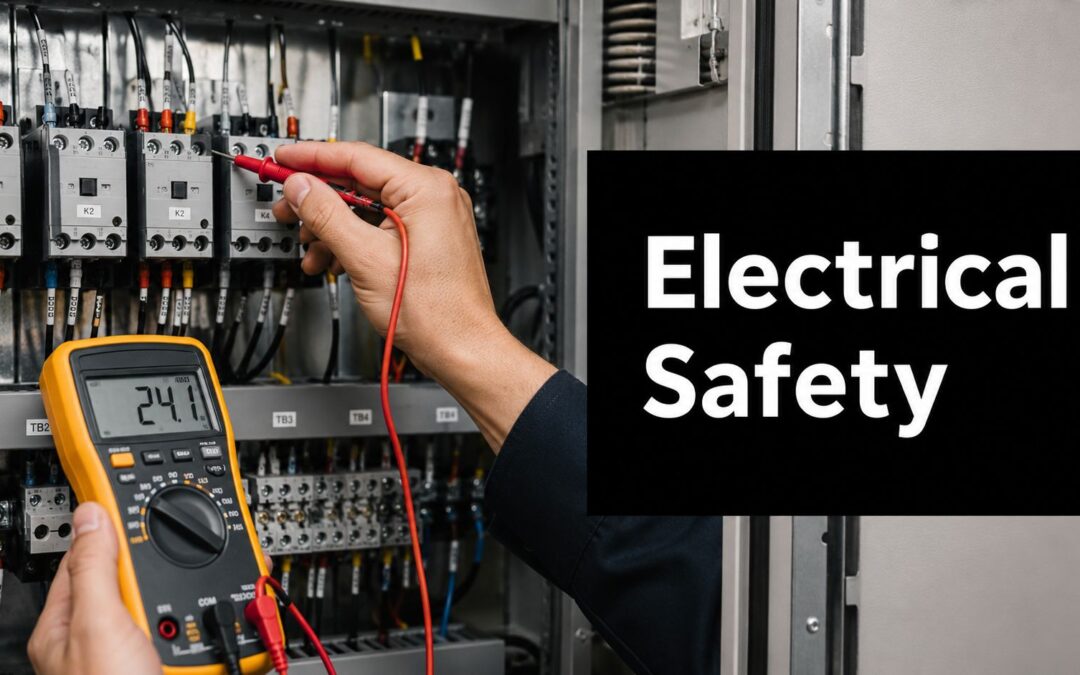
You're halfway through a switchboard audit when the inspector asks for the equipment record. The folder is incomplete, the protective-device label is scratched, and the test sticker on a portable tool has faded into an unreadable patch of colour. The equipment may still work, but you can't confidently prove which model was certified, who tested it, or when the next inspection is due.
That's the practical purpose of electrical equipment safety standards. They connect product design, supplier responsibilities, installation, maintenance and evidence. In Australia, that chain runs from the Electrical Equipment Safety System (EESS) and standards such as AS/NZS 3820 through to workplace inspection and testing under AS/NZS 3760. Durable identification is the quiet control that lets people match a physical asset to the right certificate, test result and maintenance history.
Why Electrical Equipment Safety Standards Matter on Real Worksites
A contractor arriving at a small commercial switchboard audit doesn't start with an abstract discussion about standards. They start with what's in front of them. A busbar nameplate is partly scratched off, an isolator has no clear identification, and the previous test results refer to an asset number nobody can find on the board.
That situation creates more than administrative friction. If an arc-flash event, electric shock or equipment fire occurs, inspectors, insurers and investigators need to establish what was installed, how it was protected, who worked on it and whether the equipment had been inspected. An unreadable marking or missing record can make that reconstruction harder.
Australia's regulatory framework developed in response to measurable harm. The Electrical Regulatory Authorities Council reported 11 electrical deaths from 10 incidents in Australia and New Zealand in 2023–24 (ERAC material reproduced in the Electrical Safety General Regulations regulatory impact statement). The same source records earlier evidence that 11,260 fires were attributed to electrical equipment faults in Australia and New Zealand between 2002 and 2007, with estimated economic losses of $489 million per year. Those figures explain why compliance isn't paperwork theatre. The rules respond to people being injured, killed and exposed to property loss.

Different people carry different duties
The EESS governs supplier and equipment registration for regulated electrical items, while workplace health and safety duties apply to the people who design, install, manage and use equipment. The person importing a device, the licensed installer connecting it, and the site owner maintaining it may all have separate responsibilities.
The EESS began rolling out in Queensland on 1 March 2013 before expanding to other states and territories. Its 2019–2020 annual report recorded 3,499 Responsible Supplier registrations and renewals and 30,863 equipment registrations, including 11,577 Level 3, 909 Level 2 and 18,377 Level 1 items (EESS annual activities report). That administrative scale reflects the number of products that need an identifiable compliance pathway.
The rest of the rulebook becomes easier to use once you separate the layers. You need to know which international principle informs the standard, which Australian version applies, which state rule controls the work, how often the asset must be tested and whether the label will still be readable at the next inspection.
Practical promise: Treat the process as one traceability chain, from supplier registration to an engraved asset number, and you can build a compliance flow that works on a real site.
The Standards Stack from IEC Down to AS/NZS
Think of the standards system as a building with several floors. The International Electrotechnical Commission (IEC) supplies much of the global technical foundation. Joint IEC and CISPR work supports international conformity approaches, while IECEE and CB schemes help manufacturers and certification bodies exchange test evidence across participating markets.
Australia doesn't copy every international document and call the job finished. Standards Australia and Standards New Zealand publish joint AS/NZS standards, adopting, modifying or supplementing international requirements for local conditions. Installation work commonly sits within Australian wiring rules, while product safety may rely on a product-specific standard and the EESS criteria.
Start at the product
For electrical equipment placed on the Australian market, AS/NZS 3820 is the core pre-market safety baseline used by EESS regulators alongside applicable type-specific AS or AS/NZS standards. The EESS essential safety criteria explain that equipment must meet the relevant safety criteria before it is supplied.
That doesn't mean an IEC reference automatically proves Australian compliance. Australia's supply arrangements, earthing terminology and multiple earthed neutral, or MEN, system can produce requirements that differ from generic IEC 60364 guidance. A clause number may look familiar while the applicable Australian wording, annex, transition provision or installation condition changes the result.
Then identify the installation context
The next layer concerns how the equipment is connected and used. AS/NZS 3000 provides the principal wiring rules for many electrical installations, while documents such as AS/NZS 3012 address construction and demolition sites. Site-specific standards can therefore add controls that a general product certificate doesn't cover.

At the top sits the state or territory regulator. The legal instrument in force where the work occurs can determine licensing, inspection, testing and enforcement expectations. The practical question isn't “Which IEC standard do we know?” It's “Which Australian edition, product category, installation rule and jurisdiction apply to this asset?”
Core Obligations Across Design, Supply and Installation
A useful handover divides responsibility into clear buckets. The designer establishes the safe architecture, the supplier proves the product pathway, the installer verifies the connection, and the owner keeps the equipment safe throughout service.
For designers, AS/NZS 3000 is a central reference for wiring arrangements. Product designers may also need equipment-specific documents such as AS/NZS 61439 for low-voltage switchgear assemblies. A design that looks acceptable on paper still needs accurate equipment identification, because the selected model, rating and certification evidence must remain connected to the installed assembly.
Suppliers and importers have a different job. They need to establish whether the equipment is within the EESS scope, identify the applicable standard, retain the Declaration of Conformity and keep supporting test reports. Depending on the product, that evidence may involve standards such as AS/NZS 62368.1 for information and communication technology or audiovisual equipment, or AS/NZS 60335.1 for household appliances.
Installers work within AS/NZS 3000 and the applicable state or territory licensing framework. Their records may include inspection or verification certificates before energisation. Owners and operators then inherit operational duties, including maintenance, inspection and testing under workplace requirements and relevant in-service standards.
| Lifecycle Stage | Responsible Party | Primary Standard |
|---|---|---|
| Design | Designer or engineering team | AS/NZS 3000 and applicable product standards, such as AS/NZS 61439 |
| Supply | Manufacturer, importer or supplier | EESS requirements, AS/NZS 3820 and the relevant equipment standard |
| Installation | Licensed electrical contractor | AS/NZS 3000 and jurisdictional electrical rules |
| In-service operation | Owner, employer or site operator | AS/NZS 3760, AS/NZS 3012 where applicable, and workplace safety duties |
| Records and handover | All parties at each boundary | Declarations, certificates, test records and asset identification |
Every handoff needs evidence
The handoff from manufacturer to supplier, supplier to installer and installer to owner is a documentation boundary. If the model number is ambiguous or the asset tag falls off, the evidence chain weakens even if the equipment itself hasn't changed.
The EESS guidance on essential safety criteria also makes the certification date important. The applicable standard is the one in force at certification, including amendments and transition arrangements. A durable marking should therefore support the exact certified model or version, not merely a broad product description.
Inspection, Testing and Record-Keeping in Practice
On Monday morning, a competent tester should be able to take one item from the equipment pool and follow a repeatable sequence. Start with a visual inspection. Look for damaged insulation, exposed conductors, cracked housings, bent pins, loose strain relief and signs of overheating before connecting a tester.
Next, perform the tests required for the equipment and environment. That can include earth continuity and insulation resistance testing with a portable appliance tester, followed by residual current device checks. Don't treat the sticker as the test. The sticker identifies the outcome and timing, while the underlying record should show what was examined.
Australian guidance identifies a 30 mA personal-protection threshold for RCDs, with maximum operating times of 300 ms at 30 mA, 150 ms at 60 mA and 40 ms at 150 mA (Queensland Department of Transport and Main Roads technical note). Use the site's approved procedure and the correct instrument. A push-button check alone doesn't replace the required trip-time test where that test is applicable.

Match the interval to the work
Queensland guidance states that portable electrical equipment used in manufacturing work, where the equipment isn't double insulated, has a maximum test-and-tag interval of 6 months. Rural work and service work without a safety switch have a maximum interval of 12 months (WorkSafe Queensland testing and tagging guidance).
Higher-risk workplaces generally require regular inspection and testing by a competent person, usually at least every 12 months. Equipment hired out must be inspected and tested before each hire and every 3 months, according to the Safe Work Australia inspection and testing guideline.
Record before you move on: Capture the appliance ID, location, test date, next due date, tester's name and licence number, plus the pass or fail result.
A durable asset tag created during the test can anchor the physical item to the digital register. For technical background on the measurement itself, this insulation resistance testing guide provides useful context. Teams can also use asset tracking best practices to structure the register around equipment identity rather than relying on handwritten descriptions.
How Durable Marking Supports Compliance
A label is only useful if a person can read it when the next inspection arrives. Electrical assets face abrasion from handling and cable ties, chemical attack from cleaning products and solvents, heat near terminals, and ultraviolet exposure on outdoor switchboards.
Laser engraving changes the marking method itself. A fibre or CO₂ laser can mark anodised aluminium, coated stainless steel, Traffolyte and other suitable materials with high contrast. Thermal-transfer and adhesive systems can work well in controlled locations, but the selection should reflect the asset's environment rather than the convenience of printing.
| Stressor | Laser Engraved Plate | Thermal-Transfer Label | Standard Adhesive Sticker |
|---|---|---|---|
| Abrasion | Engraved character depth or material contrast supports long-term identification | Print can wear where tools, gloves or cable ties rub the surface | Surface print and edges can scuff or lift |
| Chemicals | Suitable metal or coated substrates can resist cleaning exposure when correctly specified | Ribbon and face stock need compatibility checks | Adhesive and face material may soften or detach |
| Heat | Metal plates can suit locations near warm terminations when the substrate is selected correctly | Temperature limits depend on ribbon and label stock | Adhesive performance can decline near heat |
| UV exposure | Metal marking remains a strong option for outdoor identification | Outdoor durability depends on the complete media system | Colour and adhesive performance can deteriorate |
| Audit trail | Serial numbers, dates and codes remain physically tied to the asset | Useful where controlled conditions support retention | Replacement can break continuity if the original record is lost |
The mark can carry a serial number, model or version reference, conformity information, test date and a QR code that points to the controlled record. It shouldn't replace the formal certificate, but it can make the certificate findable.
For board-specific identification, contractors can review switchboard labelling requirements before selecting the plate material, character size and fixing method. The objective is simple: the marking must remain legible, securely attached and matched to the correct equipment.
Jurisdictions, Transitions and Emerging Equipment Classes
A contractor moves a portable appliance from Victoria to New South Wales and assumes its existing approval answers every compliance question. It does not. The EESS covers participating jurisdictions, while NSW isn't participating. Queensland, Victoria, Western Australia and Tasmania regulate household electrical equipment through the EESS, as recorded in the EESS annual activities report. State and territory laws can still set separate rules for installation, licensing and workplace practice.
Treat the certificate like a passport with conditions. It identifies the equipment, but the work location determines which additional rules apply. Check the jurisdiction before copying approval evidence from another project.
Edition control creates a second checkpoint. AS/NZS 62368.1:2026 was published on 6 March 2026 and supersedes the 2022 edition, while the 2022 version is scheduled to remain current until 6 March 2029 (Standards Australia listing for AS/NZS 62368.1:2026). Record the edition used, certification date and any permitted transition arrangement.
Queensland's Electrical Safety Regulation 2026 is scheduled to start on 1 September 2026 and refers users to AS/NZS 3820 and applicable Standards Australia or joint AS/NZS standards. Confirm the law in force at the work location through Queensland regulatory information before relying on an older project file.

New equipment changes the classification question
Battery energy storage systems and electric vehicle supply equipment show why compliance depends on classification and use. AS/NZS 4417.2:2020 Amendment 1:2026 added five product categories, including those two equipment types, to the Level 2 and Level 3 equipment list, with a 12-month transition period (JJR Laboratory summary of the amendment).
A battery system may require checks covering registration, product safety and installation guidance such as AS/NZS 5139. EV supply equipment can raise a separate EESS classification question. DC microgrids may also require different fault assumptions from conventional AC guidance.
For each asset, record its jurisdiction, equipment class, applicable standard edition and certification date. The Australian electrical safety standards overview can organise that review. The responsible regulator and current standard determine the final pathway, while a durable engraved mark helps keep the asset and its evidence connected.
A Practical Compliance Checklist You Can Use Today
A new contractor can use this checklist before equipment reaches site, during routine work and before an asset returns to service. Treat it like a flight checklist: each line needs an owner, evidence and a sign-off from the licensed electrician, site supervisor or asset owner.
Weekly checks
- Identify assets: Give every new or relocated item a unique asset number, then match it to the register and its durable label.
- Review condition: Inspect cords, plugs, covers, guards and warning marks for damage, illegible information or unauthorised changes.
- Check access: Keep isolators, distribution boards and emergency controls identified and clear of stored materials.
- Verify records: Investigate failed tests, overdue inspections and register entries that cannot be matched to equipment on site.
A missing label is an audit problem, not merely a cosmetic defect. If the number on a test record does not match the switchboard, appliance or portable tool, the record cannot reliably prove which asset passed.
Monthly and scheduled maintenance
- Confirm design evidence: Check the supplier pathway, RCM or other approval evidence, EESS registration where required, Declaration of Conformity and the cited AS/NZS or IEC family standard.
- Verify installation: Review AS/NZS 3000 requirements, RCD selection, MEN link arrangements, segregation and the installation certificate.
- Test portable equipment: Set the interval according to the work environment. Queensland guidance sets a 6-month maximum interval for specified non-double-insulated portable equipment used in manufacturing work, and a 12-month maximum interval for specified rural and service work without a safety switch (WorkSafe Queensland guidance).
- Test RCDs: Perform the push-button and instrument tests required by the site schedule. Record the result, test date, device identity and tester details.
Quarterly or project-based reviews
- Inspect switchboards: Check labels, circuit directories, protective-device ratings and warning signs. Review thermal-imaging records where the maintenance programme requires imaging under load.
- Audit calibration: Confirm each test instrument has a current calibration certificate.
- Reconcile the register: Match serial numbers, QR codes, certificates, test results and physical locations.
- Sign off exceptions: Assign every corrective action to the electrician, supervisor or asset owner, with a clear close-out date.
After service or repair, inspect, test and tag the item before returning it to service. Test second-hand equipment before first use. In hostile environments, test RCDs every 3 months when portable and every 6 months when non-portable, according to the UNSW RCD guideline. Keep the label, register entry and test result together so the physical asset remains connected to its compliance history.
Bringing It All Together with Trotec Laser and Evright
An inspector stands at a switchboard with a test register showing a pass. The remaining question is practical: does that record belong to the equipment in front of them? A certificate can identify a model, yet the physical appliance, battery system or switchboard still needs a clear connection to its compliance history.
That connection is why marking deserves attention alongside standard selection. Trotec Laser systems, including Speedy series machines and Markolaser workstations, can create permanent, high-contrast marks on suitable anodised aluminium, stainless steel, Traffolyte and coloured acrylic faceplates. The marks may carry asset numbers, warnings, circuit information or scan codes. Results depend on the substrate, settings and operating environment.
The handoff is straightforward. A contractor supplies approved asset data, the marking system produces the plate or tag, and the finished item is attached to the matching equipment before commissioning or the next inspection. A durable mark reduces dependence on a printed sticker whose ink, adhesive or face stock may deteriorate under cleaners, solvents, sunlight or repeated abrasion.
For Australian projects, Evright Industrial can convert Trotec-marked blanks into pre-formatted asset tags, RCD test stickers, barcoded switchboard labels and warning signage. The service focuses on equipment identification and engraved signage for demanding industrial applications. The physical link matters: an inspector can scan or photograph the mark, find the controlled record, and connect the asset with its certification and test history.
A durable label does not make unsafe equipment compliant. It preserves the evidence needed to show which equipment was assessed, which standards pathway applied, and whether the maintenance record belongs to the asset still in service.
Evright Industrial provides laser-engraved asset tags, switchboard labels, RCD test markings and warning signage for Australian electrical and industrial environments. Its labelling formats can keep equipment identification readable and connected to compliance records.
Recent Comments