

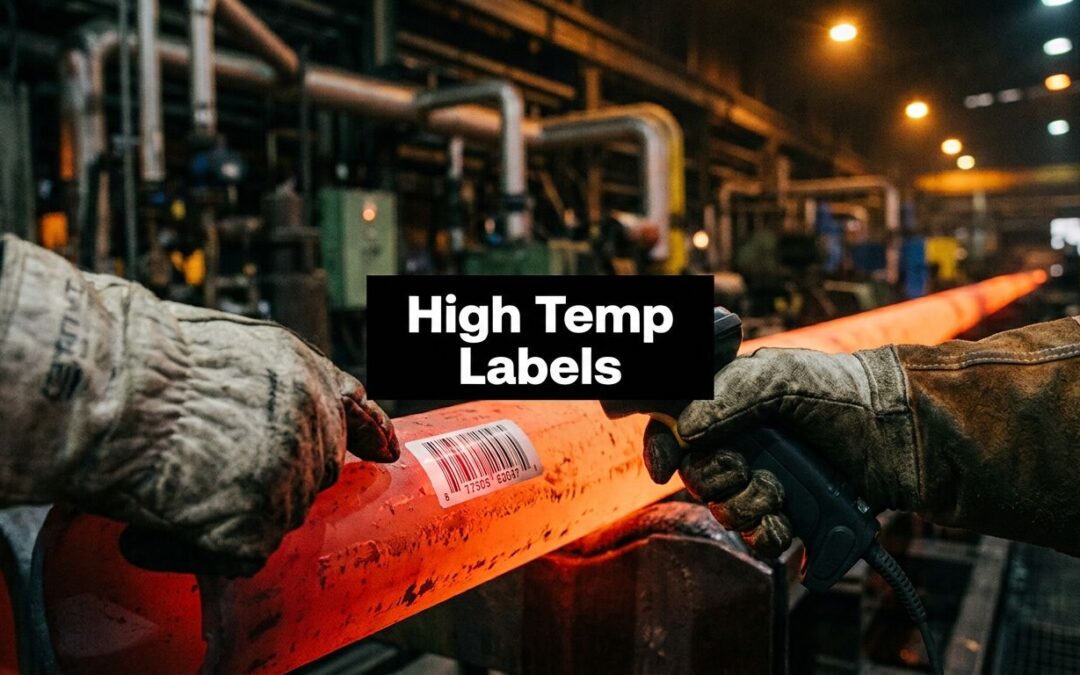
You're standing beside a production line, watching a barcode label curl away from a hot steel surface. The equipment still runs, but the identifier no longer scans. A technician reaches for a replacement, maintenance records become harder to match, and a simple label failure starts creating traceability risk.
That failure usually isn't caused by the printer. It comes from specifying high temperature label materials by a headline temperature rating instead of the conditions the label faces. Peak heat, continuous heat, thermal cycling, chemical wash-down, abrasion, ultraviolet exposure, and the time available for replacement all change the decision.
The practical question isn't “Which label is heat resistant?” It's “At what point does a printed label become the higher-risk choice than a laser-marked metal plate?”
When a Hot Surface Eats Your Label
A maintenance technician on a Western Sydney food plant floor scans a barcode on a pasteuriser line. The label has lifted at the corners, the print has faded, and the scanner can't read it. The adhesive was chosen for ordinary equipment marking, but the label was exposed to heat, cleaning chemicals, and repeated thermal cycles.
That's the common pattern. The facestock may still look intact, while the adhesive has softened and sheared. In another application, the adhesive holds but the printed image yellows, smears, or loses contrast. A label that survives a short hot process might still fail when it sits against a warm surface for hours every day.

Start with the real thermal profile
Don't specify from the highest temperature printed on a process document. Record four separate conditions:
- Continuous temperature: The temperature the label experiences during ordinary operation.
- Peak temperature: The highest surface temperature, even if it lasts briefly.
- Dwell time: How long the label remains hot during each exposure.
- Thermal cycling: How often the substrate heats and cools.
A label applied to a hot coil leaving a furnace faces a different problem from a label on a boiler valve that remains warm throughout a shift. A barcode on a pipe may also face radiant heat without reaching the same temperature as the pipe itself.
Australian and New Zealand material specifications show why a single “heat resistant” category is misleading. Avery Dennison's ANZ Product Component Guide lists industrial and asset-identification adhesive constructions with service ranges from -50°C to 90°C, while other formulations cover -50°C to 70°C or -30°C to 70°C, depending on the application. Its CD303 durable-goods and asset-tag material has a minimum application temperature of 0°C and a service range of -30°C to 70°C. The guide also lists a cold-chain construction rated for application at -20°C, with service from -50°C to 70°C. These specifications are available through the Australian labelling guidance resource.
Add the environment to the specification
Heat rarely acts alone. Food-processing labels may face caustic wash-downs. Mining and utilities tags may encounter dust, vibration, salt, sunlight, and abrasion. A label that performs well on a clean, dry panel can fail quickly on an oily, rough, or low-energy plastic surface.
Practical rule: Specify the label for the hottest surface, longest dwell time, harshest chemical exposure, and most aggressive cleaning cycle it will actually encounter.
A maximum temperature rating is only the first filter. If the label must remain readable for years, survives repeated cleaning, or sits where replacement access is difficult, you're already approaching the point where a metal marking deserves consideration.
The Main Material Families Compared
There isn't one universal high-temperature label material. Each family solves a different combination of heat, marking permanence, surface condition, and replacement risk.
Polyimide, often associated with Kapton film, is the flexible option for process identification and electronics. High-temperature polyester suits moderate heat where dimensional stability, print quality, and chemical resistance matter. Ceramic-coated constructions belong in furnace and exhaust environments where ordinary films have no realistic service life. Anodised aluminium offers a thin metal construction with strong contrast and clean laser marking. Stainless steel nameplates are the conservative choice for abrasion, chemicals, vibration, and long-term outdoor service.
| Material | Max Continuous Temp | Best Marking Method | Typical AU Application |
|---|---|---|---|
| Polyimide | Around 260°C continuous service, with short peaks beyond 400°C depending on construction | Thermal transfer or laser ablation | PCB tracking, soldering processes, automotive under-hood identification |
| High-temperature polyester | Up to 150°C for the locally sold Avery Ultra Heavy Duty construction | Laser or thermal transfer printing | Equipment labels, asset identification, chemical-hazard transport labels |
| Ceramic-coated label | Past 1000°C for specialised furnace and exhaust constructions | Ceramic-compatible print or engineered marking | Furnace components, exhaust systems, extreme thermal processing |
| Anodised aluminium | Up to 350°C for an Australian barcode-label specification | Laser marking | Equipment identification, asset tags, utilities and infrastructure |
| Stainless steel nameplate | Service depends on grade, finish, fixing, and marking construction | Engraving, etching, or fibre laser marking | Marine, chemical, food-processing, heavy industrial and outdoor equipment |
Polyimide is the workhorse where the tag must remain thin, flexible, and close to the part. It handles process heat well, but the adhesive and print system still determine field performance. Don't assume the film's thermal capability automatically transfers to the complete label assembly.
High-temperature polyester is the practical choice below its specified limit, particularly where you need a printable surface and resistance to moisture, cleaning, and outdoor exposure. Avery Australia lists its Ultra Heavy Duty Labels at -40°C to +150°C and suitable for laser printers in its Australian industrial label range. The construction is useful for thermal cycling and chemical exposure, but sustained service above 150°C calls for polyimide or a metal-backed solution.
For a permanent plate, compare the engraved metal label options from Evright Industrial. Stainless steel and anodised aluminium remove the printed ink layer as the primary failure point, which is why they make more sense on equipment that's difficult to access or expensive to relabel.
Adhesives and Mounting Methods That Actually Hold
The adhesive is often the first component to fail. A strong facestock won't save a label if the bond softens, creeps, or releases from a contaminated surface.
Acrylic adhesives suit many moderate-temperature applications. Australian arc flash label specifications from Marking Services Australia use premium-grade vinyl with an acrylic pressure-sensitive adhesive, comply with AS 1319, and specify a service range of -45°C to +82°C. The same specification includes a self-laminating polyester version with an ultraviolet-resistant clear top laminate, as detailed in the arc flash label specification.
Silicone adhesives are the serious option for higher thermal load and repeated cycling. They generally need careful application pressure and suitable surface temperature, and they may build bond more slowly than acrylic. That extra discipline is worthwhile when acrylic would soften under sustained heat.
Match chemistry to the bond problem
Use acrylic where the substrate is smooth, clean, and within the adhesive's specified service range. It offers strong initial tack and can resist solvents and ultraviolet exposure, making it suitable for many equipment and chemical-identification applications.
Choose silicone when the label must remain bonded through higher continuous heat or severe thermal cycling. A construction specified to 260°C continuous service and short peaks beyond 300°C can survive conditions that would cause a conventional acrylic bond to shear. Exact performance still depends on the complete material system and substrate.
For broader context on adhesive selection and lower-impact bonding approaches, see this resource on a sustainable adhesive for UK fulfilment. The application is different, but the same principle applies, adhesive performance must be judged against the surface, temperature, and handling conditions rather than selected in isolation.

Treat preparation as part of the material system
Clean the surface with a compatible solvent, remove oil and dust, and allow it to dry completely. Low-energy plastics may need a primer. Rough or oxidised metal can require a different adhesive construction or a mechanical fixing instead.
The surface preparation methods used for industrial labels should be part of the work instruction, not an afterthought. A label applied to a dirty panel can peel during its first thermal cycle, regardless of the facestock rating.
On vibrating equipment such as crushers and conveyors, use rivets or screws for stainless tags when access allows. Adhesive-only mounting is convenient, but mechanical fixing reduces the risk of edge lift, shear, and vibration-related release.
Standards and Testing Buyers Should Know
Start by classifying the identification task. A safety sign, a chemical-container label, and an asset tag don't carry the same compliance burden, even if they sit in the same hot plant.
AS 1319 is relevant to occupational safety signs and colours. Marking Services Australia's arc flash construction provides a practical Australian example, using premium-grade vinyl, acrylic adhesive, and a service range of -45°C to +82°C while stating compliance with the standard in its specification sheet.
BS5609 Part 2 matters where chemical-hazard transport labels must tolerate immersion and aggressive exposure. Avery's Australian ultra-resistant construction is rated from -40°C to +150°C and certified to BS5609 Part 2 for GHS chemical-hazard transport labelling, as shown in the Australian 3M industrial label specification. That combination is useful for logistics yards, storage areas, and equipment exposed to water, chemicals, ultraviolet light, and thermal cycling.
The GHS framework applies to hazard communication, not ordinary asset identification. If the label communicates chemical hazards, specify the required symbols, signal words, and durability alongside the substrate and adhesive.
| Standard or framework | Scope | Relevance |
|---|---|---|
| AS 1319 | Australian occupational safety signs and colours | Safety labels, warning signs, and electrical hazard identification |
| BS5609 Part 2 | Durability for chemical-hazard transport labelling, including immersion resistance | Chemical containers and labels exposed to water or aggressive handling |
| GHS | Globally harmonised chemical hazard communication | Chemical labels requiring prescribed hazard information and symbols |
Test the finished construction
Request certificates that identify the actual material, adhesive, marking method, and standard. “Heat resistant” on a product page isn't enough.
For internal validation, test the complete label on the substrate. Thermal ageing at the rated temperature, salt-spray testing to AS 2331.3.1, and cross-hatch adhesion testing can reveal failures that a material data sheet won't show. The test should include the actual cleaning agent, application method, barcode size, and scanning equipment used on site.
A label can remain attached but lose barcode contrast. It can remain legible but fail a safety-sign colour requirement. Test both physical retention and information quality.
Why Trotec Lasers Change the Equation
A printed label adds an image to a material. A Trotec laser changes the surface itself, which removes ink smearing and reduces the number of layers that can fail.
On polyimide, laser ablation can remove the top layer and expose a contrasting base. That produces a crisp, smudge-free mark for process identification where the film remains within its specified thermal envelope. On anodised aluminium, the laser removes the dyed anodic layer and leaves a contrasting mark that is far less dependent on surface ink.

Avery's ANZ material guide lists anodised-aluminium and durable-goods constructions for asset and product identification, while Australian industrial suppliers describe anodised-aluminium barcode labels rated to 350°C with a life-span rating of 20 years. Those figures come from the heat-resistant label guidance for industrial applications, and they show why metal-backed identification becomes attractive when a label must remain in place for the life of the equipment.
Select the laser by material
Trotec CO2 and fibre laser systems aren't interchangeable for every substrate. The machine, wavelength, power, speed, and focus must match the material and desired contrast.
- Polyimide: Use laser ablation where a permanent, high-contrast process mark is needed without adding conventional ink.
- Anodised aluminium: Remove the anodic dye for a clean contrasting mark that resists ultraviolet exposure, salt, solvents, and handling.
- Stainless steel: Use fibre laser marking to create a dark surface mark or engraving suited to abrasion and repeated cleaning.
- Metal plates: Mark serial numbers, barcodes, logos, outlines, and drilled mounting holes in an organised production setup.
For complex plate work, the value isn't just the mark. A single setup can combine cutting, hole preparation, serialisation, and engraving, reducing the opportunities for transcription errors between separate jobs. Evright Industrial's engraving crew can support this type of production requirement.
Trotec Laser equipment is also relevant when buyers need repeatable, machine-based marking rather than manual engraving. The right machine imagery for this application should show the laser process and workpiece, not mechanical cutting equipment.
A laser-marked plate won't eliminate every failure. Incorrect grade selection, poor contrast, unsuitable fixing, or a substrate that oxidises aggressively can still create problems. It does, however, remove printed ink and adhesive as the primary identification system, which is a major advantage on long-life assets.
Where Labels Stop Making Sense
The tipping point isn't only the temperature printed on the data sheet. It's the cost and difficulty of returning to the asset after the label fails.
A printed polyimide label can be the right answer for a small part moving through a controlled process. It's thin, flexible, and useful for variable data. A metal plate becomes more sensible when the tag sits behind cladding, on a hot manifold, inside a plant area with restricted access, or on equipment that must remain identifiable for years.
Australian supplier specifications illustrate the range. Polyimide systems used in metal manufacturing are specified for service up to 600°C, with non-yellowing polymer or silicone print surfaces and high-temperature acrylic or ultra-high-temperature silicone adhesives, as described in Brother Australia's explanation of heat-resistant printable labels. The same guidance makes the practical point that, at those temperatures, the adhesive interface can become the limiting factor even when the print face remains stable.
For metal identification, one Australian harsh-environment specification reports a maximum service temperature of 180°C and a minimum of -70°C, while another supplier describes anodised-aluminium barcode labels up to 350°C with a 20-year life-span rating. Don't treat those figures as interchangeable product promises. Treat them as evidence that the construction, fixing, and environment determine the result.
| Condition | Printed label viable | Engraved plate preferred |
|---|---|---|
| Dry surface below the specified polyester limit | Yes, where replacement access is easy | Not necessary unless permanence is required |
| Polyimide process identification with controlled exposure | Yes, especially for flexible parts and variable data | Consider for fixed equipment and long service |
| Continuous heat above the selected film or adhesive rating | No | Yes, specify metal and fixing for the actual temperature |
| Abrasive dust or repeated scraping | Only with a protected construction and planned replacement | Yes, stainless steel is lower risk |
| Caustic wash-down or solvent exposure | Only after full-system testing | Usually, particularly for fixed plant |
| Outdoor ultraviolet and salt exposure | Use a tested polyester or metal construction | Yes for long-life infrastructure and marine assets |
| Vibration on conveyors, crushers, or rotating equipment | Only with suitable bonding and inspection | Yes, use rivets or screws where practical |
| Difficult access or costly shutdown | Poor lifecycle choice | Yes, choose a permanent plate from the start |
The threshold is economic. Compare the unit price with inspection time, access equipment, production interruption, replacement labour, and the risk of misidentification. A cheaper label isn't cheaper if the site has to replace it repeatedly.
A Selection Checklist for Australian Industrial Buyers
Use this as a purchasing filter. Before requesting a quote, write down the environment, expected service life, and compliance load. If the information is missing, the supplier can only guess.
Environment
Record the actual temperature at the label location, not just the process temperature. Separate continuous exposure from short peaks, then add the conditions that attack the bond or marking.
- Heat: Below 150°C, a locally available high-temperature polyester construction may be suitable where the surface is clean and dry. Above 150°C, move towards polyimide, specialised film, anodised aluminium, or stainless steel.
- Extreme heat: Above 300°C continuous, start with laser-marked stainless steel or anodised aluminium rather than assuming an adhesive label will remain serviceable.
- Chemical exposure: List cleaners, oils, fuels, solvents, acids, and caustic agents. A GHS label exposed to immersion needs a different specification from a dry asset tag.
- Abrasion: Include contact with tools, metal parts, dust, forklifts, and manual handling. If the mark can be scraped, use a recessed, engraved, or laser-marked metal surface.
- Weather: UV, salt, rain, and temperature cycling favour tested polyester or metal constructions. Avery's Ultra Heavy Duty construction covers -40°C to +150°C, while its BS5609 Part 2 certification is relevant where chemical-hazard transport labels face immersion and harsh exposure.
Service life
Decide whether the identifier is temporary process control, a replaceable asset label, or a permanent equipment record.
For a short operational cycle, use a printable polyimide or polyester label if the thermal and chemical limits fit. For equipment expected to remain in service for many years, particularly where access is difficult, an engraved or laser-marked plate reduces relabelling risk. On vibrating plant, mechanical fixing should be considered before the label is ordered.
Compliance and data
Confirm whether the label is a safety sign under AS 1319, a GHS chemical label, a BS5609-related transport label, or an internal asset identifier. Specify barcode contrast, serialisation, text size, colour requirements, and whether operators must scan the code after exposure to heat or cleaning.
A supplier should receive the substrate, surface finish, application temperature, operating temperature, peak temperature, dwell time, chemical exposure, cleaning method, fixing method, and required service life. Ask for documentation for the finished construction, not just the film.
Evright Industrial offers laser-engraved metal tags, pre-printed label runs, and prototyping for Australian equipment identification. Its production approach uses Trotec laser machinery and can help determine whether your job needs a label supplier, a laser-marking partner, or both. For a practical review of your application and material options, visit Evright Industrial and provide the operating temperature, substrate, exposure conditions, and service-life requirement.
Talk to Evright Industrial before you order another batch of labels for a hostile plant environment. The team can assess high-temperature label materials against engraved stainless steel or anodised aluminium, then produce the tags, labels, or prototype you need for Australian asset tracking. Visit Evright Industrial to start with the actual surface and operating conditions.
Recent Comments