
A forklift rolls towards a loading aisle on Tuesday morning. The mandatory PPE sign is still on the wall, but its lettering has faded into the background and a worker approaching from the side can't read it. Nobody ordered a replacement because the sign was technically still there.
That's the problem with treating workplace signage as a one-off poster order. Australian sites need a layered signage system that communicates hazards under WHS duties, supports emergency egress under the National Construction Code, and identifies workplaces or construction sites where project rules require it. The sign must be suitable for the hazard, visible to the people approaching it, and maintained throughout its service life.
Why Australian Workplace Signage Requirements Matter
A faded sign can fail before anyone notices. UV exposure, chemical contact, abrasion, wash-down processes, dust and vehicle impacts all reduce legibility. A sign that looked suitable when installed may no longer communicate the hazard clearly after years in a harsh industrial environment.
The practical consequence isn't limited to an untidy wall. A worker may miss a restricted-access instruction, fail to identify the correct emergency route, or approach a chemical store without seeing the relevant warning. An auditor may record a finding, a principal contractor may reject the site presentation, and a facility team may struggle to show which signs were inspected and replaced.
Safe Work Australia's national reporting recorded 188 workers killed by traumatic injuries while working in 2024, while the traumatic-injury fatality rate fell from 2.7 deaths per 100,000 workers in 2003 to 1.3 in 2024. The same reporting recorded 200 worker deaths in 2023. Those figures don't prove that a particular sign would have prevented an incident, but they do show why hazard communication remains a foundational workplace control. The national safety-signage context is summarised here.
Practical rule: If a worker has to stand too close, squint, move around an obstruction or guess what a symbol means, the sign isn't doing its job.
Treat the site as a system
Workplace signage requirements often overlap:
- WHS hazard communication: Signs identify hazards, required actions, restricted areas and emergency information.
- Building-code egress: Certain buildings and room conditions may require photoluminescent emergency egress signage under the National Construction Code.
- Site identification: Construction projects may require principal-contractor information, including the contractor's name, after-hours contact number and site office location outside the workplace. The layered compliance position is outlined in this Australian safety-sign guide.
The correct response is a site-wide audit, not another generic carton of signs. Walk every approach route, identify every hazard and emergency point, record viewing conditions, then replace signs that are faded, obstructed, damaged or incorrectly located. That process gives facilities teams a defensible basis for what they order and why.
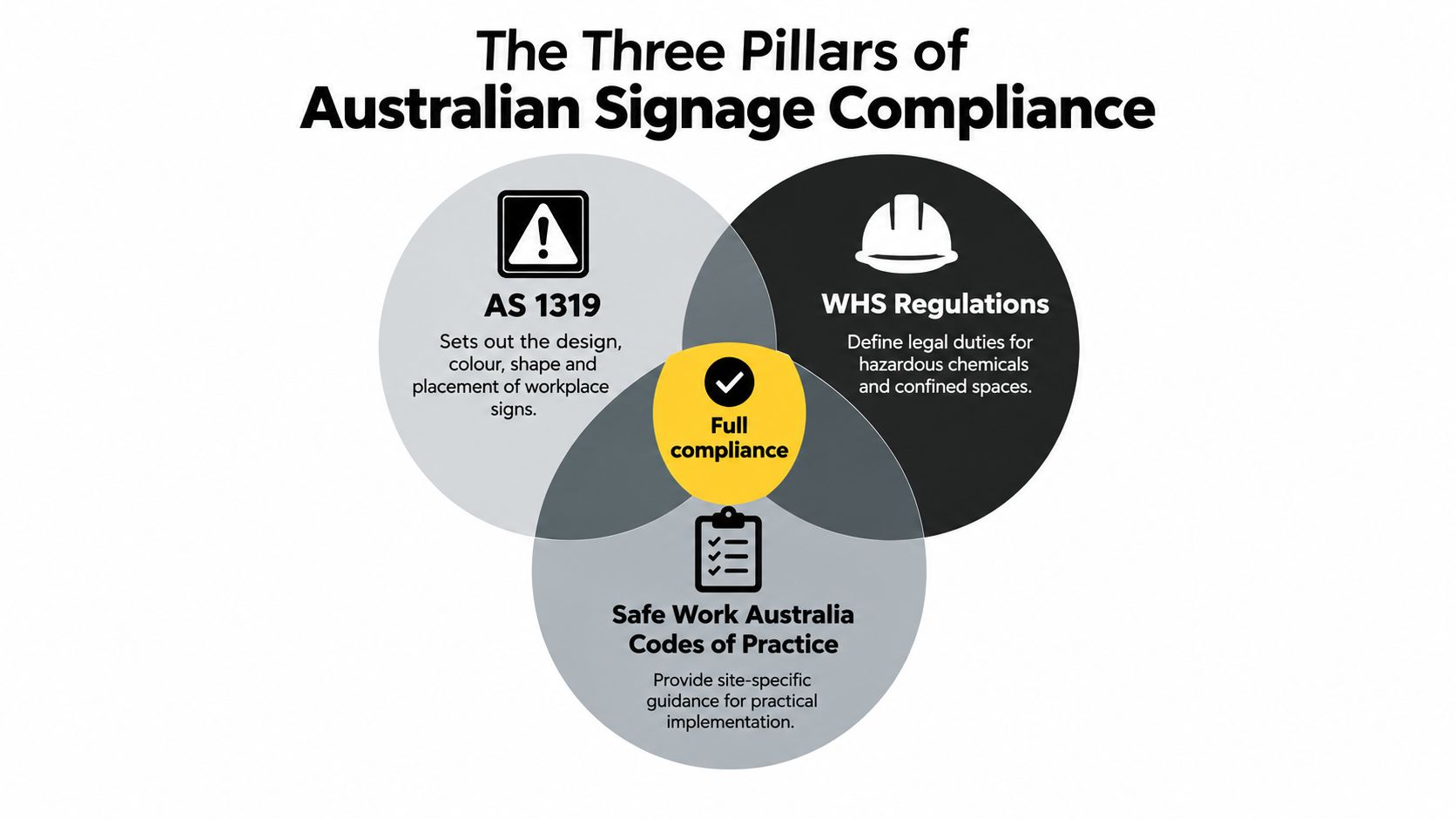
The Three Pillars of Australian Signage Compliance
Start with three questions. What behaviour must the sign control? What legal or building obligation applies? Where will a person see it? Those questions separate a useful compliance schedule from a catalogue assembled by guesswork.
Pillar one is AS 1319
WorkSafe ACT identifies AS 1319-1994 as the Australian Standard covering safety signs for work environments. Its purpose is to regulate and control safety-related behaviour, warn people about hazards and provide emergency information, including fire-protection information. WorkSafe ACT explains the standard's role and limits.
AS 1319 is a design and application reference, not a universal order list. WorkSafe ACT notes that it doesn't prescribe one required material or nominal sign size. The sign type must suit the intended application, and workers must be informed of its purpose. That means a facilities team must assess the environment, viewing distance, audience and hazard rather than assuming one substrate or dimension works everywhere.
Pillar two is WHS regulation
The model WHS framework adds situation-specific duties. Hazardous chemical storage, confined spaces and other controlled hazards may require signs or placards at defined locations. The sign must support the control already established through risk assessment, training, isolation, permits or emergency procedures.
For example, a chemical store needs hazard information where people approach the hazard. A confined-space entry needs a clear restriction at the entry, not a distant noticeboard that workers can bypass.
Pillar three is building and project compliance
The National Construction Code can add obligations for emergency egress and building-specific signage. The applicable requirement depends on the building class, room conditions and project context. Construction sites can also carry separate site-identification obligations, so the same workplace may need WHS signs, egress signs and project information at the same time.
A compliant sign often satisfies more than one need. A durable emergency sign may support WHS communication and building egress. A site-entry sign may combine restricted access, emergency contact and project identification. That's why a single purchase rarely covers a multi-building operation.
Core Sign Categories and What Each One Means
Order signs by the action they control, not by appearance alone. A prohibition sign stops an action. A mandatory sign requires one. A warning sign alerts people to a hazard, while an emergency sign helps them find assistance or escape.
The categories below are useful for building a procurement schedule, but the final design should be checked against the applicable standard, regulation, building requirement and site risk.
Seven categories for an industrial sign schedule
- Prohibition: Communicates that an action isn't allowed, such as smoking near a flammable-material storage area.
- Mandatory: Tells a person what they must do, such as wearing eye or hearing protection before entering a controlled zone.
- Warning: Alerts people to a hazard that may cause harm, such as moving plant, overhead operations or stored energy.
- Danger: Signals a serious and immediate hazard. Use it only where the hazard and sign design justify that level of warning.
- Emergency information: Directs people to first aid, eyewash facilities, emergency exits or other assistance.
- Fire: Identifies fire equipment and fire-related facilities. Fire-sign requirements should be checked against the applicable fire-sign standard and building obligations.
- Informational: Provides general directions, room identification, site rules, access instructions or operational information.
Colour and shape help workers interpret a sign quickly, but colour alone isn't enough. The pictogram, wording, contrast, placement and viewing conditions must work together. Don't substitute a decorative icon for a recognised safety message, and don't place a general information board where a person needs an immediate hazard warning.
Sign Categories at a Glance
| Category | Colour and shape | Typical use |
|---|---|---|
| Prohibition | Standardised prohibition treatment | No smoking, no entry or no unauthorised access |
| Mandatory | Standardised mandatory-action treatment | PPE, required procedures or compulsory controls |
| Warning | Standardised warning treatment | Plant movement, overhead hazards or hazardous conditions |
| Danger | High-severity hazard treatment | Immediate serious hazards at controlled locations |
| Emergency | Emergency-information treatment | First aid, eyewash, exits and assistance |
| Fire | Fire-equipment treatment | Fire extinguishers, hose reels and fire facilities |
| Informational | Site-specific information design | Directions, identification and operational instructions |
Before approving artwork, compare the proposed sign with AS 1319 and the relevant site risk assessment. A sign category is only useful when it leads to the right behaviour at the right location.
Industry-Specific Requirements Across Worksites
A sign catalogue that works in an office won't cover a manufacturing plant, warehouse, hospital or construction project. Each environment changes the duty holder, audience, building context and exposure conditions.
Manufacturing
Machine interfaces need clear hazard and required-action communication. Operators may need instructions at guards, isolation points, access doors and maintenance areas. The sign schedule should align with plant risk assessments and lockout procedures, rather than relying on a generic “authorised personnel only” notice.
Warehousing
A warehouse gives signs a harder visibility problem. Workers may approach from long aisles, around racking, beside forklifts or through pedestrian crossings. The schedule should cover vehicle and pedestrian separation, loading areas, racking information, charging areas and restricted zones. Check each sign from the furthest normal approach, not just from the wall directly in front of it.
Construction
Construction sites change rapidly. Principal-contractor identification, access controls, induction points, emergency information and project-specific warnings may need updating as the workface moves. Site managers should assign ownership for temporary signs, because a sign that was accurate during excavation may be wrong after the next phase begins.
Healthcare and aged care
Healthcare facilities serve patients, visitors, contractors and staff with different levels of familiarity. Wayfinding, accessibility and room identification need more care than a standard industrial label. Tactile and braille identification may be relevant, while contrast, glare and cognitive accessibility should be considered alongside hazard communication.
Government and council premises
Public buildings can add heritage, security, accessibility and anti-graffiti requirements. A sign may need to blend with an approved colour palette while remaining conspicuous enough for emergency use. Procurement should identify which requirements are fixed by the building owner and which are determined by WHS risk.
| Industry | Key duties | Typical sign types | Primary audience |
|---|---|---|---|
| Manufacturing | Control machine, plant and maintenance hazards | Warning, mandatory, prohibition and isolation signs | Operators, technicians and contractors |
| Warehousing | Separate vehicles and pedestrians, identify storage hazards | Directional, exclusion, charging-area and load-information signs | Forklift operators, pickers and visitors |
| Construction | Identify the site, manage changing work areas and communicate access rules | Site-entry, induction, emergency and temporary hazard signs | Workers, subcontractors and visitors |
| Healthcare | Combine safety, accessibility, privacy and wayfinding needs | Room identification, emergency, restricted-access and directional signs | Patients, visitors, clinicians and contractors |
| Government | Meet public-access, security, heritage and operational requirements | Directional, security, emergency and asset-identification signs | Staff, visitors, contractors and responders |
Multi-site operators should maintain a core catalogue, then add location-specific schedules. One national template is efficient. One unedited template for every building is careless.
Sizing, Placement, Contrast, and Visibility Rules
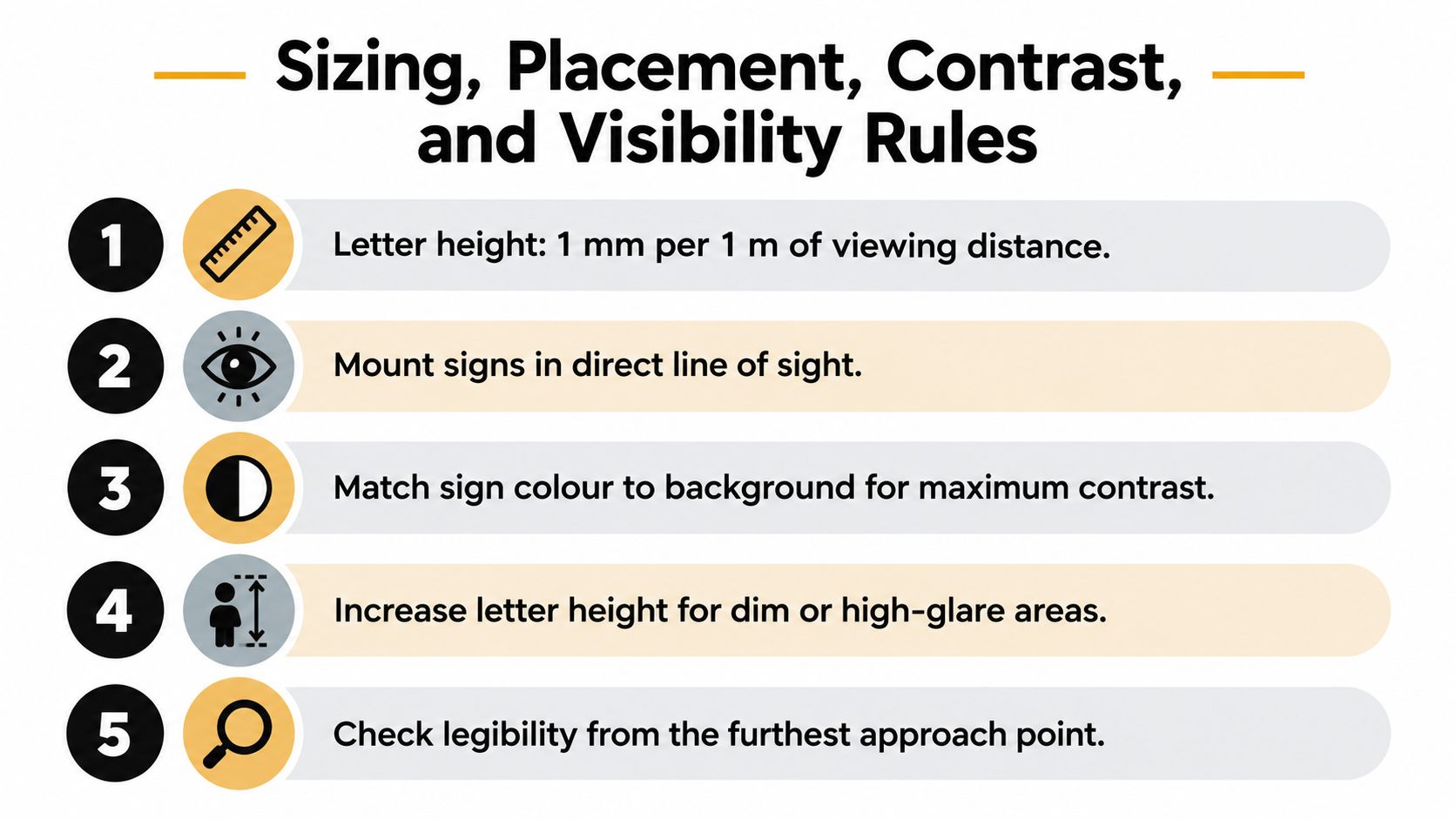
A sign works only when the intended reader can identify it in its intended environment. Start at the furthest approach point and check the sign while standing, walking, driving or operating the relevant equipment. A design that looks clear on a desktop proof may fail beside glare, dust, racking or moving plant.
WorkSafe ACT states that AS 1319 doesn't prescribe a required material or nominal size for every safety sign. That makes application-specific judgement essential. Facilities teams should document the viewing distance, lighting, background, obstruction risk and audience for each sign type instead of treating a standard dimension as automatically compliant.
Five checks before approval
- Check viewing distance. The message and pictogram must remain legible from the point where a person needs to act.
- Check the line of sight. Keep signs visible from normal approaches, not hidden behind doors, stacked goods, pipes or vehicles.
- Check contrast. The sign face, pictogram and text must remain distinguishable from the surrounding wall or equipment.
- Check lighting. Emergency and exit information must remain usable in the conditions in which people may need it, including low-light areas.
- Check the hazard relationship. Place the sign next to or before the hazard so the warning arrives before the decision point.
Illumination deserves its own site walk. Plant rooms, basements, external paths and areas affected by power loss may require a building or emergency-lighting assessment. A qualified commercial lighting contractor can help facilities teams review whether the surrounding lighting supports the sign's intended use.
Laser engraving on suitable materials can produce crisp pictograms and consistent text. Trotec Laser systems are useful when the sign specification calls for repeatable detail, but the machine alone doesn't make a sign compliant. Material selection, artwork approval, contrast, location and maintenance still determine whether the finished sign performs.
For a practical design and production reference, review Evright Industrial's safety signage design service. Ask the supplier to show the sign at its intended size and viewing distance before production.
Hazardous Chemical and Confined Space Signage Rules
A chemical store or confined-space entry needs a sign at the hazard, not a generic safety board at the site entrance. Australian workplace signage is a layered compliance system. WHS hazard communication, building-code egress and site-identification duties can overlap, and each sign must serve its specific control point.
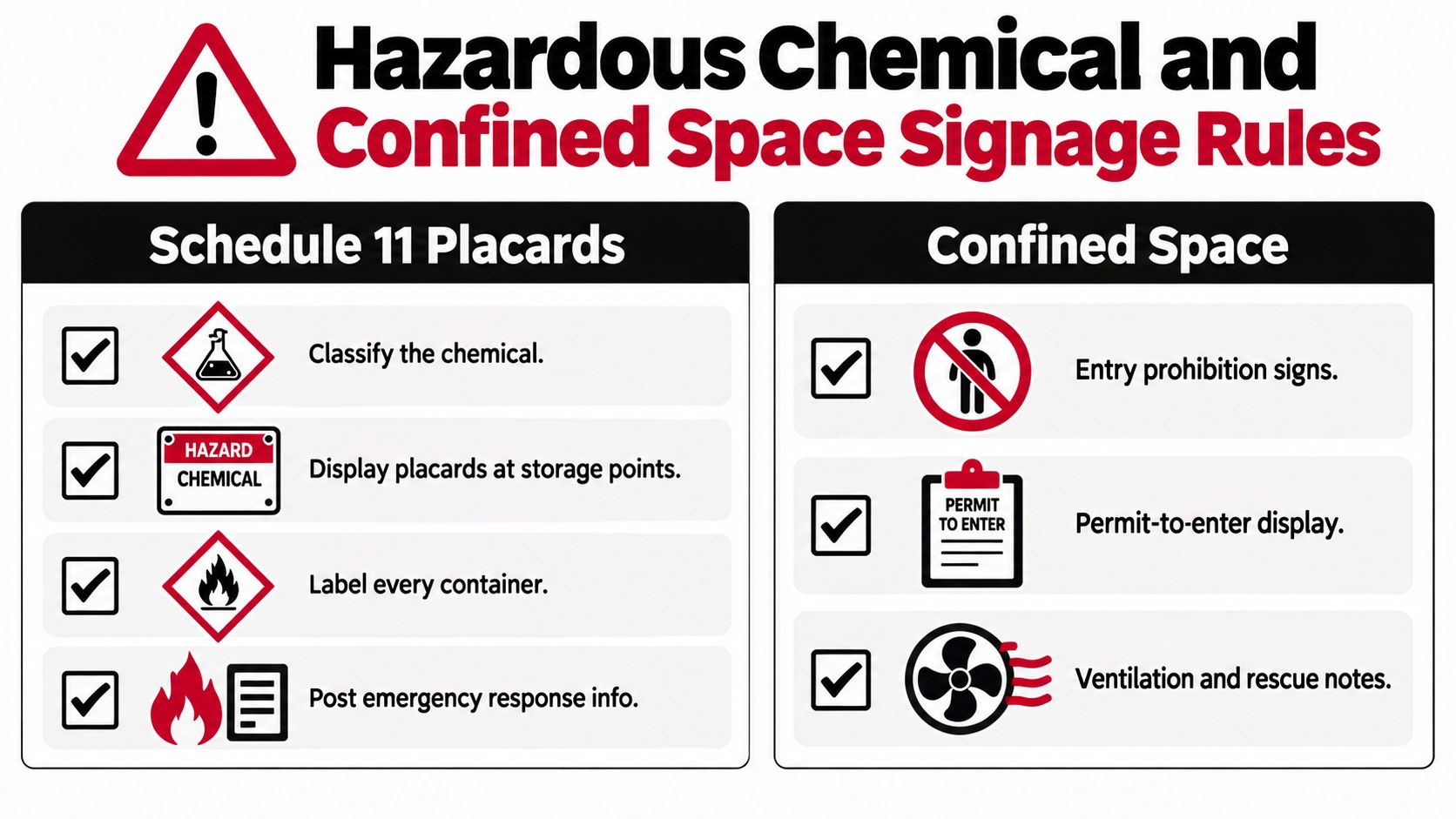
Safe Work Australia requires a safety sign where a PCBU stores, handles or uses hazardous chemicals. A placard is required when quantities reach the Schedule 11 placard thresholds in the model WHS Regulations. Position the sign next to the hazard, where people approaching it can read it before handling, entering or moving through the area. Safe Work Australia sets out the chemical sign and placard duties.
Set up chemical storage signs around the real risk
Start with the storage and handling points, then confirm each sign against the site procedure:
- Identify the point of control. Put the relevant safety information where workers approach the chemical hazard.
- Confirm the quantity. Check whether the stored amount reaches the applicable Schedule 11 threshold.
- Separate labels from placards. Container labels identify the contents and hazards, while larger storage-point information serves the surrounding area.
- Protect visibility and legibility. Keep signs clear of gates, pallets, open doors and stored equipment. Select a face that remains readable after chemical exposure, cleaning and outdoor conditions, using Evright Industrial's chemical-resistant labels where those conditions apply.
The sign should reflect the chemical-risk assessment and its control arrangements. The Opus Safety coshh assessment provides useful assessment terminology, but Australian operators must apply Australian WHS requirements and their local procedures. A Trotec-laser-built sign can support this system from artwork through production when the specified material, wording and finish suit the site.
Confined-space signs have a defined work window
Under the model WHS Regulations, erect the sign immediately before work begins. Keep it in place while work is underway and remove it when the work is completed. The sign must identify the confined space, instruct workers not to enter without a confined-space entry permit and sit clearly next to each entry. The model WHS explanatory statement describes this timing and placement requirement.
Use wording that matches the site procedure, such as “Confined space. Do not enter without a confined-space entry permit.” Do not add hazards the risk assessment has not established, and remove temporary signs after the work so they cannot mislead workers.
State Variations and Multi-Site Operators
Australian operators shouldn't assume that “nationally harmonised” means “identical in every jurisdiction.” Safe Work Australia states that the model WHS laws apply only after a state or territory separately adopts them as its own laws. That means the model framework provides a common reference point, while the applicable local legislation and regulator guidance still control the job. Safe Work Australia explains how the model laws operate across jurisdictions.
Use a national baseline, then verify exceptions
A multi-site operator should create one controlled baseline for sign categories, artwork, pictograms, terminology and material specifications. Before procurement, the responsible person should check the local implementation for hazardous chemicals, confined spaces, plant, emergency egress and construction-site information.
The baseline should also identify who approves changes. A local site manager may know that a chemical store has moved, while a building consultant may know that an egress sign must satisfy a project-specific condition. Neither should alter a master file without version control.
| Jurisdiction | Governing law | Key signage variation | Action for operators |
|---|---|---|---|
| Commonwealth model framework | Model WHS laws used as a reference | Duties apply only after local adoption | Use the model rules as a starting point |
| State or territory site | Locally adopted WHS legislation | Local wording, regulator guidance and implementation may differ | Confirm the current local requirement before ordering |
| Construction project | Local WHS law plus project and building obligations | Site identification and egress duties may sit alongside hazard signs | Review the contract, building context and site plan |
| Multi-site portfolio | Several local regimes and building contexts | One artwork set may need controlled local variants | Maintain a master catalogue with jurisdiction notes |
The consistent elements are usually the need for clear hazard information, suitable placement and worker understanding. The variable elements require a local check. Put that check into the purchase workflow, not into an emergency response after delivery.
Material Choices for Durable Industrial Signage
Material selection starts with the environment, not the supplier's default stock. A chemical store, outdoor yard, forklift aisle and emergency egress path expose signs to different stresses. Specify the substrate, finish, fixing method and expected maintenance conditions together.
Match the face to the failure mode
Anodised aluminium suits many industrial identification and safety applications where a stable metal face and resistance to corrosion matter. It still needs a review for aggressive chemicals, impact and mounting conditions.
Colour-coated steel can work for outdoor or building-mounted signs where a durable panel is required. Edge protection, scratching and corrosion at cut edges deserve attention, particularly in wet or coastal environments.
Polycarbonate is a practical option in impact-prone areas because it can tolerate knocks better than some brittle sign faces. Confirm chemical compatibility before using it near solvents, cleaners or process chemicals.
Photoluminescent materials support emergency egress applications where the building assessment calls for them. They shouldn't be treated as a universal replacement for other emergency-lighting or egress requirements.
Retroreflective aluminium can assist visibility around vehicles and low-light approaches. The application still needs a line-of-sight and lighting review, because reflectivity doesn't solve an obstructed sign.
Traffik-Guard materials may suit high-abrasion environments where ordinary printed faces are likely to be damaged. Confirm the exact product specification, compatibility and expected service conditions before adding it to a standard schedule.
Laser engraving can remove reliance on a surface overlay for the engraved detail, particularly on suitable metal substrates. Trotec Laser production can support consistent artwork and fine pictograms, but the substrate still determines how the sign behaves under UV, chemicals, impact and cleaning.
Industrial Signage Material Comparison
| Material | Service life | Best-fit application | Key limitation |
|---|---|---|---|
| Anodised aluminium | Depends on exposure and maintenance | Industrial safety and asset identification | Requires compatibility review for aggressive chemicals |
| Colour-coated steel | Depends on coating, edges and environment | Outdoor buildings and general site signs | Scratches and exposed edges can become failure points |
| Polycarbonate | Depends on chemical and UV exposure | Impact-prone internal areas | Not every chemical or cleaner is compatible |
| Photoluminescent material | Depends on charging conditions and product specification | Egress and emergency-path applications | Must be assessed alongside building and lighting obligations |
| Retroreflective aluminium | Depends on face, exposure and cleaning | Vehicle areas and low-light approaches | Reflectivity can't overcome poor placement |
| Traffik-Guard material | Depends on the selected grade and site conditions | High-abrasion or traffic-exposed areas | Verify the exact product specification before purchase |
Ask for a sample exposed to the actual cleaning method and environment when the site is demanding. A cheap face that needs frequent replacement is rarely cheap once labour, access equipment and audit disruption are included.
Installation, Maintenance, and Audit Readiness
Installation is where a good sign schedule either works or fails. A sign can have the correct message and still be ineffective if a pallet hides it, a door swings across it or a vehicle clips the panel.
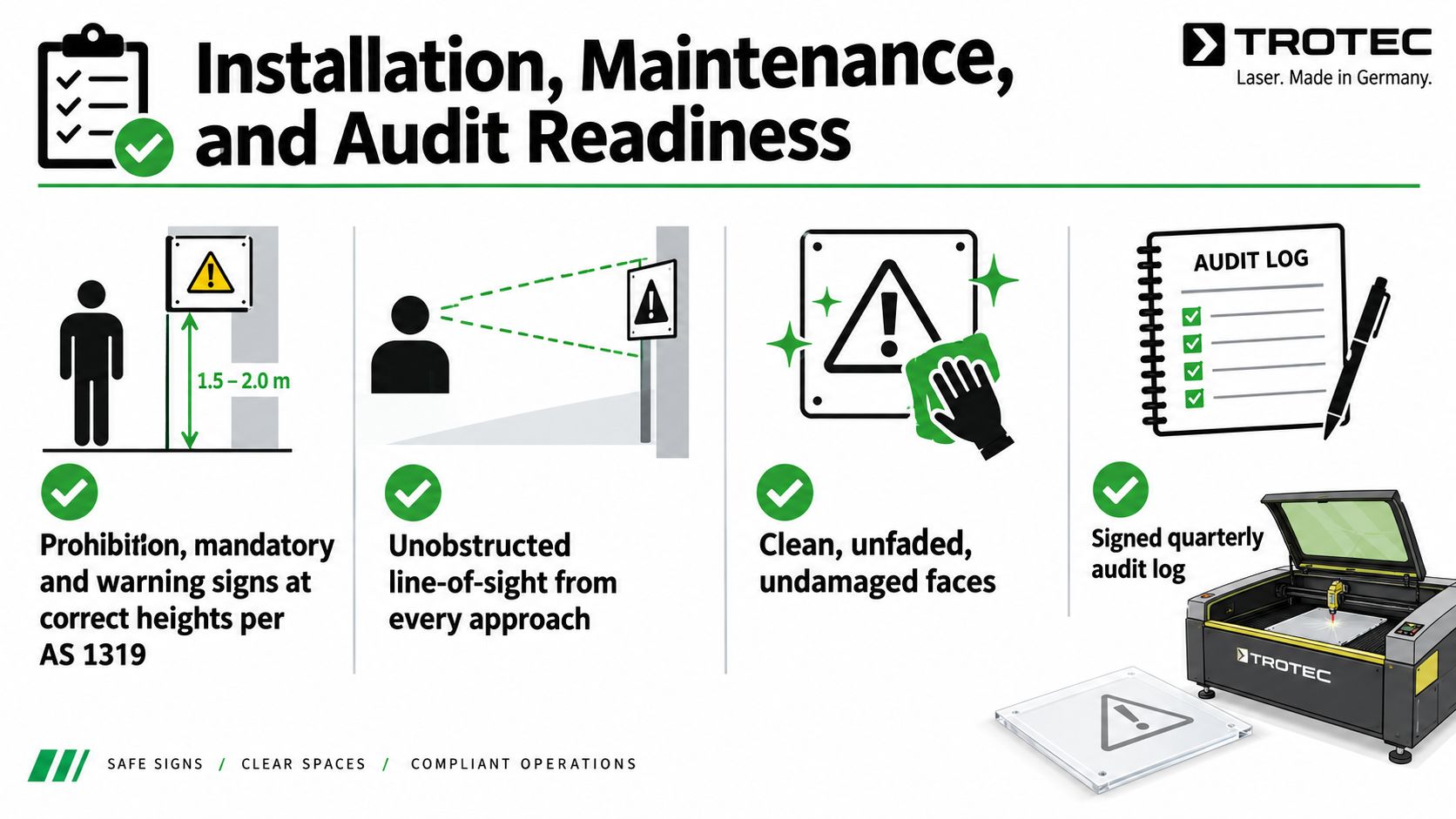
Use the applicable AS 1319 guidance and the site risk assessment to determine mounting position. WorkSafe ACT makes clear that the standard doesn't impose one universal material or nominal size, so teams should record why the selected sign is suitable for the intended application.
Installation checklist
- Confirm the approach: View the sign from every normal pedestrian, vehicle and equipment approach.
- Protect the clearance: Keep signs away from vehicle paths, door swings, stored goods and moving plant.
- Align the message: Place the sign before the decision point where a worker needs to act.
- Check emergency visibility: Confirm that emergency and fire information remains visible during realistic conditions.
- Photograph the result: Capture the installed sign and its surrounding context for the register.
Inspect on a fixed routine
A quarterly inspection is a sensible operational rhythm for many facilities, with more frequent checks in harsh or high-traffic areas. Clean the face using an approved method, inspect contrast and pictograms, test fasteners, and look for fading, graffiti, cracking, delamination, corrosion or impact damage.
Replace a sign when the message can't be read quickly, when the pictogram is damaged, when the panel has moved out of position or when the surrounding operation has changed. Don't wait for a regulator, auditor or incident to expose the gap.
For teams building a broader evidence system, a Wistec compliance documentation guide can help frame the record-keeping task. Your signage register should include:
- Location and sign category
- Wording and artwork revision
- Material and finish
- Supplier and batch information
- Installation date
- Inspection date and inspector
- Photographic evidence
- Defect, replacement and close-out records
A register turns “we think the signs are current” into evidence that someone inspected the site and acted on defects.
Procurement Workflow and Bringing It All Together
Order workplace signage requirements in a controlled sequence. Start with the site, not the supplier catalogue.
Step one is a complete audit
Walk the site with the person responsible for WHS, the facility manager and a representative from operations. Mark chemical stores, confined-space entries, plant interfaces, pedestrian routes, vehicle areas, emergency equipment, exits, assembly points, restricted rooms and construction-site entry points.
Record the viewing direction, approximate distance, lighting, background, exposure and current sign condition. Take photographs before removing anything. The audit should identify missing signs as well as damaged ones.
Step two is a risk-based sign schedule
Assign each requirement to a category and write the required action in plain language. Check whether the location invokes AS 1319, model WHS duties, building-code requirements, project rules or more than one of these.
For chemicals, confirm whether the relevant storage quantity reaches the applicable placard threshold. For confined spaces, confirm each entry point and the timing of temporary signs. For egress, confirm the building context and emergency-lighting assessment rather than ordering generic glow-in-the-dark arrows.
Step three is artwork and specification approval
Every RFQ should state:
- Sign wording and approved pictograms
- Finished dimensions and viewing conditions
- Substrate, finish and edge treatment
- Fixings and mounting method
- Indoor or outdoor exposure
- Chemical, abrasion and wash-down conditions
- Required documentation and batch traceability
- Expected service conditions and replacement process
- Applicable AS 1319, WHS, building or project checks
Ask suppliers how they control batch consistency, how they proof artwork, what production method they use and how they handle replacement orders. Request a physical sample when colour, contrast or material performance is critical.
For custom workplace orders, Evright Industrial's custom safety signs are one option for facilities teams specifying durable engraved or labelled signs. Trotec Laser machinery can produce repeatable engraved detail and consistent artwork, but the procurement decision should still be based on the complete specification.
The broader evright.com engraving service works by turning approved artwork and material requirements into a produced engraved item, with the sign or label then checked against the order before dispatch. That production step supports traceability, but it doesn't replace the client's responsibility to confirm the correct message, location and regulatory context.
Step four is controlled installation
Install from the approved schedule, photograph each completed location and record any field change. Update the sign register immediately. If the building, process or traffic route changes, reopen the sign assessment instead of moving a panel casually.
A Worksite Tuesday morning should produce a short action list:
- Replace unreadable or damaged signs first.
- Confirm chemical and confined-space entries.
- Check emergency egress and site-identification obligations.
- Approve material and artwork samples.
- Issue one controlled RFQ with the full schedule.
- Book installation and update the register on completion.
Evright Industrial supplies custom safety, compliance and asset-identification signage for industrial, healthcare, construction, infrastructure and government environments. Visit Evright Industrial with your site schedule, viewing conditions and material requirements, and ask for a production recommendation that can stand up to daily use and future replacement orders.
Recent Comments