

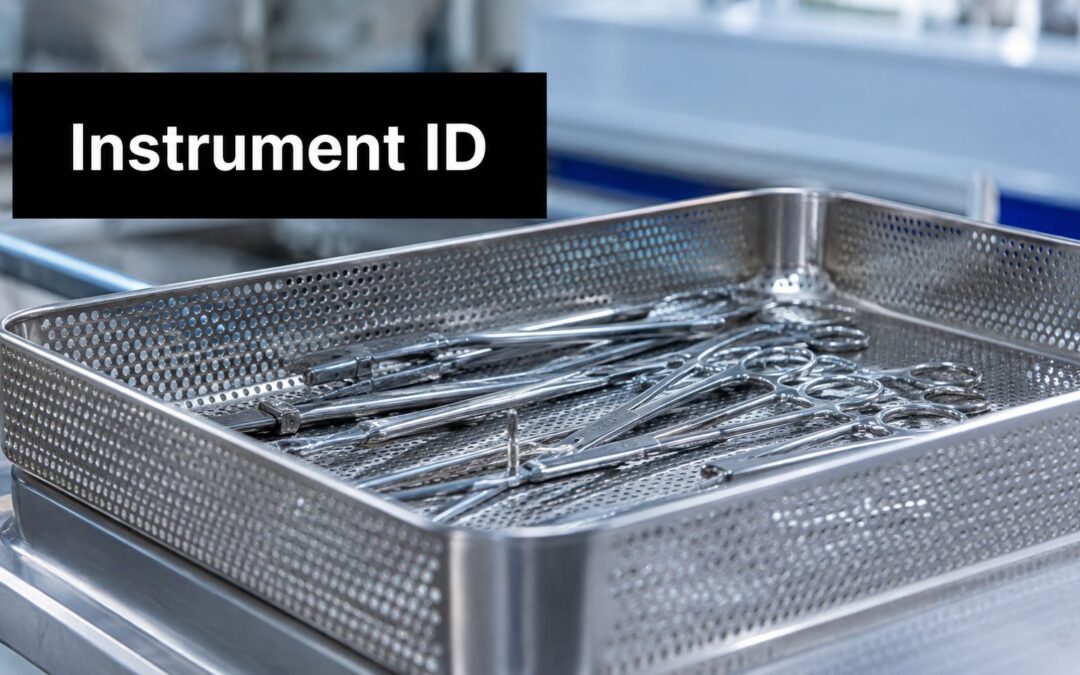
A tray arrives in decontamination after a busy operating list. Most instruments are familiar, but one small clamp has no manufacturer mark, no readable code, and no obvious place in the count sheet. The technician can identify its general function, yet can't confidently link it to a purchase record, a sterilisation history, or the patient event where it was used. That gap is the practical challenge behind surgical instrument identification. It involves more than recognising a forceps by shape. It means creating an identity that survives cleaning, sterilisation, storage, clinical use, audits, recalls, and changes in staff.
Why Surgical Instrument Identification Matters in Modern Healthcare

An unmarked clamp can stop a tray in decontamination. The technician may know its general function but still be unable to confirm whether it belongs in that set, has a complete inspection history, or should be quarantined for assessment. If a nonconforming device is later linked to a procedure, the department may struggle to locate the affected instrument and contain the recall.
That problem exists alongside newer instruments supplied with UDI-compliant identification. A new device may carry a readable code, while a legacy collection still depends on names, tray locations, handwritten notes, or staff memory. A workable identification program has to support both conditions without slowing every handoff.
Australian hospitals and day procedure services have been required to maintain traceability for critical and semi-critical reusable instruments under the National Safety and Quality Health Service framework. The process must identify the patient, procedure, and specific reusable equipment used during the procedure. The requirement affects daily processing decisions, from accepting an item into the department to confirming its history after use.
The identity must follow the instrument
A tray label identifies the set, not necessarily the individual device inside it. Item-level identity gives staff a stronger connection between the instrument and its inspection, reprocessing, maintenance, and procedure records.
A practical chain can connect:
- Receiving: The instrument enters with a known source, description, and status.
- Inspection: Staff record damage, missing components, repairs, or removal from service.
- Cleaning and sterilisation: The item is associated with reprocessing activity and relevant test results.
- Tray assembly: Staff can place the intended instrument in the correct set and reduce substitutions.
- Point of use: The record connects the device with a procedure and patient event.
- Recall response: Staff can isolate affected items instead of treating an entire inventory as unknown.
Identification only helps when staff can read and use it at the first scan. A blurred label, shallow mark, inconsistent name, or mark hidden beneath a hinge creates manual searching. That search can delay a tray or result in an unverified substitution.
Practical rule: If a technician cannot identify an instrument quickly in decontamination, its mark is not supporting the workflow adequately.
The same identity must make sense to operating theatres, procurement, biomedical services, infection prevention teams, and external maintenance providers. Facilities coordinating environmental hygiene around clinical areas may also use a trusted medical cleaning provider. Cleaning support, however, does not replace device-level traceability. The instrument still needs a durable identity that staff can verify after reprocessing.
Australian Standards and Regulatory Requirements for Instrument Traceability

Australian facilities work within two connected requirements. The National Safety and Quality Health Service framework sets expectations for health-service traceability. The Therapeutic Goods Administration is developing a Unique Device Identification framework that places identity on the device, its label, and relevant packaging.
AS/NZS 4187:2014 became operational in December 2016 and remains widely used by hospitals and day procedure services for reusable instrument traceability. Its practical focus is the documentation chain. The standard addresses more than sterilisation quality. It supports records that connect equipment with a patient event and help a facility act when a nonconforming device has been used.
For a new UDI-compliant instrument, the manufacturer should provide an identity that survives the device's intended handling and reprocessing. Legacy collections create a different problem. They may have inconsistent names, missing marks, or identifiers that exist only on packaging. A facility still needs a workable method to distinguish those instruments within its own records, even where the current regulatory requirement does not demand direct marking.
AS 5369 raises the operational bar
AS 5369:2023 moves traceability from reprocessing towards point of use. Australian instrument-tracking practice commonly records patient ID, sterilisation cycle, and device usage, with unique identification supported where possible. Tracking systems may also combine Al-Foil, pencil test, washer-disinfector, autoclave, and helix results in one audit trail, as described in Australian guidance on UDI and instrument tracking.
That distinction becomes clear during an audit. A steriliser record alone does not show which instrument reached which patient event. Staff must be able to connect the cycle, instrument, and use record. The mark is therefore part of the information system, not a cosmetic addition.
The regulatory position leaves a practical gap. AS 5369 directs facilities towards full traceability and electronic or manual tracking, while the TGA does not currently require direct part marking or UDI for Class I reusable surgical instruments. Those instruments still make up much of routine surgical tooling. The comparison between TGA requirements and AS 5369 expectations explains why a facility may need stronger operating controls than the narrowest regulatory requirement specifies.
UDI implementation is phased
The published Australian UDI pathway includes these milestones:
- 26 May 2021: Implantable and Class III devices were required to comply.
- 26 May 2023: Class IIa and IIb devices were included.
- 26 May 2025: Class I reusable medical devices were included.
- 26 May 2027: Direct part marking on reusable Class I devices is scheduled for inclusion.
This phased pathway is outlined in the Australian surgical instrument UDI update. It separates label-level identity from a permanent device mark. Packaging can be removed or separated during handling, while direct marking stays with the reusable instrument.
The TGA defines a UDI as a Device Identifier, or UDI-DI, and, where applicable, a Production Identifier, or UDI-PI. The UDI-DI identifies the device model. The UDI-PI carries production details such as lot or batch information, expiry information, and manufacturer information. Approved issuing agencies in Australia include GS1, HIBCC, and ICCBBA, as set out in this TGA UDI factsheet.
Facilities reviewing label design and marking obligations can consult this medical device labelling requirements guide.
Current TGA guidance says manufacturers and sponsors must place a UDI on the device label, on the device itself where direct marking applies, and on applicable higher packaging levels. For reusable devices intended for reprocessing between patients, the full UDI must be directly marked so it cannot be removed and can withstand normal use and cleaning throughout the device's lifetime, as described in the TGA's UDI labelling and packaging requirements.
Comparing Identification Methods and Materials for Surgical Instruments
No single marking method suits every instrument, inventory, or scanning environment. The correct choice depends on the substrate, available surface, expected cleaning process, code size, staff behaviour, and whether the facility needs a permanent device identity or a temporary handling label.
| Method | Durability (Autoclave Cycles) | Cost per Instrument | Implementation Complexity | Best Use Case |
|---|---|---|---|---|
| Laser engraving or etching | High when correctly specified and validated for the instrument material | Moderate | Moderate | Permanent identity on stainless steel and compatible reusable devices |
| Dot peen marking | High on suitable rigid metals | Moderate | Moderate to high | Deep, tactile marks where surface deformation is acceptable |
| Durable labels | Variable and dependent on adhesive, material, and placement | Low to moderate | Low | Packaging, temporary identification, or items unsuitable for direct marking |
| RFID tags | Dependent on tag construction and attachment method | Moderate to high | High | Automated location and workflow capture where readers are installed |
| Colour coding | Limited as a unique identifier | Low | Low | Set organisation, department grouping, or visual differentiation |
Why laser marking is often the practical choice
A laser can create a consistent, high-contrast mark without attaching a separate label to the instrument. On stainless steel, the process can be configured as engraving or etching, depending on the required interaction with the surface and the readability target. The mark still needs validation. A laser is not a substitute for correct code design, suitable placement, or post-processing inspection.
Trotec Laser equipment is relevant where a facility or marking provider needs controlled positioning, repeatable output, and fine detail. Trotec laser machine imagery is also more appropriate for communicating medical marking work than imagery of mechanical marking equipment, because the production method needs to reflect the precision and cleanliness expected of surgical instrument identification.
The TGA states that direct marking on reusable devices should withstand normal use and cleaning for the lifetime of the device. That sets a meaningful performance requirement, but it doesn't mean every mark will remain readable automatically. Surface finish, curvature, contrast, chemical exposure, handling, and scanner angle all affect performance.
Alternatives still have a place
Dot peen can produce a physically pronounced mark, but it may be unsuitable where surface deformation, crevices, or stress concentration could affect cleaning or instrument function. Labels are simple to deploy, though they can lift, obscure a working area, or become unreadable during repeated reprocessing. RFID can capture data without line-of-sight scanning, but it adds hardware, tag-management, validation, and integration demands.
Colour coding works well for quick grouping, such as differentiating a service line or helping staff spot a set component. It shouldn't be treated as the sole identity of an individual instrument. Colours fade, become contaminated, and don't provide a dependable link to a patient record or production history.
For stainless steel marking specifications and examples, review laser-etched stainless steel services before choosing a process. Ask for sample marks on the actual instrument grade, not merely a similar-looking test coupon.
Implementation Best Practices for Marking Surgical Instruments
A durable mark starts with a workflow decision, not a machine setting. Before marking a collection, define what staff must identify, what the tracking system can read, and which surfaces can accept a mark without affecting function, cleaning, inspection, or sterilisation.

Start with the identity model
Separate model identity from production identity. The UDI-DI identifies the device model, while the UDI-PI can carry production-specific details such as a lot or batch number, expiry information, and manufacturer information. A reusable surgical instrument may need a human-readable identifier alongside a machine-readable carrier, but the selected format must fit the available marking area and scanning environment.
Use a controlled naming convention for legacy instruments and internally managed assets. Avoid descriptions such as “small curved clamp” as the primary record. That description may help a technician, but it doesn't distinguish similar items reliably. Combine a stable asset identifier with fields for instrument family, manufacturer when known, model, material, department ownership, condition, and disposition.
Choose the placement zone carefully
The best location is visible during inspection and scanning, but it mustn't interfere with the instrument's working surfaces or moving parts. Common considerations include:
- Handle areas: Often provide a readable surface, but avoid textured grips, locking mechanisms, and locations where the mark is hidden when the instrument is closed.
- Shafts: Can work for suitable instruments, provided the mark doesn't sit in a contact area or compromise cleaning access.
- Flat collars or widened sections: May provide better contrast and scanner access than narrow curved surfaces.
- Box locks and hinges: Require caution because debris retention and mechanical wear can create cleaning or inspection concerns.
Marking location should be approved by clinical engineering, sterile processing, and the manufacturer where appropriate. A mark that is technically permanent but routinely hidden or difficult to scan will still create manual work.
Validate the complete process
Test the mark after the cleaning and sterilisation process used by the facility. Check human readability under normal department lighting, scanner performance at realistic angles, and the effect of soil, moisture, surface wear, and instrument curvature.
Record the acceptance criteria and retain sample images. If a provider is involved, request evidence that the marking process is suitable for the instrument material and intended reprocessing environment. Trotec Laser systems can support repeatable marking, but the facility remains responsible for verifying that the result works in its own workflow.
Train staff to reject ambiguous marks. The correct response to a failed scan is controlled verification against the instrument record, not guessing from shape or placing an unknown item into a tray. That decision prevents a small identification defect from becoming a traceability defect.
Integrating Identification into Sterile Processing and Traceability Workflows
A mark only creates value when staff can use it at the point where a decision is made. The identity should enter the tracking record during receiving or inspection, then remain available through decontamination, assembly, sterilisation, storage, distribution, and point of use.
At receiving, staff confirm that the physical mark matches the inventory record. During inspection, they check whether the mark remains legible and whether the instrument has damage or wear that requires repair. In decontamination, the identifier supports correct routing and helps staff avoid creating duplicate records for similar instruments.
Build the record around events
A practical electronic workflow may capture:
- Receiving and inspection: Asset identity, source, condition, and disposition.
- Cleaning: Washer-disinfector association and inspection status.
- Sterilisation: Cycle identity, load information, and release checks.
- Testing: Al-Foil, pencil test, helix, autoclave, and other applicable results.
- Assembly: Tray, count sheet, operator, and substitutions.
- Use: Patient ID, procedure, and device usage.
- Maintenance: Repair, refurbishment, retirement, or replacement activity.
Australian expectations are moving beyond tray-level records towards item-level, patient-linked chain of custody. The operational benefit is containment. When a problem is identified, staff can search for the affected item or usage record rather than relying on memory, paper notes, or an assumption that every instrument in a tray followed the same path.
Design around failure points
The most common failure isn't always the absence of software. It's the mismatch between the physical mark and the system. A code may be too small for the scanner, placed where the operator can't reach it, duplicated in the inventory, or recorded under a description that differs between departments.
Integrate scanners where staff already work. If RFID is introduced, define which events require a reader and what happens when a tag can't be read. If barcodes are used, test the carrier after cleaning and sterilisation, not just when it leaves the marking area.
A tracking platform such as hospital equipment tracking software can support the broader asset workflow, but implementation still depends on disciplined master data, user permissions, exception handling, and staff training.
A tracking system can't recover an identity that was never assigned, duplicated, or made unreadable.
Use exception queues instead of informal workarounds. An unreadable mark should create a visible task for assessment, remarking, quarantine, or retirement. That approach gives managers a measurable view of recurring problems, whether they arise from a particular instrument material, marking location, cleaning process, or supplier batch.
Solving the Legacy Instrument Identification Challenge
Many facilities have a mixed collection. New instruments arrive with manufacturer information and an emerging UDI pathway, while older items may carry an illegible logo, a partial catalogue number, or no mark at all. Treating every unknown instrument as disposable can waste usable equipment, but returning it to service without a controlled identity leaves a traceability gap.
The first step is classification, not marking. Photograph the instrument from several angles, record its functional features, compare it with approved count sheets, and search manufacturer catalogues or internal procurement records. Historical catalogues and photographed collections can help when current product codes no longer match the instrument.
The SPASM Museum notes that more than 50% of its instruments and equipment items have been identified and catalogued using scanned images and catalogues rather than current product codes in its collection work, as shown on its instrument collection reference page. That example demonstrates why visual comparison and historical documentation remain useful, especially for instruments without modern identifiers.
Create a controlled backlog process
Separate unidentified items from routine production without stopping daily work. A practical queue can classify instruments as:
- Known and serviceable: Add the existing identity to the inventory and verify the record.
- Known but unmarked: Confirm provenance, assign an approved identifier, and assess whether permanent marking is appropriate.
- Possibly identifiable: Compare photographs, dimensions, function, and catalogue information before making a decision.
- Unknown or unsuitable: Quarantine for expert review, refurbishment assessment, or retirement.
Don't mark an instrument before its identity and ownership are sufficiently established. A permanent code attached to the wrong record is harder to correct than a missing code.
For legacy items that remain clinically appropriate, laser marking may provide a durable link to the facility's asset record. The mark should identify the instrument within the organisation's system, rather than imply a manufacturer UDI that the facility can't substantiate. Where provenance remains uncertain, cataloguing may be the right outcome, while replacement may be safer when the instrument's material, function, or reprocessing suitability can't be verified.
Selecting the Right Identification Solution for Your Facility
Choose the solution by starting with the workflow you need to control. A small legacy backlog may need cataloguing, approved asset IDs, and a marking partner. A large hospital network may need a coordinated programme that connects permanent marks, barcode scanners, UDI data, inventory software, and recall procedures.
Assess these questions before selecting equipment or a provider:
- What must be identified? Separate new regulated devices, reusable Class I instruments, legacy items, trays, containers, and loan sets.
- Where will scanning happen? Test access in receiving, decontamination, assembly, sterilisation, storage, and theatre.
- What must the record prove? Define the links between instrument, sterilisation cycle, patient, procedure, usage, and recall action.
- Which materials are involved? Validate stainless steel and any other instrument materials individually.
- How will failures be managed? Set rules for unreadable marks, duplicate identities, damaged items, and unknown instruments.
- Who owns the master data? Assign responsibility for code creation, changes, retirement, and audit review.
- How will the rollout be tested? Pilot a representative sample before expanding across the collection.
Ask marking providers about Trotec Laser machine capabilities, code readability, placement controls, material compatibility, sample validation, and documentation. Evright Industrial offers laser engraving and asset labelling services that can be considered alongside internal marking, UDI support, and other identification options. A pilot should include instruments with different shapes, finishes, hinges, and cleaning demands, because a mark that works on a flat sample may fail on a curved or frequently handled instrument.
Phase the programme around operational capacity, procurement cycles, and the published UDI milestones. Start with the items that create the greatest recall, audit, or identification risk, then expand once staff can verify marks consistently and the tracking system handles exceptions without resorting to paper workarounds.
If your facility is dealing with unmarked legacy instruments, new UDI-related requirements, or unreadable identifiers after reprocessing, Evright Industrial can discuss laser engraving and durable asset labelling options for your collection. Contact the team with representative instrument samples and your workflow requirements so the marking approach can be assessed for placement, readability, and traceability use.
Recent Comments