
$40 million in combined financial penalties accompanied Australia's 293 WHS prosecutions in 2023, including 45 cases involving a fatal injury, according to Safe Work Australia's prosecution update. The same update reports an average penalty of $138,724, with 72% of defendants pleading guilty and fewer than 1% pleading not guilty.
Those consequences can begin with something ordinary: a maintenance job handed over without a clear isolation list, a machine returned to service before its guard is checked, or an emergency instruction nobody can read. Safety non compliance isn't defined by whether an inspector arrives. It starts when the work no longer meets the duty to protect people.
A Stop-Work That Started as a Faded Control
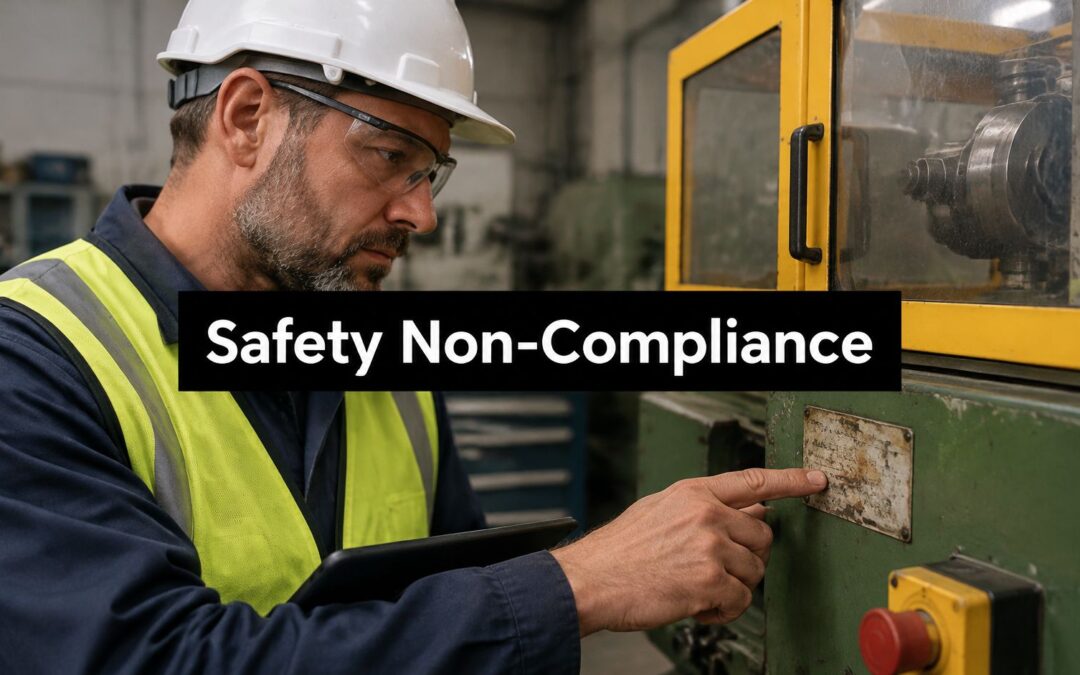
Say a production crew arrives to find an inspector standing beside a conveyor. The drive guard is off, the isolation point isn't clearly identified, and the supervisor can't confirm whether the maintenance team has finished. A prohibition notice stops the exposed work. Operators wait while someone finds the electrician, retrieves the job record and works out who authorised the restart.
The human stakes are larger than a delayed dispatch: 200 workers were fatally injured at work in Australia in 2023, compared with 195 in 2022, according to Safe Work Australia's key WHS statistics.
The failure began before the shutdown
In this scenario, the faded identification didn't remove the guard. It did make an already unsafe handover harder to resolve. The supervisor couldn't reliably connect the physical machine, its energy sources and its maintenance instructions.
Safety non-compliance is a failure to meet a work health and safety duty in how work is done, not a missing signature on a form.
A quieter prosecution year isn't proof that the floor is safer. Some failures remain unnoticed until someone tests the control, reports the hazard or gets hurt.
A useful response needs more than replacement signs. It needs a clear understanding of the duty, the regulator's notice, the applicable penalty framework and the evidence that the repair worked. The cause-and-evidence and notice lookup tables below support that assessment, followed by a practical sequence a supervisor can run before the next audit.
What Safety Non-Compliance Means in Practice
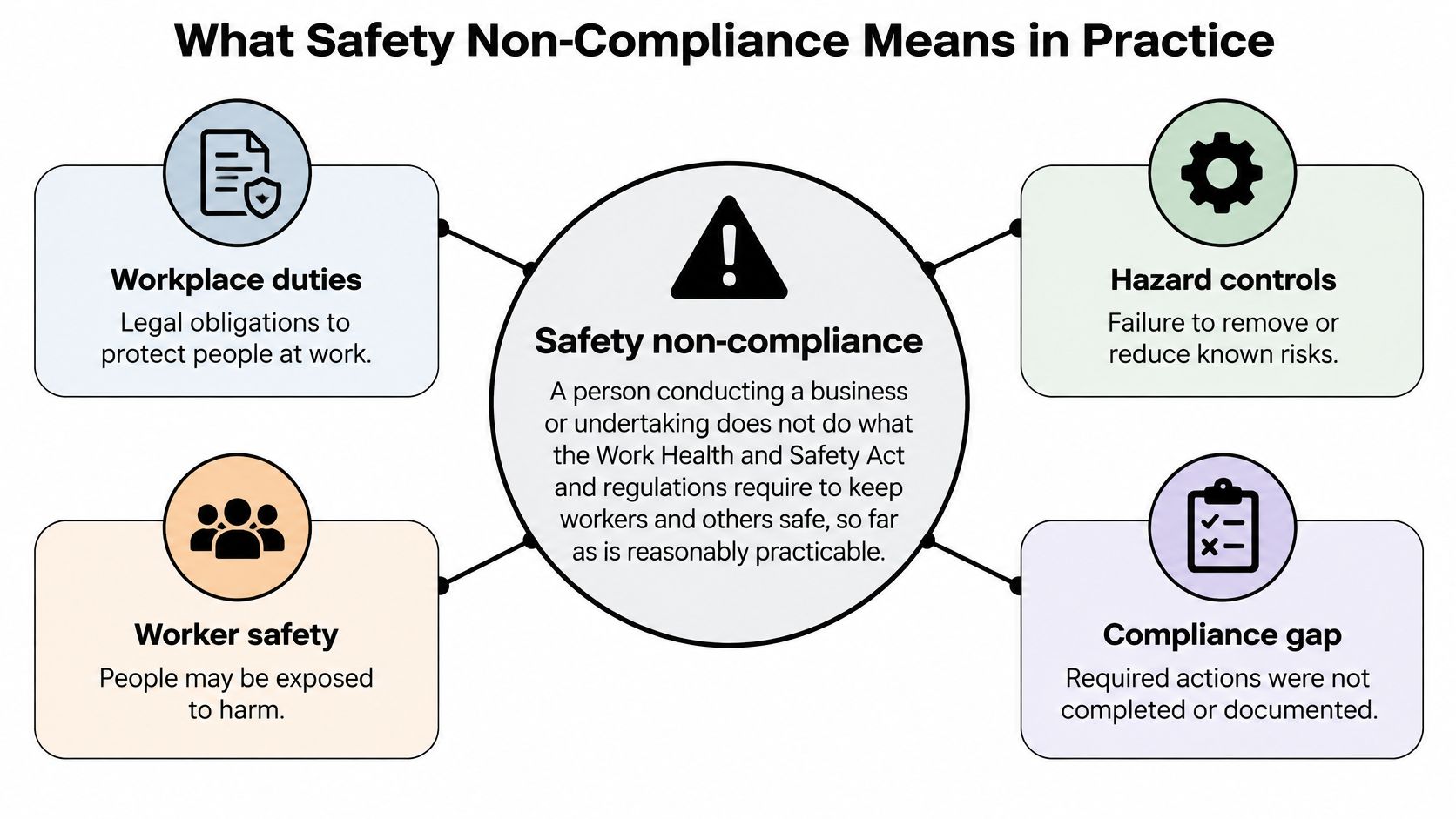
A person conducting a business or undertaking, or PCBU, must do what the applicable WHS legislation requires to protect workers and others, so far as is reasonably practicable. Non-compliance occurs when the business doesn't meet that duty. An injury isn't necessary for a breach to exist.
Take a workshop saw. The engineering control is the guard that prevents access to the blade. The procedure governs who may remove it and how the saw is isolated. The identification tells the incoming shift which saw is out of service and which instruction applies.
A complete folder doesn't make an exposed blade safe. Equally, a clear out-of-service label doesn't prevent an unauthorised restart unless isolation is effective.
Falling case counts don't measure all unsafe work
Safe Work Australia's prosecution release recorded 308 prosecutions in 2025, down from 321 in 2024, while the average financial penalty increased 33% to $147,985; 99% resulted in a financial penalty, and manufacturing represented 20% of defendants.
Those figures describe enforcement outcomes, not the prevalence of unsafe conditions. Inspectors can't observe every task, workers may not report every incident, and prosecution decisions don't provide a census of failed controls. A lower count therefore can't establish that fewer people were exposed.
The practical question is whether a control can fail without anybody noticing.
Common causes of safety non-compliance and the evidence that proves control
| Cause | Control that must work | Evidence to keep |
|---|---|---|
| Illegible or missing asset identity | Each item identifiable and matched to its procedure | Asset register and legible on-site label record |
| Unknown maintenance status | Inspection dates visible and current | Inspection and maintenance log entries |
| Unmarked isolation points | Every energy source located and tagged | Lockout audit record |
| Stale emergency information | Current contacts and instructions at point of use | Dated review record |
| Weak contractor handover | Incoming crew can read labels and isolation lists | Signed handover checklist |
| Controls never verified | Guard interlock, lockout and checks tested in operation | Dated test results and competency records |
| Under-reported psychological harm | Incidents captured under applicable strengthened notification duties | Incident register entries |
A missed inspection is a deviation requiring assessment. Continuing to operate equipment when that omission leaves a required safety control unverified can become non-compliance. A notice or injury is a possible consequence, not the definition.
Durable identification supports the control system. It cannot replace a guard, a lockout or a risk assessment. Its job is to help the right person apply the right control to the right asset.
Australian Notices Fines and Prosecutions
Australian WHS notices and outcomes, 2018–19
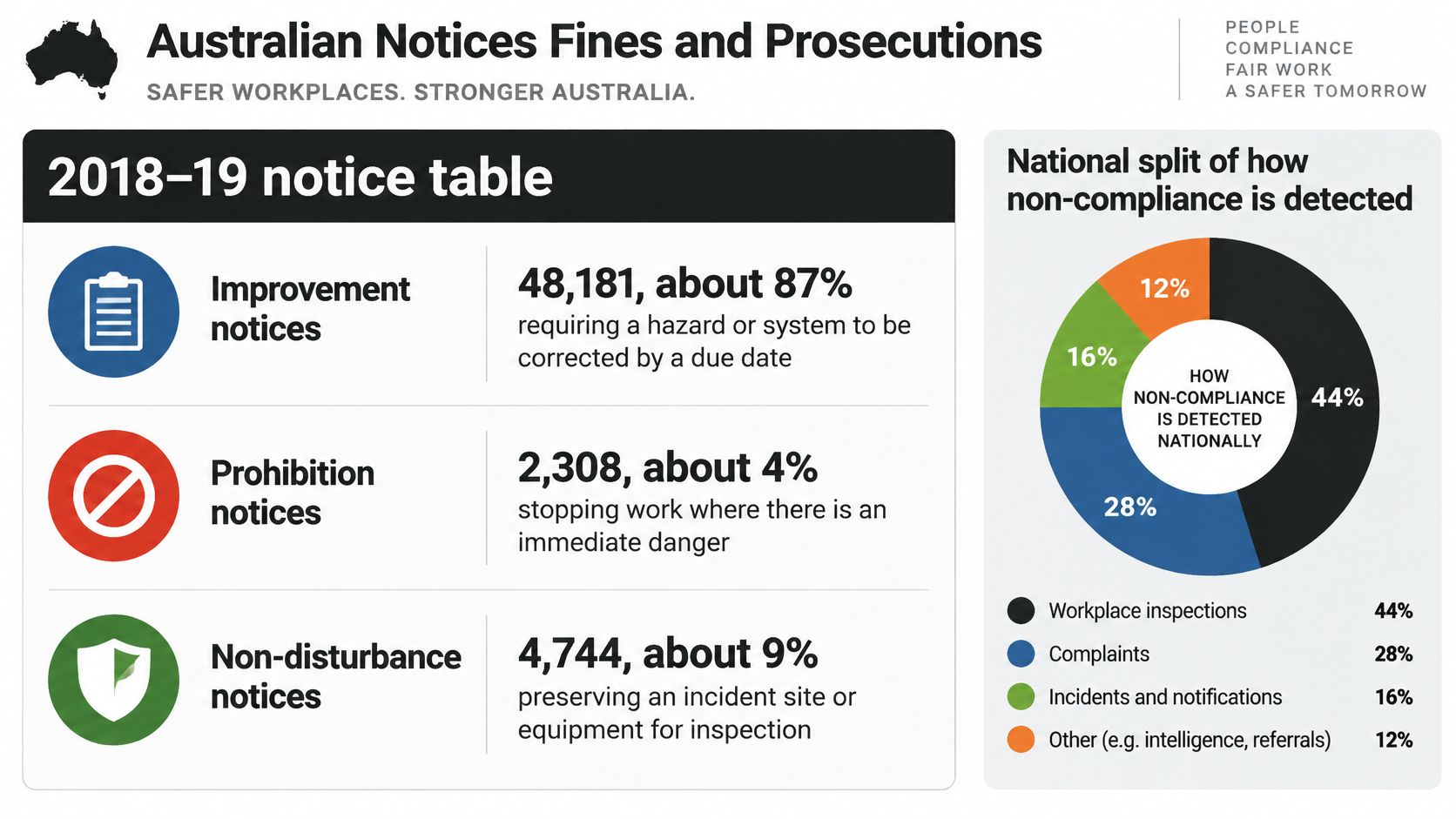
The national figures in Safe Work Australia's comparative performance monitoring report record 55,568 notices in 2018–19, up 20% on the previous year, with the notice split and finalised proceedings shown below.
| Outcome | Count | Share of notices | What it requires |
|---|---|---|---|
| Improvement notice | 48,181 | About 87% | Correct the hazard or system by the due date |
| Prohibition notice | 5,884 | About 11% | Stop the work until the serious risk is controlled |
| Infringement notice | 1,503 | About 3% | Pay a penalty for the breach |
| Proceedings finalised | 307 | Not a notice | 264 ended in conviction, order or agreement; $18.6 million in fines |
The shares are rounded, so they don't add neatly to the whole. Proceedings are a separate enforcement outcome, not another type of notice.
For a site manager, the useful distinction is what must happen next. An improvement notice requires corrective action within its terms. A prohibition notice prevents the specified work from continuing while the relevant risk remains. Paying an infringement penalty doesn't repair the hazard.
The accompanying visual introduces the notice categories. Use the report-linked table above for the numerical breakdown.
Close the hazard, not just the notice file
Say an improvement notice concerns an unreliable machine interlock. Ordering a replacement switch is a purchasing action. Installing it is maintenance. Testing that the machine stops and cannot restart in the prohibited condition is verification.
The close-out record should connect those actions. Identify the machine, describe the defect, record the repair, attach the test result and name the person who authorised return to service. A photograph of a new component alone doesn't demonstrate that the protective function works.
For a prohibition notice, don't assume that restarting is permitted because a contractor says the job is finished. Read the notice, follow its conditions and obtain competent advice where the requirements aren't clear. Keep the restart decision separate from pressure to recover lost production.
Practical rule: Assign someone to verify the corrective action who can challenge the repair, not merely confirm that the job number has been closed.
Read enforcement figures with the right limits
The prosecution figures in the opening show the potential severity of cases that reach court. The later falling-count comparison doesn't change what a supervisor must establish at the machine.
Neither notices nor prosecutions count every unsafe condition. They describe matters detected and dealt with through particular enforcement processes. They also concern different periods and outcomes, so treating them as a single continuous measure of workplace safety would mislead.
Equipment identification, hazard communication and maintenance records matter because they connect decisions to physical conditions. Ask whether the record proves the control was operating when people relied on it. If it only proves that someone uploaded a document, the operational question remains unanswered.
Penalty Bands for Serious Safety Breaches
Queensland's offence categories show how the law distinguishes a duty breach from more serious conduct. Category 3 covers a failure to comply with a health and safety duty. Category 2 applies when that failure exposes someone to a risk of death or serious injury or illness. Category 1 concerns reckless conduct that creates the relevant exposure.
Industrial manslaughter is a separate offence involving a PCBU or senior officer whose negligence causes a worker's death. The legal classification depends on the legislation and the facts, not a label chosen during a toolbox discussion.
Queensland WHS offence maxima
The category ceilings below are stated in WorkSafe Queensland's guide to health and safety laws. Industrial manslaughter ceilings are stated on WorkSafe Queensland's penalties page. These are maximum penalties, not average fines.
| Offence | Corporation or body corporate | PCBU or officer | Worker or other individual |
|---|---|---|---|
| Category 1 reckless conduct | $3 million | $600,000 and/or 5 years' imprisonment | $300,000 and/or 5 years' imprisonment |
| Category 2 exposure to death or serious harm | $1.5 million | $300,000 | $150,000 |
| Category 3 duty breach | $500,000 | $100,000 | $50,000 |
| Industrial manslaughter | $10 million | 20 years' imprisonment for an individual PCBU or senior officer | 20 years' imprisonment |
Check current Queensland provisions before relying on these amounts. Operators working across Australia must check each jurisdiction's legislation and indexed penalties rather than copy this table into a company-wide legal register.
A ceiling isn't a likely outcome
A supervisor finds a missing guard on a machine. Stopping production and arranging a competent repair addresses the immediate exposure. Restarting while telling workers to keep their hands clear leaves them exposed to the hazard.
The legal outcome depends on the conduct and circumstances. Records can show what was known and what action followed, but a complete maintenance file cannot determine an offence category or cap a penalty.
The operational priority is a sound decision, an effective control and a reliable verification record. Legible equipment identification helps connect those elements. It does not replace guarding or safe procedures.
Where Non-Compliance Shows Up in Industry
In a healthcare setting, an after-hours worker faces threatening behaviour but doesn't report it. The manager sees no incident entry, so the roster and lone-worker arrangements stay unchanged. A reporting path that works after hours helps surface the risk; a contact number alone does not address unsafe staffing or repeated violence.
Safe Work Australia's Evidence Matters publication describes rising psychological injury claims and December 2025 model WHS Act amendments strengthening notification provisions for psychological injury, workplace violence and work-related suicide. Model amendments must be distinguished from the requirements adopted in each jurisdiction.
Useful records include roster reviews, escalation processes, lone-worker check arrangements and responses to reports. Each should connect to the work arrangements people face.
Manufacturing needs asset-specific proof
Manufacturing accounted for 21% of recorded Australian WHS prosecutions in 2024; across all recorded cases, 16% involved a fatal injury and 49% a serious injury, according to Safe Work Australia's industry prosecution update.
Say a supervisor requests the latest interlock test for a packaging line. The maintenance system shows a completed job, but its attachment belongs to the neighbouring machine. Until the test is tied to the correct asset, method and result, the record does not establish what happened on the line in front of them.
Apply the same asset-specific approach to lifting-accessory inspections, lockout audits and competency records. A general statement that maintenance is current cannot resolve uncertainty about a particular machine.
Contractor handovers need a physical walk-through
Say a contractor's isolation list still names a pump that has been replaced. Before work starts, the incoming crew should match the procedure to the installed plant and resolve discrepancies with an authorised person. Guidance on electrical safety standards in Australia provides further context for electrical identification and site requirements.
Across these settings, labels and signs need to be durable, readable, correctly positioned and linked to current instructions. A faded or mismatched identifier can leave a control's status unclear; a clear marker supports the system but cannot replace engineering controls, safe procedures or effective reporting.
How to Remediate and Prevent the Next Breach
Start with the task people are performing, not the document you'd like to complete. A useful corrective-action record follows the exposed work through to a verified restart and a scheduled review.
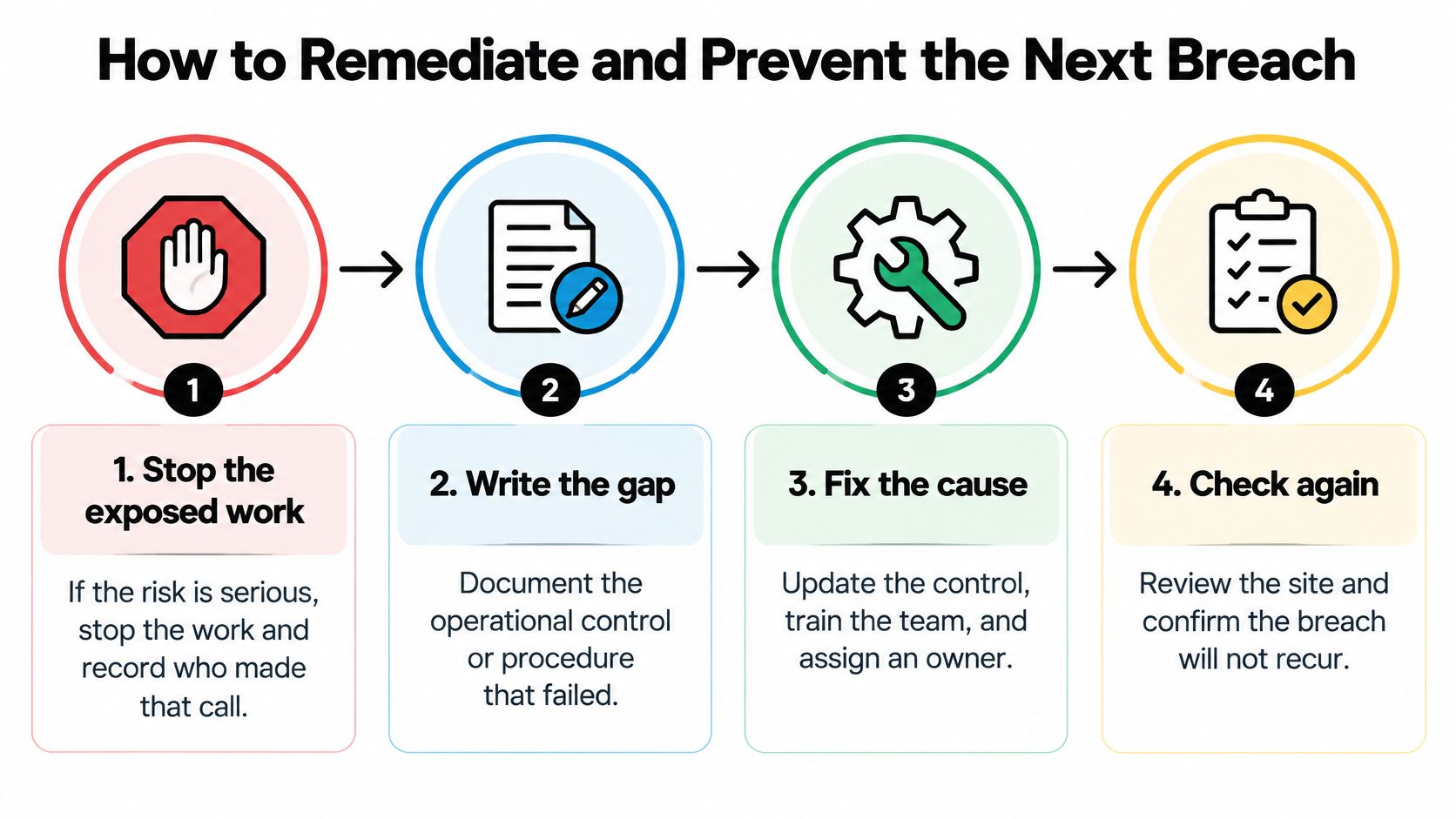
The visual summarises the broad process. The detailed sequence includes the handover and reporting decisions that can otherwise be missed.
Follow the work through to verification
Stop the exposed work when the risk is serious. Make the area safe using authorised isolation and access-control arrangements, and record who made the decision. Don't send someone into the hazard merely to collect a better photograph.
Describe the gap in operational language. Record the asset, task, energy source and people potentially exposed. Write that the conveyor can restart while someone accesses the drive, rather than recording only that a checklist failed.
Fix the physical cause before rewriting the instruction. Repair or improve the engineering control through competent personnel, then align the procedure and supporting information. If the issue concerns psychological harm, address the work design, supervision or exposure rather than treating a reminder email as the remedy.
Verify performance under controlled conditions. Have an authorised, competent person test the interlock or walk through the isolation method without exposing anyone to danger. For emergency arrangements, check that the contact route works and that the person receiving the call knows what to do.
Correct the information at the point of use. Replace unreadable identifiers, isolation tags and instructions after confirming their content against the repaired installation. Check visibility, attachment, cleaning exposure and lighting so the information remains usable between inspections.
Brief every affected crew. Include contractors, lone workers and after-hours teams, not just the shift attending the toolbox talk. Ask an incoming worker to locate the asset and explain the changed action; a signature alone doesn't demonstrate understanding.
Review incident capture and notification. Include psychological injury, violence and work-related suicide in the notification review, checking the strengthened model provisions against the duties applicable locally. Record the assessment, escalation and notifications made, while protecting sensitive personal information.
Book the next verification before closing the action. Assign an owner, a review trigger and a place for the evidence. Include changes to plant, staffing or work methods as reasons to reassess the control rather than waiting for a calendar reminder.
Check the awkward cases
A prohibition notice means the regulator has already required specified work to stop. Follow its terms and don't treat this sequence as authority to restart.
A faded sign beside a functioning guard is an information defect to assess and correct. It isn't permission to omit the guard check, nor does every damaged label automatically establish the same level of risk.
When a worker says a hazard is normal, ask what exposure they've learned to tolerate. Familiarity isn't verification.
For an organised close-out file, use our compliance audit readiness guidance to connect asset records, corrective actions and supporting evidence. Keep one clear trail from the identified gap to the person who confirmed the work could safely resume.
Confirm Legible Marking Before the Next Audit
A faded label beside a switchboard can leave a worker unsure which asset matches the procedure. Fewer prosecutions do not prove a safer workplace. A control can fail unnoticed when the identifier is hard to read, while clear marking supports safe work without replacing guards, isolation procedures or other controls.
Pick one critical asset group this month: isolators, switchboards, medical devices or essential-services plant. Walk the area with the asset register and relevant procedure. Check whether each item can be identified without guessing, its identifier matches the instructions and workers can read it under operating conditions.
Check from the isolation point, not only from a comfortable standing position. Consider viewing angle, torch glare, cleaning chemicals and surfaces people touch. Record mismatches as corrective actions with an owner.
Match the marking to the application
Evright Industrial provides precision engraving and asset labelling for industrial applications. Its products include asset labels, safety signage, steel plaques, panels, switch plates, electrical switchboards and stencils, as well as branding and laser-cut architectural designs. Advanced laser machinery produces the markings.
Medical items are marked for Unique Device Identification (UDI) traceability. Laser marks on medical items will never detach and are completely safe for the patient. Evright Industrial also provides identifying markers for defence and essential-services items. Use workplace safety signage guidance to consider what information workers need at the point of use. Signage supports safe work; it does not replace engineering or procedural controls.
Approve the information before production
- Confirm the identifier: Match the proposed wording to the asset register and current procedure.
- Specify the environment: Describe chemical exposure, cleaning, heat, lighting and attachment constraints.
- Approve the sample: A full sampling and testing programme is carried out before full production of customer-supplied items.
- Connect the record: Keep the approved layout and inspection reference with the relevant asset documentation.
Bring the material requirements, layout, inspection record and project timeline into the conversation. A clear marking helps workers identify the right asset and instruction, while the underlying controls still need to be in place and checked. Visit Evright Industrial to discuss a critical asset group and the marking information required for its operating environment.
Recent Comments