

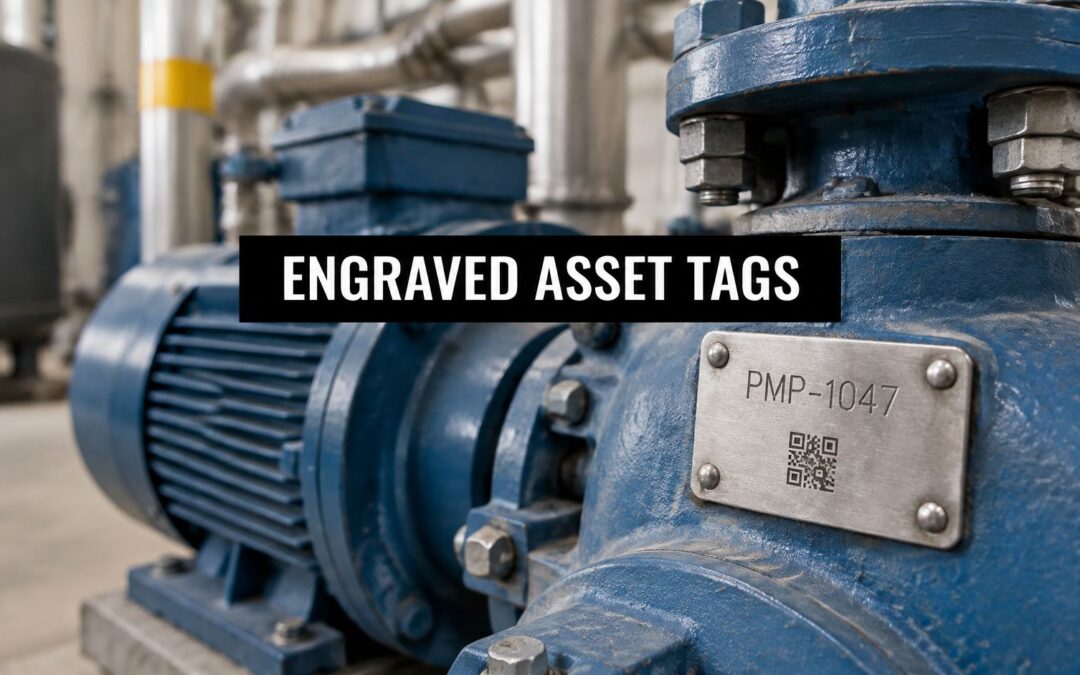
You're standing in front of a pump that needs attention, but the sticker has lifted and the maintenance system lists several identical units. The manufacturer's plate tells you what the pump is, not which service record belongs to it. Before anyone orders parts or isolates equipment, someone has to establish its identity.
Engraved asset tags solve that physical identification problem, provided they're specified as part of a record system rather than ordered as small metal signs. The material matters, but so do the number, the mounting position and what a technician can still read when the scanner won't work.
What Engraved Asset Tags Are and Where They Fit
An engraved asset tag is like a passport stamped into the equipment itself. A pump might change owners, workshops and installation sites, but its identity should travel with it. Without that connection, a perfectly serviceable machine can become difficult to match to inspection records, warranties or previous repairs.
In plain terms, it's a metal, plastic or acrylic plate with an asset number, serial number, rating or code cut or marked into its surface. The marking doesn't rely on an adhesive printed layer that can peel away, although the plate itself still needs secure attachment.
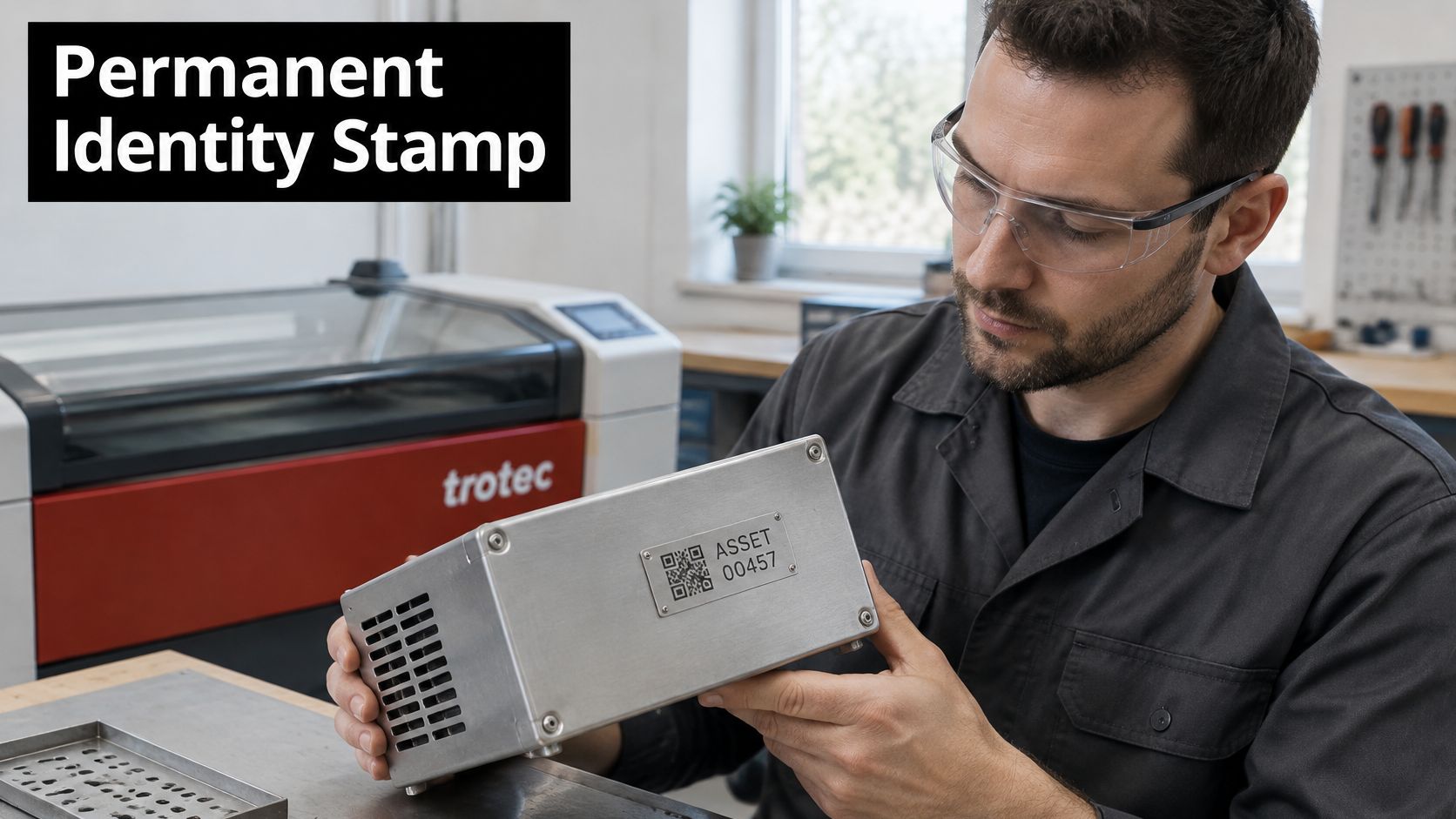
The plate carries identity, not the whole history
A useful layout separates its information into distinct fields:
- Human-readable identity: An asset number someone can read and enter manually.
- Machine-readable identity: A barcode, Data Matrix or QR code for compatible scanning equipment.
- Fixed equipment details: Model, serial number or ratings that belong permanently with that item.
The Australian Government Digital Health Implementer Hub describes the GS1 Global Individual Asset Identifier, or GIAI, as an identification key for individual physical assets, represented through barcodes or EPC/RFID and recorded in asset-management and accounting systems. An engraved plate can carry the visible identifier; RFID requires its own electronic carrier.
Tags appear on switchboards, pumps, compressors, fire equipment and surgical instruments. Memorial plaques use related marking techniques, although their purpose is commemoration rather than maintenance tracking. Our explanation of how asset tagging works covers the connection between the physical item and its register.
Fibre and CO2 laser systems, including Trotec Laser machines, suit different marking materials. They can produce marks without printing ink, although some material-and-process combinations require marking compounds.
If an item must remain identifiable through repairs, resale or relocation, engraving is usually worth considering.
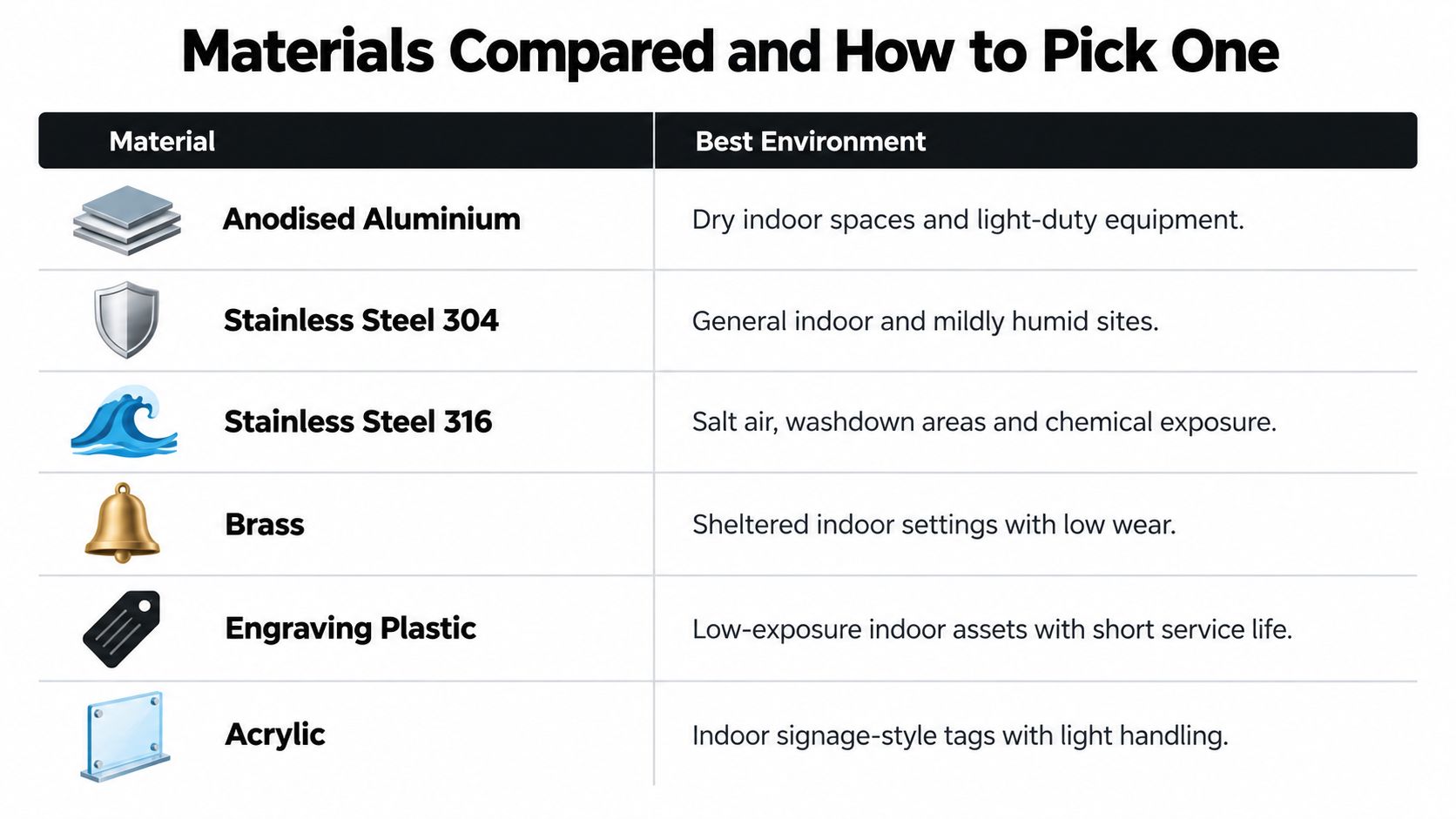
Materials Compared and How to Pick One
Engraved asset tag materials compared
| Material | Best environment | Engraving contrast | Resistance profile | Typical service life |
|---|---|---|---|---|
| Anodised aluminium | Indoor and outdoor equipment, electrical panels | High, light metal on dark anodising | Good with compatible cleaners; strong alkalis can attack the finish | Specify against exposure and coating quality; approve a tested sample |
| Stainless steel 304 | General indoor and mildly humid sites | Good with a suitable dark marking process | Strong general corrosion resistance; avoid assuming chloride resistance | Long-term service where cleaning and corrosion exposure are controlled |
| Stainless steel 316 | Coastal sites and washdown areas | Good with a suitable dark marking process | Better suited to chloride exposure than 304; not immune to chemical attack | Long-term service, subject to cleaning chemistry and surface condition |
| Brass | Plaques, memorials and decorative fittings | Warm contrast on a dark or lacquered base | Good indoors; tarnishes outdoors unless protected | Decades indoors; several years outdoors unless lacquered, as a planning estimate |
| Engraving plastic, two-colour | Panels, switchgear legends and short-term tags | High, contrasting surface and core | Moderate; UV and heat can fade unsuitable grades | Typically 2–5 years outdoors as a planning estimate; confirm the grade |
| Acrylic | Interior signs, displays and backlit tags | Good with suitable clear or tinted finishes | Limited heat resistance; scratches readily | Several years indoors as a planning estimate with light handling |
Choose by the harshest exposure the tag will meet, not by the age of the asset. The service-life descriptions above are selection guides, not warranties. Material grade, marking method, cleaning and attachment can change the outcome substantially.
This comparison provides a quick shortlist before sample testing.
Match the material to the actual exposure
A sheltered switchboard usually doesn't need a heavy stainless plate. Anodised aluminium gives clear contrast with little weight, provided the cleaning chemistry suits the finish.
A food-processing washdown line or coastal installation calls for closer examination of 316 stainless steel. Chlorides can attack lower grades, but choosing 316 doesn't excuse leaving chemical residue trapped behind the plate. Specify the cleaning agent, concentration, contact time and rinse procedure before approving the finish.
Brass and stainless steel both suit memorial work. Brass develops a patina outdoors, while lacquer needs maintenance rather than blind reliance on its original appearance. For projects considering cast bronze rather than an engraved sheet-metal plaque, Stobbe Design's bronze plaque guide provides a useful starting point for discussing that different construction method.
Two-colour engraving plastic can be sensible for a leased fleet or indoor legends. Specify an outdoor-rated grade if sunlight is unavoidable. Acrylic suits display-style identification better than locations where tools will scrape across it.
Practical rule: Test shortlisted materials with the actual cleaner and lighting conditions. A polished sample on a desk doesn't prove that its lettering will be readable on site.
How Engraving Holds Up Under Real Conditions
A technician wearing gloves leans under a dim panel light. The scanner battery is flat, the plate is dusty and the maintenance tablet has no network connection. A tag that works only when scanned hasn't provided a dependable fallback.
Durability means keeping the identity usable, not just keeping the metal intact. A stainless plate can remain attached while its marking becomes unreadable through glare, surface damage or poor contrast.
Test the mark as well as the substrate
Chemical cleaning can attack a coating, remove colour fill or leave deposits over the code. Heat and sterilisation can change a finish or damage an unsuitable adhesive, even when the plate survives. UV exposure can fade plastic colours, while gloves, tools and repeated wiping can wear exposed markings.
Depth helps when light abrasion removes the surrounding surface, but deeper isn't automatically better. A rough recess can collect grime, and a deep code with poor edge definition may scan worse than a controlled surface mark. Specify readability after representative cleaning and wear, rather than accepting engraving depth as the entire durability specification.
For aggressive cleaning environments, our guidance on chemical-resistant labels helps frame the questions about substrate, finish and attachment. Test the complete assembly, including adhesive or fasteners, rather than the bare material alone.
Build a fallback that technicians can use
The TGA's Australian UDI Database legislation guidance records that the database became operational in 2025, with voluntary compliance continuing until 30 June 2026. Digital identification still needs practical arrangements for equipment and staff working outside a connected workflow.
Use a prominent readable asset number alongside the machine-readable code. Give authorised staff a way to retrieve the corresponding record during an outage, such as a controlled offline register extract. Don't put confidential information into an openly readable code merely to avoid a login.
Verification should happen with the tag installed, under normal working light and at the actual viewing angle. Check whether a replacement cover could carry the tag away from the asset it identifies.
- Readable text: Keep a clear line of asset identity that can be transcribed without scanning.
- Duplicate control: Prevent accidental reuse across sites; document any intentional secondary marking of the same asset.
- Commissioning evidence: Photograph the fitted tag and associate that photograph with the register.
- Ongoing checks: Inspect legibility and attachment during the relevant maintenance visit, and replace damaged identification through a controlled process.
Mounting Options and Where the Tag Should Sit
Place the tag where a technician can see it from the normal maintenance position, without removing panels or disturbing wiring. Find that position before choosing the attachment method.
A convenient flat patch isn't necessarily a good location. Check the final installation, including guards, insulation, adjacent equipment and the direction from which someone approaches.
Mounting methods for engraved asset tags
| Method | Best for | Permanence | Watch for |
|---|---|---|---|
| Pop rivets, stainless or aluminium | Panels, enclosures and machine frames | Permanent; removal can damage the plate | Needs drilled holes; unsuitable for thin plastic |
| Stainless screws, M4 typical | Removable covers and serviceable housings | Removable and re-fittable | Torque to specification; check after vibration |
| Structural adhesive or foam tape | Smooth, painted or suitably curved surfaces | Intended as permanent once cured or bonded; test a sample | Surface must be clean, dry and low in oil |
| UV-stable cable tie through a drilled tag | Pipes, cable runs and valves | Quick to fit and replace | Ordinary nylon ties may degrade in sunlight |
| Welded stud | Heavy steel and outdoor infrastructure | Very permanent | Needs qualified welding; unsuitable for thin or heat-sensitive parts |
Fit the attachment to the asset
Rivets suit frames and panels where authorised drilling is acceptable. Select compatible fastener materials and consider corrosion between dissimilar metals. Don't drill an electrical enclosure without checking what's behind it and whether the modification affects its protection rating.
Screws make sense when identification must be removed during servicing. Match thread engagement and tightening requirements to the housing, rather than treating the table's typical screw size as a universal specification.
Adhesive avoids holes but demands preparation. Remove contamination with a cleaner compatible with the surface, allow it to dry and apply the specified pressure. Observe the adhesive manufacturer's cure or bond-development period before washdown or loading.
Cable ties should hold a tag where it won't rotate out of sight or catch on clothing. Welded studs need an approved welding procedure and suitable parent metal, followed by restoration of any affected protective finish.
A permanent attachment is no advantage if the technician can't read the plate after installation.
Pre-drill mounting holes, deburr edges and keep plates clear of moving parts and unnecessary heat. Choose rivets or approved welded attachments for permanent installations, screws for service access, and tested adhesive where drilling isn't permitted.
Standards and Rules That Govern Asset Marking
The applicable rules come from the sector, state and contract. Some prescribe the information, some prescribe placement, and others establish an identification system rather than a mandatory engraving method.
Australian rules that shape engraved asset tags
| Rule or standard | Applies to | What the tag must do |
|---|---|---|
| AS 1345, where invoked | Piped and wired services within the applicable specification | Work alongside required colour coding and service identification |
| NSW transport equipment requirements | Equipment covered by the relevant transport specification | Provide permanent capacity, model and serial identification, inspectable after installation |
| SA Department for Infrastructure and Transport asset specification | Infrastructure assets covered by that specification | Provide durable, legible, secure operational and asset identification, including the specified barcode |
| ARTC signalling procedure SPS04 | Relevant signalling electrical and electromechanical equipment | Provide permanent external identification and applicable technical details |
| TGA unique device identification framework | Medical devices within its scope | Apply the relevant device identifiers and labelling requirements under the phased schedule |
| GS1 Global Individual Asset Identifier | Individual physical assets using the GS1 system | Carry a unique identifier associated with asset records; barcode or RFID implementation is possible |
Confirm scope before approving artwork
South Australia's Department for Infrastructure and Transport asset-management specification permits stamped, engraved, etched or painted labels, but requires legibility, durability, secure attachment and materials that cause no harmful effects; it specifies two labels, separating the operational number from the asset number and its barcode. Unless the contract already defines the method and nomenclature, obtain the principal's approval before manufacture.
The NSW transport equipment requirements require permanently fixed manufacturer plates with capacity, model and serial information accessible after installation, and invoke AS 1345 for piped and wired service identification. An added asset plate supplements those obligations; it doesn't replace them.
For signalling equipment, ARTC procedure SPS04 requires permanently affixed external unit identification with applicable serial, model/version, electrical-rating and schematic details, plus permanent adjacent terminal identification. Don't apply that procedure indiscriminately to unrelated machinery.
Fire equipment has its own inspection and servicing context. Australian fire extinguisher standards explained from Celtic Fire & Security is a useful orientation resource, but the governing standard and contract remain the compliance references.
Keep a short rule log for each asset class, recording the applicable document, required fields and approving authority. Resolve differences between operational numbers and register identifiers before artwork approval; our guide to the equipment tag number explains that practical distinction.
Specification and Ordering Checklist
A readable tag still has a job on the day the scanner is flat, the code is scuffed or the register is offline. Specify it as the physical carrier of a record: a stable identifier, enough human-readable detail to confirm the asset, and a machine code that points back to the same register entry.
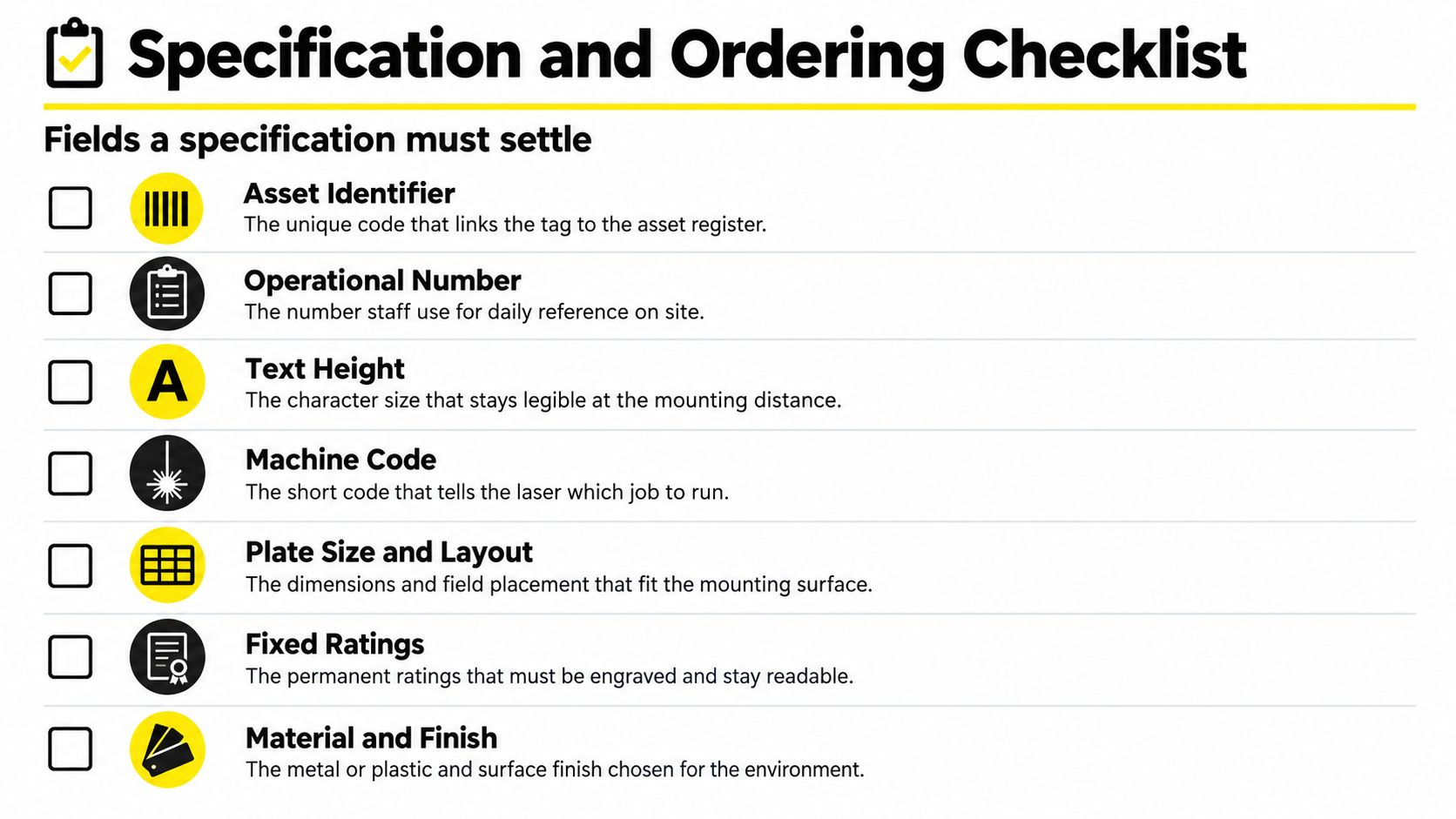
Engraved asset tag specification fields
| Field | What to specify | Example value |
|---|---|---|
| Asset identifier | Unique, stable identifier that is never reused | A register-controlled identifier allocated before artwork |
| Operational number | The number operators use on site, if different | SW-12, an illustrative signal or circuit reference |
| Text height | Character height readable at the working distance | Trial approximately 3 mm at arm's length; about 8 mm per metre further away |
| Machine code | Data Matrix or QR payload and register connection | The approved asset identifier encoded as Data Matrix |
| Plate size and layout | Mounting envelope, margins and fixing clearances | Fit the measured flat area with clear space around text and code |
| Fixed ratings and data | Permanent, verified equipment details | Model, serial, voltage and current |
| Material and finish | Substrate, grade and marking appearance | Black anodised aluminium with contrasting light text |
Treat the text-height examples as starting points for a physical trial. Glare, character shape, viewing angle and poor lighting can all require larger lettering, so check the proposed size on the actual asset rather than from a desk.
Use the checklist to gather the information before artwork begins.
Freeze the identity, not the changing record
Queensland Health's asset-identification guideline recommends a Single Asset Identifier approach and distinguishes financial assets from maintainable items through identifier prefixes and label conventions. Establish which record the plate identifies before generating the numbers.
Keep location, service status and maintenance history in the register. Otherwise, routine relocation creates an unnecessary plate replacement. In this specification, machine code means the machine-readable asset code; keep the laser operator's production-job reference outside the asset payload.
If the code cannot be read, the engraved identifier should still carry enough meaning for a technician to find the correct record. That means the printed number, the encoded payload and the register key must be resolved as one identity before production.
Release the order through a controlled sequence
- List assets and exposures. Include cleaning, outdoor conditions and restrictions on modifying equipment.
- Choose the material. Use the exposure information to shortlist a substrate and marking finish.
- Set placement and mounting. Record the approved position so installers don't improvise.
- Define required fields. Separate register identity, operational references and rule-driven technical information.
- Draft the layout. Leave margins around lettering, fixing holes and the code's required clear space.
- Approve a sample. Check the actual finish, readability, scan result and attachment before production.
- Release and reconcile. Match produced identifiers to the register and record installation acceptance.
Before release, confirm quantity, finish and lead time. These influence production cost and delivery, so settle them alongside the artwork rather than after approval.
The laser-marking video below shows the production process behind this release sequence.
An error caught on a sample avoids the labour, access arrangements and downtime involved in replacing an installed plate. Verify the code's decoded content too; a code that scans successfully can still contain the wrong identifier.
Engraved Tags in Industry, Health and Memorial Work
Industrial and utility applications
Illustrative industrial example. A maintenance team manages around 400 pumps across a hypothetical processing plant. Stainless tags carry each pump's asset number, a Data Matrix code and verified rated power, allowing a technician to retrieve the right history rather than search by appearance. Put the identity on the pump assembly being maintained, not merely on a nearby guard that could be exchanged.
Illustrative utilities example. A substation switchboard uses anodised aluminium legends with circuit and asset references visible from the authorised operating position. The layout distinguishes the functional circuit name from the identity of the physical equipment, while leaving manufacturer information unobstructed. Treat transport-specific placement rules as applicable only when the installation falls within that specification.
Portable tools introduce another concern: identification helps establish ownership, but it doesn't physically prevent removal. Overton Security's discussion of tool theft prevention metrics is a useful companion when planning how tool records, issue controls and site security should work together. Don't confuse an engraved ownership mark with a complete theft-prevention system.
Healthcare and memorial applications
Illustrative healthcare example. A sterile services department needs surgical instruments to remain identifiable through cleaning and sterilisation, while implant identification must support the applicable device-traceability workflow. These applications call for validated direct marking, not an improvised attached plate that could interfere with cleaning or use. Confirm the device manufacturer's marking restrictions and the approved process before modifying an instrument or implant.
The TGA's Australian healthcare UDI executive summary describes information capture across manufacturing, distribution, clinical use, recalls and patient records, with mandatory labelling for high-risk implantable devices beginning on 1 July 2026 and progressively extending to other device classes. An internal hospital asset number isn't automatically a UDI, and engraving it doesn't by itself establish compliance.
For legacy equipment, assign responsibility for identifier ownership, approved data fields, placement and migration between systems. Verify how the physical mark relates to packaging identifiers and clinical records. A readable mark is useful only if staff can resolve it to the correct device information during a recall.
Illustrative memorial example. A family commissions a brass or stainless plaque carrying a name, dates and an emblem for an outdoor setting. Lettering needs sufficient contrast and spacing to remain readable after weathering, and the fixing arrangement must suit the supporting stone or structure. Check spelling and dates against an approved proof, then retain the artwork and installation details for future matching or restoration.
The shared principle is accountability. Every tag needs an owner and a record, whether that record holds maintenance history, clinical traceability information or an approved memorial inscription.
Confirm Your Tag Specification Before You Order
Material follows exposure. Mounting follows access. Fields follow the applicable rules. Settle those decisions before comparing production quotes.
Send the following to Evright Industrial:
- Asset list: Existing identifiers, operational references and verified fixed data.
- Environment: Cleaning chemicals, sunlight, heat and mounting restrictions for each asset class.
- Requirements: Applicable standards, approved locations, quantities and implementation schedule.
A dedicated project manager is your key contact, working to the project's schedule and budget and arranging required samples for approval before production. Samples carry a small fee redeemable against the larger production invoice.
Use the approved proof to check the specification before release. Read each engraved field against the register entry it points to: the human-readable number, the stable identifier and any barcode or data code. A scanner can be lost, flat or locked out of the system. The number on the tag still has to name the asset on its own, so confirm it is legible at arm's length and matches the record staff will search for.

Understand the marking process
Evright Industrial is the industrial engraving and asset-labelling division of evright.com, backed by nearly six decades of engraving experience. We can mark almost any material, including anodised aluminium, stainless steel, brass, acrylic and engraving plastic.
The laser machinery removes material at a controlled depth or changes the surface colour, so the mark becomes part of the surface rather than a printed layer that can peel. Where cutting depth is a concern, stainless steel can be colour changed for a longer-lasting finish as an alternative to sublimation.
Evright Industrial offers laser-engraved asset labels, material advice and samples to help you confirm a specification before production. Visit Evright Industrial with your asset list, exposure details and applicable standards to request a quote and discuss the right marking approach for your equipment.
Recent Comments