

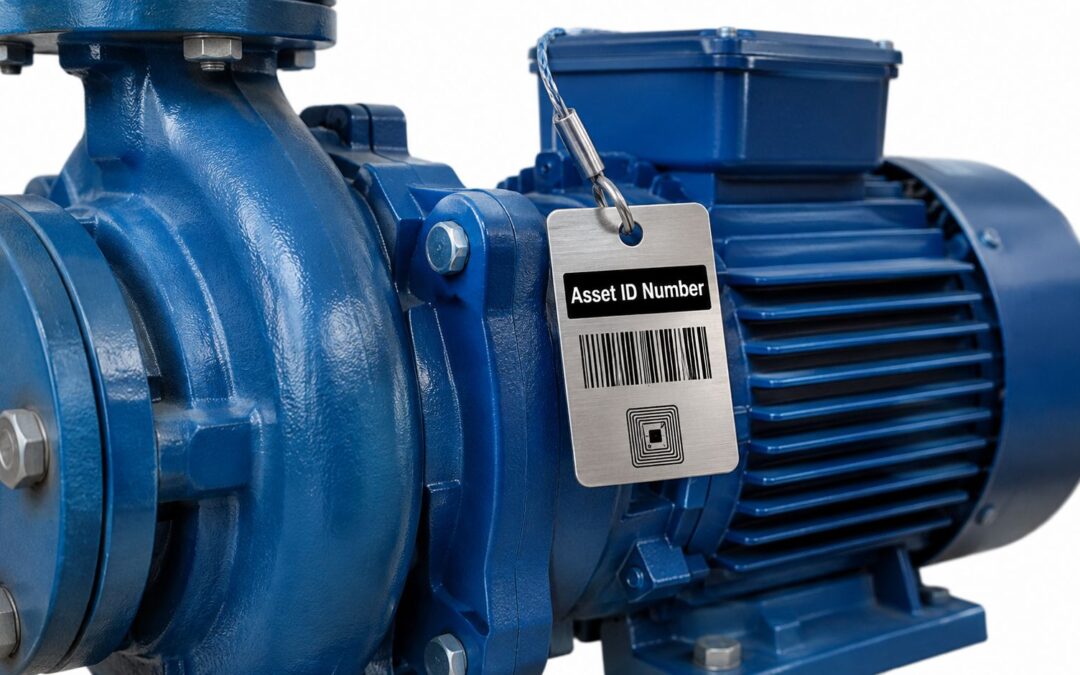
You're standing in a plant room with a maintenance log open, trying to work out which pump was serviced last quarter. The pumps look identical, their model plates match, and the work order says only “plant room pump”. Before anyone can plan the next job confidently, someone has to establish which physical unit the record belongs to.
An asset identification number removes that guesswork. Its value comes from connecting the equipment in front of you to the right records, not just from putting a label on its casing.
What an Asset Identification Number Really Is
In that pump example, the model name tells you what kind of equipment you're looking at. It doesn't tell you which particular pump received a replacement seal, passed an inspection or needs attention.
An asset identification number is a unique reference assigned to an individual physical asset, similar to a passport number rather than a nationality. Many people can share a nationality, but a passport number identifies a particular person's document.
The same distinction applies to equipment. A description such as “transfer pump” groups similar items together. An asset number separates each item so technicians can record work against the correct unit.
Identity is different from description
A useful way to untangle the terminology is to ask what each piece of information answers:
- Model designation: What type of equipment is this?
- Manufacturer's serial number: Which production unit did the manufacturer identify?
- Internal asset number: Which item does our organisation manage in its register?
- Location description: Where should we find it?
These fields can sit together in the same record. They aren't interchangeable, and a location description shouldn't have to carry the whole identification task.
For example, a maintenance planner might search by room name to find nearby equipment, then confirm the asset number before issuing a work order. The location narrows the search; the identifier confirms the item.
The number connects the history
Transport for NSW's asset information standard requires a unique identifier for each registered asset, normally system-generated and assigned for the asset's whole life. It serves as the primary key for searching, tracking and connecting maintenance information, attributes and documents.
A primary key means the reference a system uses to distinguish a record from all other records. You don't need database expertise to use the principle: everyone recording work needs to agree on which identifier represents the equipment.
A useful asset number answers “Which exact item?” before anyone asks “What work does it need?”
That's the foundation. The label makes the identity accessible in the field, while the register gives that identity meaning.
Formatting Standards That Keep Numbers Unique
Start with the boundary of uniqueness. Does the number need to be unique within a workshop, across an organisation, or when information passes between organisations? Decide that before choosing a numbering pattern.
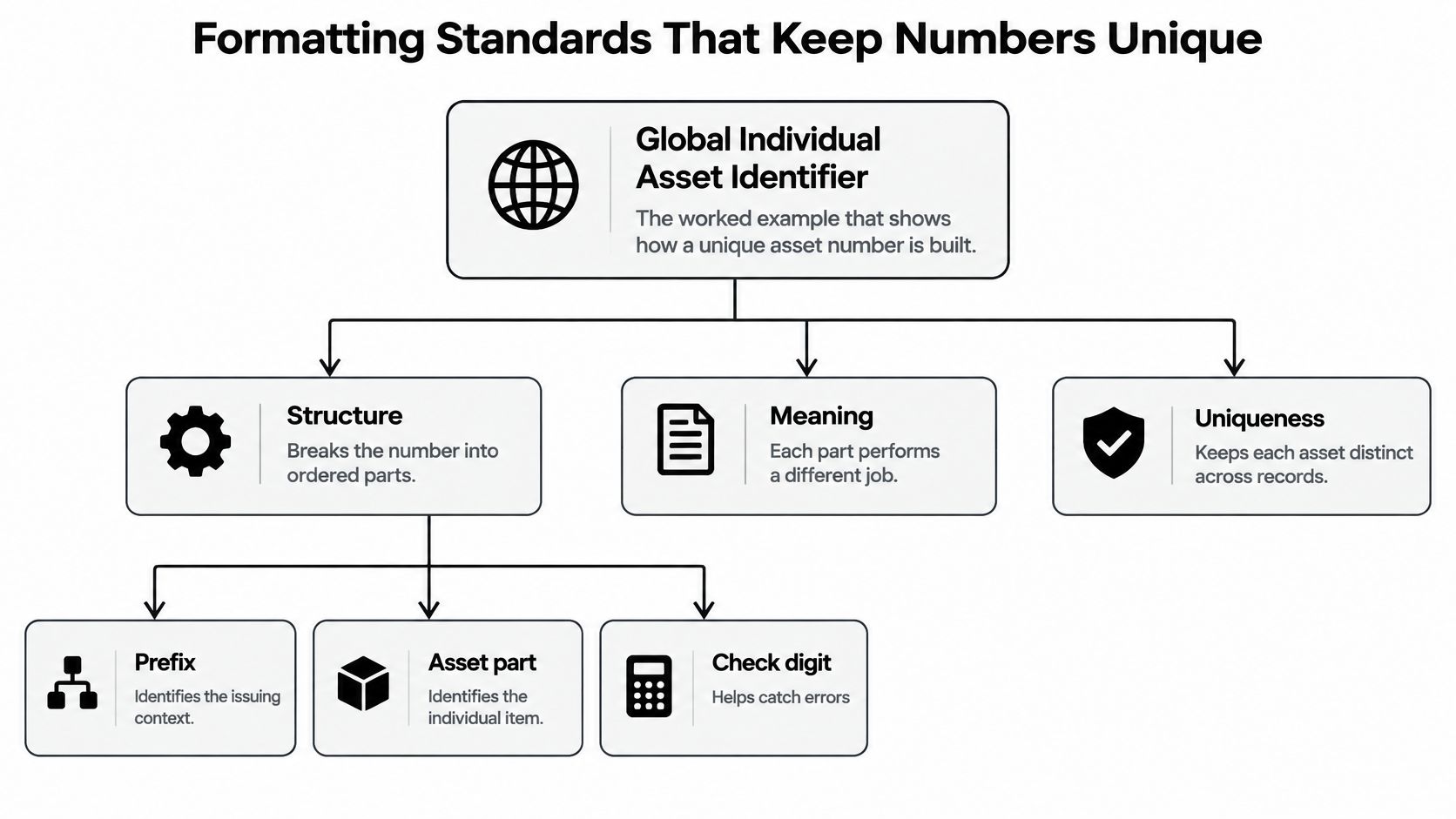
The Global Individual Asset Identifier, or GIAI, provides a standards-based example of how to separate the issuing organisation from the individual asset reference.
Separate ownership from the asset reference
The Australian GIAI standards guidance describes a GS1 Company Prefix, typically 7–9 digits, combined with an organisation-defined alphanumeric asset reference of up to 30 characters. The prefix establishes the assigning organisation's identity; the asset reference distinguishes the individual item.
The same guidance identifies GS1 Application Identifier 8004 for carrying the GIAI in compatible barcodes or EPC/RFID tags. Treat those length limits as standards information, not permission to invent an encoding format without checking the applicable specification.
The diagram provides a conceptual view of identifier components. Its check-digit branch shouldn't be treated as a GIAI implementation instruction; confirm the actual structure against the linked standard.
Keep changing information outside the number
A tempting approach is to build the department, room and equipment category into every identifier. That makes a number look informative, but creates a problem when the asset moves or the organisation changes its department names.
My recommendation is to keep the identifier stable and place changing attributes in separate register fields:
- Site and location: Update these when equipment moves.
- Custodian: Record who currently controls or uses the asset.
- Status and condition: Maintain these through inspections and lifecycle changes.
- Service interval: Manage this through the maintenance plan, rather than the engraved number.
An internal sequence doesn't have to explain the whole asset. It needs to lead reliably to the record that does.
Also document presentation rules before issuing labels. Decide whether spaces are display-only, whether letter case matters and how imported records will be checked for duplicates. Otherwise, different teams may interpret visually similar references as different assets.
Choosing Between Serials, Barcodes and RFID Tags
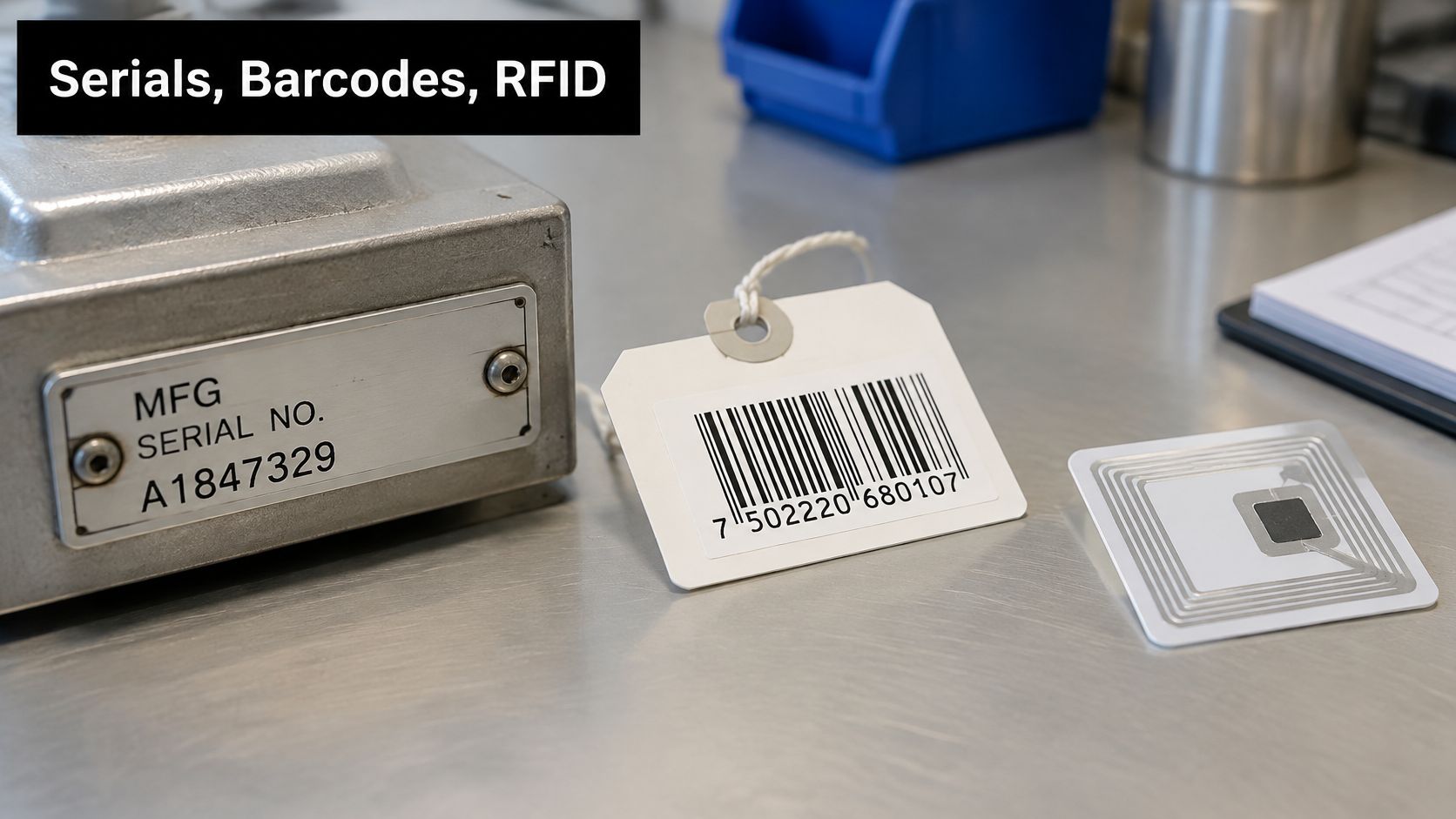
The identifier is the reference. The carrier is how someone reads it from the equipment. Keeping those ideas separate makes physical labelling decisions much easier.
This illustration shows the different forms identification can take in the field.
Serial Numbers, Barcodes and RFID Tags Compared
| Identifier Type | Where It Works Best | Main Trade-off |
|---|---|---|
| Manufacturer's serial number | Confirming production identity from the original nameplate, usually by visual reading | The organisation must decide how it maps into the internal register |
| Barcode label | Scan-based onboarding, inspections and work-order access | The code needs to remain visible, accessible and readable |
| RFID tag | Workflows designed around compatible electronic readers, including reading without optical line of sight | Tag, reader, mounting position and surrounding materials need application testing |
These aren't necessarily competing choices. A label can carry human-readable text alongside a machine-readable representation of the same internal identifier.
For electrical equipment, distinguish identity information from rating information. The resource on NEMA ratings with E & I Sales is a useful companion when reviewing motor-tag terminology, but a rating isn't a substitute for an individual asset reference.
Match the carrier to the job
Choose the carrier by watching how technicians will use it. Can they approach the asset safely? Will they read the label under poor lighting? Must they identify equipment without opening an enclosure?
For RFID planning, use the RFID asset tracking overview to frame questions about the reader, tag and register connection. Don't assume that choosing an RFID tag automatically establishes the digital workflow.
For engraved identification, discuss Trotec Laser machinery as a production option for equipment tags, rather than treating generic mechanical-equipment imagery as an engraving example. Ask the supplier to demonstrate the proposed material, marking contrast and finished code.
The accompanying video can support that production discussion.
Some assets can't reasonably accept a physical barcode. The University of Sydney's asset-identification standard permits virtual identification, combining a spatial barcode, equipment standard code and a sequence for that asset type within the room.
That standard also connects unique equipment codes with CMMS records. Treat virtual identification as a controlled fallback, with clear field instructions, rather than an excuse to leave difficult assets undocumented.
Why Asset Numbers Matter for Manufacturing and Utilities
A sticker can identify equipment without helping anyone maintain it. The operational benefit appears when the technician's field reference matches the asset record used to plan, approve and close work.
A computerised maintenance-management system, usually shortened to CMMS, holds maintenance information and work orders. The University of Sydney approach described earlier illustrates the important relationship: equipment identification and maintenance records belong in the same controlled process.
Manufacturing needs the history of the actual unit
Consider a production machine transferred between lines. The receiving team needs its inspection findings, unresolved defects and maintenance history, not just a description copied from similar equipment.
The same reasoning applies to repairable tooling and individually tracked spare assemblies. If a technician records every repair against a general description, the planner can't confidently distinguish a recurring fault on one unit from unrelated faults across several units.
A practical reconciliation should compare:
- Field identity: Does the label match the item named on the work order?
- Record identity: Does the register describe the installed equipment?
- Work evidence: Were findings and replacement details saved against that asset?
- Installation relationship: Is the asset associated with its current machine or operating position?
These checks turn identification into a maintenance control, rather than a labelling exercise.
Utilities need continuity across dispersed equipment
For a utility planner, a remote pump, substation component or network asset may have documents held by different teams. Contractors may use different descriptions for the same equipment.
A shared asset reference gives those teams a concrete point of agreement. When investigating a fault, they can compare the equipment label, inspection report and work order before deciding what needs to happen.
Planning insight: Before trusting a maintenance trend, confirm that the underlying work orders belong to the same physical asset.
This is also why duplicate identification deserves attention. If separate units share a reference, the planner may combine their histories and draw the wrong conclusion about condition or repair priority.
The business case isn't that labels themselves improve reliability. It's that planners and technicians can make better-supported decisions when they can reconcile physical equipment with the correct evidence.
Healthcare Device Labelling Alongside UDI
A generic internal asset label isn't the whole identification picture for medical equipment. Healthcare teams also need to understand the manufacturer's Unique Device Identification, or UDI, and preserve its role.
Australia's UDI framework commenced voluntarily on 27 March 2025, with mandatory requirements for higher-risk devices scheduled from 1 July 2026, according to the TGA's UDI news and updates. Check the applicable requirements for the device concerned rather than assuming every item follows the same timetable.
Separate regulatory identity from local management
The TGA's consumer explanation of UDI distinguishes the UDI-Device Identifier, which identifies the device model, from the UDI-Production Identifier, which captures applicable production information such as serial, batch or expiry details.
UDI records connect to the relevant Australian Register of Therapeutic Goods inclusion. AusUDID provides consistent identification information, including manufacturer and sponsor details, device classification and change history.
However, the TGA's introduction to UDI requirements explicitly distinguishes the database from an inventory-stock tracking system. A hospital still needs local records for ownership, maintenance responsibility, location and disposal.
That distinction answers the practical question: supplement the manufacturer's identification rather than replacing it.
Establish a clear label hierarchy
Use the following as a local governance checklist, alongside applicable device requirements:
- Preserve required information: Don't cover manufacturer identification, warnings or human-readable and machine-readable UDI information.
- Differentiate the internal label: Make its purpose clear so staff don't confuse the hospital's asset number with the manufacturer's identifier.
- Assess permanence carefully: Review the proposed attachment or marking method for the specific device before altering its surface.
- Test scanning coexistence: Confirm that staff can select the intended code and reach the intended record.
- Assign approval responsibility: Decide who authorises label placement and checks the resulting register entry.
A clearly separated internal label helps staff distinguish a maintenance lookup from a device-identification task. The record should preserve the relationship between those references without suggesting they mean the same thing.
Use the medical device labelling requirements guide to prepare a labelling discussion, then verify the application with the responsible clinical engineering and compliance teams. A general-purpose tag specification shouldn't automatically become the specification for every medical device.
Assigning and Tracking Asset Numbers Compliantly
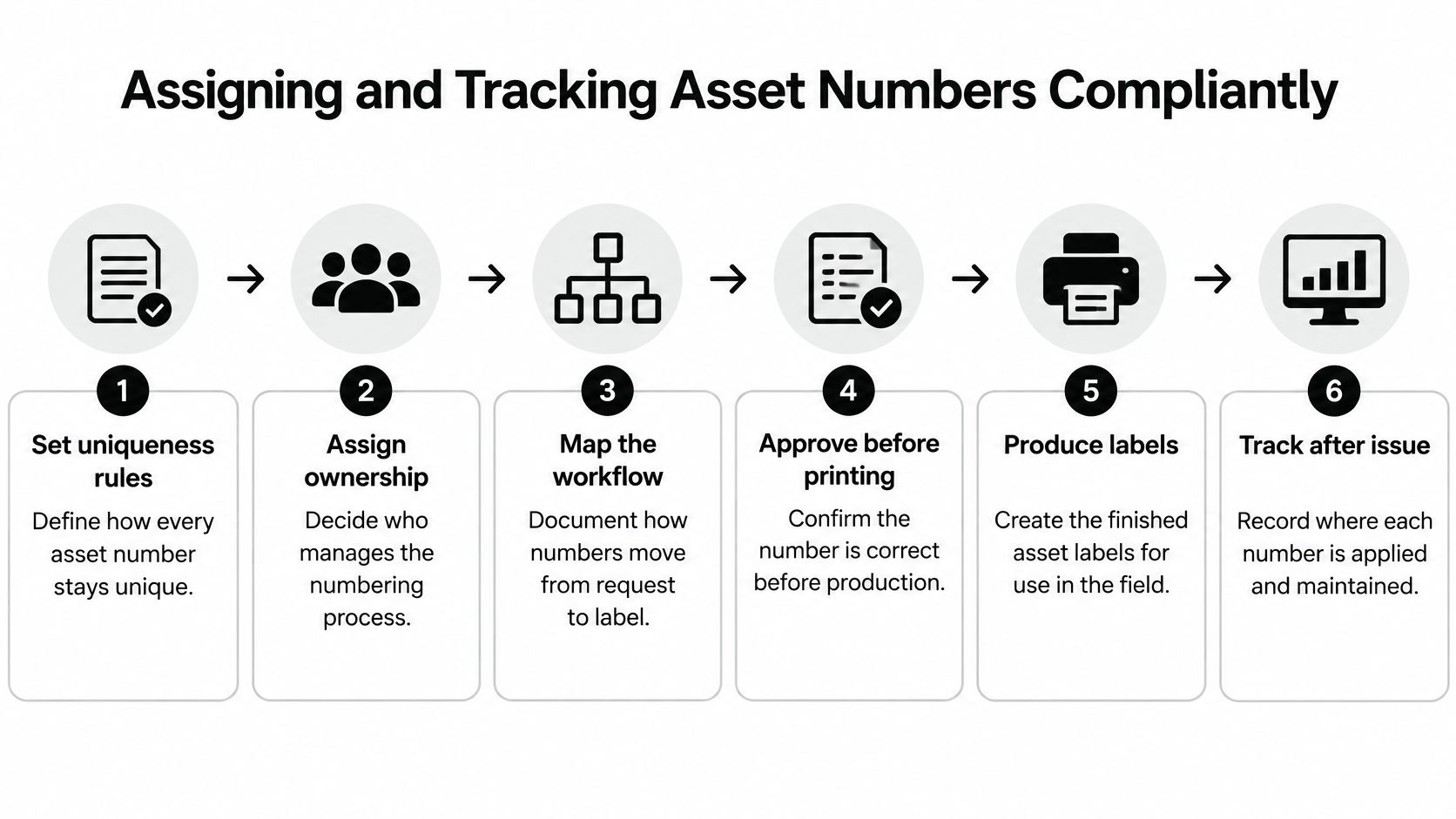
Set up the workflow before ordering labels. A durable engraving won't fix an incorrectly assigned reference, and an attractive barcode won't help if it opens the wrong record.
The practical sequence below places approval before production and continuing control after installation.
Control issue and installation
- Define uniqueness and ownership. Nominate the register or authorised team that issues identifiers. Check incoming records for duplicates before approving new entries.
- Map the workflow. Specify which CMMS field receives the identifier and how barcode or RFID data reaches it. Include the handover between procurement, stores and maintenance.
- Approve before production. Compare the label artwork with the authorised record, including punctuation and machine-readable content.
- Verify installation. Confirm that the label is attached to the intended asset and that the scan retrieves its record.
- Manage later changes. Document replacement labels, relocation, retirement and duplicate-resolution procedures. A replacement label should preserve the approved identity.
An equipment tagging procedure can help turn these decisions into instructions technicians can follow consistently.
Retain the evidence behind the identifier
The ATO's asset-register ruling allows paper or electronic registers without a prescribed arrangement. However, the register must meet record-keeping requirements and contain information reasonably relevant to determining a capital gain or loss, otherwise the original supporting documents must be retained.
Keep acquisition evidence, relevant transactions and disposal documentation connected to the asset record. The number is a reference to evidence, not a replacement for it.
Record-keeping rule: A successful scan proves that a code can be read. It doesn't prove that the underlying record is complete.
Sector procedures offer useful examples. Queensland Health's SAID guideline requires organisation-wide unique numbers, labels on receipt and a single SAID label per item; white financial-asset labels begin with “1”, while yellow maintainable-item labels begin with “3”.
Victorian government school policy requires new assets to enter the CASES21 Finance Asset Register within 30 days, with tagging after the register code is assigned. These are sector-specific rules, not universal deadlines.
For manufacturing, document configuration changes and repairs. For utilities, emphasise retirement evidence; for healthcare, preserve device-history relationships. Teams managing drives can also use DUCHENG Industrial's industrial asset management for VFD fleets as a discussion resource when defining equipment-specific records.
Next Steps for Labelling Your Asset Register
Start with a labelling audit rather than a bulk print order. Walk through representative equipment with someone who uses the maintenance system and someone who works on the assets.
Ask them to identify the equipment, find its record and explain how they would record a defect. Any uncertainty reveals a problem worth resolving before reproducing it across the register.
Make the audit produce a usable specification
Your findings should describe the application, not just the label dimensions. A purchasing specification that says “durable tag” leaves too many practical questions unanswered.
| Audit finding | Decision to document |
|---|---|
| Staff can't distinguish similar equipment | Confirm identification and record-matching rules |
| Existing labels are difficult to reach | Agree on a safe, consistent mounting position |
| Codes fail during field checks | Test artwork, contrast and the intended reader |
| Environmental exposure is unclear | Describe cleaning, moisture, chemicals and abrasion |
| Manufacturer information is crowded | Establish approved separation and placement |
For stores and maintenance teams reviewing the surrounding workflow, browse MRO inventory topics from MA Hydraulics Ltd. Use those topics to identify questions about repairable spares and stock handling, while keeping individual asset identity distinct from stock quantity.
Discuss production using approved records
The specialist industrial division of evright.com provides precision laser engraving and asset labelling for equipment identification, safety signage and custom plaques. Its process combines laser machinery, material selection and technician collaboration to tailor the finished marking to the application.
For an asset-number project, bring an approved register extract, the intended code format, label dimensions and photographs of the mounting area. Ask for a representative sample and test it with the readers and procedures your staff will use.
Material durability should be discussed against the operating environment rather than assumed from appearance. Responsible material sourcing and energy-efficient production are also part of the division's stated approach, so include those considerations in the purchasing conversation.
You don't need to replace every existing label to make progress. Resolve uncertain identities, missing records and unreadable tags first, then use the agreed specification for new equipment and planned replacements.
The most useful outcome is a repeatable handover: the asset arrives, its record is approved, its identification is applied and the receiving team knows how to use it.
Evright Industrial offers laser-engraved equipment tags and asset labelling that connect physical equipment with your approved register references. Audit your current labels, identify the carrier each environment needs, and visit Evright Industrial to discuss materials, code formats and a sample for field testing.
Recent Comments