

A plaque on a grave, wall or community monument has gone dull and streaky, and you're wondering whether a metal polish or strong household cleaner will bring it back. Before reaching for a product, pause. Memorial plaques can combine different metals, stone, lettering and protective finishes, and a cleaner that brightens one surface can strip another.
Knowing how to clean memorial plaques starts with identifying what you're looking at, checking whether you have permission to work on it, and recognising when routine cleaning should stop. The safe approach is usually gentler than people expect.
Why Memorial Plaques Need Gentler Care Than Household Metal
A memorial plaque isn't an ordinary metal fitting. Its surface may carry a natural patina, delicate lettering or a protective coating, and it may sit against stone that reacts differently to water and cleaning products. A harsh polish might make the metal look brighter while removing the finish or softening details that give the inscription its character.
The restoration of the Leichhardt War Memorial in New South Wales shows why this work is conservation, not just polishing. After Inner West Council obtained support through the Community War Memorials Fund, the memorial was restored in November and December 2023. The documented work included hand-cleaning stone, reducing limescale, repointing joints, cleaning copper elements, treating the bronze plaque and insignia, applying a protective hot-wax coating, and regilding incised lettering with 24-karat gold leaf. Each surface needed care suited to its material and condition. The Leichhardt War Memorial restoration is a practical reminder that one strong product or polishing technique can't safely treat the whole memorial.
Cleanliness isn't the same as preservation
A cleaner-looking surface isn't always a better-preserved one. Bronze can naturally develop a dark, dull patina, and aggressive polishing may remove it along with fine surface detail. On a plaque with gilding, enamel or old paint, even a seemingly modest cleaning attempt can affect more than the dirt.
The safest starting point is to work out what the plaque is made of, what finish it has, and whether it's stable. This guide gives you a method for matching care to material, avoiding products and tools that can cause damage, and keeping a simple maintenance record. It also marks the point where cleaning should stop and a conservator or heritage adviser should take over.
Practical rule: If you can't tell whether a mark is dirt, patina, corrosion or failing coating, don't try to scrub it off.
Identifying Your Plaque Material and Finish First
Before using a damp cloth, check the plaque and its surroundings. Memorials may combine bronze, granite, marble, sandstone, limestone, lead lettering, mounts and attached surfaces. Australian guidance distinguishes among these materials because a method that is acceptable for one surface may harm another. Heritage Tasmania warns that chemicals can react with minerals and salts in stone, accelerating erosion, and recommends water and soft-bristle brushes for sandstone, marble and limestone. Australian memorial maintenance guidance is a useful reminder to assess the whole assembly, not just the visible plaque face.
Look, don't scrape
Start with visible clues. Bronze often has a dark brown or dull surface; brass may look more yellow, while stainless steel can appear silver and reflective. These appearances aren't proof of composition, especially on older or coated plaques. A magnet may help you check whether some steels are magnetic, but it can't identify every metal reliably. Don't scratch the surface or lift an edge to test it.
Then examine the finish. Look for a clear coating, painted lettering, enamel, gilding, laminate edges or a change in sheen. A protective layer can alter which cleaning method is safe, so don't assume a surface is bare metal just because it looks metallic. Check the mount and fixings too. A plaque that moves, has a loose edge or is separating from stone isn't ready for routine washing.
Use this table as a cautious first guide, not a substitute for identifying an unknown or historic finish.
| Material or finish | Gentlest first step | Stop and refer when |
|---|---|---|
| Bronze or brass | Remove loose dust with a soft cloth or very soft brush | Corrosion, fragile gilding or a failing coating is present |
| Stainless steel | Wipe gently with a soft, damp cloth | The surface is pitted, coated or fixed insecurely |
| Granite, marble, sandstone or limestone | Use water and a soft-bristle brush | Stone is crumbling, cracked, eroding or stained by an unknown substance |
| Lead lettering, enamel or painted detail | Dust lightly without scrubbing | Lettering flakes, lifts or feels unstable |
| Anodised aluminium or laminate | Wipe gently with a soft cloth | The finish is scratched, lifting or separating at an edge |
Take clear photographs before doing anything. Capture the whole memorial, close-ups of lettering and finish, and any existing marks or damage. Those images provide a baseline for comparison and help a cemetery operator or conservator assess the condition if questions arise.
Cleaning Bronze, Brass and Stainless Steel Plaques
Metal plaques reward restraint. I've watched well-meaning families scrub a bronze marker with metal polish until the patina turned patchy pink and the lettering edges went soft in the same pass. Bronze, brass and stainless steel each fail differently, so the details of the method change with the metal even when the sequence stays the same.
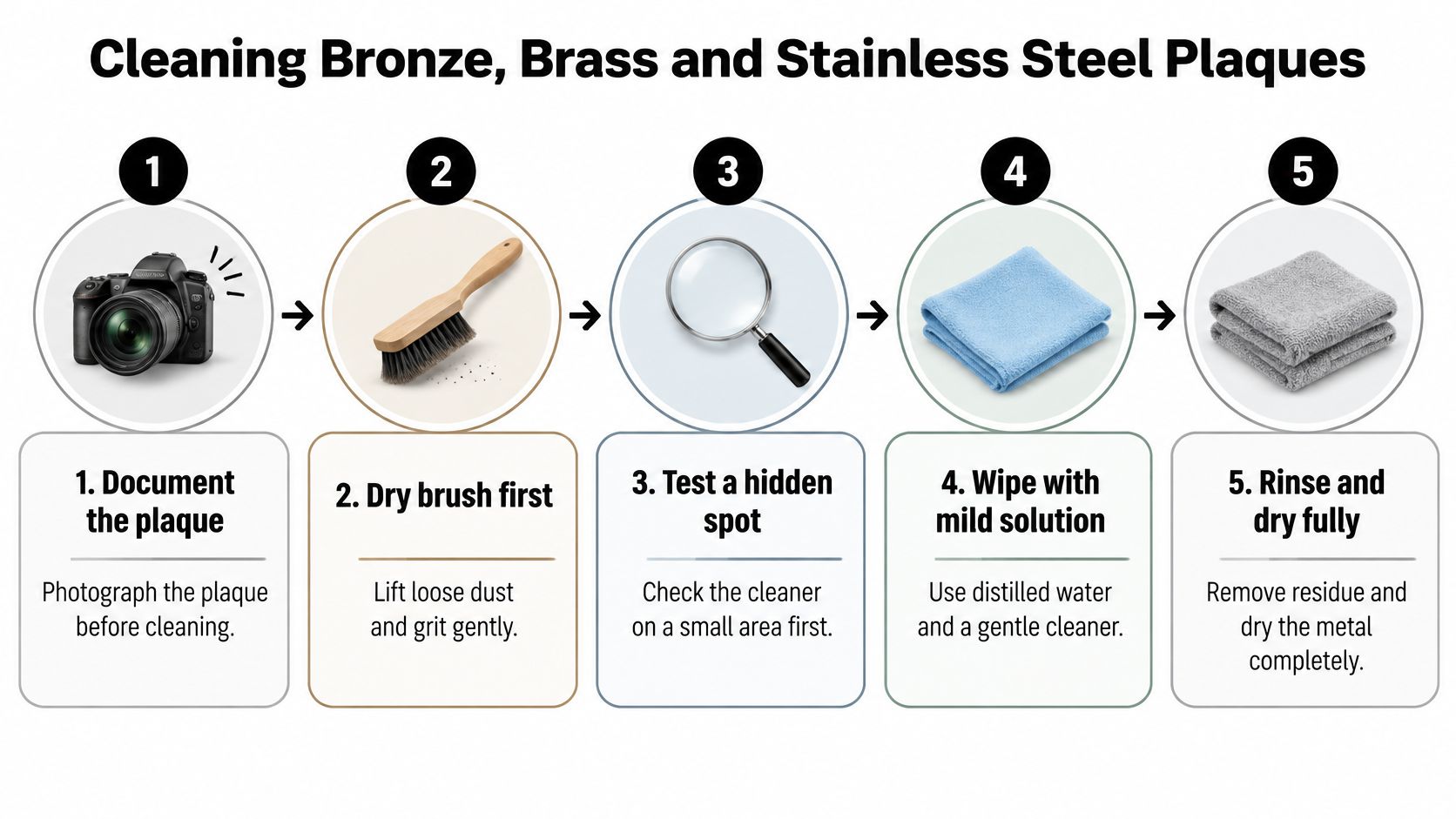
Check permissions before you wet anything. Some Australian cemeteries require approval, or a licensed contractor, for any work on memorials, and a plaque you don't own may carry conditions. That conversation belongs at the start of the job, not after the wash. Western Australia's burial plaque guide recommends documenting the plaque, confirming stability, dusting, then washing with plain or mild soapy water, and it warns against abrasives and commercial metal cleaners outright.
A careful cleaning sequence
Confirm stability. Check that the plate, fixings and mount are solid. Loose hardware or visible corrosion means you stop and refer the job, not wash around the problem.
Lift off loose dust. Use a soft cloth or a very soft brush, such as a baby toothbrush. Work lightly around lettering and crevices so grit never gets dragged across the face.
Wash gently. Plain water or mild soapy water on a soft cloth or soft nylon brush handles most grime. Soften dried bird droppings with repeated gentle wetting. Never pick at them with a blade.
Remove residue and dry. Wipe off soap with clean water or a damp cloth, then dry with a soft cloth. Streaks left behind undo the careful wash you just did.
Know your stop points by material. Bronze's dark patina is a stable surface layer, and polishing it away erases history, but fresh green powder that smears or spreads points to active corrosion and a conservator's call. Brass is often lacquered, so if that coating is crazed or lifting, keep water out from under it and stop. Stainless steel handles washing well, yet pitting or brown tea-staining, common near the coast, sits beyond routine cleaning. For plaques mounted on stone, keep runoff off the surrounding surface. If you're replacing rather than restoring, Evright Industrial's stainless steel plaques are one option for a low-maintenance memorial material.
Once the plaque is dry, check that lettering remains sharp, the original finish is intact, and no residue or streaking remains. If the surface looks worse, or you've uncovered corrosion, stop. Repeating the wash with a stronger product only makes the eventual repair harder.
Cleaning Stone, Anodised Aluminium and Laminated Plaques
A granite base with a metal plate can look like one job from arm's length. It is really two or three surfaces sharing the same runoff, so clean each one on its own terms and keep dirty water away from the adjoining material. If the memorial sits in a managed cemetery or may be heritage listed, confirm the allowed method before wetting anything; permission can change the cleaning decision.
Stone needs a soft touch
Pre-wet the stone, then work with a soft-bristle brush, soft sponge or old toothbrush. Clean from the bottom upward and rinse often so grime does not streak down the face. Cemetery-conservation guidance in Australia warns against hard bristles, scrapers, wire brushes, abrasive pads and high-pressure hosing on historic or delicate surfaces; the National Trust's cemetery conservation guide describes the gentler approach those rules are meant to protect.
Stone can look tough and still react badly to chemicals. Products can disturb minerals and salts, and runoff from a plaque can mark marble or sandstone nearby. For marble specifically, use care methods suited to stone rather than tile habits, such as marble care advice from Varun Marbles. Stop if you see flaking, salt bloom, open cracks, deep biological growth, or lettering losing definition. Those are assessment points, not scrubbing challenges.
Check the finish, not just the substrate
Anodised aluminium depends on a coloured surface layer. Use a soft cloth with mild, pH-neutral soap and light pressure. If the colour, sheen or uniformity starts to change, stop. A mark that survives gentle cleaning is telling you the finish may already be compromised.
Laminate fails differently. Wipe gently, keep solvents away, and watch the edges and corners for lifting, bubbles or moisture under the film. Do not press a lifted edge back down or seal it yourself; trapping water under laminate makes the next repair harder. Green or white corrosion around fixings, pitting, or a suspected heritage listing are also stop points. For replacement stone work or new lettering, granite plaque engraving from Evright Industrial gives a practical reference for the finish a specialist would aim to preserve.
Choosing Safe Cleaners and Tools for Engraved Plaques
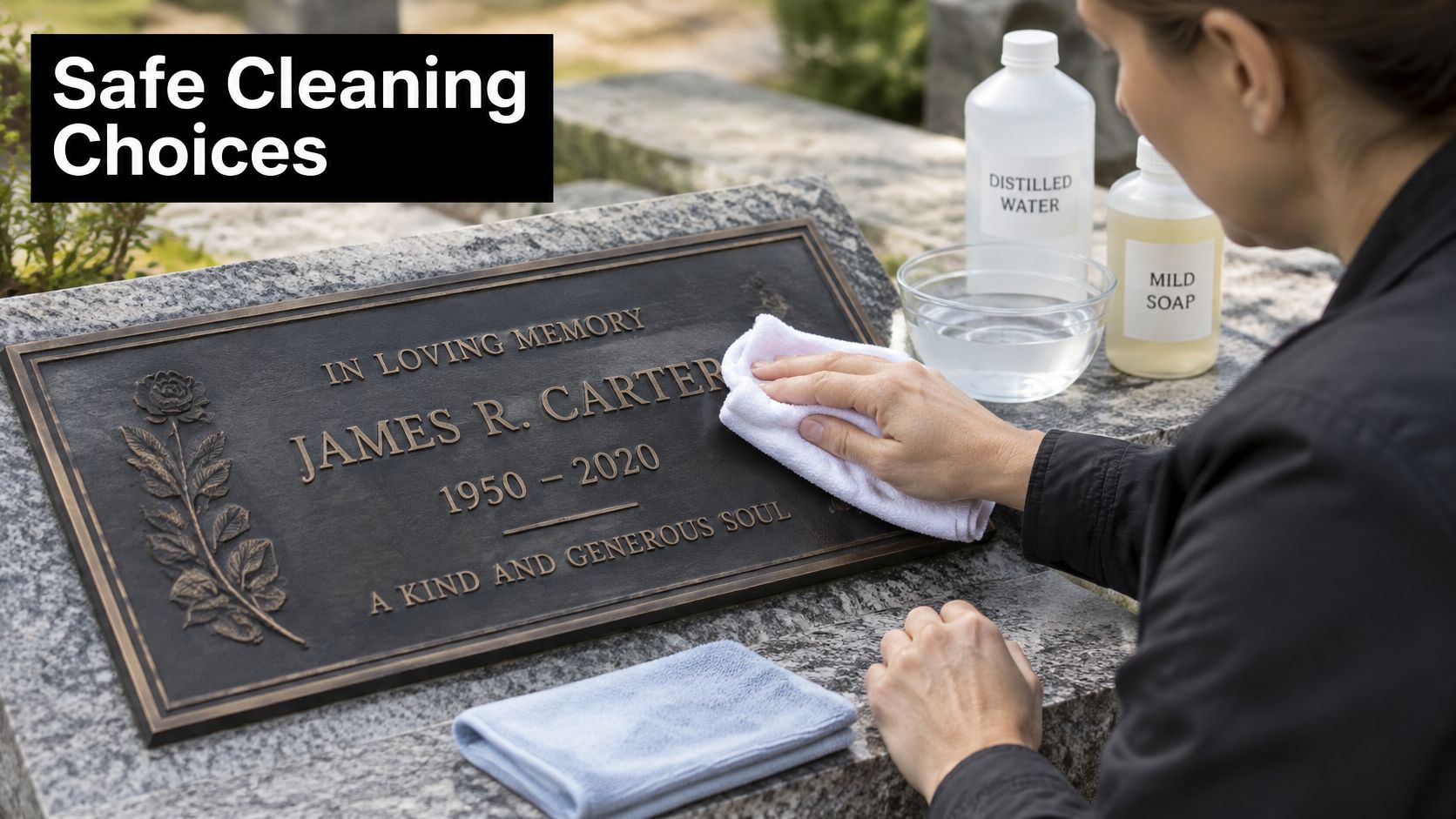
A useful cleaner is one that removes loose grime without attacking the plaque's material or finish. For routine care, that often means plain or distilled water, a soft cloth or sponge, and, where appropriate, a small amount of mild, pH-neutral soap. A soft long-haired dusting brush can lift dry debris, while a wooden spatula may help loosen bird droppings when used carefully on a suitable surface.
Commercial metal cleaners and traditional liquid cleaners aren't a safe default for memorial plaques. Western Australian cemetery guidance warns that they can considerably damage bronze; so can heavy polishing, scrubbing and abrasives. Avoid bleach, acids, abrasive pads, wire brushes and pressure washers on historic or delicate memorials. General-purpose cleaners and detergents can leave residues, while stronger household degreasers aren't formulated for historic surfaces. If a mark resists gentle cleaning, that's a reason to stop and assess it, not to increase the force or change to a harsher product.
| Better suited to gentle care | Avoid on historic or delicate plaques |
|---|---|
| Plain or distilled water | Bleach and acids |
| Soft cloths, sponges and brushes | Scouring pads, wire brushes and hard bristles |
| Mild, pH-neutral soap where suitable | Commercial metal cleaners and abrasive products |
| Wooden spatula for suitable, dried debris | Scrapers and pressure washing |
Engraving durability starts with the marking method
Cleaning and engraving are different concerns, but the way lettering is made affects how it wears. Laser engraving creates a mark in the material rather than applying lettering as a surface layer, which reduces the risk of lettering lifting like an applied label or paint. Trotec Laser systems are used for precision laser engraving, while Evright Industrial produces engraved plaques using premium materials and quality checks for outdoor applications. The material and site conditions still matter, so choose a plaque and finish suited to where it will be installed.
If you're comparing cleaning approaches for another hard surface, Tiles Mate's porcelain cleaning guide offers useful context about matching cleaning methods to the surface rather than reaching for an abrasive by default.
Outdoor Preservation and a Practical Maintenance Schedule
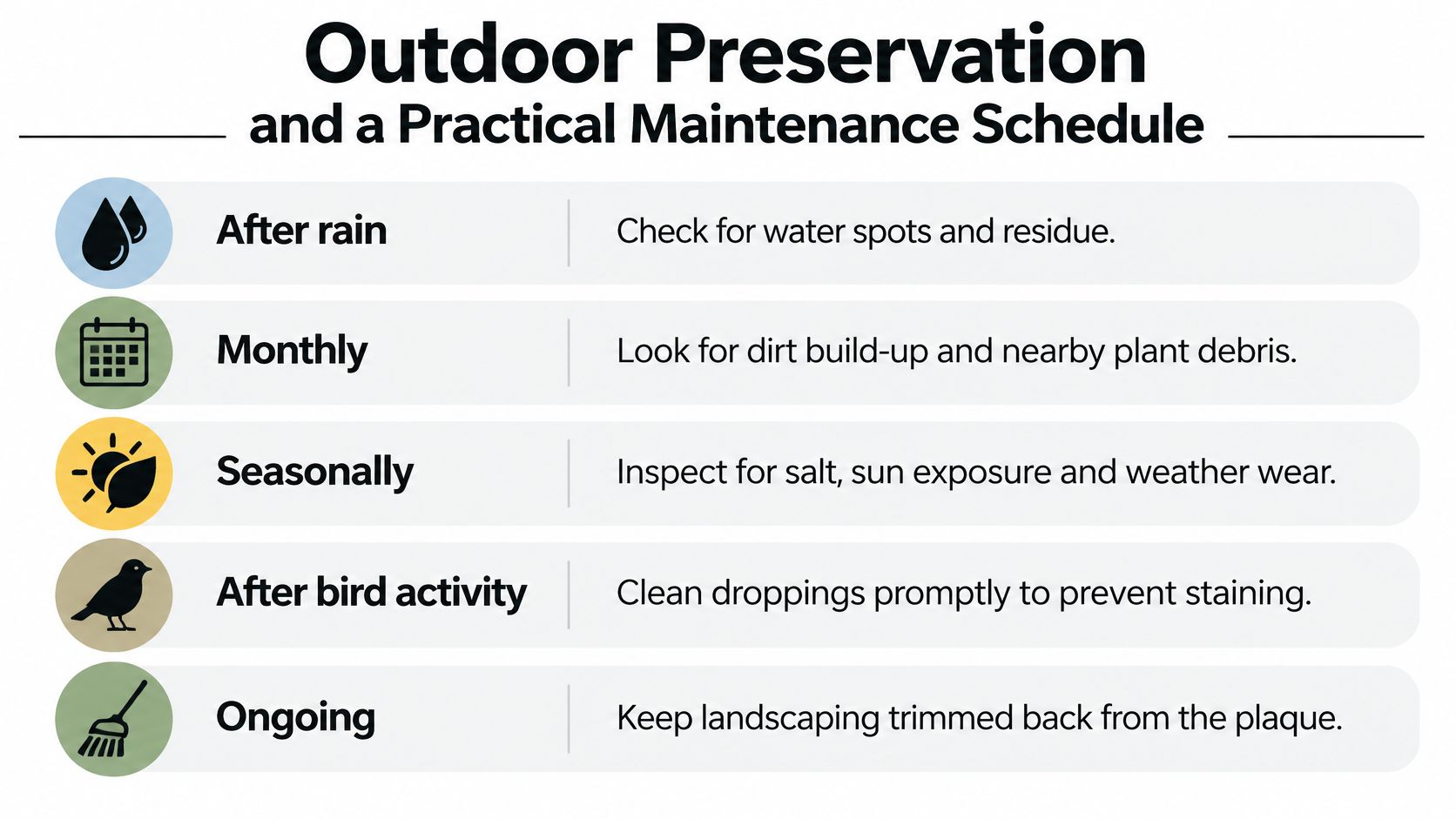
A bronze plaque on a coastal headland and one beside a garden irrigation line do not age the same way. Rain, sun, salt-laden air, bird activity and surrounding landscaping act on a finish differently, so a fixed polishing timetable tends to do more harm than it prevents. Annual condition monitoring is a defensible baseline. Between those checks, let exposure and appearance decide when a gentle clean is warranted.
Match the schedule to the material and site
Bronze develops patina unevenly in exposed positions, and checking after rain shows whether water spots and runoff marks are building up or drying clean. Stainless steel in coastal air can pick up tea-coloured surface staining that washes off but signals a harsher site worth logging. Stone bases collect biological growth in shade, and anodised aluminium dulls where sprinkler spray lands repeatedly. The material and finish set your inspection points.
Bird droppings deserve faster action. They etch and stain the longer they sit, so remove them gently when practical.
Keep plants trimmed back and keep irrigation spray off the plaque and its supporting stone. Herbicide applied near monuments needs particular care, because overspray can mark adjacent surfaces. Check mounts and fixings after severe weather. If a plaque rocks on its mount, or the finish lifts at the edges, stop there. Loose fixings, active corrosion and flaking coatings are stop points for a conservator or the site authority.
Keep a simple condition log
A log turns casual checks into evidence. Note the date, weather, condition observed and work performed, and photograph lettering, coating and growth from a consistent angle each time. A couple of dated photos a year tells you more than memory does.
For a family plaque, dated photos may be enough. Councils, funeral homes and facility managers can apply the same method across a memorial wall, recording each plaque separately and flagging work that needs approval. When specifying a new plaque for an exposed setting, custom outdoor memorial plaques from Evright Industrial are worth comparing against the conditions your log records.
Checking Permissions and Planning Your Next Step
A family arrives at the cemetery with a soft brush and a bottle of mild detergent, then learns the plaque sits on managed land and even gentle washing needs the operator's sign-off. That phone call should happen before the cleaning kit comes out of the car.
The first question is who owns the memorial and who can authorise work on it. NSW guidance says families may be responsible for individual grave plaques and advises contacting the cemetery operator before cleaning. Victorian heritage guidance goes further on listed memorials: it prohibits sandblasting, high-pressure water, bleach, acids, silicone sealants and permanent graffiti barriers, and recommends qualified contractors for removing lichen or algae. NSW cemetery guidance on caring for memorials puts permission and method in the same decision, which is where they belong.
Stop points matter as much as technique. Put the brush down if the plaque is loose or unstable, corrosion products are present, biological growth is established, paint or coating is flaking, or the memorial is heritage-listed and you have no advice in hand. Those conditions belong to a cemetery operator, heritage adviser or qualified conservator, and no household cleaner will improve them.
Work through this sequence first
- Confirm authority: Ask the cemetery operator, council or site manager whether cleaning is permitted, and check heritage requirements if the memorial is listed or historic.
- Record condition: Photograph the plaque and note loose fixings, damaged lettering, corrosion, biological growth or flaking finishes.
- Protect the site: Plan for runoff, keep cleaning water and products away from sensitive landscaping, and wear the personal protective equipment the site requires.
- Choose the right scope: Gentle washing sits in a different category from refurbishment, repainting, resurfacing or restoration. Ask whether the proposed work needs formal approval.
Take the photograph, make the call and ask what is permitted. If the plaque needs replacement rather than cleaning, document its condition and confirm who authorises the work before commissioning a new one, as noted earlier. Evright Industrial produces engraved replacement plates and durable memorial plaques through its laser engraving service when a new plate is the right answer.
For a plaque that has reached the point where gentle cleaning can no longer restore legibility, contact Evright Industrial about engraved replacement plates and custom memorial plaques, and discuss the material, engraving and installation requirements for your site.
Recent Comments