

You've been called to a board you didn't install. The drawings are on a tablet, the production manager wants a motor isolated, and the labels in front of you are faded, handwritten, or pointing to equipment that was moved two years ago. That's the moment electrical equipment labels stop being cosmetic. They're the instructions left for the next person, and if they're wrong, that person has to guess around live equipment. This guide separates what should stay permanent for the life of an asset from what must change after testing, repair, or relocation.
Why Electrical Equipment Labels Matter
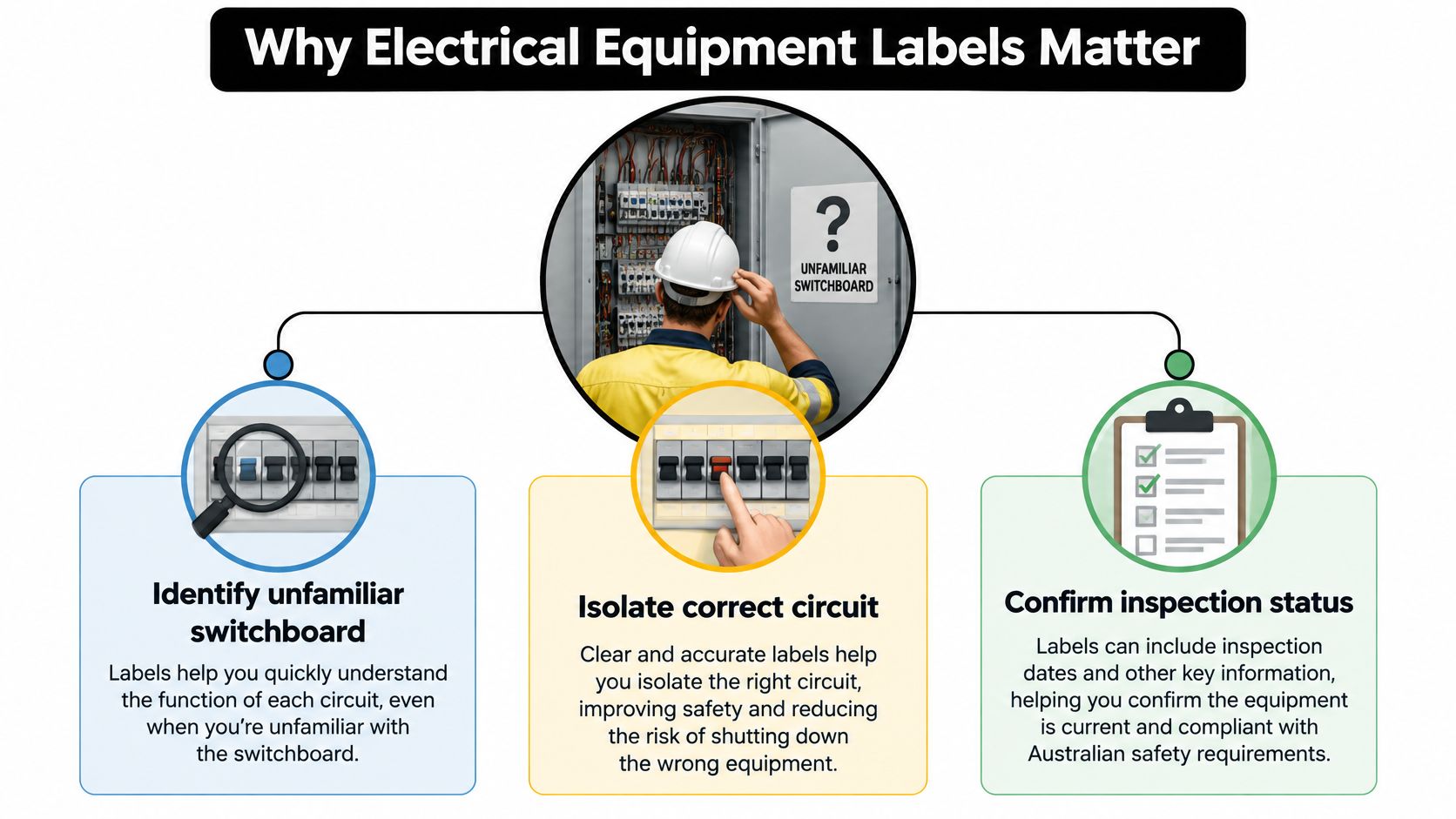
A contractor arrives at an unfamiliar switchboard during a shutdown. Half the circuit markers are heat curled. One engraved plate names a pump that now sits in another building, and a test tag hangs on a lead with no clear status. He can still do the job, but he'll spend time tracing circuits that should've been identified at a glance, and every extra check is time spent close to energised parts.
That scene is common because labels are often treated as the last small purchase on a project. In practice, they carry identity, location, supply source, isolation points, hazards, compliance marks, and inspection status. A label is a map for someone who may open that cabinet years after manufacture, long after the installer has left site.
A Safety Control You Read
Clear identification helps a technician do three things in order. First, recognise which board or machine this is. Second, isolate the correct circuit without shutting down the wrong process or leaving the intended circuit live. Third, confirm whether the equipment has passed inspection, failed it, or been removed from service.
Those steps sound basic until one is missing. If two distribution boards look identical, a generic label doesn't help. If the isolation point is named differently on the board and in the maintenance system, the worker has to reconcile two versions of the truth under time pressure.
- For contractors: Accurate labels reduce tracing time and support safer isolation at handover and during fault finding.
- For facility managers: Consistent naming links the physical board to drawings, asset registers, and work orders.
- For maintenance teams: Status information tells them what can be used, what must stay quarantined, and what needs retesting.
- For asset owners: Durable identification preserves model and rating details when staff change or equipment is transferred.
Permanent Isn't Always Safer
Durability protects information, but it also preserves mistakes. A permanent plate with obsolete circuit details can mislead people for years.
That's why this guide keeps two categories separate. Permanent identity markings record stable facts such as equipment name, model, and supply relationship. Replaceable status tags record changeable facts such as test outcomes and warnings against use. When you mix the two, you either engrave information that will expire or rely on a temporary tag for identity that should never disappear.
What Electrical Equipment Labels Identify
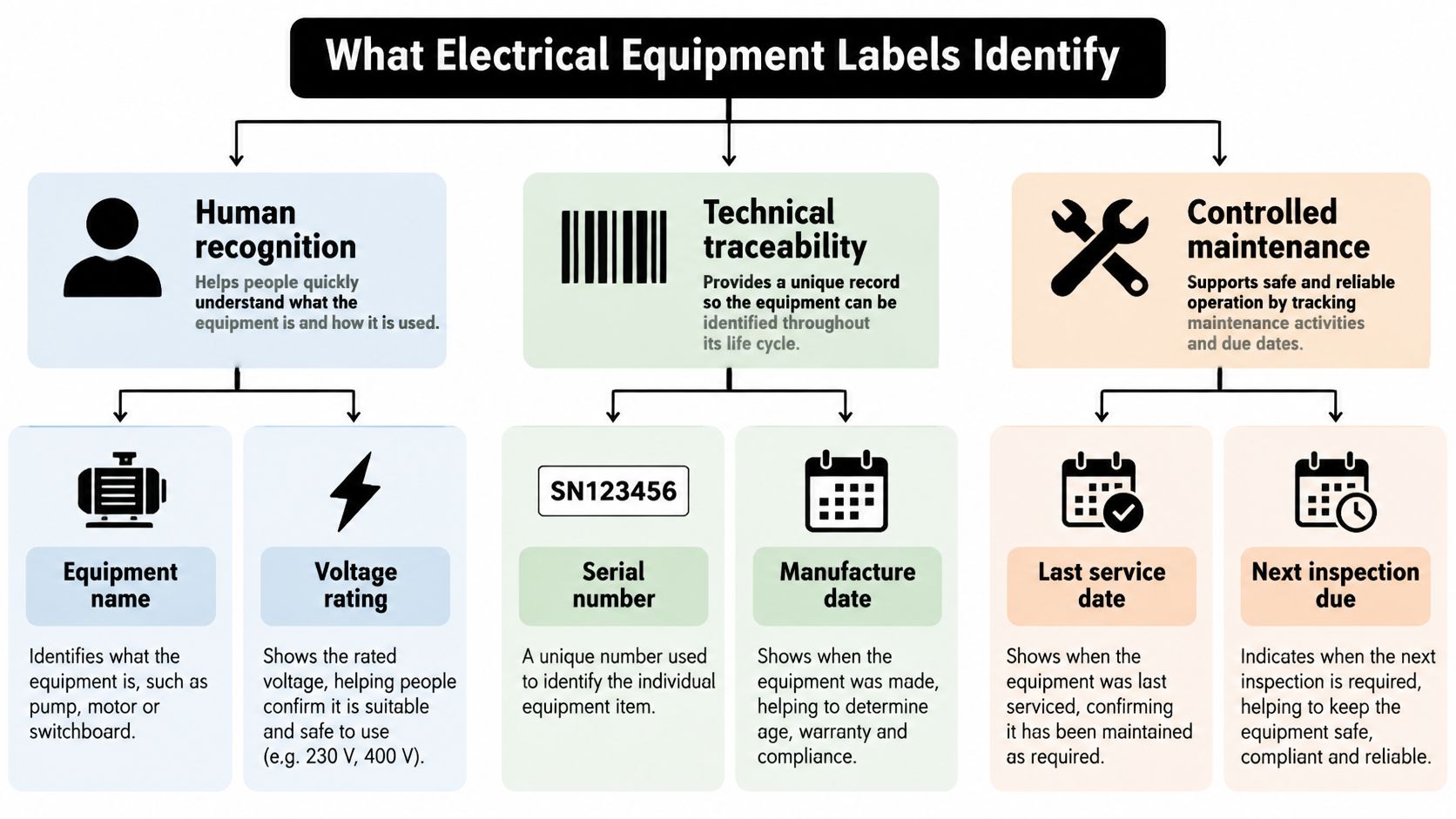
Start with the person standing in front of the equipment. They need human recognition first, a plain name they can match to a work order, a drawing, and the physical asset. "DB 4" only helps if DB 4 means the same thing everywhere. A stronger label gives the board name, its location, and where it's supplied from, so a new technician doesn't need local memory to understand it.
Next comes technical traceability. Model or type, serial or asset number, ratings, and manufacturer details connect the physical item to manuals, spare parts, and approval records. When that link breaks, even compliant equipment becomes hard to verify. In Australia, AS/NZS 3820:2020 establishes essential safety requirements for electrical equipment before it's placed on the market, while AS/NZS 4417.2:2020 specifies requirements for applying and placing the Regulatory Compliance Mark on electrical and electronic equipment.
One Label Rarely Does Every Job
Take a machine control cabinet on a packing line. The cabinet door might carry the machine name and main isolator identification. Inside, individual circuit breakers need their own markers. The motor it feeds needs a data plate, and a separate warning may be needed where stored energy or multiple supplies create a specific hazard. A test tag on a portable lead used during maintenance serves a different purpose again.
Trying to squeeze all of that onto one plate creates clutter, and clutter gets ignored. Separate labels work together when each one has a single clear job.
- Asset identity: Equipment name, asset number, model, and serial details for traceability.
- Circuit and supply information: What the circuit feeds, where supply comes from, and which device isolates it.
- Operating information: Ratings and instructions a worker needs at the point of use.
- Hazard warnings: Specific risks that aren't obvious from looking at the enclosure.
- Status information: Tested, failed, quarantined, or returned to service.
Stable Facts and Changing Facts
The dividing question is simple. Will this information still be true after a repair, a relocation, or the next inspection? Model and serial details usually will. Test status won't. A circuit description sits in the middle, it's stable until someone alters the installation, which is why alterations need a label update as part of the job, not as an afterthought.
Write labels for a stranger. If a competent electrician who's never visited your site can identify the equipment, find its isolator, and understand its status without ringing anyone, your labelling is doing its job.
Choose Labels and Materials for the Environment
Material choice starts with where the label will live, not with what looks neatest on a sample board. A plate inside a clean switchroom faces a different life from one on an outdoor enclosure that's pressure washed, exposed to sunlight, and brushed by tools every week. Heat, abrasion, cleaning chemicals, moisture, and ultraviolet exposure all attack legibility in different ways, so you need to name the actual conditions before you order anything.
Attachment matters just as much. Western Australian electrical specifications state that label fixing must not void an equipment enclosure's IP rating or certification, and SafeWork South Australia guidance on isolating switch markings specifies lettering at least 6 mm high in a contrasting colour, points set out in the SafeWork South Australia electrical guidance for construction installations. Drilling a certified enclosure to rivet a plate can create a bigger problem than the one you were solving. Adhesive bonding to a suitable flat external surface, or fixing to an existing identification area, usually protects both the label and the enclosure rating.
Comparing the Main Options
Laser engraved plates cut text into the surface, so the marking doesn't rely on ink sitting on top. They suit switchboard legends, circuit identification, and data plates where wording is stable. Printed adhesive labels are fast to produce and useful for short runs or information that changes, but the print layer and adhesive become the weak points under heat, solvents, or abrasion. Etched metal nameplates suit harsh industrial settings and long service lives, though they take more planning because corrections aren't quick. Replaceable tags are deliberately temporary, they're the right tool for inspection status because they're meant to be removed and replaced.
Where heat is the main threat, check the substrate and adhesive system together rather than trusting a generic description, and review suitable high temperature label materials against the actual surface temperature and cleaning routine at your site.
| Option | Best suited to | Selection caution |
|---|---|---|
| Laser engraved plate | Switchboard legends, isolator labels, stable circuit descriptions | Engraving obsolete wording makes errors long lasting, verify text before production |
| Printed adhesive label | Indoor equipment, short runs, information likely to change | Print and adhesive can degrade with heat, chemicals, sunlight, or abrasion |
| Etched metal nameplate | Outdoor plant, washdown areas, long life asset identity | Longer lead time, fixing method must suit the enclosure |
| Replaceable test tag | Inspection status, quarantine warnings, return to service records | Must be controlled and replaced, never treat it as permanent identity |
Match Permanence to the Message
Practical rule: Engrave what identifies the asset. Tag what describes its current condition.
Metal nameplates and engraved polymer labels both have a place, and neither is automatically superior. A metal plate on a curved, oily surface may fail sooner than a well bonded polymer label on a clean flat door. Ask about surface preparation, adhesive compatibility, contrast after ageing, and resistance to your cleaning products. Avoid low contrast colour combinations and glossy finishes that reflect light in a bright switchroom. If a label can't be read from the normal operating position, its material performance is irrelevant.
Meet Australian Compliance and Safety Expectations
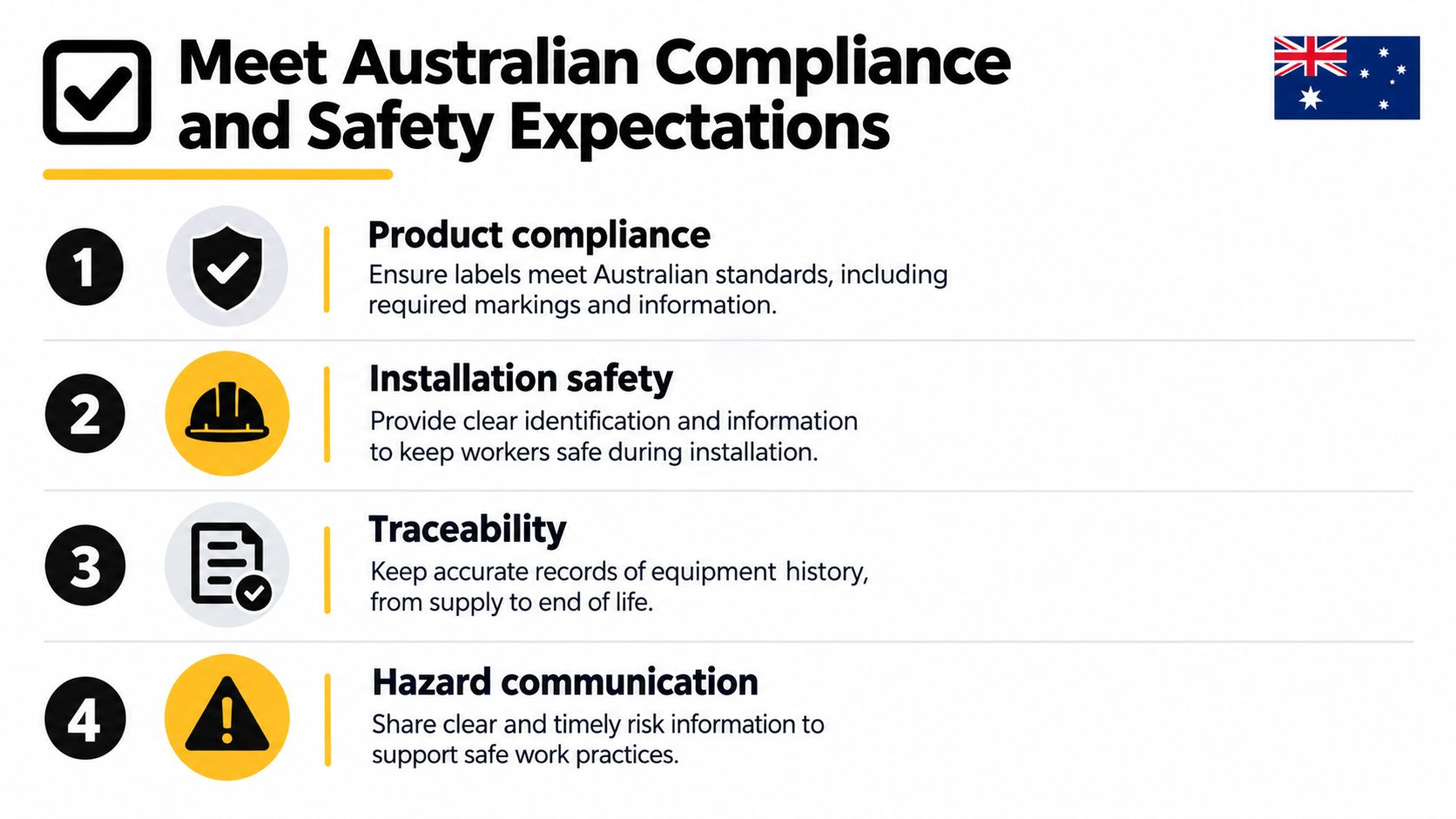
Australian requirements treat labelling as part of electrical product compliance, not as optional identification. Labels provide traceable evidence of conformity at the point of supply and later during inspection, which is why manufacturers, importers, contractors, and asset managers all have a stake in getting them right. You don't need to memorise every standard, but you do need to know which decisions they affect.
The Electrical Equipment Safety System, or EESS, requires in scope equipment supplied by a registered Responsible Supplier to carry the Regulatory Compliance Mark, or RCM. Under the EESS guidance on marking electrical equipment, the RCM should generally sit on the equipment's external surface as close as practicable to the model identification, and each type of in scope equipment must have its own model number corresponding with the nameplate or rating label. For a nameplate designer, that means the compliance mark and model details need to be visible without dismantling the equipment, and they need to survive covers being removed, routine cleaning, heat, and abrasion.
Where Standards Shape Label Design
Some standards address labelling for a specific application because the risk of incorrect intervention is high. Photovoltaic installations are a good example, workers need to distinguish live DC circuits during maintenance, isolation, and emergency response, often outdoors where sun exposure tests every material. Switchgear maintenance raises a different issue, labels, notices, and danger plates have to be inspected and replaced when equipment changes, so the label becomes part of routine maintenance rather than a one off installation task.
For a plain language overview of how these obligations fit together before you brief a supplier, the summary of electrical equipment safety standards helps connect product compliance, installation identification, and inspection practice. Use it as orientation, then verify current requirements against approved documentation and competent advice for your jurisdiction and equipment type. State and territory rules differ, and a label that's acceptable in one context may not satisfy another.
Legibility Is a Measurable Control
- Contrast: Dark lettering on a light background, or the reverse, read clearly under site lighting. Mid tone on mid tone doesn't.
- Letter size: Markings need to be readable from where a person normally stands, not only with a torch at close range.
- Unique identification: Boards and equipment need identifiers that don't repeat across a site.
- Placement: Put the mark where covers, cable entries, and routine handling won't obscure it.
The Governance Gap
Incorrect model or compliance identification can undermine traceability even when the physical equipment is electrically sound. That's why label artwork should be checked against approved equipment documentation before manufacture, not proofread from memory.
The harder problem appears years later. Equipment gets modified, circuits get repurposed, and a permanent plate keeps stating the old arrangement with complete confidence. An old permanent mark can become a hazard when nobody owns the process for superseding it. Every labelling system needs a named owner, a trigger for review after alteration, and a way to remove or replace obsolete plates so only one version of the truth remains on the equipment.
Select and Apply Labels Across Industrial Sites
Good labelling across a whole site doesn't happen board by board. It starts with a survey. Walk the site with drawings in hand and record what each board, cabinet, and machine is today, not what the original project called it. Photograph existing labels, note damaged or missing plates, and flag any equipment where the physical label disagrees with the asset register. That survey becomes your production list.
Before you look at the workflow in detail, notice what a site inspection should capture at each board.

A Repeatable Selection Workflow
- Survey the equipment: Record board names, locations, supply sources, circuits, and existing label condition.
- Define the information hierarchy: Decide what appears on the door, what belongs at each breaker, and what belongs on a separate warning or data plate. Keep one job per label.
- Verify against approved documentation: Check every model number, rating, and circuit description against manuals, test records, or as installed drawings. Don't copy an old label that may already be wrong.
- Select material and fixing: Match the label to heat, sunlight, cleaning, abrasion, and surface type. Confirm a flat external surface or existing identification area so you aren't drilling into a certified enclosure.
- Produce a proof: Review wording, spelling of equipment names, letter height, and contrast at actual size before full production.
- Install and verify on site: Fit each label, then walk the site again and read every plate from the normal operating position.
Controlled Production With Laser Marking
Consistency is where production method earns its keep. When dozens of switchboard legends, circuit markers, and data plates need identical formatting, a Trotec Laser machine engraves text, asset numbers, barcodes, and QR codes directly into the label material from a controlled digital file. That means the wording approved at proof stage is the wording that appears on every plate, without handwriting variation or print fading between batches. Evright Industrial uses Trotec Laser equipment for this kind of electrical marking work, producing switchboard labels, breaker identification, wire markers, and data plates from verified customer data.
Laser production doesn't remove the need for human checking. The machine will faithfully engrave a wrong circuit description. Your verification step before production is what makes the consistency valuable.
Placement Details That Get Missed
Clean and dry the surface before bonding, and allow adhesives to cure as directed before the equipment returns to a washdown or outdoor area. Position labels where opening a door, removing a cover, or running cables through an entry won't hide them. Keep wording consistent with your drawings and maintenance system, if the drawing says "Chiller 2 Isolator," the label shouldn't say "CH2 ISO" unless that abbreviation is defined everywhere it's used.
Finally, hand over an updated label schedule with the job. Recording what was fitted, where, and from which data file makes the next alteration faster and gives the next contractor a starting point you wish you'd been given.
Apply Labels to Common Workplace Scenarios
The principles stay the same across sites, but the consequences of a wrong label change with the setting. Looking at four common environments shows how one labelling standard adapts without becoming generic.
Manufacturing Lines
On a production line, a packaging machine may be fed from a local isolator, controlled from a separate panel, and linked to conveyors with their own drives. Machine identity labels, circuit references, and isolator markings need to use the same asset names as the maintenance system, so a fitter responding to a breakdown can isolate the right section without stopping the whole line or, worse, isolating the wrong section while the faulty one stays live. Durable plates suit the fixed plant, while test tags handle the portable tools moving through the workshop.
Construction Sites
Temporary power creates a different problem. Boards move, leads multiply, and several trades share the same supply. In Tasmania, construction site switchboards must be distinguishable using clear numbers or letters such as "Temp Board 1," permanently and legibly identify the supply source, and show specific isolation labels including "Main Switch" and "Distribution Board Isolating Switch." Because those rules sit in state guidance rather than the verified sources linked elsewhere here, treat them as an example of the pattern, unique board identity, visible supply information, and unambiguous isolation wording, and confirm the current requirements for your state before you print a single label.
Where arc flash risk has been assessed for larger boards, warning information needs the same rigour as circuit identification, which is why many sites standardise their arc flash labels alongside switchboard legends rather than treating them as a separate purchase. The key point is consistency, a worker should read hazard and circuit information in the same visual language.
Healthcare Facilities
In a hospital or aged care facility, the priority is unambiguous equipment identification in areas where non technical staff work around essential services. Labels need plain wording, high contrast, and placement that survives frequent cleaning. The practical lesson is restraint, name the equipment and its isolator clearly, avoid internal jargon, and keep critical supply identification consistent across wards so relief staff aren't decoding local shorthand during an incident.
Solar and Outdoor Infrastructure
Solar arrays add outdoor exposure and circuits that remain energised in daylight. AS/NZS 5033:2021 includes requirements for labels and signs addressing UV resistance, photovoltaic cable and enclosure identification, junction boxes containing DC cable terminations, and fire or emergency information. Those labels must communicate system function to firefighters and maintenance crews years after installation, so UV stable materials and engraved or otherwise durable marking become a safety decision, not a cosmetic upgrade.
Maintain Labels Through the Equipment Lifecycle
Installation day is the easiest point in a label's life. After that, cleaning, sunlight, solvents, knocks, and well meaning modifications all work against it. A lifecycle approach gives every label an owner and a set of trigger events, so damaged or outdated information gets corrected instead of staying in service.
Separate Identity From Status
Portable equipment shows the distinction clearly. In the Australian Capital Territory, WorkSafe ACT guidance on electrical equipment states that equipment passing inspection and testing must receive a durable, non-reusable, non-metallic tag or other indicator, while equipment that may be unsafe must be removed from service immediately and fitted with a label warning against further use. The tag is deliberately replaceable because the equipment's status changes at every test. The asset number plate underneath it shouldn't change at all.
Second hand equipment follows a similar logic. Tasmanian rules for selling second hand electrical articles require a label stating whether the article has been tested, and where testing occurred, the date and the name of the person or company who tested it. Again, the label records a point in time decision, it isn't decoration, and it must be accurate when the next person relies on it.
A Controlled Status Workflow
When equipment fails a test or shows a serious defect, the label should trigger a sequence rather than sit as a passive warning.
- Quarantine: Remove the item from service and fit the unsafe warning label immediately.
- Assess: A competent person examines the defect and decides on repair or disposal.
- Repair with evidence: Record what was repaired and by whom.
- Retest: Inspect and test again before any thought of return.
- Release: Fit the new durable tag and remove the quarantine label only when the retest passes.
- Record: File the result against the asset so the history is auditable.
Keeping Permanent Labels Honest
Add label condition to existing inspection rounds. Check legibility after cleaning, look for lifting edges, fading, and plates obscured by new cable entries or equipment. Any alteration, relocation, or board modification should trigger a label review as part of the same work order.
- Owner: Name the role responsible for label accuracy at each site.
- Triggers: Alteration, relocation, failed test, repair, and damage all prompt review.
- Authorised replacement: Only approved artwork and data files get used for reprints.
- Records: Keep the label schedule with drawings so replacements match the originals.
Build a Reliable Industrial Labelling Standard
A reliable standard combines five things, accurate source data, materials matched to the environment, controlled production, correct placement, and documented replacement when equipment changes. Miss one and the others can't compensate. Queensland's rules underline the point, Queensland legislation requires a label stating portable equipment is electrically unsafe when a serious defect is found, prohibits removal or reconnection until specified repair conditions are met, and requires a durable tag after inspection and testing. Status is governed, not improvised.
Permanence belongs to identity. Safety status must remain changeable.
For printed labels in stores and workshops, clear overlays such as label protection tape options from Material Handling USA can shield short term labels from scuffs while permanent plates are produced. For production, Trotec Laser marking through evright.com connects industrial labelling with an established laser engraving and awards business, you supply verified equipment data, artwork is proofed, and plates are laser engraved for consistent, durable identification across switchboards and plant.
If your switchboards, machinery, or portable equipment need identification that stays readable and accurate through testing, repair, and relocation, Evright Industrial can produce laser engraved electrical equipment labels, data plates, and safety signage from your verified data. Visit Evright Industrial to discuss your equipment schedule and get a proof started for your site.
Recent Comments