

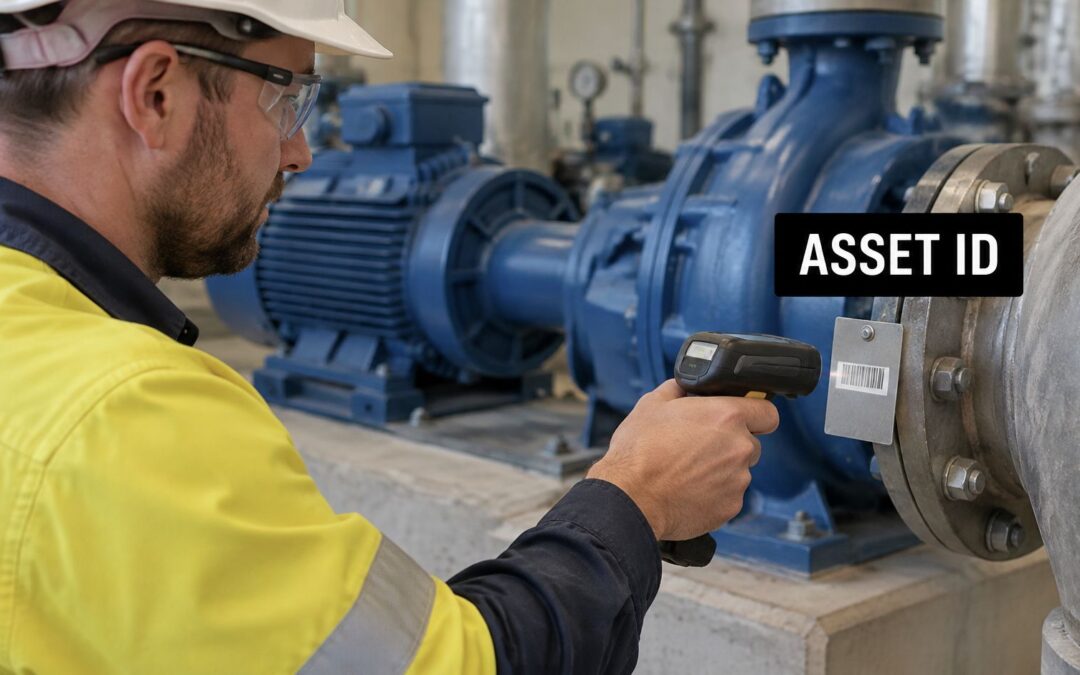
You're preparing a maintenance shutdown, and the contractor asks which pump needs attention. The work order names a location, the equipment register uses an old description, and the plate on the machine is unreadable. Before anyone can service the equipment confidently, someone has to establish which physical asset the records describe.
A reliable asset tracking number prevents that uncertainty. Designing one starts with responsibility, record ownership and lifecycle rules, not with choosing a barcode or ordering a metal tag.
Why a Missing or Duplicated Number Costs You
Consider a hypothetical maintenance visit to a regional Australian water utility. A contractor opens a cabinet beside a bank of identical pumps, but none has a readable identifier. The tablet shows maintenance records, yet the contractor can't confidently match them to the equipment.
The inspection setting looks familiar, but the critical question is which record belongs to which pump.
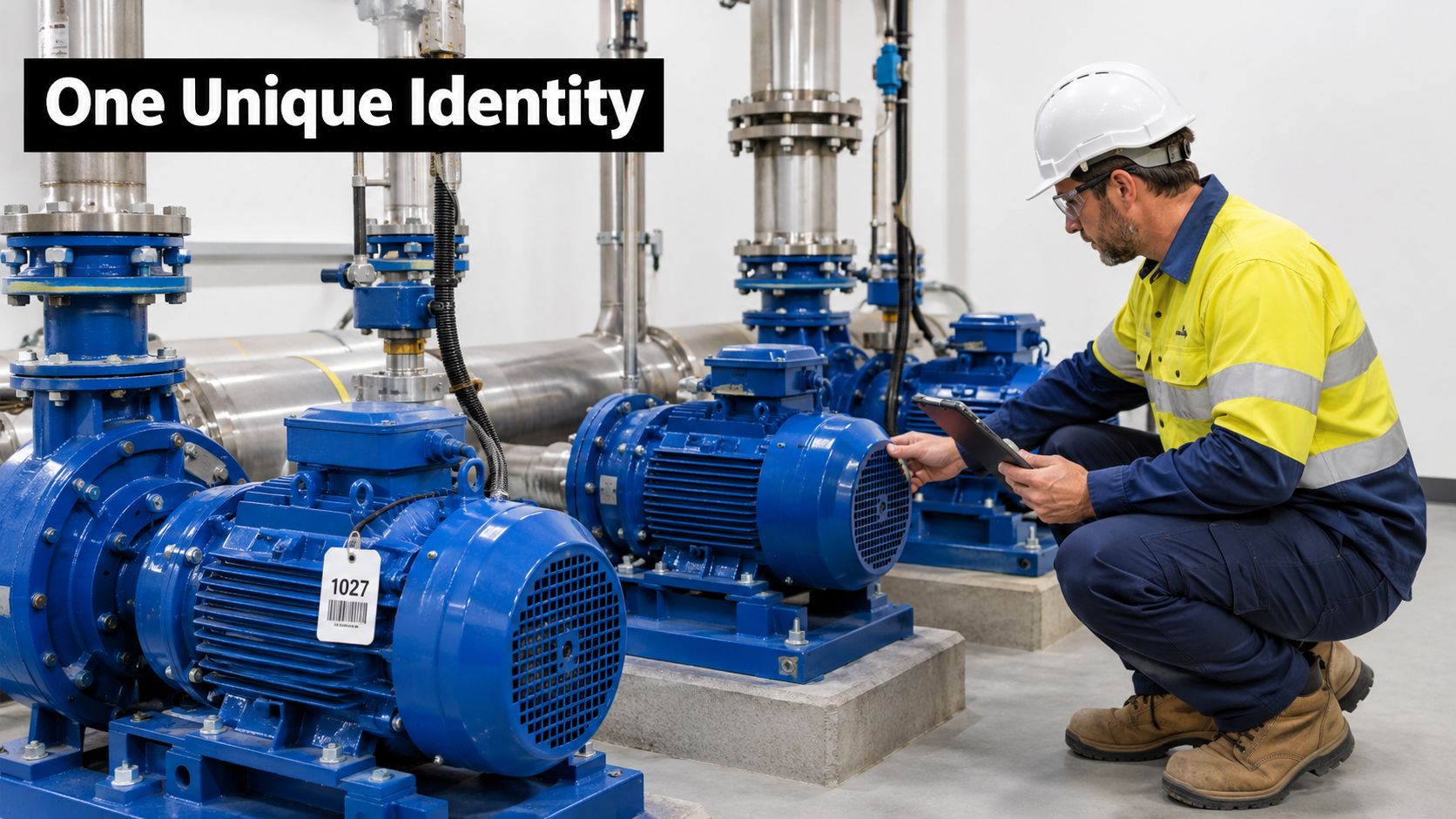
Service may have to wait while the maintenance manager checks installation photographs and procurement records. A warranty enquiry could then follow the wrong purchase record. If associated instruments have calibration histories, staff might struggle to establish which history applies to the item being inspected.
The cost starts before the repair
These are possible consequences, not a documented case study. They illustrate why identification belongs in operational planning: a technician needs evidence of identity before relying on the attached history.
A duplicated number creates a different trap. The label looks convincing, so staff may attach a completed work order to the wrong record without recognising the mistake.
Practical rule: A readable label isn't enough. The number must identify the intended asset unambiguously in the records people actually use.
For a useful exercise in retrieval discipline, SIX ERP's traceability test for manufacturers provides a starting point for discussing whether staff can find connected records. Apply that question to maintenance: can your team move from a physical machine to its relevant documents without guessing?
Replacing a damaged tag addresses visibility. It doesn't resolve duplicate records, uncertain ownership or inconsistent numbering. Before approving replacement labels, ask who controls the identifier and how staff confirm that the replacement points to the correct asset.
What an Asset Tracking Number Actually Is
An asset tracking number is a stable, unique identifier assigned to an individual physical item. Treat it as the item's identity, while storing its location, condition, custodian and maintenance status as separate attributes.
Think of the distinction between a vehicle's identity and its parking space. Moving the vehicle doesn't make it a different vehicle. Similarly, transferring a motor from a workshop to a remote installation shouldn't require rewriting its identity.
The Australian Digital Health description of GIAI explains how individual-asset identification can connect physical assets with asset-management and accounting systems across company boundaries. That's a useful distinction: the identifier names the item, while the systems describe what has happened to it.
Similar-looking numbers answer different questions
| Number on the paperwork | Question it answers |
|---|---|
| Asset tracking number | Which individual item are we managing? |
| Manufacturer serial number | What identity did the manufacturer assign? |
| Model number | What design or product model is this? |
| Purchase order reference | Through which purchasing transaction was it acquired? |
| Stock-keeping unit | Which stocked item or category are we handling? |
Keep the manufacturer serial number as a separate field, even when it's useful for searching. Don't assume a purchasing reference identifies an individual asset, particularly when a purchase includes multiple similar items.
Business change makes this distinction important. The Australian Bureau of Statistics reported 2,662,998 actively trading businesses at 30 June 2024, including 999,161 employing businesses, with 436,018 entries and 362,893 exits, producing annual entry and exit rates of 16.8% and 14.0%, respectively, in its counts of Australian businesses.
Those figures provide context for a practical design choice: don't make an asset's identity depend on its current owner's organisational chart. People, departments and operating arrangements can change. Your register should let staff update those details without losing the connection to the original physical item.
Common Formats and Standards You Will Meet
Choose the identifier according to what you're identifying and where that identity must work. A local register, a returnable-tooling programme and an infrastructure contract may need different approaches.
GS1's Global Individual Asset Identifier, or GIAI, suits individually managed assets. GS1 Australia specifies a 7–9 digit GS1 Company Prefix with an owner-defined alphanumeric asset reference of up to 30 characters, encoded under Application Identifier 8004 and compatible with ISO/IEC 15459-4 and 15459-5, in its GIAI guidance.
Choosing the right GS1 asset identifier
| Identifier | Purpose | Structure | Best fit | Standard |
|---|---|---|---|---|
| GIAI | Identify an individual asset | GS1 Company Prefix plus individual asset reference | Vehicles, computers, equipment and individually managed spare parts | GS1 GIAI |
| GRAI | Identify returnable assets by type or individually | GS1 returnable-asset key with serial identification where needed | Returnable transport items and tooling | GS1 GRAI |
| Organisation-defined ID | Identify assets within a controlled local register | Internally governed prefix and reference | Internal operations without a mandated external key | Organisation's numbering policy |
| Linked identifiers | Preserve identities used by different parties | Authority identifier mapped to operating identifier | Contractor and infrastructure arrangements | Applicable sector or contract requirements |
For returnable tooling, ask whether you need to manage the asset type, each individual tool, or both. For a standalone vehicle or computer, the individual item is usually the management focus.
A locally sequential number can be workable inside a controlled organisation. Don't describe it as globally unique unless its wider uniqueness is established.
Let obligations guide the choice
Check customer specifications and asset-steward requirements before approving the format. A convenient local scheme won't solve a contractual requirement for linked identifiers.
For the laser-marking discussion, distinguish Trotec Laser equipment from mechanical engraving equipment. Review machine demonstrations as production context, not as proof that a proposed identifier or barcode meets a standard.
Whichever format you choose, validate the complete encoded identifier. A familiar-looking barcode isn't evidence that its contents follow the required rules.
Data Carriers That Survive Australian Conditions
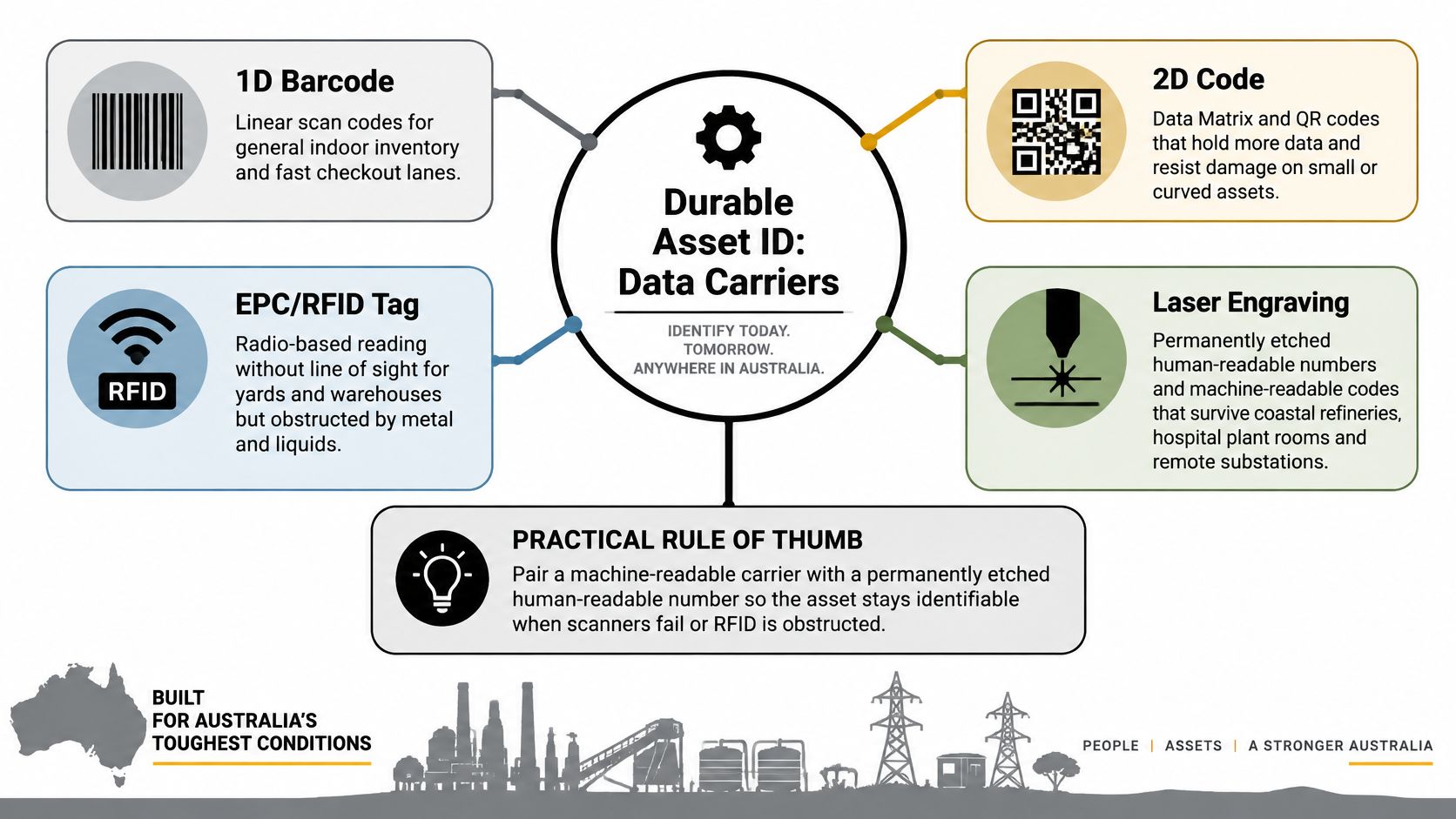
The identifier and its data carrier are different things. The carrier is how people or equipment read the identity: a barcode, a radio tag or a human-readable engraving.
GS1 Australia identifies laser etching as an appropriate marking technique for parts, components and assets. Its barcode and marking guidance supports selecting the identifier and barcode requirements before choosing the physical marking method.
A metal identification plate is one possible approach, but its suitability still depends on the application.

Data carrier performance in harsh environments
Use this as a selection checklist, not a universal performance rating. Actual results depend on the reader, substrate, attachment and installation.
| Carrier | Scan distance | Metal/liquid tolerance | Durability | Best use |
|---|---|---|---|---|
| Linear barcode | Confirm with the intended scanner | Optical access and surface condition need checking | Depends on marking and protection | Accessible equipment with suitable label space |
| Data Matrix or QR code | Validate code size and reading position | Check reflections, moisture and contamination | Depends on substrate and marking | Compact identification where optical reading is practical |
| EPC/RFID tag | Test at the required operating distance | Metal and liquids can obstruct reading | Depends on tag construction and installation | Movable assets and automated movement capture |
| Human-readable laser engraving | Visual reading rather than radio capture | Requires a visible, legible surface | Validate material and exposure together | Manual identification fallback |
Test the actual environment
For a coastal refinery, ask about salt exposure, cleaning chemicals and attachment security. In a hospital plant room, check whether technicians can reach the reading position safely and whether cleaning affects legibility. At a remote substation, consider weather exposure and how staff will identify equipment when their normal reader isn't available.
My practical recommendation for fixed equipment is to pair a suitable machine-readable code with a laser-engraved human-readable identifier. RFID deserves an installation trial where metal, liquids or electromagnetic conditions may obstruct reading.
When specifying asset tracking labels, provide the marking supplier with the surface material, exposure conditions, reading position and intended attachment method. Request a sample and test it on representative equipment before approving production.
Designing a Numbering Scheme That Will Not Bite Later
Start with the person or team authorised to issue numbers. Without a numbering authority, procurement, maintenance and contractors can each create plausible identifiers that collide when registers are combined.
Queensland Health's single asset identifier guidance offers a concrete Australian governance example. It requires unique SAID numbers for financial assets and maintainable items, recording in relevant finance and enterprise-asset-management fields, application on receipt, and only one identifier label per asset.
Establish the issuing rules
- Prefix ownership: For a GS1 scheme, use the appropriate GS1-assigned company prefix. For an internal scheme, document who controls the organisational prefix.
- Readable length: Test the proposed text with technicians wearing their usual protective equipment. Keep the full encoded identity and any shortened display reference explicitly mapped.
- Allocation control: Use a controlled issuing register or system, with duplicate rejection and an audit trail.
- Future capacity: Reserve capacity for future sites and asset classes. If separate ranges are needed, document them centrally rather than allowing sites to improvise.
The carrier choices can be summarised visually, but they don't replace these issuing controls.
A manufacturer's rollout example
Consider a hypothetical manufacturer operating across several plants. Procurement requests an identifier at receipt, the central authority issues it, and the receiving team confirms the equipment-to-record match before applying the tag.
Store the plant and department separately rather than embedding details that will become misleading after relocation. If sites need offline allocation, give them controlled, non-overlapping ranges and reconcile issued numbers centrally.
Build redundancy into the allocation process and record backups, not by creating competing identities for the same asset.
Document who can correct an issuing error, approve a replacement tag and close an unused allocation. These small administrative decisions are much harder to reconstruct after technicians have started using the numbers.
Integrating the Number With Your Asset Management Systems
Integration begins with data ownership and field mapping, not software selection. Decide which system creates the authoritative asset record and which systems may update particular attributes.
Transport for NSW requires unique identification for registered fixed, linear, mobile and other operational assets. Its asset-register requirements describe the identifier as the primary key linking related data, attributes and documents, including inspection, maintenance and location information.
A successful scan must therefore return the intended record, not produce a readable string.

The identifier is immutable. Store changing attributes in separate fields, with clear responsibility for updating them.
Follow an asset through the workflow
At goods receipt, connect the issued identifier to purchasing information and the manufacturer serial number. During commissioning, add the installation details and required supporting documents.
The maintenance system should reference that identity when a planner raises a work order. A relocation should update the location record and transfer evidence. Disposal should trigger the agreed closing process instead of deleting the asset without any record.
| Information | Ownership question to resolve |
|---|---|
| Asset identity | Who may create or correct the authoritative reference? |
| Financial details | Which finance record governs accounting information? |
| Maintenance status | Who approves service and inspection updates? |
| Custody and location | Who confirms receipt after a transfer? |
| Supporting documents | Where are approved versions retained? |
When assessing industrial asset-management software, ask vendors to demonstrate these hand-offs using your proposed fields. Test whether leading characters, punctuation and alphanumeric references survive import and export unchanged.
Also test exceptions. What happens when a contractor submits an unfamiliar identifier, a scan matches no record, or finance and maintenance describe the equipment differently? Assign those cases to a named role instead of allowing automatic creation of another asset record.
Lifecycle Rules Most Numbering Schemes Forget
A permanent mark doesn't settle whether a rebuilt machine remains the same asset. Your policy must define the managed asset boundary and explain what happens when components, custodians or systems change.
Victoria's medical-equipment framework provides a useful lifecycle model. It states that an identifier should remain with the asset throughout its life, be retired and archived at disposal, never be reused for its replacement, and retain visible mappings between prior and current identifiers.
Decide what continues and what ends
- Refurbishment: Document whether the work preserves the managed asset's identity under your policy. Record the work and relevant component changes.
- Component replacement: Don't imply that a replacement component is the original item. Record its identity separately where individual component management is required.
- Replacement equipment: Issue a new identity and document the predecessor-successor relationship.
- Disposal: Archive the record and supporting history. Prevent the retired identifier from returning to the available allocation pool.
Cross-organisation transfers need particular care. A Transport for NSW technical direction requires the new asset steward to retain the existing identifier when responsibility changes. It also provides for linked authority and service-provider identifiers.
Preserve the mapping, not just the mark
That transport approach shows why linked identifiers can be legitimate without allowing uncontrolled relabelling. Different parties may need operational references, but the relationship between them must remain visible.
The same reasoning belongs in fixed asset management: accounting closure, operational retirement and physical disposal should be reconciled, not treated as unrelated events.
Before a system migration, export identifier mappings alongside the asset records. Require staff to verify those relationships after import, including archived assets that may still matter to historical maintenance, warranty or disposal enquiries.
Practical Checklist for a Durable Numbering Rollout
Approve the rollout when the team can demonstrate the workflow from receipt to retirement, not merely show an attractive sample tag.
The financial context warrants that care. ABS recorded Australian manufacturing EBITDA of A$48.730 billion and profit before tax of A$34.648 billion in 2024–25, with EBITDA rising A$753 million, or 1.6%, and purchases of goods and materials increasing A$25.6 billion, or 8.6%, in its Australian Industry release. Those figures describe manufacturing activity, not a measured return from asset labelling.
Check the complete identification process
- Identifier choice: Confirm whether individual, returnable or linked identification fits the operating requirements.
- Issuing authority: Name the owner of allocation, duplicate checks and correction approvals.
- Data-carrier pairing: Confirm that encoded and human-readable references resolve to the intended record.
- Physical suitability: Test the substrate, attachment and legibility under representative conditions.
- System integration: Check field mappings and exception handling across procurement, finance, maintenance and contractor workflows.
- Lifecycle governance: Approve transfer, refurbishment, replacement and retirement rules before production.
- Acceptance evidence: Retain the approved artwork, encoded data, sample inspection results and production reconciliation.
Specify the marking workflow
For laser-engraved tags and labels, provide a controlled data file rather than asking the supplier to reconstruct identifiers from assorted spreadsheets. Agree how artwork approval, sample scanning and final quantity reconciliation will work.
For an understanding of how the service works, evright.com's engraving business is the parent operation behind the industrial division, drawing on nearly six decades of engraving expertise. The practical workflow is to translate approved identifiers into a suitable marking layout, confirm the material and application, and validate the finished result against the asset register.
Evright Industrial offers laser-engraved asset tags and labels carrying human-readable identifiers, barcodes and QR codes. Visit Evright Industrial with your numbering policy, sample data and exposure requirements to discuss markings that support your chosen identification scheme, including GS1-compliant workflows where required.
Recent Comments