

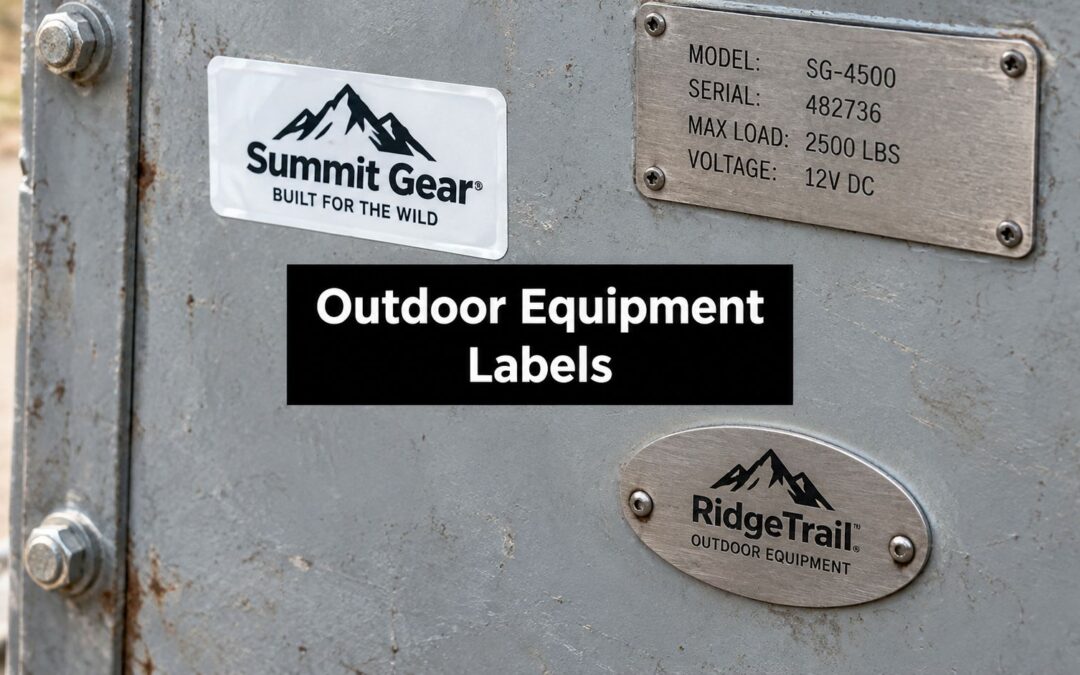
You've probably got a tray of faded asset tags on the bench, or a switchboard label that looked fine last summer and now feels like guesswork after a wet season. That's the problem with outdoor equipment labels in Australia, they don't usually fail as graphics, they fail as a whole system of material, marking, attachment and inspection.
For outdoor assets, the label has to stay truthful, clear and accurate while the equipment keeps living in sun, rain, dust, vibration and cleaning cycles. Australian business guidance says many products sold here need labels, and where mandatory safety standards apply, those standards can require warning statements or instructions on the product or packaging. [business.gov.au guidance on product labelling]
Why Outdoor Equipment Labels Deserve a System View
A coastal council crew opens a service cabinet and finds the tag still hanging on, but the text has washed out and the serial number can no longer be read. The cabinet is still there, the asset is still there, yet the label no longer links the two. That is the point where procurement and maintenance teams see that outdoor equipment labels need to be treated as a system, with the substrate, marking method, attachment, and inspection cycle working together.
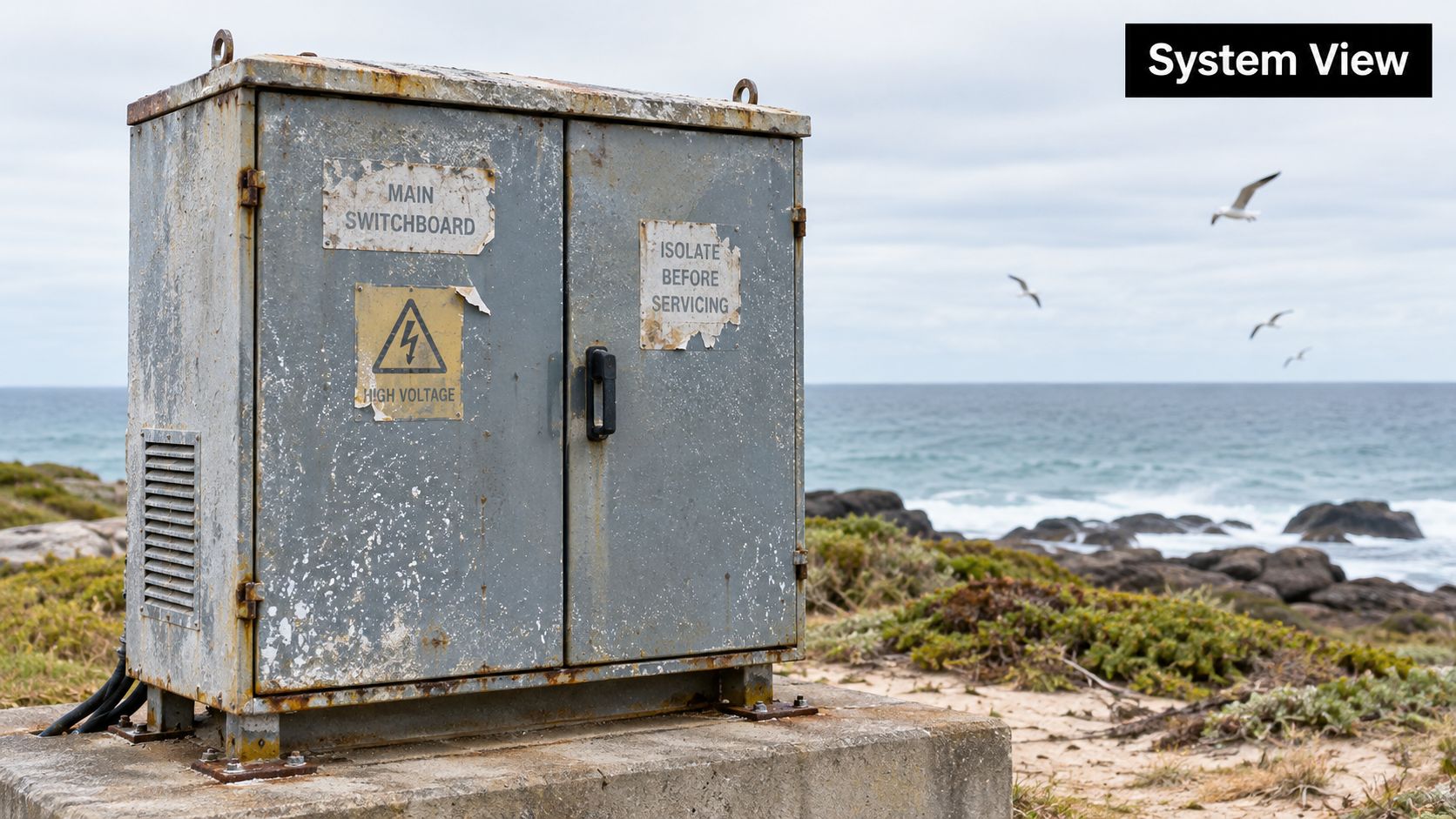
The four questions every label spec has to answer
A useful outdoor label spec starts with four questions. What is the substrate? What is the marking method? How is it attached? How will it be checked in service? If any one of those answers is vague, the label usually becomes the weak point.
Australian business labelling guidance makes the same broader point, label information can be part of safety and compliance, not decoration. Where mandatory safety standards apply, labels may need warnings or instructions on the product or its packaging, and those details have to remain honest and legible over time. [Australian business labelling guidance]
Field conditions are less forgiving than a brochure claim like “weatherproof” suggests. Outdoor equipment can face electricity, fuel, water, heat, moving parts and public handling, so the wrong substrate or adhesive can turn a valid identifier into a maintenance problem.
Practical rule: if a label cannot survive the site's cleaning, touch points and weather exposure, it is not a label spec yet, it is a guess.
What usually goes wrong first
Teams often assume the printed face is the whole product. In practice, the first failures are usually edge lift, faded text, damaged adhesive, or a label mounted where nobody can see it once cables, guards or brackets go in. The failure may look small, but the effect is large, because the asset register and the physical asset stop matching.
A system view helps prevent that mismatch. It gives you a way to compare label families, then narrow the right choice by environment, mounting method and inspection cycle instead of buying on price alone.
The Main Types of Outdoor Equipment Labels Explained
Outdoor labels fall into a few construction families, and each one is physically doing something different on the asset. Think of it less like choosing a colour and more like choosing how the information will survive heat, abrasion, chemistry and handling.
Flexible films and overlays
Printed vinyl behaves a bit like clothing for a surface, it can conform, wrap and follow curves. That makes it useful where the label needs to sit on a contoured panel or a rounded housing, but the trade-off is that it relies heavily on adhesive quality and surface prep.
Polyester and polycarbonate overlays are more like protective skins for controls and membrane panels. They suit interfaces where the print sits beneath or behind a film layer, so the face can take repeated touches without the text being scrubbed away.
Metal and deep-marking families
Anodised aluminium plates use a hardened surface layer that carries the mark. They're popular for asset tags because they're light, readable and suitable for many outdoor locations where corrosion is a concern.
Stainless steel and reverse-engraved plates are the heavy-duty option when the label has to shrug off abuse. Reverse engraving is closer to embossing a seal than printing a graphic, because the mark sits protected within the material structure.
Electrical and technical nameplates
Phenolic and traffolyte nameplates are familiar in electrical and industrial settings because they can handle identification duties where consistent legibility matters. They're often selected for equipment labels that need clear contrast and a stable substrate.
Laser-marked polymer and metal plates sit across this whole family set. They're especially useful when the mark needs to be clean, repeatable and tied to an asset register, rather than just looking neat at installation.
| Label family | UV resistance | Temperature range | Chemical and abrasion notes |
|---|---|---|---|
| Printed vinyl | Suitable for shorter service in exposed areas | Depends on adhesive and film | Good on smooth surfaces, weaker at edges and on rough texture |
| Polyester and polycarbonate overlays | Strong for control-facing applications | Stable in many indoor-outdoor transitions | Designed for repeated contact and panel use |
| Anodised aluminium plates | Strong outdoor performance | Suited to many field environments | Good balance of durability and readability |
| Stainless steel and reverse-engraved plates | Very high durability in harsh sites | Appropriate for demanding industrial locations | Excellent against impact, abrasion and aggressive cleaning |
| Phenolic labels | Useful in technical and electrical applications | Chosen for stable service on equipment | Good identifier choice when legibility matters more than appearance |
What to read on a quote
A quote should tell you more than the face material. You want to know whether the information is printed, engraved, laser marked or layered, because the marking layer is what decides how the label behaves after scratches, washdown and sunlight exposure. Safe Work Australia's plant guidance also makes it clear that a registration number must be marked where it is easily seen, and emergency instructions must be clearly displayed on or near the plant. [Safe Work Australia plant guidance]
That requirement pushes the spec towards permanence. If the mark can't stay visible, the label family is the wrong one for the job.
Reading Environmental Ratings the Right Way
A label data sheet can look reassuring while still telling you very little about field performance. The phrase “UV resistant” doesn't automatically mean a label will survive full sun on a coastal panel, and “marine grade” doesn't always tell you how the adhesive behaves after cleaning, heat cycling or salt spray.
The four rating axes that matter
Start with UV exposure. If the site sees strong sunlight, the issue is not only fading, it's also whether the adhesive and the substrate keep their bond and contrast after repeated exposure.
Next comes temperature range. A label that behaves acceptably in a mild warehouse can become brittle in an alpine winter or soft in a hot wash-down zone.
Then check chemical exposure. Oils, solvents, detergents and process chemicals can attack the face stock, inks or edge adhesion even when the label still looks intact from a distance.
Finally, look at abrasion and impact. A label on a handrail, panel edge or frequently serviced housing faces more contact than one tucked into a protected recess.
Practical rule: a data sheet is only useful if it names the exposure the asset actually sees, not the exposure the supplier hopes you'll assume.
| Rating axis | What to ask | What the term alone does not guarantee |
|---|---|---|
| UV exposure | Will the face and adhesive keep legibility in direct sun? | Long service life in every climate |
| Temperature range | Will it remain stable through hot and cold cycles? | Performance on every substrate |
| Chemical exposure | What cleaners, oils or solvents are in play? | Resistance to all wash-down chemicals |
| Abrasion and impact | Will handling, dust and rubbing damage the mark? | Survival on exposed edges |
How to think about the site
A tropical Queensland site and a coastal site don't punish labels in the same way, even if both are outdoors. A wash-down bay in the Pilbara creates a different problem again, because chemical contact and repeated cleaning can matter more than weather alone. The key is to match the rating to the actual exposure path, not just the season or postcode.
ACMA's labelling guidance is clear on the outcome that matters, a durable label must not be likely to fall off, be washed off or fade, and it must remain legible to the unaided eye on an easily accessible surface. [ACMA label guidance]
That's the standard to hold in your head when a datasheet leans on broad claims. If the label can't remain readable in normal use, the rating hasn't solved the problem.
Mounting and Installation Methods That Hold Up
A strong label on a poor mount still fails. Outdoor installation is a mechanical problem as much as a graphic one, because vibration, thermal cycling and surface contamination all work against the bond.

Adhesive, mechanical and recessed mounting
Pressure-sensitive adhesive is efficient when the surface is clean, flat and stable. It becomes far less reliable on powder-coated texture, oily machinery, hot housings or surfaces that flex under use.
Mechanical fastening with rivets, screws or clips is better when the label needs positive retention. It adds a fixing step, but it also reduces the risk of edge lift or total loss in vibration-heavy environments.
Recessed or in-groove mounting works when the asset design gives the label a protected seat. That can be the cleanest option where the label would otherwise be hit by tools, handles or moving parts.
What good installation looks like
Surface prep matters more than people expect. If there's dust, oil, oxidation or release residue on the mounting face, the bond is compromised before the label even goes on.
Edge sealing also matters when the environment is wet or dirty. A label that starts to lift at the corners becomes a trap for water and grime, and that usually accelerates failure.
Safe Work Australia's asbestos guidance says warning signs and labels should be weatherproof, lightweight and adequately secured, with non-porous, corrosion-resistant materials used where conditions demand it. That principle generalises well to outdoor equipment: the fixing method has to suit the environment, not just the artwork. [Safe Work Australia asbestos guidance]
If you need a process reference for internal teams, equipment tagging procedure guidance is a useful way to align asset identification, installation and inspection steps before the labels go out the door.
Industry Use Cases Across Australian Conditions
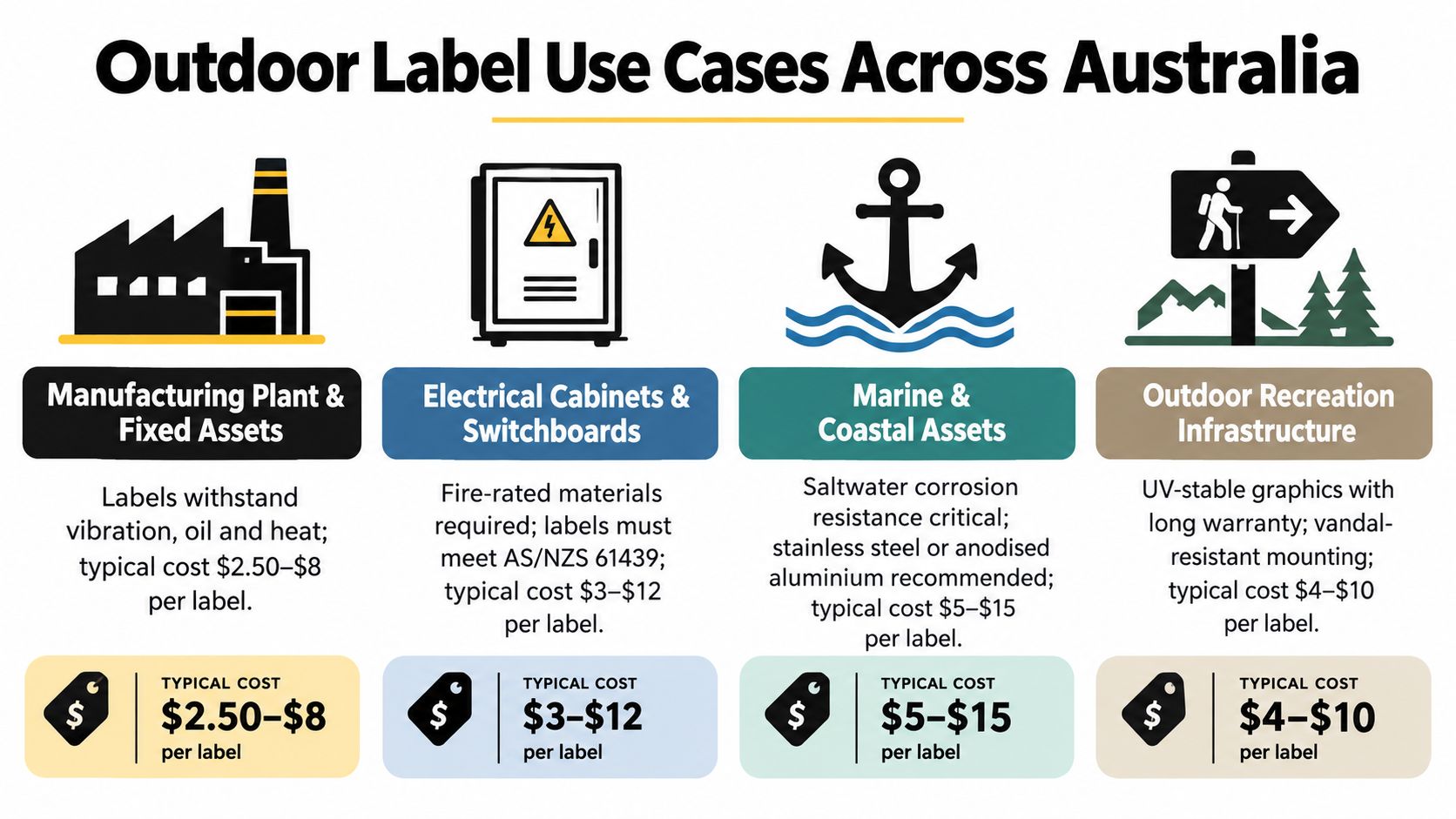
A site can look straightforward and still punish the wrong label choice. A plant tag, a switchboard label, a marine identifier and a park asset plate all serve the same identification job, but each one faces a different mix of heat, moisture, handling and compliance pressure.
Plant, electrical gear and fixed assets
In a manufacturing plant, vibration, heat, oil and repeated contact usually decide whether a label lasts. Permanent plates and mechanically secure fixings often hold up better than softer label formats because the asset keeps moving, flexing and getting wiped down.
Electrical cabinets and switchboards add a compliance layer. The Electrical Equipment Safety System requires the Regulatory Compliance Mark on the external surface of in-scope equipment, as close as possible to the model identification, so the marking stays visible instead of disappearing inside the enclosure. [EESS RCM marking guidance]
For technical electrical installations, AMSA's standard shows how specific marking can get. It uses circuit-identification labels at 10 mm high with 4 mm lettering and description labels at 15 mm high with 4 mm lettering, with 20 mm labels allowed where three-line descriptions are needed. [AMSA electrical installation standard]
Marine, coastal and public-use infrastructure
Marine and coastal assets need more than a generic “outdoor” claim. Salt, condensation, UV and constant exposure can break down adhesives and unprotected edges, so metal plates and corrosion-resistant fixings usually suit these locations better than light film labels.
Public infrastructure brings a different pattern of wear. Parks, trails and exercise stations face weather, vandalism, cleaning and constant public contact, so the label has to stay readable while also resisting peeling, scratching and surface contamination.
If people move around the asset, assume the label will be touched, cleaned and occasionally abused.
Procurement teams can also use the label conversation to cover adjacent branded items. A supplier that understands durable outdoor marking can also help councils, clubs and venues find promotion products for events, so identification and visible branding sit in the same asset family.
Why ‘Outdoor Rated' Is Not a Specification
“Outdoor rated” sounds decisive, but it usually hides the actual decision you still have to make. Two labels can both be sold as suitable for outside use and still behave differently once one goes onto a sunlit cabinet and the other goes onto a protected asset under a roofline.
Australian product-safety guidance keeps the focus on the outcome, warnings must be easy to read and clearly displayed for regulated equipment. That means legibility, not just adhesion, is the safety result. [Australian product-safety guidance on readable warnings]
A more useful acceptance method
Use a simple four-step check instead of a marketing phrase.
- Test initial contrast and scanability. If a barcode, QR code or asset ID can't be read straight after installation, the spec is already weak.
- Inspect it on a set interval. Look at the face, the edges and the attachment points, not just the centre of the print.
- Verify code readability after cleaning. If the label is part of a maintenance system, the scan has to survive normal cleaning, not just first use.
- Define replacement thresholds. If fading, edge lift or scuffing crosses your limit, replace it before identification is lost.
A longer material warranty doesn't automatically mean better field performance. The real question is whether the label stays readable where the asset actually lives.
That shift matters because it turns procurement language into something maintenance can enforce. Instead of ordering “outdoor rated”, you're ordering measurable readability, secure attachment and a replacement trigger.
A Practical Specification and Ordering Checklist
A clean order starts with the asset, not the label catalogue. Match the spec to the operating site, the mounting method, and the compliance need, and the shortlist gets much shorter while the risk of the wrong label drops sharply.
What to put in the brief
- Asset type and location: name the equipment and the exposure zone, such as coastal, wash-down, public-use or enclosed plant.
- Substrate choice: state whether you need film, overlay, anodised aluminium, stainless steel or another plated format.
- Marking method: specify printed, engraved, laser-marked or reverse-engraved, because each wears differently under damage and cleaning.
- Attachment method: call out adhesive, rivet, screw, clip or recessed mounting so installation and durability are aligned.
- Readability requirement: define character size, contrast and any symbol or warning text that has to stay visible.
- Compliance marks: include any regulatory marking that must stay externally accessible, especially on electrical gear, and make the placement rule part of the same approval step.
- Acceptance criteria: decide how you'll inspect, scan and replace the label once it enters service.
For electrical products, the Regulatory Compliance Mark should be included in the sign-off check so factory acceptance testing confirms it sits where the product needs it and remains easy to see.
If maintenance, procurement and engineering all sign off on the same checklist, the label arrives as part of an asset system rather than a loose consumable. That is the difference between a sticker chosen for the catalogue photo and a label system built for traceability, inspection and field use.
Bringing It Together With Laser-Marked Industrial Labels
Outdoor assets in Australia fail in different ways. A park bollard sees public handling, a switchboard may face heat and dust, a marine cabinet gets moisture and salt, and a fixed plant plate has to stay readable through cleaning and service work. The label has to match that exposure, so substrate, marking method, attachment and inspection all need to be chosen as one system.
Laser-marked metal plates suit that approach because the identification is formed into the plate, rather than relying only on surface ink. Evright Industrial's engraved metal labels page shows that method in practice, with material selection, marking and finishing arranged for equipment that must remain identifiable in service.
That matters in Australian outdoor infrastructure, where AusPlay tracks participation across more than 600 sports and physical activities, and where public-facing assets still need identifiers that hold up under weather and routine handling. [AusPlay participation framework]
If your team is comparing options, specify the plate the same way you would specify any field component, by substrate, marking method, attachment and inspection criteria together. Talk to Evright Industrial and set those details as one package, so the label survives the site it is installed on.
Recent Comments