
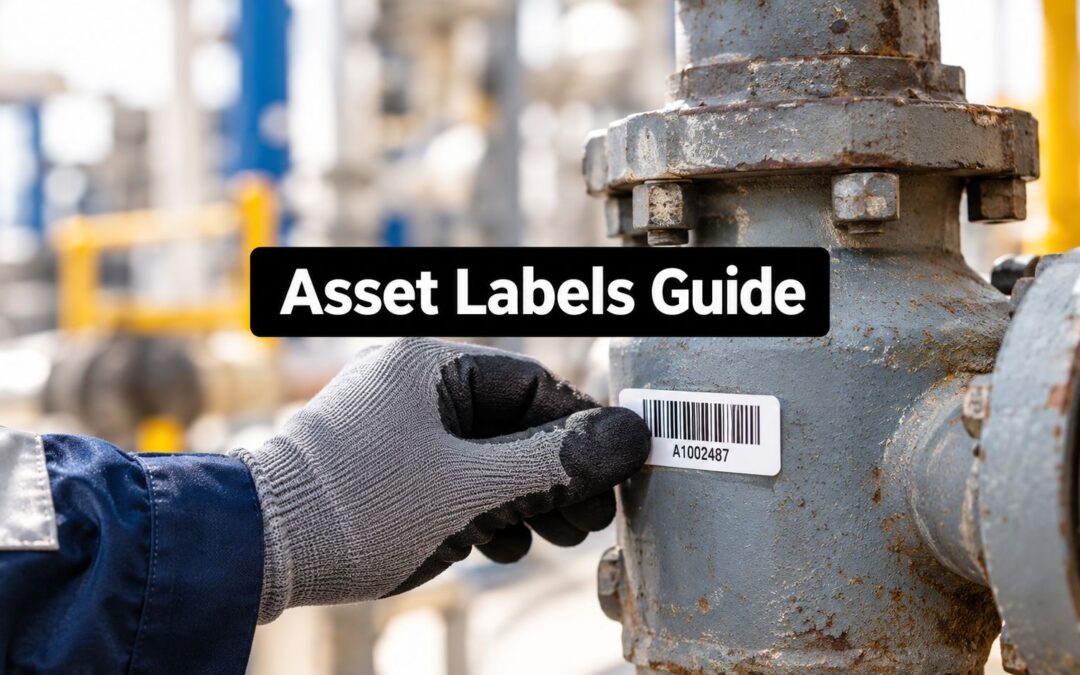
You know the moment. A technician is standing at a cabinet, the maintenance job is live, and the only label on the asset has gone cloudy, peeled off, or been duplicated by someone who needed a quick fix. Work stops while people cross-check drawings, serials, and register entries, because the label was never just a sticker. It was the physical anchor for the whole digital record.
In Australian environments, that anchor has to survive more than a casual scan. It has to stay legible, stay attached, and stay tied to the right asset through maintenance, ownership changes, cleaning, weather, and audit cycles. That's why asset labels are a data-integrity tool first and a visual marker second, especially where registers, work orders, and compliance records all need to agree.
Why an Asset Label Is a Data-Integrity Tool, Not a Sticker
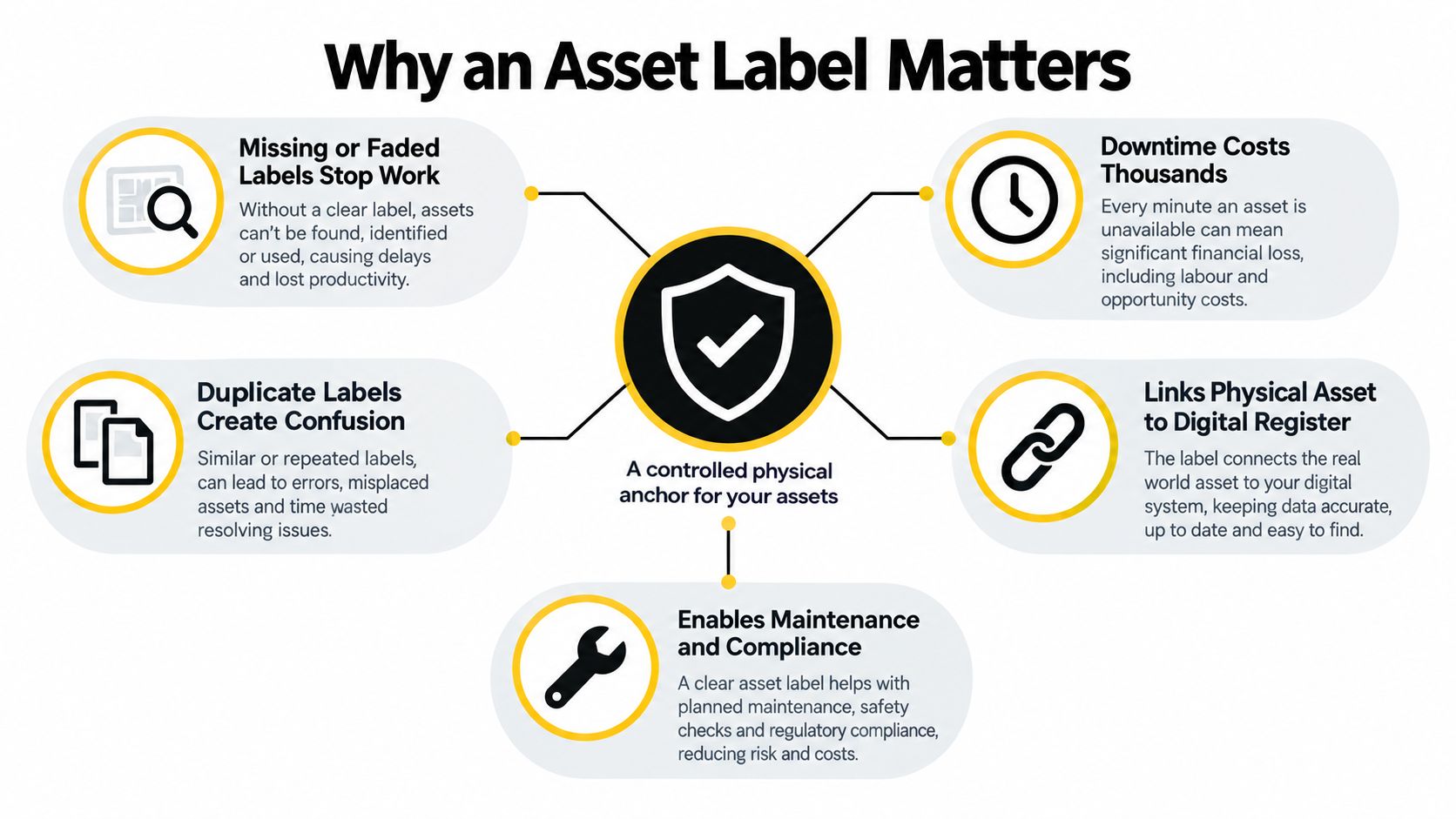
A faded label can do more damage than many teams expect. One unreadable plate on a pump, switchboard, or trolley does not just slow the job, it can break the link between the physical item and the records people rely on to approve work, trace history, and verify compliance. In transport settings, that link is formalised, Transport for NSW requires every asset in its register to carry a unique identifier tied to its location or functional position, with identifiers preserved when stewardship transfers between organisations (Transport for NSW standard).
The label is the record's physical anchor
That is the job of a label, it binds the object in front of you to the authoritative record behind it. If the identifier fades, duplicates, or detaches, the chain between field equipment, drawings, maintenance history, and financial systems becomes fragile very quickly. The answer is controlled identity, durable placement, and a format that survives the conditions where the asset lives.
Practical rule: if a label cannot be read at the point of use, it is not doing its job, no matter how good it looks in the workshop.
The strongest asset label programs treat placement and permanence as part of the asset register, not as an afterthought. Engraved plates, barcode labels, and machine-readable marks are selected for the conditions they must survive, not because they are familiar or cheap. If the label will not hold up to cleaning, heat, UV, or abrasion, the register can drift away from the asset surprisingly fast.
What fails in the field
The failure modes are usually plain. A label peels after wash-down, a barcode smears under solvent exposure, or a duplicate number appears on a replacement part and nobody knows which record is current. Once that happens, maintenance crews spend time reconciling identity instead of fixing equipment.
The practical takeaway is direct. Asset labels are not consumables when the operation depends on them for traceability. They are controlled identifiers, and the whole downstream system depends on them staying readable and unique.
The Main Label Technologies and When Each One Earns Its Place
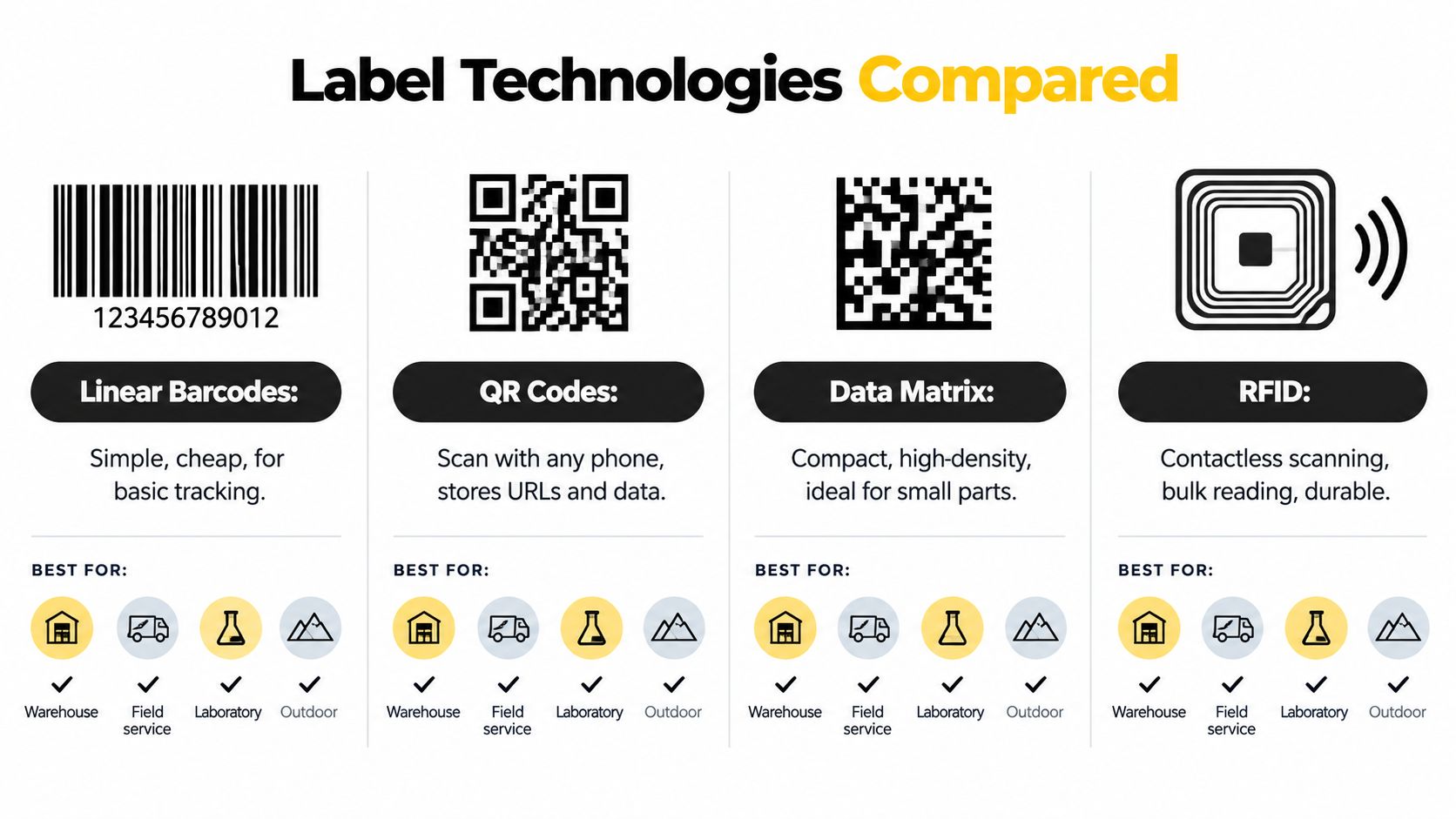
The right technology depends on how the label gets read, who reads it, and how hostile the environment is. There's no single winner across a factory floor, a hospital store, a roadside cabinet, and a plant room. A linear barcode is still useful where line-of-sight scanning is easy, QR and Data Matrix codes help when smartphones or compact layouts matter, and RFID earns its place when you need contactless reads or bulk checking.
Linear codes, matrix codes and when they fit
A Code 39 barcode remains a solid choice when the identifier needs to be simple and compatible with standard scanners. Queensland Health's SAID label uses an eight-digit Code 39 barcode on a 48 mm by 15 mm label, with colour categories tied to use cases, which is a good example of how a basic code can still support a disciplined asset-control system (Queensland Health SAID guidance). That format works because the code is paired with a strict label structure, not because the barcode alone is magical.
QR and Data Matrix codes earn their keep when the label has to carry more information in a small footprint or when a phone scan is part of the workflow. RFID is different again, because it's built for contactless identification and faster checking where line-of-sight is awkward or too slow. In practice, that means warehouse racking, storerooms, and high-volume asset audits often favour RFID, while field service teams and maintenance crews still rely heavily on scan-friendly printed codes.
Field insight: the smartest label isn't the one with the most features, it's the one the team can still read with dirty gloves, poor light, and a damaged scanner.
Durability matters more than code type
A code printed on the wrong surface is still a bad label. If the printing smears, the laminate lifts, or the substrate can't take the environment, the technology choice doesn't matter much. That's why laser-engraved marks, especially on metal or durable plastics, are often the backbone for long-life asset identification even when a barcode or Data Matrix is part of the design.
For a practical comparison of engraving and marking methods, the guide on laser marking vs engraving is a useful companion reference. It helps separate the question of how the mark is made from the question of which code format is best.
Choosing by use case
- Linear barcodes: best when the asset moves through a standard scan process and the label space is tight enough for a simple identifier.
- QR and Data Matrix: better when you want smartphone access, more data, or compact encoding on small assets.
- RFID: useful when speed and bulk reads matter more than human readability.
- Tamper-evident constructions: worth specifying where audit integrity, warranty control, or unauthorised removal are concerns.
Queensland's colour-coded SAID structure is a useful reminder that the label format and the asset category should work together. White, yellow, and the stronger identifier group for harsh environments all point to the same principle, the label has to suit the use case, not the other way around.
Materials, Adhesives and the Case for Laser Engraving
Material choice decides whether the label survives the job or turns into landfill. Polyester, vinyl, anodised aluminium, stainless steel, traffolyte, and ceramic-filled laminate all have different strengths, and the right answer depends on abrasion, chemicals, heat, UV, and cleaning routines. Adhesives matter just as much, because even the best printed face fails if the bond can't hold on the substrate.
Match the substrate to the environment
Polyester and vinyl are practical for many indoor assets, especially where the label won't face harsh solvents or mechanical wear. Metal plates and durable laminates are a better fit for outdoor assets, machinery, and equipment that gets cleaned hard or handled often. Victorian school guidance also accepts barcoding, engraving, or stamping, and requires the school name and asset number to be applied at the earliest practical date after entry into the CASES21 Finance register (Victorian Department of Education guidance).
The adhesive choice is the next filter. Removable adhesives suit temporary identification, permanent adhesives suit most fixed-use labels, and high-tack structural options are for rougher surfaces or places where the bond has to resist harder service conditions. Surface energy, cure time, and temperature exposure all matter, because a label stuck to the wrong surface can fail long before the printed content wears out.
Why laser marking solves the service-life problem
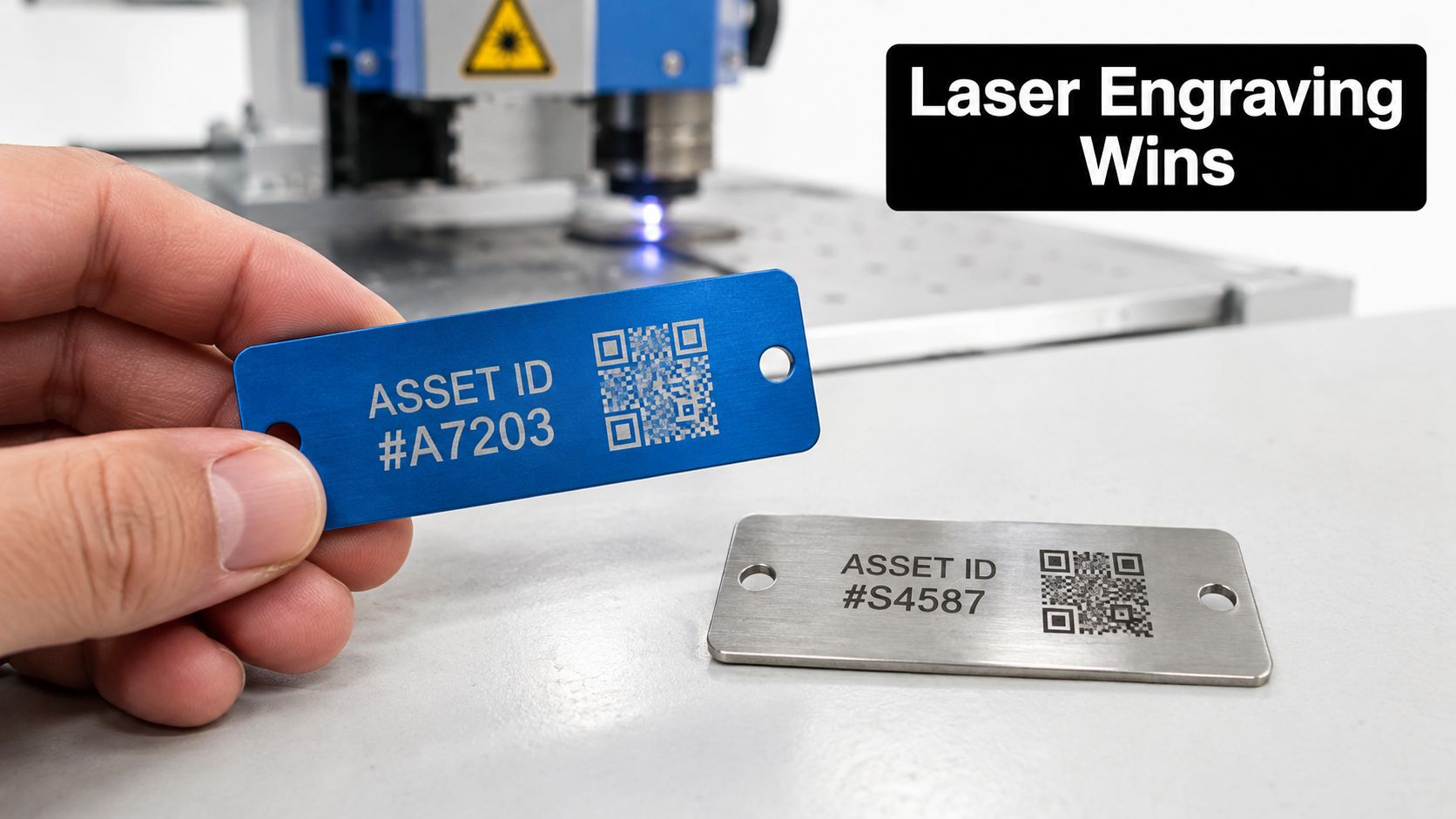
Laser engraving and laser marking are different from print because the mark is part of the material, not sitting on top of it. That non-contact approach is why engraved identifiers are so useful on anodised aluminium, stainless steel, and durable plastics where adhesive labels struggle. It's also why laser-made marks hold up better against chemicals, UV, and repeated cleaning cycles.
Practical rule: if the asset will be washed, sterilised, degreased, or exposed outdoors for years, assume adhesive print is the weak point until proven otherwise.
That doesn't mean printed labels are obsolete. They're still the right choice for lower-cost assets, short service lives, and applications where replacement is easy. But once the asset is critical, hard to access, or expensive to take out of service, a laser-engraved plate usually becomes the more defensible specification.
A quick specification check
- Choose printed adhesive labels when the asset is indoor, low abrasion, and easy to relabel.
- Choose engraved plates when the asset is exposed to solvents, weather, UV, heat, or cleaning cycles.
- Choose mechanical fixing or structural adhesion when the substrate is textured, curved, or difficult to bond.
- Choose laser marking when permanence and readability matter more than low initial cost.
If you're comparing surface options, the material guide at laser marking materials is a sensible starting point for narrowing down the right construction.
Australian Compliance and Regulatory Considerations for Asset Labels
A label only works if it can be trusted in the field. Australian requirements push label design beyond simple readability, because electrical equipment, plant, hazardous materials, and healthcare devices all need marking that supports identification, inspection, and traceability at the same time. The content hierarchy matters. If the plate is crowded or the most important field is buried, it becomes harder to verify when conditions are poor.
Electrical and plant marking need clarity first
Western Australian Main Roads gives a clear example of how viewing conditions shape marking rules. Its specification calls for 25 mm main designation lettering, 12 mm danger labels, 6 mm instrument labels, and red labels with white engraved DANGER lettering above 110 V AC, plus 50 mm black characters on a 50 mm by 60 mm Class 2 yellow retroreflective background for roadside sign asset numbers (Main Roads WA specification). The point is obvious once you've had to read a label in bad light, contrast and size are safety features.
Safe Work Australia makes the same point from another angle for plant. A plant item's registration number has to be marked directly on the item where it can be easily seen, and instruction or warning text needs to be tested so users understand it and it does not create a health or safety risk (Safe Work Australia manufacturing safe plant guide). That is why layout discipline matters. A clean hierarchy and tested wording usually work better than squeezing every possible detail onto one plate.
Healthcare and hazardous materials need register alignment
Healthcare traceability is tightening too. The TGA says the Australian Unique Device Identifier Database is meant to help users, manufacturers, and regulators identify specific device models during safety events, and notes that some medical devices supplied in Australia must meet UDI requirements from 1 July 2026 (TGA medical device adverse event monitoring update). In practice, that means the label has to preserve manufacturer identity and UDI-related information instead of replacing it with a facility-only number. An asset label here is not decoration, it is part of the device record.
Asbestos controls are just as strict. Safe Work Australia requires workplace areas containing asbestos or asbestos-containing material to have clear, visible signage and labels showing the presence and location of the material, with warning signs complying with AS 1319-1994 where labelling is not reasonably practicable (Safe Work Australia asbestos guidance). That makes register accuracy just as important as the physical label, because a label that points to the wrong location creates a real management problem. For a practical guide to aligning label content with broader obligations, safety compliance is a useful reference alongside the formal rules.
| Specification | Asset type | Key requirement |
|---|---|---|
| WA Main Roads electrical marking | Electrical equipment and roadside signs | Large, high-contrast engraved designation and danger text |
| Safe Work Australia plant marking | Registered plant | Registration number visible directly on the item |
| TGA UDI framework | Medical devices | Preserve device identity and UDI-related traceability |
| Asbestos labelling | Hazardous materials and plant areas | Visible labels or compliant warning signs tied to the register |
Avoid the crowded-label trap
More information is not always better. A plate overloaded with asset number, model, serial, compliance mark, warning text, and QR code can be harder to verify than a simpler layout with stronger hierarchy. The usual answer is not to remove required data. It is to prioritise it properly so the critical fields are readable first, then keep the rest aligned to the register and the site procedure.
That approach also supports audit work. A label that survives daily handling, cleaning, and inspection is easier to defend than one that only looks complete at installation.
Lifecycle Integration With Asset Management Systems
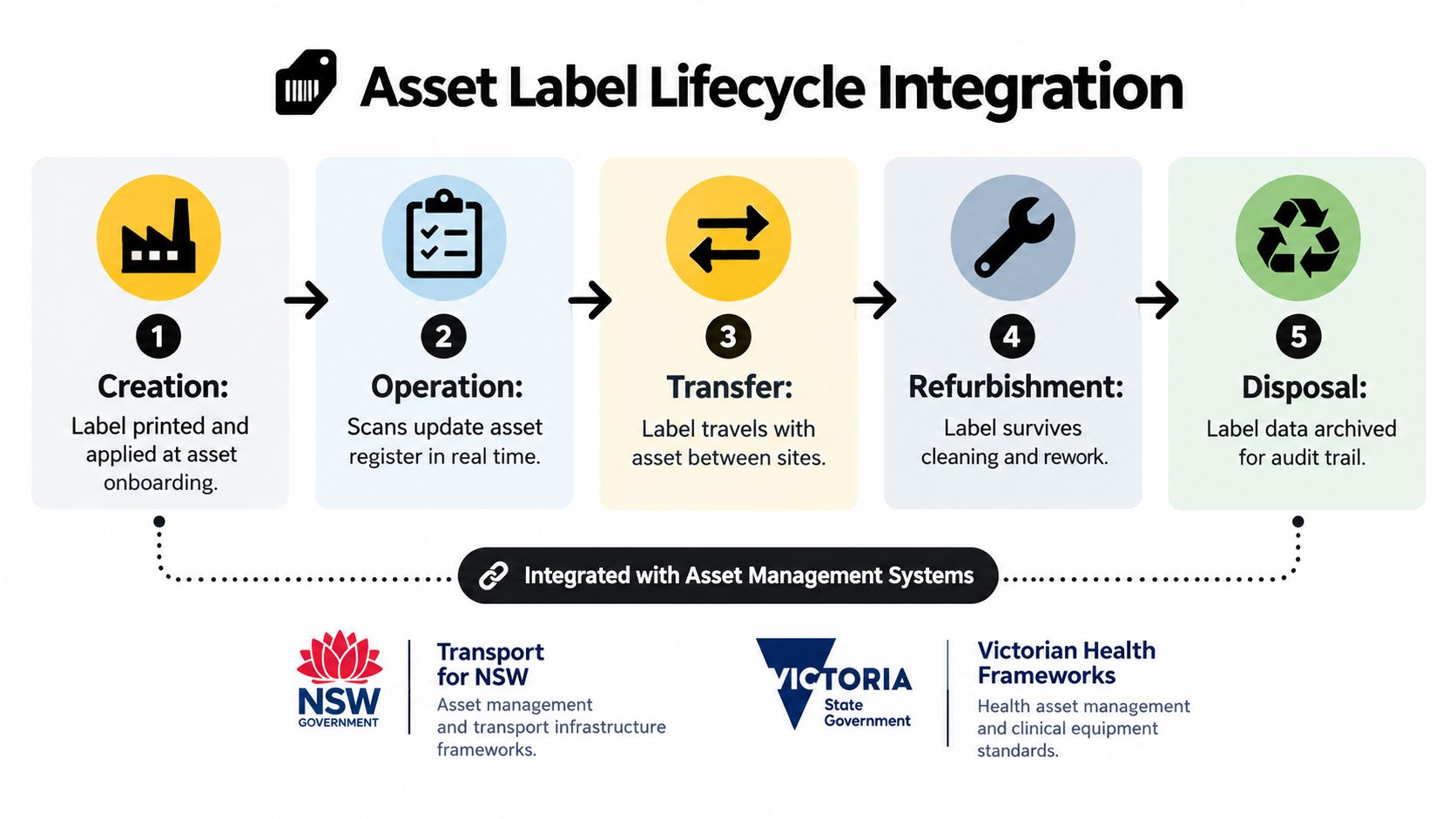
A label only works if it survives the asset's life. Treat it as the physical anchor of the digital record from creation through transfer, refurbishment, and disposal. Durable plates and disciplined numbering keep the same identifier usable across systems, owners, and service histories.
Keep the identifier stable
Identifiers should stay unique and attached to the same asset identity through its service life. When stewardship moves between organisations, the record needs to follow the item, not get rewritten to suit a new filing system.
A Trotec laser engraved serial or Data Matrix on an anodised plate suits that job because it gives the asset a permanent physical carrier for the same identity across CASES21, EAM, CMMS, and service-provider records. If the asset changes hands, the plate still points to the right record, which is the point. Reusing an old identifier creates confusion in procurement, warranty claims, and audit trails.
Design the content hierarchy once
The label should carry only what the field team needs to verify quickly. That usually means the asset number, a barcode or QR code, model details, compliance marks where required, and any electrical or UDI-related fields that must stay visible with the identifier. Use the same identifier logic in the register and on the plate so people do not have to guess which number belongs to which system.
For risk-managed fleets, insurance planning also comes into the picture. A useful reference for broader plant cover considerations is ABS Insurance Brokers plant cover, because asset identity and insurable value are often checked together after a loss event.
If the label survives but the number changes, the record is still broken.
Disposal should close the loop
When an asset is retired, the label should stay part of the audit history even if the physical item leaves service. That archived relationship keeps financial reporting, service history, and replacement planning clean. A sound lifecycle policy retires and archives an identifier at disposal rather than reusing it.
Real-World Applications Across Industrial Environments
A production line does not care what the label looked like when it left the printer. It cares whether the scanner still reads it after coolant, dust, oil mist, wash-down, and vibration. In that environment, the asset label becomes the physical anchor of the digital record, and the choice usually shifts toward engraved or otherwise permanent identification for machinery. Printed overlays still have a place, but only where replacement is quick and the exposure is light.
Manufacturing and industrial sites
On plant, a laser-engraved barcode plate gives maintenance teams a stable way to tie the asset back to the register after harsh cleaning. I specify that approach on gearboxes, conveyors, electrical cabinets, and mobile plant because those surfaces get handled, scrubbed, and bumped constantly. A printed sticker may be acceptable on an indoor trolley. It is a poor answer on equipment that gets wiped down shift after shift or exposed to chemicals.
Electrical contractors and essential services
Electrical work shows label discipline fast. If the switchboard danger label is unreadable, or the wording does not match what the inspector expects to verify, the job can stall while the tag is checked, replaced, or reissued. I have seen that happen on commissioning work where the team had to confirm the exact danger wording on the board before sign-off. Engraved plates with consistent nomenclature reduce that friction and keep the evidence trail tidy for auditors.
Healthcare, schools and hazardous materials
Healthcare teams have a different problem, because the label has to support both local control and device traceability. A permanent label can preserve manufacturer identity and UDI-related information while the facility layer carries the local asset ID. That arrangement is safer when recalls or adverse events need to be traced later.
In schools, a durable engraved identifier is often the better fit for equipment mounted outdoors or moved between buildings. As noted earlier, asbestos areas require the visible labelling covered in the compliance section above, so the mark has to stay legible in the same conditions the site presents.
For teams specifying fitted-out spaces and controlled rooms, laboratory casework solutions are a useful adjacent reference because the same priorities apply. Durability, cleanability, and legibility matter more than decorative finish.
Implementation Steps, Best Practices and Working With Evright Industrial
Start by scoping the asset population, then separate assets by environment. A label that works on an indoor switchboard may fail on outdoor plant, washdown gear, or equipment that gets handled with gloved hands. Choose the identifier format, select the label material, and set the artwork so the most important fields read first.
Run a pilot on the harshest asset type in the fleet. Weak adhesive, poor contrast, or awkward placement shows up fastest there.
What to lock down before rollout
- Placement: put the mark where it can be seen and scanned without dismantling equipment.
- Hierarchy: make the asset number and machine-readable code dominate the plate.
- Register match: confirm the on-asset number matches the register entry exactly.
- Comprehension: test any warning or instruction text with the people who'll use it, as the safe plant guidance recommends when warning text needs to be trialled for understanding and safety.
Laser work earns its place because controlled artwork files, consistent repeatability, and durable output reduce the drift that comes with hand-assembled or improvised labels. Evright Industrial produces this kind of work on Trotec laser machinery, which suits equipment tags, plates, and safety identifiers when the label has to stay a controlled identifier rather than a disposable consumable.
If you're setting up a new lab, workshop, or maintenance store and need durable identification that stands up in daily use, get in touch with Evright Industrial. They produce asset labels, engraved plates, and compliance-ready markings for industrial environments where the label has to stay readable for the long haul. For teams specifying fitted-out spaces and controlled rooms, laboratory casework solutions are a useful adjacent reference, because durability, cleanability, and legibility carry the same weight there.
Recent Comments