
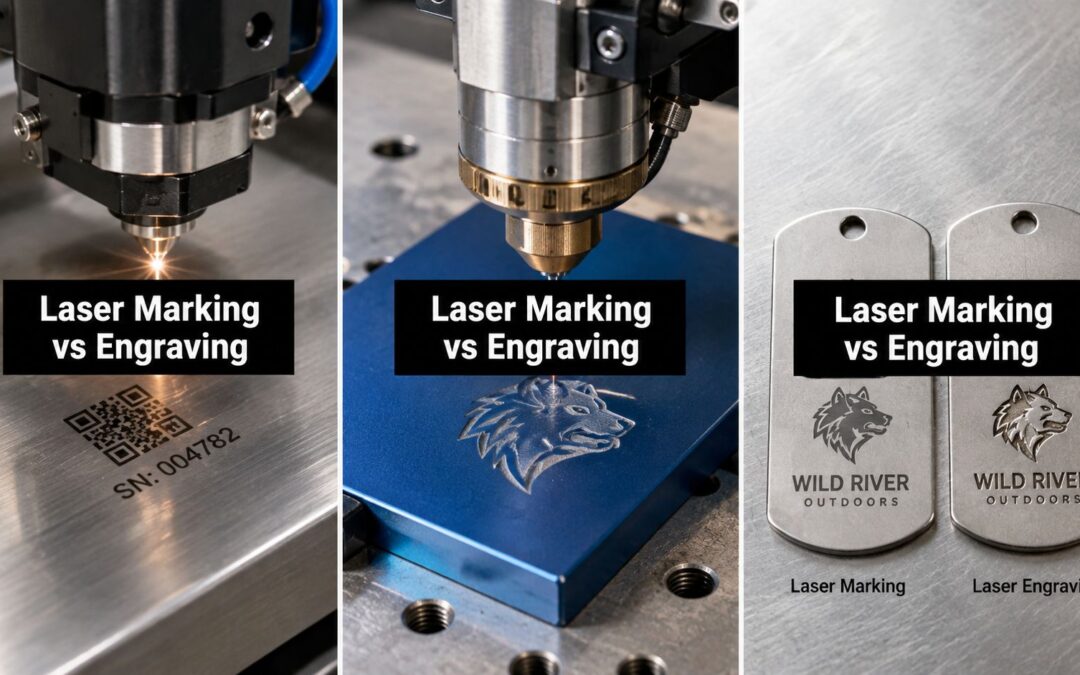
You're staring at two quotes, both say “laser,” both look capable, and procurement wants an answer today. One vendor is pushing a fast surface mark, the other is selling deeper removal, and your maintenance lead just wants something that won't fail in service or get knocked back in audit. That's the decision, laser marking vs engraving is not a machine choice first, it's a failure-mode choice.
| Dimension | Laser Marking | Laser Engraving |
|---|---|---|
| Material interaction | Surface change, discolouration, annealing, coating removal | Material removal, recessed feature |
| Best fit | Serial numbers, barcodes, data matrices, compliant IDs | Tactile labels, harsh wear, outdoor exposure, depth-dependent permanence |
| Readability driver | Contrast on the surface | Depth plus contrast in the recess |
| Geometric impact | Preserves part geometry | Changes the surface profile |
| Typical durability risk | Abrasion, repainting, heavy cleaning | Lower contrast if over-deep or poorly specified |
| Specification focus | Surface finish, contrast, scanability | Depth, edge quality, legibility after wear |
The Specification Decision You Are Actually Making
A procurement officer doesn't lose sleep over the word “laser.” They lose sleep when the label peels, the scan fails, or the auditor asks why an identifier on a switchboard doesn't match the standard. That's why the first question isn't which process looks cleaner, it's which failure mode your asset can't afford.
A good Australian spec starts with the substrate, the exposure, and the required reading method. On one job, a surface mark is the right call because the part needs high-throughput identification without changing geometry. On another, engraving is the safer move because the asset will be scrubbed, blasted, repainted, or handled enough times that a contrast-only solution won't survive.
Australia has done this work before. By the 1980s, Laser Lab Limited had reportedly exported laser-processing machines to the United States, Canada, the United Kingdom, Sweden, China and Israel, and held more than 10% of the global market for laser-processing machines, which is a reminder that this country's laser know-how wasn't imported yesterday, it was built into production long ago. That historical record matters now because it supports a practical view of specification, the process needs to fit the job, not the brochure.
The same fibre-laser class machine can usually deliver both outcomes. Trotec-class equipment does the work when the parameters are right, but parameters are only half the story, the substrate and the compliance obligation tell you what “right” means.
Practical rule: if the mark must survive the dominant degradation mechanism, choose the process that resists that mechanism, not the one that looks more permanent at first glance.
For buyers sourcing substrate guidance, laser marking materials is the right place to sanity-check what your part can tolerate before you sign off a quote.
| Dimension | Laser Marking | Laser Engraving |
|---|---|---|
| Primary question | Will contrast stay readable? | Will depth survive service? |
| Best procurement use | Asset IDs, QR codes, serials | Plates, tags, plaques, harsh-use labels |
| Main risk | Surface wear removes readability | Poor contrast or unnecessary depth slows production |
| Buyer test | Readability on the actual finish | Depth and legibility after wear simulation |
What Each Process Actually Does to the Material
Laser Marking changes the surface, it doesn't carve it away
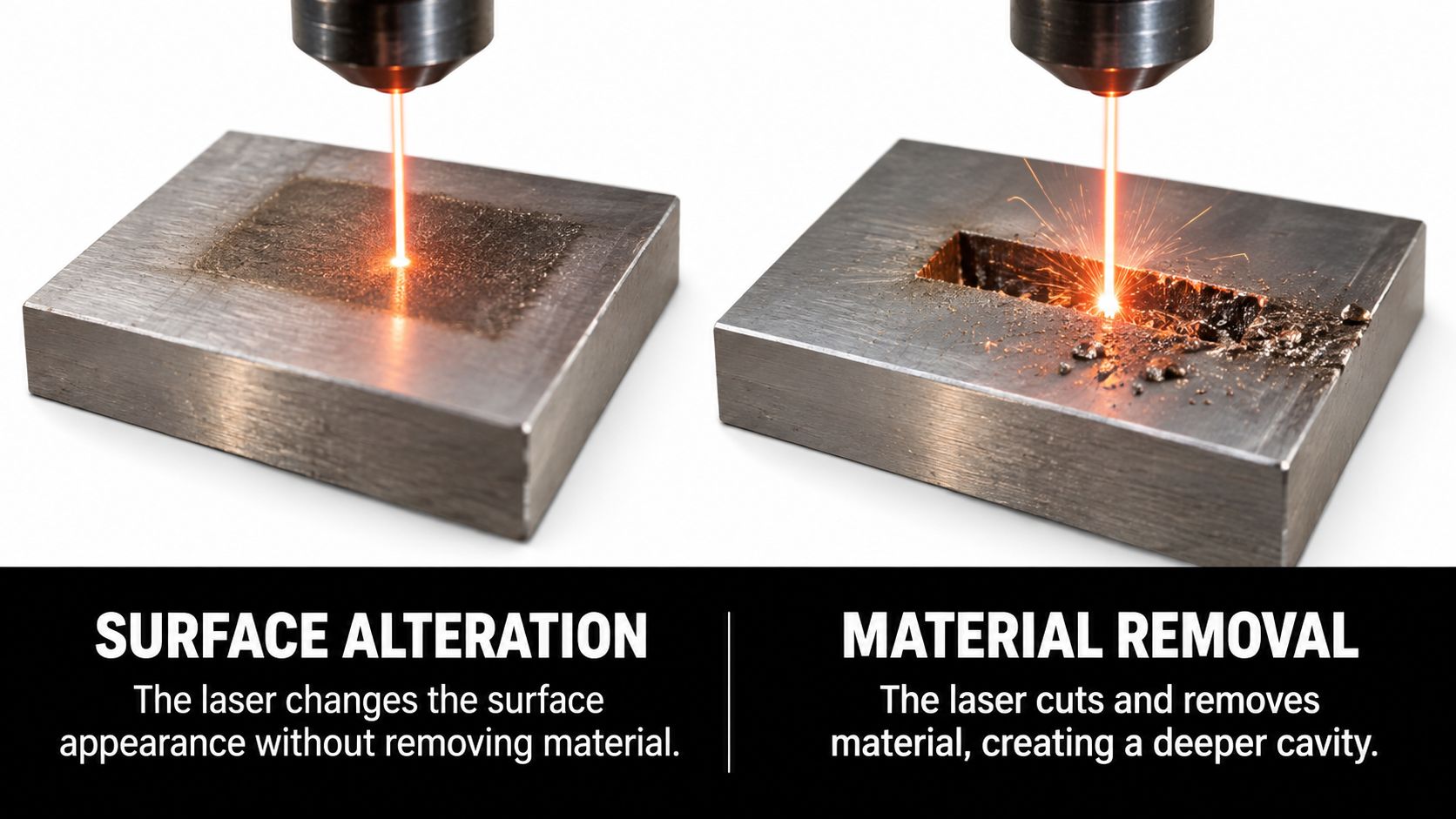
Laser marking is a surface interaction. On stainless steel, it can create a controlled annealed mark, on anodised aluminium it can remove or alter the coating, and on coated laminate or painted surfaces it can expose a contrasting layer. The result is usually shallow, fast, and tidy, which is why production teams like it for serial numbers, barcodes, and machine-readable IDs.
That same surface-first behaviour is also its limit. If the mark depends on contrast alone, abrasion or aggressive cleaning can take that contrast away even when the part itself is still perfectly usable. For that reason, marking is the process I reach for when preserving geometry matters more than tactile depth.
Laser Engraving removes material and creates a recess
Engraving is different because it cuts into the substrate. On metal, that means a measurable cavity, and on laminate it means the top layer is removed to expose a contrasting core. The edge is physical, not just visual, so a good engraved mark gives you both depth and a shape you can feel.
That extra depth costs time and can affect surface integrity, which is why engraving is not the first answer for every job. It's the right answer when the mark needs to survive repeated handling, repainting, blasting, or outdoor exposure where a surface-only mark is a weak bet.
Australian buyers should stop treating all laser results as equivalent. Equipment-marking guidance recommends validating the choice on standardised coupons and recording contrast, depth, edge quality, and cycle time, which is exactly how you separate a decent-looking sample from a production-ready specification.
A sample that looks fine on the bench can still fail on the floor if the substrate, finish, and cleaning regime weren't part of the test.
The difference shows up across common materials. Stainless steel often suits annealed marking when you need readable identification without cutting into the part. Anodised aluminium usually rewards a coating-removal mark, while laminate and coated panels may need engraving where the core colour does the visual work. Same machine family, different result, because the beam is only part of the system.
Comparing Marking and Engraving Side by Side
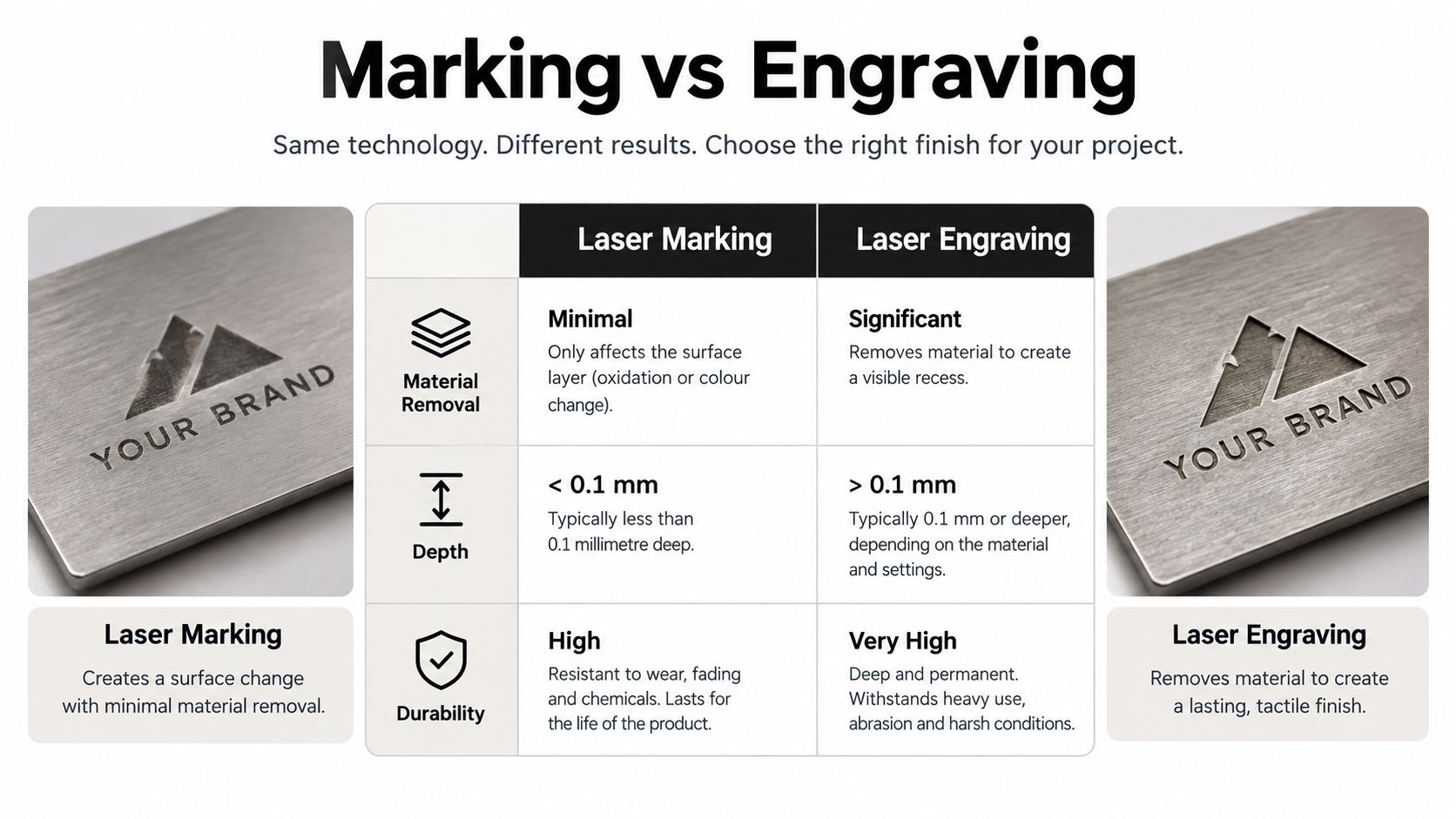
The cleanest comparison is blunt. Marking preserves the part and wins when speed, contrast, and scanability matter. Engraving removes material and wins when the identifier has to outlast abrasion, repainting, repeated handling, or the kind of treatment that strips a surface mark away.
| Criterion | Laser Marking | Laser Engraving |
|---|---|---|
| Material fit | Best on metals, coatings, and surfaces where contrast is enough | Best when the substrate needs a recessed identifier |
| Visual result | High-contrast surface change | Visible recess with tactile depth |
| Throughput | Usually faster | Usually slower |
| Surface integrity | Preserved | Altered |
| Typical use | Serials, barcodes, data matrices, compliance IDs | Tags, plaques, outdoor labels, heavy-use asset IDs |
The real difference is durability driver, not aesthetics. If abrasion is the enemy, depth matters. If preserving the surface is the enemy, marking usually wins.
That's the framework Australian buyers need because the local market is moving fast. The Australian laser-technology market was valued at US$269.98 million in 2023 and is projected to reach US$532.19 million by 2032 at a 7.77% CAGR from 2024 to 2032, with manufacturing demand for precision, efficiency and speed identified as a major driver. Those market figures are exactly why process choice now sits inside a precision-led buying environment, not a hobbyist one.
| Specification Comparison Between Marking and Engraving | Laser Marking | Laser Engraving |
|---|---|---|
| Surface impact | Minimal | Material removal |
| Best production style | Fast, repeatable, low-contact | More permanent where depth matters |
| Readability focus | Contrast and clean scan | Depth and contrast together |
| Risk profile | Surface wear | Over-specifying depth on the wrong part |
| Buyer priority | Speed, geometry, cleanliness | Permanence, tactile legibility |
Australian Compliance and Durability Rules
Australia doesn't treat “looks permanent” as the same thing as compliant. A laser-produced identifier can be durable and still miss the standard if the label content, placement, colour, or fixedness don't match the asset class. That's the gap most comparison pages ignore, and it's the gap that gets people into trouble.
Queensland Health states that laser equipment labels must follow AS/NZS IEC 60825.1:2014 and include warning, explanatory, and aperture labels that are durable, permanently fixed, legible, and visible during operation. That requirement makes the point cleanly, a laser-engraved identifier is not automatically the same thing as a standards-based safety label.
What the standards logic means on the floor
ACMA says product labels may be applied by suitable means, including etching or engraving, but the label has to stay put, stay readable, and not wash off or fade. That's the useful test, because it shifts attention from the method name to whether the label survives the operating environment.
For switchboards and electrical gear, the durability conversation gets more specific. Australian guidance notes that the IEC 61439-1 marking-rub test uses water and petroleum spirit, while markings made by moulding, pressing, engraving, or similar methods are excluded because permanence is inherent rather than dependent on a printed layer. That's a direct reason to stop specifying labels by habit and start specifying them by duty cycle.
Safe Work Australia also treats Class 4 lasers as a serious hazard, with eye and skin burns and fire risk, and says Classes 3B and 4 are prohibited in construction work. The class rules matter because the machine's safety controls are a separate issue from the mark it leaves behind.
The machine side matters too. Tasmanian compliance guidance says Class 3B and Class 4 systems need remote interlocks, audible or visible warnings, enclosed beam paths where practicable, remote control, and control of unwanted reflections. That control stack is why enclosed industrial laser machines are nothing like improvised engraving setups.
For laser safety and label selection, laser safety standards is a useful starting point if your job touches warning labels, class markings, or compliance plates.
Where Each Method Fits in Real Industrial Scenarios
A production floor doesn't need theory, it needs the right call on the actual part. The fastest way to get there is to match substrate, exposure, and the dominant failure mode, then choose the process that survives that environment without overcomplicating production.
Stainless steel asset IDs and serials
On stainless manufacturing assets, I'd usually favour laser marking when the identifier needs to stay clear without cutting into the part. A controlled annealed mark keeps the surface intact and works well when the main need is human-readable serials or machine-readable data on a clean metal face.
Switchboards, plant tags, and outdoor labels
If the tag is going to be handled, cleaned, or exposed outdoors, I lean toward engraving on the right substrate, especially when the label may face abrasion or repainting later. Australian guidance notes that standard engraved laminate can chalk or yellow under prolonged direct sun, so UV-stabilised grades or metal substrates are the better call for long-term outdoor and coastal use.
Healthcare and laboratory plates
Healthcare and lab assets often need both readable text and machine-readable content. That pushes the spec toward a clean surface process on the main identifier field, especially where surface integrity matters and the mark has to coexist with safety or asset-control workflows.
Memorial plaques and brass nameplates
For memorial work and brass plaques, engraving is still the right answer because depth and tactile contrast are part of the outcome. The customer isn't buying a code, they're buying a visible, durable object that should still read well years later.
If you want a separate view of examples from a supplier floor, laser engraving examples is worth checking alongside a machine shop's broader labelling workflow. For a useful adjacent read on layout and process integration, printing solutions for machine shops shows how some operations handle mixed identification needs across their production cells.
A lot of real specifications use both methods on the same label. Mark the data matrix for scan speed, engrave the surrounding legend for resilience, and stop pretending one process has to do every job on its own.
Why Lifecycle and Readability Beat Raw Durability
The wrong question is, “Which lasts longer?” The better question is, “Which keeps the identifier useful through transfer, service, audit, and integration with a digital register?” That's the difference between a mark that looks durable and a mark that carries operational value.
Australian asset guidance points out that ISO 55000/55001/55002 governs asset management rather than prescribing physical labelling, while machine-readable and human-readable identifiers should be used together. That combination matters because a label that survives the truck ride but can't be scanned cleanly is still a bad label.
Readability beats ego every time
A mark engraved deep can survive harsh handling and still fail if the scan angle, contrast, or geometry is wrong. I've seen that happen on parts where someone assumed deeper meant better, then discovered the recessed mark was awkward for cameras or hard to read after dust and grime built up.
A higher-contrast surface mark can be faster to scan and easier to use in a digital register. It still needs validation against abrasion, chemicals, UV, and cleaning regimes, which is why lifecycle testing beats guesswork.
Procurement should define the identifier before it chooses the process. Who owns the data, how far away it gets scanned, how often it changes, and what the surface sees in service all belong in the spec.
For teams juggling service records and physical identifiers, jewelry repair shop software is a useful reminder that the workflow around the mark matters as much as the mark itself. Different industry, same lesson, the identifier only works if the record system and the physical label stay aligned.
That's the procurement checklist I'd use on a factory floor. Define the identifier, the scan distance, the update policy, the substrate finish, the cleaning chemicals, and the audit requirement, then choose marking or engraving after that. If you don't do that work first, you're just buying a texture.
Choosing the Right Method for Your Project
If the substrate is smooth metal and you need fast, readable IDs, choose laser marking. If the surface will be blasted, repainted, scrubbed, or exposed to rough handling, choose laser engraving on a substrate that can take the depth. If the job is a safety or compliance label, the standard comes first and the process follows it.
On Evright Industrial's floor, those jobs are typically handled on Trotec laser equipment, with parameter families set around contrast, speed, and depth depending on the job. For marking, that usually means controlled surface interaction. For engraving, it means more material removal and a deeper recess. The machine is not the decision, the application is.
Send the actual substrate sample, state the minimum contrast or depth band, list the cleaning chemicals, and tell the supplier what abrasion or outdoor exposure the part will see. Then name the governing standard and ask for a sample on a standardised coupon before you release production.
Evright Industrial is a specialised division of evright.com, Australia's longest-running laser engraving and awards company, with nearly six decades of production experience. It handles both marking and engraving in-house on laser equipment, so the recommendation should be based on fit to the job, not on which process sounds more impressive on a quote.
Visit Evright Industrial if you want a straight answer on substrate, compliance, and scan-readability, plus a production quote that starts with the part you need to label.
Recent Comments