
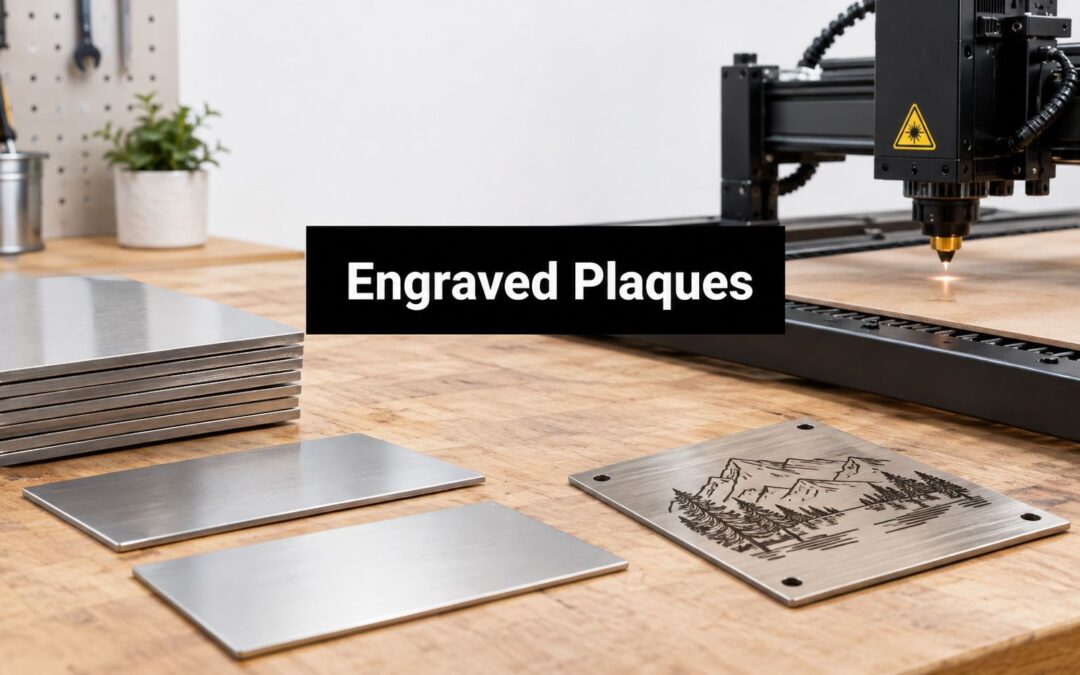
Quality engraved plaques in Australia typically require the right substrate for the environment, a design checked against AS 1428.1 and National Construction Code requirements where applicable, and a specialist manufacturer using modern Trotec Laser equipment. The choice matters whether you're marking a chemical installation, identifying hospital equipment, or commissioning a memorial intended to remain legible for generations.
A plaque can look excellent on installation day and still become a maintenance problem later. Sun, salt, cleaning chemicals, glare, poor contrast, incorrect mounting height and unverified wording all create failure points that rarely appear in a supplier's product photograph. The practical question isn't which plaque looks attractive. It's whether the plaque will continue communicating the right information, to the right people, in the conditions where it will be used.
Why Plaque Decisions Fail Later Even When the First Fixtures Look Fine
A council installs a commemorative plaque beside a coastal walking path. The brushed metal looks appropriate against the stone, the inscription is centred, and the fixings are neat. Years later, salt exposure has marked the surface, glare makes the lettering difficult to read in bright light, and visitors using the path can't approach closely enough to read the smaller text comfortably. The plaque hasn't necessarily broken. It has stopped performing its job.
The same pattern appears in industrial settings. An equipment label may be clear inside a workshop but become hard to distinguish after oil contamination, repeated cleaning or exposure to direct sunlight. A cheap surface print can fade or lift while the asset remains in service, leaving workers with an identification system that looks complete from a distance but fails when someone needs a serial number, hazard description or isolation reference.
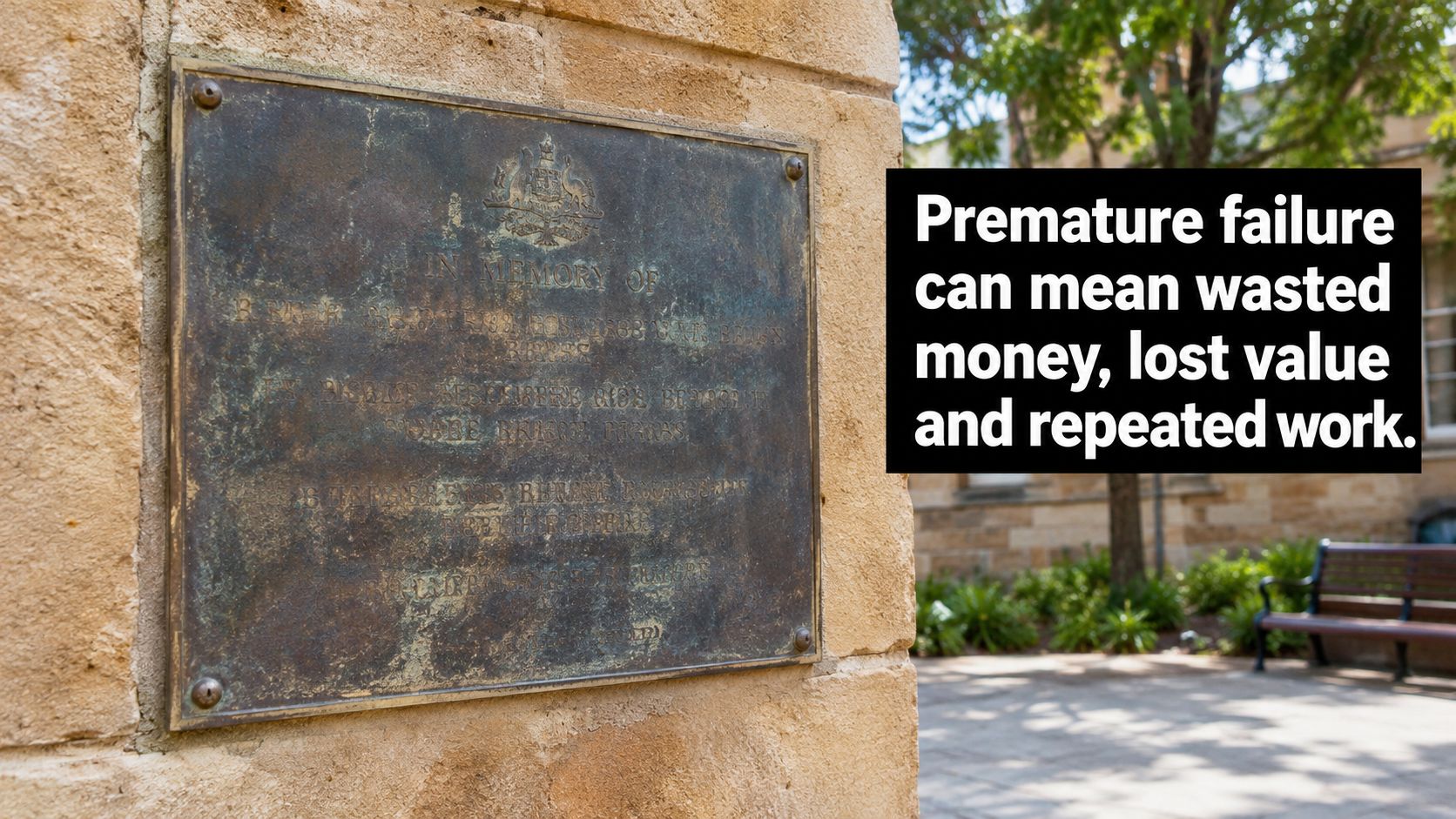
The installation date hides the real test
Australian plaques sit within a much wider commemorative field. The Australian Government reported that Monuments Australia recorded 30,626 monuments nationwide in November 2017, covering all themes and historical periods. That inventory is a recorded baseline rather than a complete census, but it shows why wording, material selection and ongoing maintenance matter beyond an individual fixture. The government report on protecting Australia's commemorative places also discusses how Melbourne's central business district memorials predominantly represented colonial histories, civic leadership and patriotic or heroic achievement, with monuments recognising men greatly outnumbering those recognising women.
That context changes the commissioning conversation. A plaque isn't only a decorative object attached to a wall. It becomes part of how a site records people, events and public memory. New work may also need to support more inclusive historical interpretation, including appropriate recognition of Indigenous heritage where relevant.
Practical rule: approve the plaque for its future environment, not for the showroom conditions in which you first inspect it.
Three decisions need to stay connected
The hidden cost usually begins when three decisions are separated:
- Environment: sunlight, moisture, salt, chemicals, abrasion and cleaning methods determine the substrate and finish.
- Accessibility: contrast, mounting position, tactile content and approach routes determine whether people can use the information.
- Governance: approved wording, revision control, asset records and replacement procedures determine whether the plaque remains accurate.
A supplier that asks only for dimensions and artwork may produce a neat plate while missing the operational brief. Before ordering engraved plaques in Australia, identify who will read the plaque, how close they can stand, what contamination or weather it will face, and what happens if the information changes. That short review prevents a low initial price from becoming a premature replacement, site revisit or compliance correction.
Choosing the Right Material and Finish for Australian Conditions
A plaque can look excellent on the bench and still fail on site within a short maintenance cycle. The usual cause is simple. The material was chosen for appearance first, then asked to handle sun, salt, washdown, hand contact or chemical cleaning it was never specified to resist.
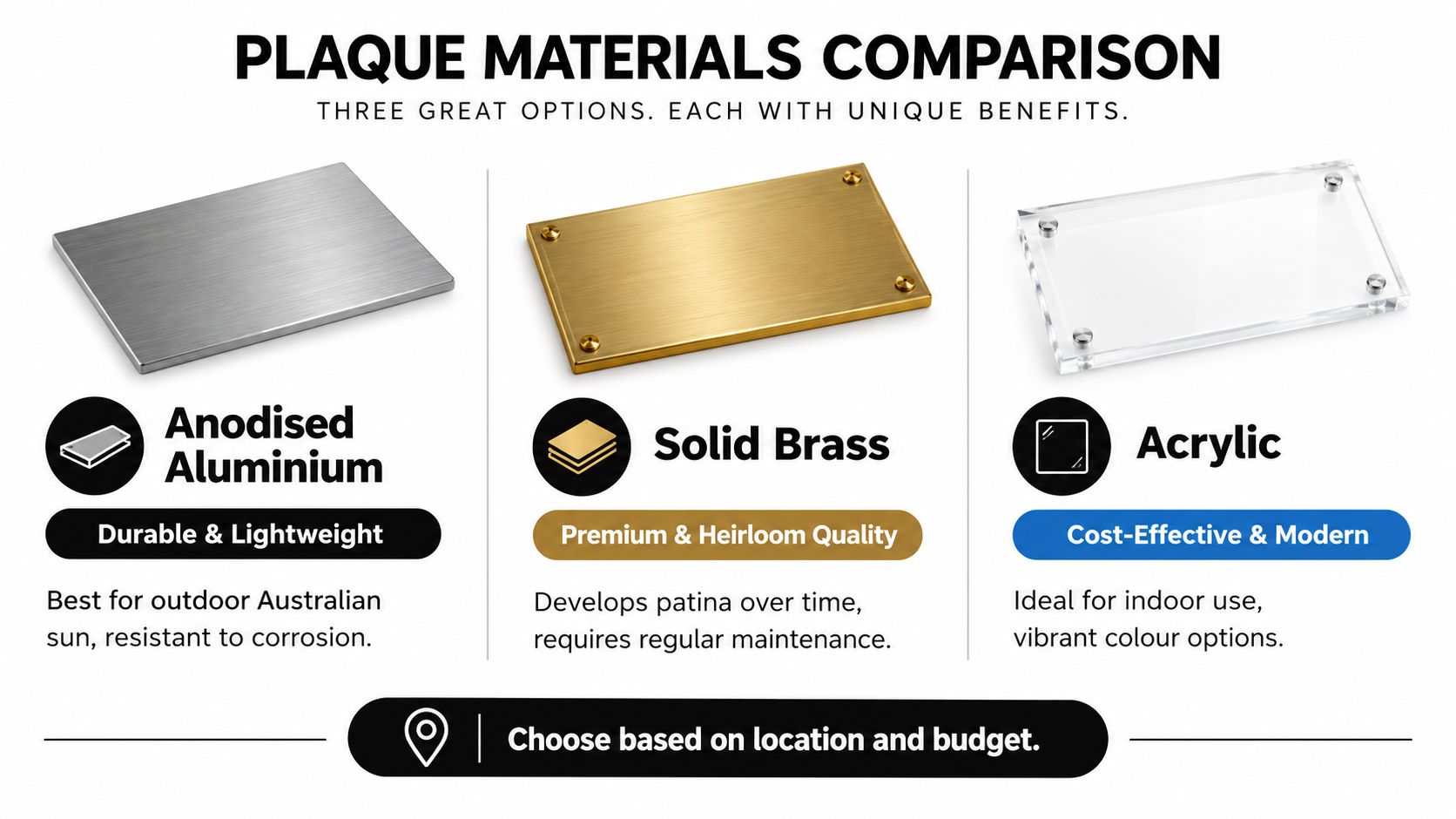
Selection needs to follow exposure and service conditions. A polished brass plaque may suit a heritage interior and become a constant upkeep problem outdoors. A light aluminium plate can be a sound choice for plant and equipment identification, while a coastal hospital, aquatic venue or food-processing area may justify stainless because corrosion, moisture and cleaning chemistry create a very different risk profile.
Australian signage guidance points to anodised aluminium for many outdoor equipment-identification uses, engraved laminate for demanding indoor and washdown settings, and stainless steel for coastal, wet, healthcare and corrosive locations. It also makes the practical point many buyers miss. Grade selection and chemical compatibility still have to be checked against the actual site. There is no universal plaque material.
Match the substrate to the working conditions
Anodised aluminium works well where low weight, exterior use and corrosion resistance matter. It is common on equipment labels and general outdoor identification, but only when the anodised finish, contrast, fixings and expected chemical exposure all suit the application. In practice, failures often come from the details around the plate, not the plate alone.
Engraved laminate is often the better call inside plant rooms, service corridors and other areas cleaned on a routine cycle. Its performance depends on choosing a construction that matches the cleaning regime. Decorative-looking stock that sees caustic washdown or hard abrasion can deteriorate quickly even if it looked fine at handover.
Stainless steel suits harsher environments where corrosion or hygiene requirements raise the cost of failure. Coastal air, wet process areas and healthcare facilities are typical examples. The exact grade and finish still matter, as do fasteners, drainage and how the plaque sits against the mounting surface. For exposed metal applications, compare stainless steel plaques against site conditions rather than the catalogue photo.
Brass, acrylic, granite and other materials still have their place, especially in memorial, donor-recognition and architectural work. The trade-off is different. They need to be assessed for glare, handling, cleaning, edge damage and how well the finish will age if the plaque is expected to remain visually consistent over time. A material chosen because it presents well in a rendering can become the expensive option once replacements, refinishing or readability complaints start.
Recessed marking usually earns its place
Australian UV exposure is hard on coatings, inks and some polymers. Recessed legends usually hold up better under abrasion, repeated cleaning and general wear than surface-only print. They also support lifecycle governance more effectively because the information remains legible for longer instead of depending on a top layer that can scuff, fade or lift.
Recessed legends survive washdown and abrasion better than surface print, and laser production is what makes that affordable across mixed material runs. Trotec Laser's Australian Speedy documentationcompressed.pdf) describes CO₂ processing for materials such as plastic, wood, rubber and leather, while fibre processing supports metal marking. Some systems combine both sources, which is useful when a project includes non-metal plaque faces and metal identification plates in the same workflow. The same documentation also refers to permanent tactile markings, fewer passes and minimal residue, all relevant where finish quality and repeatability matter.
Good production still needs good detailing. Use protected or rounded edges where contact is likely. Specify mechanically secure fasteners. Choose matte, high-contrast finishes where glare can reduce legibility. Teams building a repeatable plaque or asset-labelling system should also design around production limits early, not after artwork approval. This manufacturing guide for consumer brands is a useful general reference for that approach.
The following video provides a visual look at laser processing. Use Trotec Laser machine imagery and production footage when presenting the process, rather than illustrating modern plaque work with unrelated mechanical engravers.
Designing and Sizing Engraved Plaques for Legibility and Australian Compliance
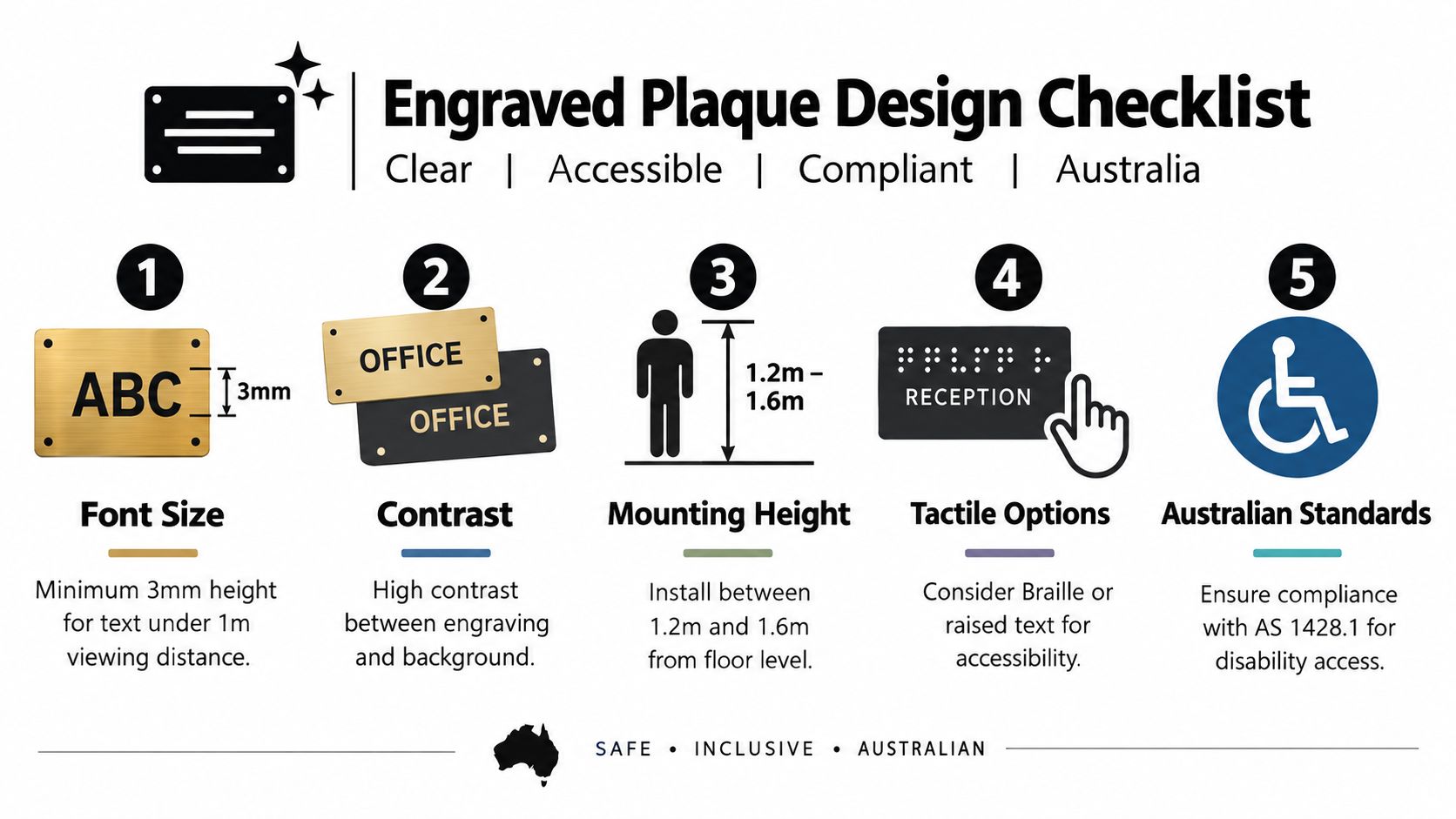
A readable plaque begins with the viewing situation, not the artwork file. Decide whether people will read it while standing close, approaching from a corridor, working beside machinery or moving through a public space. Then set the text hierarchy, contrast, mounting location and tactile treatment around that use.
Australian accessible wayfinding and hazard identification should be checked against the access provisions associated with AS 1428.1 and the National Construction Code. South Australian and related access guidance states that tactile ground surface indicators should be set back 300 ± 10 mm from a hazard, extend 600–800 mm in the direction of travel and provide at least 30% luminance contrast with the surrounding surface. Those figures concern tactile ground indicators, not every plaque, but they demonstrate why placement and contrast need technical review rather than visual guesswork.
Start by separating the sign type
A memorial plaque, an equipment label and regulated building signage can all be engraved, but they don't carry the same obligations.
- Memorial plaques need respectful wording, balanced layout, durable contrast and a location that supports visitors.
- Equipment labels need concise identification, strong readability and a format that remains useful during maintenance.
- Regulated building signs may require tactile characters or braille in specified locations, such as sanitary facilities, exits, hearing-augmentation rooms and some inaccessible entrances.
For identification plaques installed below 1600 mm above the finished floor, raised tactile information is required when tactile compliance applies. Flat engraving alone isn't an appropriate substitute in that situation. The National Construction Code and applicable access provisions should be reviewed for the building and sign location, rather than applying a memorial specification to a regulated wayfinding sign.
Build the layout for real readers
Use a clear information hierarchy. The primary name or hazard should dominate, supporting details should remain distinct, and decorative elements should never compete with essential wording. Choose a typeface that engraves cleanly, preserve generous spacing and inspect the design at the intended reading distance.
Contrast matters as much as depth. An engraved legend can still disappear against a reflective background or become difficult to read when dirt fills the recess. Matte finishes, controlled colour contrast and a clean mounting surface often achieve more than increasing plaque thickness.
Installation height deserves the same attention. The relevant guidance identifies an installation range of 1200–1600 mm for tactile signage and tactile characters generally raised 1–1.5 mm in associated access guidance. Confirm the exact requirement for the sign category and location before production.
Design check: ask someone unfamiliar with the artwork to identify the sign's purpose and read its essential information from the intended approach. If they need a verbal explanation, the layout still needs work.
For a commemorative item, personalized award plaques may offer useful inspiration for hierarchy and finish, but an award format shouldn't be copied directly into a safety or access-controlled environment. The same engraved surface can serve different purposes, yet the design duty changes with the reader and risk.
A similar principle applies when related building materials affect site decisions. For example, guidance on fire resistant ratings on cladding can help project teams understand why adjacent construction choices require their own performance review. A plaque doesn't inherit compliance merely because it is fixed to a compliant wall.
Understanding Lead Times, Pricing Factors and Regulatory Expectations
A plaque can look fine on the proof, arrive on time, and still become an expensive problem once it reaches site. That usually happens when the quote covers the plate itself but leaves out the decisions that govern service life, readability, approvals and installation. A useful quote names the material, finish, dimensions, artwork responsibility, proofing steps, fixing method, packaging, delivery assumptions and any compliance review. If those points stay vague, the low price is often only the starting figure.
What changes the production workload
Production time changes quickly once the job moves beyond a basic label. Material grade affects machining, finishing and corrosion resistance. A simple indoor identifier is one task. A plaque exposed to weather, cleaning chemicals or public contact is another, especially if it needs drilled fixing points, variable serial data, tamper-resistant mounting or a documented approval trail.
Artwork control often takes longer than engraving. Supplier-drawn layouts, licensed logos, tactile content, long inscriptions, variable data and repeated proof revisions all add handling time. On memorial work, the slowest step is often wording approval rather than manufacture, because families, councils, cemeteries or heritage managers may all need to sign off the final text.
Batch structure matters as much as unit count. A run of identical labels can be nested and processed efficiently. A commemorative program with many different names, dates or titles needs a controlled source file, formal proof approval and a final inspection against the approved record before installation. That is lifecycle governance in practice. It reduces avoidable replacements later.
Speed isn't the same as finished turnaround
Fast laser equipment helps, but machine speed is only one part of delivery. The production window also includes setup, masking, nesting, cutting or engraving, cleaning, finishing, inspection, packing and freight. If the plaque needs colour fill, special fixings, site-specific drilling templates or staged dispatch, the schedule extends again.
The same issue applies to governance. A supplier can promise a quick run time on the machine and still miss the lead time if artwork is unresolved, the mounting surface has not been confirmed, or the compliance check has been left until after approval. In practice, the jobs that run smoothly are the ones where artwork status, installer requirements and the sign's operating environment are settled before production starts.
Regulatory checks affect design, not just paperwork
For chemical-storage applications, AS 3780:2023 addresses the safe storage and handling of Class 8 corrosive substances under the Australian Dangerous Goods Code. Its scope includes placarding, signage, marking and labelling of containers, equipment, installations and storage areas. Standards Australia's AS 3780:2023 listing sets out that standard and its publication details.
That does not create one universal industrial plaque format. It does mean the plaque sits inside a wider safety information system. Required wording, placement, legibility, durability and substrate suitability all need to be checked against the actual installation.
For outdoor commemorative projects, custom outdoor memorial plaques should be quoted with site exposure, fixing preparation, approval responsibility and maintenance expectations stated clearly. Ask who confirms the spelling, who checks the mounting surface, who signs off the final artwork and who keeps the approved record. Those answers usually tell you more about long-term cost than the headline price.
Commemorative Scale, Australian Context and Modern Laser Production
Australian memorial work combines emotional importance with production discipline. Each name may represent an individual family, service record or community history, yet the finished installation must still use consistent spacing, alignment, materials, fixing methods and maintenance procedures.
The West Australian Garden of Remembrance at Perth War Cemetery demonstrates the scale involved. It contained approximately 10,200 official commemorative plaques as at August 1998, primarily commemorating eligible veterans who served after the Second World War, with a substantial proportion connected to the Second World War and some to the First World War and inter-war period. The Western Australian heritage inventory record makes clear why high-volume plaque programs need consistent identification, legible inscriptions, weather-resistant construction and long-term conservation planning.
Uniformity protects meaning
Large memorial installations expose weaknesses that a single plaque can conceal. Slightly different fonts, inconsistent punctuation, variable border widths or changing metal finishes make a site look piecemeal. Inconsistent records also make later additions and corrections harder to manage.
A controlled production system should preserve:
- Approved wording: Names, dates, ranks, affiliations and acknowledgements need a clear approval trail.
- Repeatable layout: Templates should establish hierarchy without forcing every inscription into an unsuitable shape.
- Material continuity: Future additions should match the installed plaques in substrate, finish and fixing approach.
- Maintenance records: Site managers need to know what was installed, when it was checked and how obsolete information will be handled.
This governance approach also suits infrastructure identification. A durable engraved identifier can remain on the asset while a digitally managed record stores changing maintenance or ownership information. That layered model avoids overloading the plaque with details likely to become obsolete.
Laser production suits repeat work
Trotec Laser equipment is relevant because modern systems can prepare repeatable lettering, serial numbers and detailed artwork across suitable metal and non-metal substrates. Trotec's Australian information describes software that combines job management, material settings and real-time machine monitoring, with drag-and-drop preparation, nesting and more than 500 material-database presets. Trotec Laser's Australian platform information identifies more than 500 tested materials, ranging from acrylic to anodised aluminium.
Nesting helps use sheet material efficiently, while stored settings can support consistency across repeat jobs. The machine still needs an experienced operator, correct substrate selection and inspection. Laser capability doesn't replace proofreading or site knowledge.
A memorial plaque deserves more than an attractive finish. It needs wording that has been checked, a material suitable for its exposure, a layout that visitors can read and a production record that supports future stewardship. Industrial plaques need the same discipline, with the emphasis shifted towards safety, asset identity and operational change.
Why Choosing a Specialist Australian Laser Engraver Improves Outcomes
A specialist supplier reduces the number of handovers between artwork, material selection, production and inspection. That matters when a job combines custom wording, difficult exposure, tactile requirements, variable asset data or a large group of individually meaningful plaques.
Trotec Laser's Australian machine information identifies a Speedy 400 working area of 1,016 by 610 millimetres, a maximum workpiece height of 283 millimetres in the Flexx configuration, CO₂ power options from 60 to 120 watts, fibre options from 20 to 50 watts, and laser class 2. The Australian Speedy 400 specification also states that the machine complies with Australian safety standards. These limits matter during planning because blanks must fit the working area, shaped or thick substrates must remain within the height limit, and production estimates must distinguish machine capability from total job time.
Look for a supplier that can discuss substrate compatibility, artwork proofing, access requirements, fixing details and future replacement records in the same conversation. Evright Industrial provides laser engraving and asset-labelling services for equipment identification, safety signage and custom memorial plaques, using material and production options suited to industrial, healthcare, infrastructure and commemorative applications.
A plaque is successful when it remains useful after the installation team has left. That requires technical judgement before production, controlled artwork during production and a clear maintenance approach afterwards.
For durable engraved plaques, equipment labels and memorial signage, Evright Industrial can help with material selection, artwork proofing and laser-based production for Australian environments. Visit the site to discuss your application, exposure conditions, compliance needs and the information the finished plaque must preserve.
Recent Comments