

A family has approved the wording, selected a location and paid for a tribute, only to discover that the cemetery won't accept the plaque as specified. The material is wrong, the dimensions don't match the lawn section, or the installer isn't authorised to fix it. By then, changing the order can delay the memorial and add avoidable cost.
Memorial plaques for outside are not merely decorative signs. They must withstand Australian sun, rain, heat, salt air and cleaning routines, while also meeting the rules of the cemetery, council or asset owner. A sound specification brings together four decisions: material, marking method, approval and installation.
Outdoor Memorials Face Harsh Climates That Undermine Durable Claims
A plaque can leave the workshop looking flawless and show visible wear within months. Australian outdoor sites expose memorials to ultraviolet light, wind-driven grit, salt deposits, and repeated wetting and drying. Coastal air is especially demanding because chloride exposure can cause pitting and surface breakdown in metals that perform well indoors or under shelter.
The site changes the specification. A shaded garden bed, exposed lawn, coastal headland, and public bench each create a different microclimate. A plaque protected beside a monument may weather differently when installed horizontally at ground level, where water, dirt, mower residue, and lawn chemicals can remain against the surface.
Practical rule: Specify the plaque for the site, not only for the showroom appearance.
Before artwork is approved, confirm the installation conditions. Is the plaque close to the coast? Will it be fixed to stone, brick, concrete, timber, or a metal structure? Will visitors walk over it, will mowing occur around it, and what cleaning chemicals will be used? The required reading distance also matters. Lettering viewed from a standing position in full sun needs a different contrast and finish from wording read at close range.
Why outdoor durability claims need context
“Durable” describes no single performance standard. A plaque may remain securely attached while its lettering loses contrast, its paint fill deteriorates, or staining develops across the surface. Outdoor memorials can also be rejected or restricted if their material, dimensions, wording, placement, or fixing method conflicts with the asset owner's rules. The Victoria's memorialisation policy template sets requirements for outdoor memorials and distinguishes locations where bronze and granite plaques may be installed.
The tribute's purpose still guides the wording. Families may need assistance confirming names, documenting people who are missing, or recording someone without a conventional grave. The resource on finding names on memorials provides a careful starting point before the engraving file is approved.
A workable specification matches three elements: a corrosion-resistant substrate for salt air, a marking method that keeps contrast under strong UV, and fixings suited to the supporting surface. Council or cemetery approval can affect all three. A plaque that looks attractive but fails the site, maintenance, or installation requirements will not serve as a durable outdoor memorial.
Selecting Materials for Coastal and High-Exposure Sites
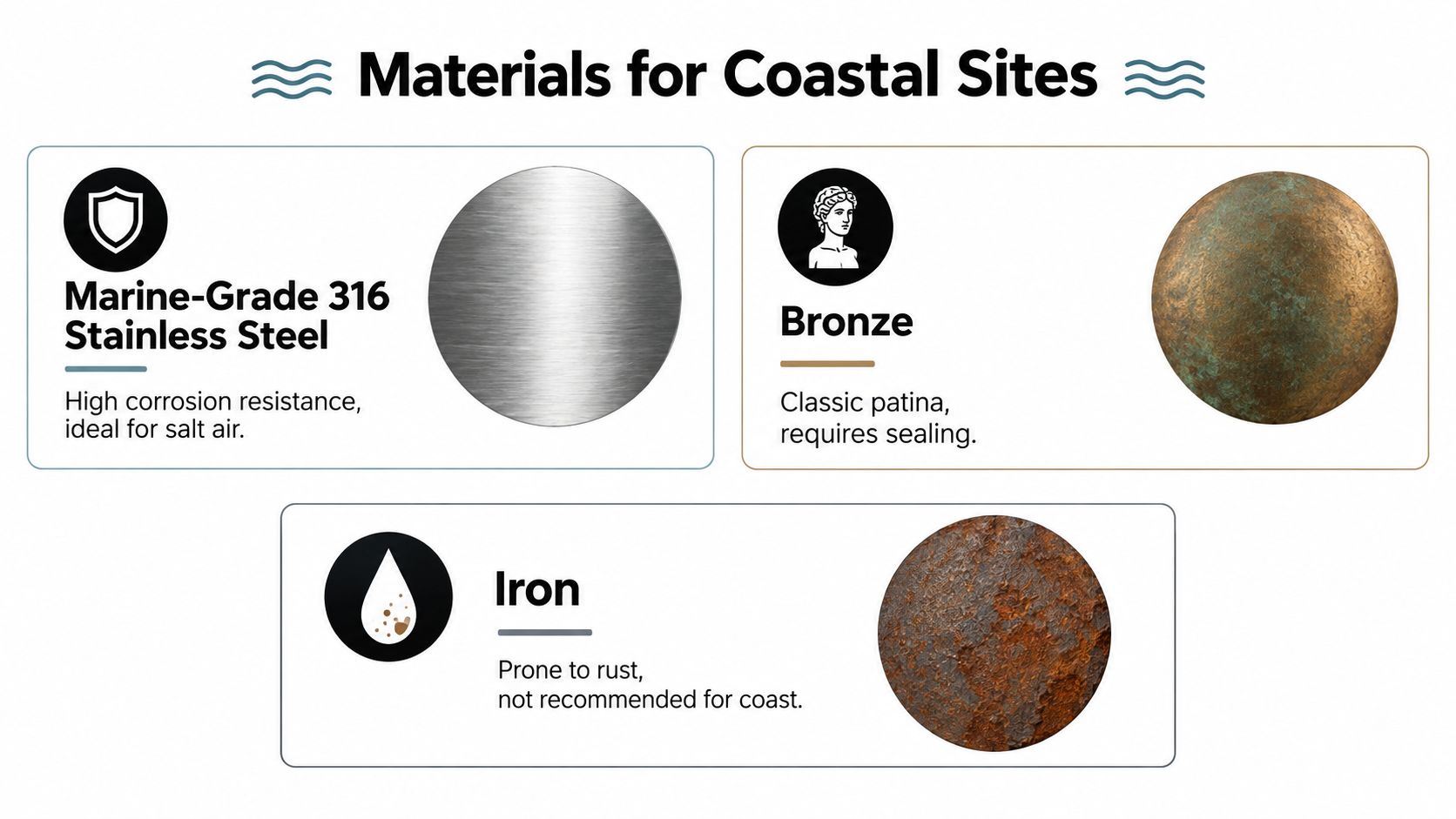
Material selection usually comes down to three practical contenders, marine-grade 316 stainless steel, cast bronze and granite. Iron sits outside that shortlist for most coastal work because rust can compromise both appearance and long-term integrity.
Marine-grade 316 stainless steel is the technical default for exposed coastal sites. A Queensland materials guide recommends it for permanent signs exposed to coastal elements, particularly east of the Bruce Highway, where marine air accelerates corrosion in lesser metals. Its advantage comes from greater resistance to salt-related pitting than other stainless grades. That doesn't make it maintenance-free, but it gives the plaque a stronger starting point where chloride exposure is high. Australian materials guidance on 316 stainless steel explains why coastal exposure should influence the grade specified.
Bronze, granite and iron in comparison
Cast bronze remains popular because it has a traditional memorial character and develops a patina over time. That colour change is part of its appeal, but it also means the finish must be agreed in advance. If the brief calls for a consistent painted or sealed appearance, the maintenance plan needs to account for exposure and coating condition.
Granite offers a hard substrate and a formal stone appearance. Australian plaque guidance identifies it as a strong choice where the longest readable life is the priority, although the result still depends on placement, inscription depth and local cemetery rules. Granite is also heavier and usually demands a more deliberate base or fixing arrangement than a thin metal plaque.
Iron is a poor choice for most marine installations. Rust can spread from edges and fixings, stain adjacent masonry and create a surface that no longer provides a clean contrast. The attractive initial price or industrial appearance doesn't compensate for the corrosion risk in salt-laden air.
For a practical comparison, use the site as the deciding factor:
| Site condition | Sensible starting point | Main trade-off |
|---|---|---|
| Coastal or salt-exposed | 316 stainless steel | More technical appearance than bronze |
| Traditional memorial setting | Cast bronze or granite | Patina, sealing or weight may require planning |
| Sheltered inland location | Bronze, granite or suitable stainless steel | Local rules still control what can be installed |
| High-contact or exposed public asset | Hard substrate with deep marking | Finish and fixing require careful specification |
Before ordering, review options for plaques that withstand weather, then confirm the cemetery's own material list. For Australian production and site-specific options, custom outdoor memorial plaques can be assessed against the installation surface, exposure and mounting method rather than selected from a generic catalogue.
Navigating Council and Cemetery Compliance Rules
A plaque can pass a material inspection and still be rejected at installation. Australian cemetery authorities often control who may install it, what it can be made from, how large it can be and where it can be fixed. Written approval also protects ground-level safety, maintenance access, cemetery layout and visual consistency.
The measurements can be exact. One Queensland cemetery code lists bronze plaque formats of 380 mm by 280 mm, with minimum thicknesses of 10 mm for bronze and 12 mm for granite. A NSW council limits niche-wall plaques to 180 mm by 120 mm for singles and 300 mm by 120 mm for doubles. Camden General Cemetery requires a permit for plaque or monument work and specifies a bronze lawn plaque measuring 350 mm by 450 mm, alongside a 200 mm by 200 mm by 6 mm bronze inscription panel. These requirements appear in the Queensland cemetery code.
Material mandates differ by authority
Cairns requires applications before work begins and states that plaques must be cast bronze unless another material is specified. Its requirements also refer to AS 4204-2019 for memorials and AS 4425-2020 for above-ground structures. Other authorities prescribe bronze-coloured, straight-edged plaques, approved locations or authorised installers. Mildura, for example, requires authorised people to install bronze plaques. The Cairns cemetery specification shows why production should wait until the local document has been checked.
The word “outdoor” does not define one standard product. A council may allow bronze on a lawn but restrict granite to a garden area, monument or headstone. It may also require written approval covering the material, dimensions, wording and placement. Treat those details as part of the production brief, not as paperwork to complete after engraving.
Gather the approval information first
Ask the cemetery or council for:
- Approved material: Confirm whether the authority mandates cast bronze, permits 316 stainless steel or accepts granite.
- Exact dimensions: Check length, width, thickness, corner treatment and any inscription-panel limits.
- Placement and fixing: Establish whether the plaque goes on a lawn, wall, monument, headstone, seat or garden feature.
- Installer requirements: Identify permits, authorised installers and inspection conditions.
- Artwork and wording: Submit the final names, dates, symbols and layout in the requested format.
The same discipline applies to related site work. Guidance on retaining wall permit costs illustrates how approval obligations can sit outside the finished object itself. A cemetery rejection often traces back to one unchecked requirement, such as size, material grade or installer accreditation. Finding that gap before fabrication costs minutes, not months.
Engraving Techniques and Finish Options for Legibility
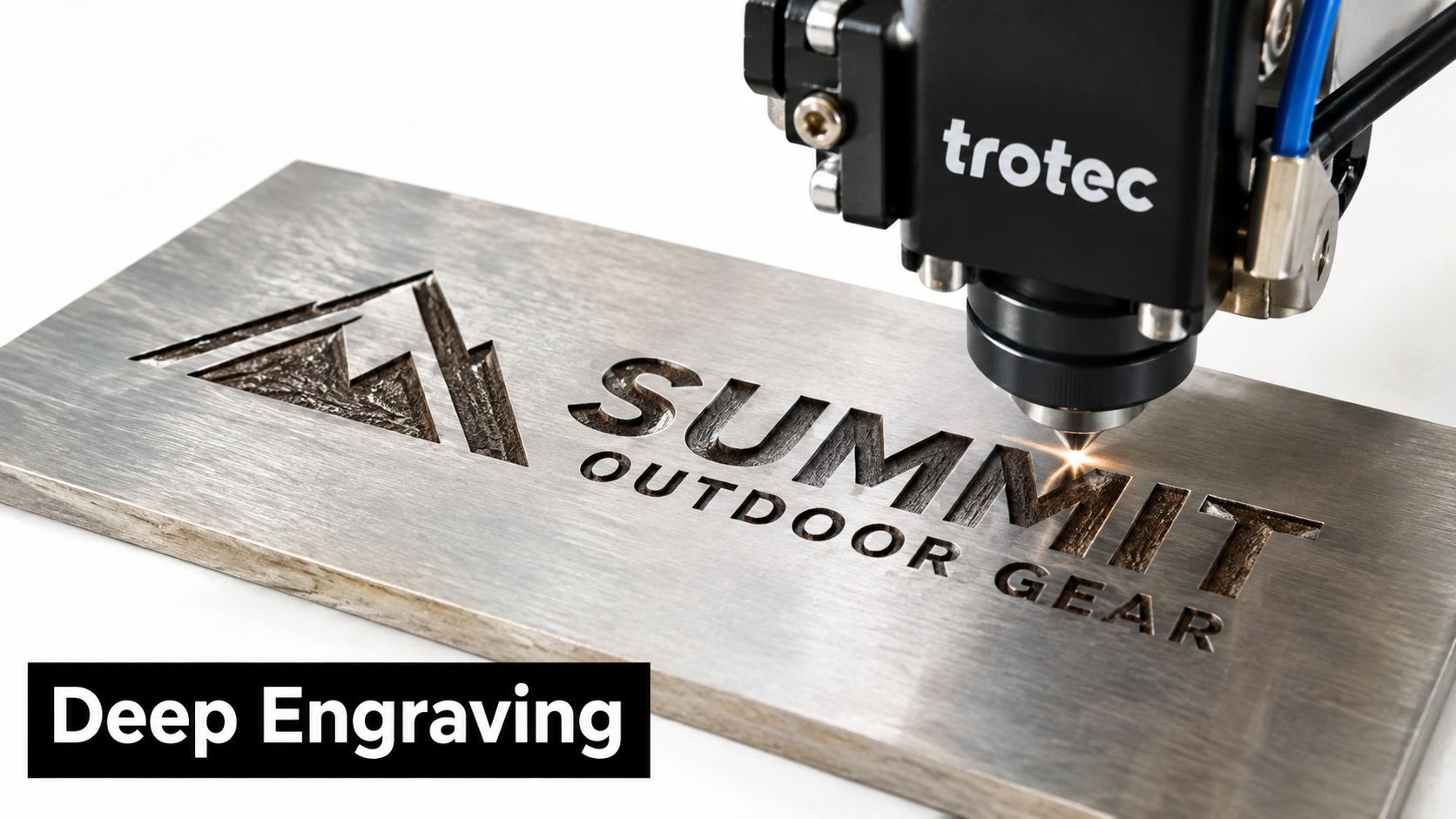
Lettering fails gradually. A shallow mark loses contrast first, especially when ultraviolet exposure, abrasion, grime and weathering attack the surface around it. Harder substrates and deeper marking retain a clearer edge, which is why a plaque intended for full sun and rain shouldn't be specified by material alone.
Start with contrast, not decoration
For granite, the engraving depth and stone colour determine how quickly lettering becomes difficult to read. On stainless steel, a deep etch with a suitable fill can create a strong contrast without relying on a delicate surface coating. Bronze offers a warm base colour, but its developing patina changes the relationship between the background and the lettering.
A production brief should identify:
- Reading distance: Close-up niche reading differs from a lawn plaque viewed while standing.
- Letter size and stroke width: Fine strokes and overly compact typefaces are vulnerable to dirt and glare.
- Marking depth: Deeper engraving or etching provides more material protection than a superficial surface mark.
- Fill and background: A durable fill or controlled background treatment can improve contrast, provided the finish is approved for outdoor exposure.
- Artwork control: Names, dates, logos and symbols should be proofed at full scale before production.
Trotec Laser machinery is useful where consistent positioning, intricate artwork and repeatable marking matter. Laser processing can produce clean detail across complex layouts, while the operator can select settings for the substrate and desired finish. Mechanical routing still has a place for some stone and deep-cut applications, but it may be less convenient for fine symbols, small lettering or repeatable multi-plaque work.
Ask for a production proof
A proof should show the actual wording, line breaks, emblem size and expected contrast. Don't approve a design only from a screen image. A polished metal surface can reflect sunlight, and a dark fill can look stronger indoors than it does outdoors.
This laser-engraved memorial plaques service is relevant when the project requires a controlled layout on metal and a finish selected for outdoor use. The essential question isn't whether the plaque is laser engraved. It's whether the marking depth, substrate and contrast suit the site.
The video below shows laser processing in action. It's useful for understanding how a Trotec Laser system handles controlled marking, although the exact production settings for a memorial plaque must be tested on the specified material.
Mounting Methods and Weatherproofing Strategies
A well-made plaque can fail because the installation traps water, uses incompatible fixings or relies on an adhesive that was never designed for outdoor structural work. Mounting must be treated as part of the specification, particularly where the plaque is installed on masonry, a granite base, a lawn support or a timber memorial seat.
Start by identifying the base material and the load path. A heavy granite plaque needs a stable support and appropriate anchors. A thin metal plate on a wall needs fixings that won't loosen under vibration, thermal movement or repeated contact. A lawn plaque must sit securely and safely without creating a trip hazard or interfering with mowing equipment.
Match fixings to the exposure
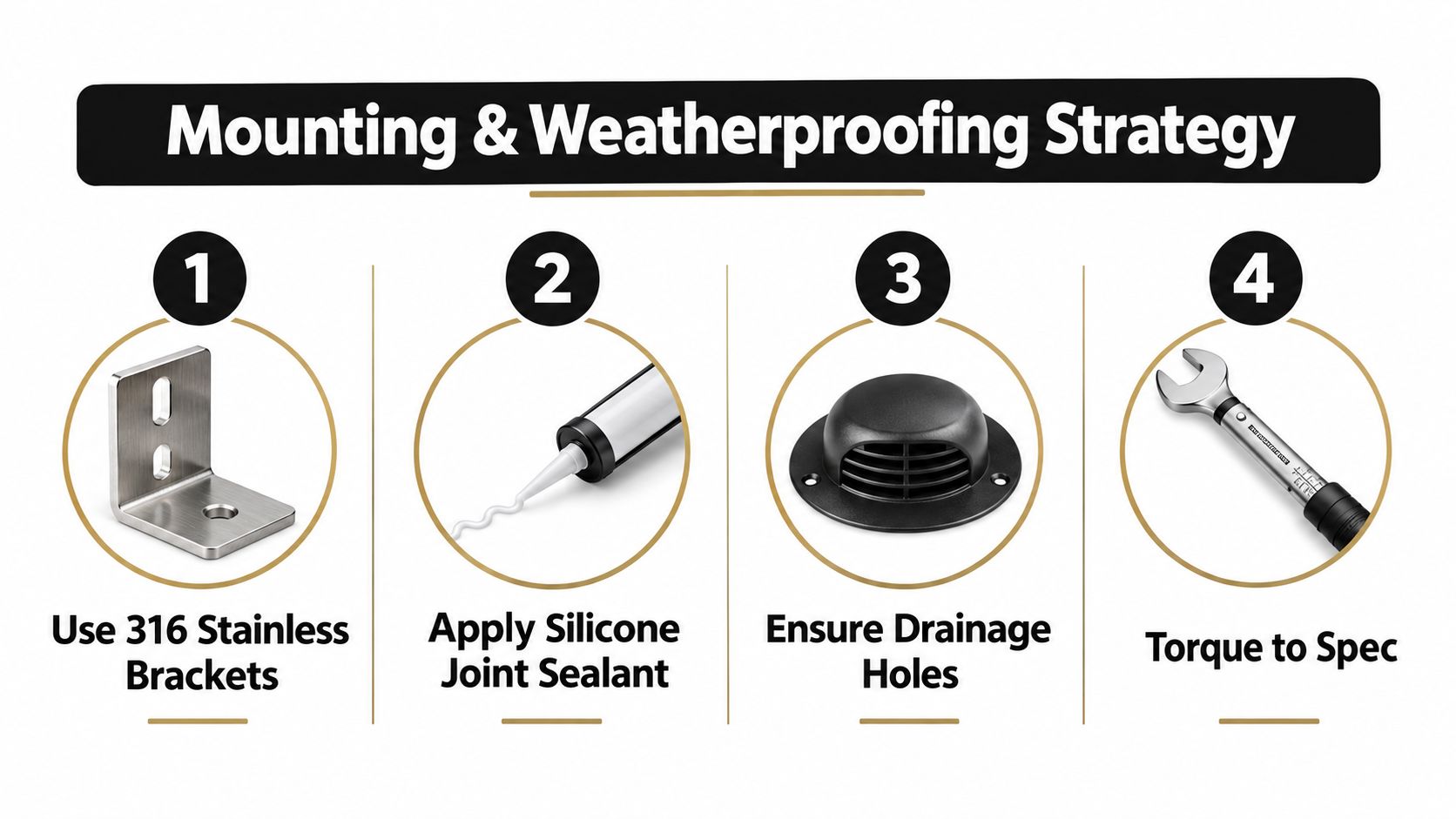
Marine-grade 316 stainless steel fixings are the sensible choice for coastal or high-exposure sites. Using a lower-grade screw beside a 316 plaque can create a weak point, staining or corrosion at the fixing rather than across the plaque face.
Dissimilar metals also need attention. Direct contact between different metals in the presence of moisture can encourage galvanic corrosion. Use compatible hardware or an appropriate isolating washer, sleeve or barrier where the design creates that risk.
Keep water from becoming a hidden load
A sealed rear face can limit water ingress behind the plaque, but sealing must not create a permanently wet cavity. On wall-mounted work, the installer should prepare a sound, clean surface, use an outdoor-rated structural adhesive where appropriate and provide a controlled joint rather than smearing sealant around the perimeter without a drainage plan.
For benches and timber structures, moisture trapping can accelerate rot. For stone, trapped water can contribute to staining or damage where the base is already compromised. Any drainage or ventilation detail should be designed into the mounting arrangement, not improvised after the plaque arrives.
A practical installation sequence is:
- Inspect the base: Reject loose render, cracked stone, rotten timber or unstable lawn supports.
- Set out accurately: Confirm centre lines, fixing locations, access and the finished height.
- Use compatible hardware: Select 316 stainless fixings in exposed locations and isolate dissimilar metals.
- Seal and drain: Apply suitable joint sealant while preserving a route for water to escape.
- Tighten correctly: Torque fixings to the hardware and substrate requirements without distorting the plaque.
For wall installations, memorial plaques for wall mounting should be assessed against the wall construction and the intended fixing method. The installation drawing should accompany the approval submission where the cemetery or council requires it.
Long-Term Maintenance and Realistic Lifespans
A plaque can leave the workshop in perfect condition and still change quickly on an exposed Australian site. Salt air, ultraviolet light, heat, rain and cleaning methods all affect the finish. “Durable” describes the material's performance, not a promise that its colour, coating or surface will remain untouched. Bronze may develop patina, painted lettering can fade or lose adhesion, and a coastal plaque usually needs closer inspection than one installed under cover.
Maintenance expectations should also account for the authority controlling the site. Tweed Shire Council's guidance gives practical, location-dependent ranges: outdoor plaques may last about 10 years before refurbishment, while flat lawn-level granite inscriptions may last about 3 years and upright memorials about 5 years. These periods vary with weather, cleaning and placement, so the handover record should state the expected inspection and refurbishment cycle. Tweed Shire Council's memorial guidance provides the relevant site context.
Clean without stripping the finish
Ultraviolet exposure, temperature changes and other weather extremes can affect paint colour and adhesion. The NSW guidance also warns against abrasive and traditional liquid cleaners. A harsh cleaning attempt can remove paint fill, scratch polished metal or strip a protective treatment that was intended to weather gradually.
Use a controlled inspection routine:
- Inspect visually: Check for fading, staining, corrosion marks, edge lifting and movement around the plaque.
- Remove loose dirt: Use clean water and a soft cloth or a brush suitable for the surface.
- Avoid abrasives: Do not use scouring pads, harsh powders or unapproved liquid cleaners.
- Record changes: Photograph the plaque at inspection so its condition can be compared over time.
- Escalate early: Have a specialist assess coating failure, corrosion or damaged stone before attempting a repair.
Bronze care may involve removing an old coating, applying corrosion inhibitor and recoating with protective wax. The NSW Office for Veterans Affairs guide states that these treatments generally last up to 4 years depending on exposure, making maintenance a recurring responsibility rather than a one-off service. The NSW guide to caring for war memorials
A plaque fixed to a public bench has a different compliance expectation. Burnside's policy requires the plaque to remain for the life of the asset and, in that context, for no less than 10 years. Burnside's memorials policy connects retention to the bench's service life, so the plaque specification and fixing plan must suit the structure.
Partnering with an Expert for Your Memorial Project
A plaque can look right on screen and still fail approval or installation. The supplier must interpret council specifications, verify dimensions, match the material to Australian exposure conditions and document how the plaque will be fixed.
Ask for an approval pack before production begins. It should state the material and thickness, finished dimensions, wording proof, fixing arrangement, installation responsibility and finish requirements. Check whether the cemetery, council or asset owner mandates cast bronze, a particular alloy, or a specific fixing system. A technically durable substitute, such as stainless steel, may still be rejected if the authority has specified bronze.
What a capable production process includes
A reliable workflow should cover:
- Site review: Record the base material, orientation, exposure, access and expected maintenance conditions.
- Authority check: Confirm the current cemetery or council rules before artwork is approved. Ask who signs off the design and installation.
- Material selection: Balance corrosion resistance, weight, appearance, marking method and the approved location.
- Full-scale proof: Check names, dates, symbols, spacing and contrast at the intended viewing distance.
- Controlled production: Use suitable equipment, including Trotec Laser machinery where the design and substrate require precise laser marking.
- Installation handover: Provide fixing guidance, product details and maintenance instructions to the responsible party.
Evright Industrial is a specialised division of evright.com providing precision engraving, asset labelling and custom memorial plaque production. Its services include laser engraving on durable materials, with Trotec Laser machinery used for intricate designs and consistent marking. The team supports site-specific decisions for plaques installed on walls, bases, lawns and timber seats.
The value of an experienced industrial engraver is early problem detection. Council mandates, unsuitable substrates, restricted access, incompatible fixings and finishes that will deteriorate in salt or heat can be identified before manufacture. That timing matters because changing a drawing or material is simpler than remaking an approved plaque after installation.
A practical partner also separates design approval from installation approval. Confirm who owns the asset, who is responsible for future maintenance and whether the plaque must remain for the structure's service life. Those details affect material choice, fixing depth and access for later inspections.
Families need a tribute that remains legible and secure. Funeral homes and councils need records that support approval, safe installation and ongoing care. Treat the plaque as a small engineered project, not an appearance-only purchase.
Evright Industrial offers custom outdoor memorial plaques, laser-engraved memorial products and guidance on materials, compliance and mounting conditions. Visit Evright Industrial to discuss the site, council requirements and plaque design before production begins.
Recent Comments