
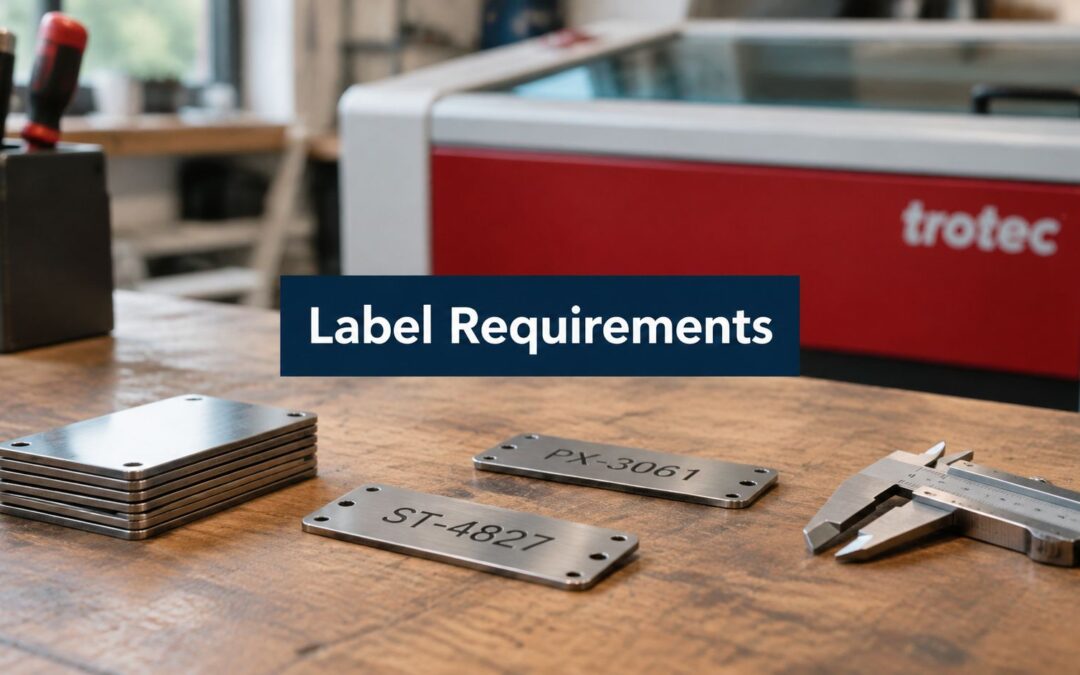
You're standing beside a finished switchboard, paperwork complete, serial records saved, and the unit ready for dispatch. Then someone notices the identification label has lifted at one corner. The model number is still visible, but the batch code is smudged, and the compliance marking sits under a film of oil. That small defect can become a production hold, a failed inspection, or a traceability problem after installation.
Manufacturer label requirements exist to connect the physical product with its maker, specifications, hazards, origin, and service history. Australian rules don't rely on one universal label rulebook. The Australian Consumer Law, food standards, workplace safety duties, electrical marking rules, and product-specific regulators each impose obligations that manufacturers must translate into a label that remains readable where the asset works. Australian Government guidance on product labelling explains how identity, quantity, supplier details, safe-use information, food declarations, and origin claims fit within this wider framework.
The practical question is therefore not only what the label says. It's whether the marking will still be legible after years of UV, abrasion, washdown, solvents, handling, and maintenance. This guide connects the regulatory wording with material selection, placement, verification, and laser engraving using Trotec Laser machines.
When a Failed Label Stops the Line
A forklift tears open a wooden shipping crate on the workshop floor. The steel enclosure inside has travelled through loading docks, rain, dust, and oily hands. As the crate straps come away, a polyester sticker catches on a timber edge and peels across the face of the switchboard. The serial number disappears beneath the lifted adhesive and a thumbprint.
The production supervisor pauses the release. A technician checks the job folder, but the unit's physical identifier no longer matches the record with confidence. An auditor arrives during the hold point and asks a simple question: which batch left the factory, and which units share the same component history?

That's where a label stops being a piece of artwork and becomes part of the production-control system. A readable serial number supports commissioning, maintenance, warranty decisions, supplier verification, and recall containment. If the mark fails, people start relying on invoices, photographs, memory, or incomplete spreadsheets.
Shop-floor rule: If a technician can't identify the asset without opening a file or removing a cover, the label placement is already working against traceability.
The consequences tend to spread outward. An unreadable plate can trigger a hold on one unit. A wider uncertainty can require investigation, customer contact, and re-labelling of equipment that's already installed. Australian product-labelling guidance links supplier information, batch identification, and safe-use details to consumer information and recall control, rather than treating labels as a branding exercise. The Australian Consumer Law and product labelling guidance provides the broad foundation for that approach.
A Trotec Laser machine can convert the approved label artwork into a permanent engraved or marked identifier on a suitable substrate. The value isn't the machine alone. It's the controlled combination of correct content, material, contrast, location, verification, and records. The sections that follow apply that method to Australian manufacturer label requirements, from the first regulatory decision to the final audit file.
The Australian Regulatory Framework: Which Rules Apply to Your Product
Australian manufacturer label requirements begin with the product category, then narrow through the applicable law, standard, and approval pathway. Consumer law generally expects goods to show identity, quantity, supplier details, and safe-use information where relevant. Food products add ingredients, allergens, nutrition information, supplier name and address, country-of-origin claims, lot identification, and other details required by food rules. The Australian Consumer Law and product labelling guidance provides the broad starting point, but no single label format suits every manufactured product.
Traceability connects the physical item with its responsible records. A switchboard, chemical container, food pack, or medical device needs markings that let an inspector or technician identify the item, confirm who supplied it, and locate the relevant approval, batch, or service information.
Start with the product category
Electrical equipment follows its own marking pathway. For in-scope equipment, the Regulatory Compliance Mark indicates compliance with EESS and ACMA labelling requirements. It must be applied before sale and placed on the external surface as close as possible to the model identification. That location supports inspection and supplier verification. The EESS guidance on the Regulatory Compliance Mark also links placement, dimensions, and location to AS/NZS 4417.2. For project-specific electrical work, compare the equipment documentation with the switchboard labelling requirements in Australia and the installation context before finalising artwork.
Hazardous chemicals require a different information set. A workplace container label must be in English and include the product identifier, manufacturer or importer details, hazard pictograms, signal words, hazard statements, and precautionary statements consistent with the chemical classification. Safe Work Australia's labelling code of practice also identifies information such as the UN number where applicable, directions for use, first aid, and emergency procedures.
Food and agricultural products add further layers. Food labels need supplier identification and traceability information. The APVMA requires agricultural and veterinary chemical labels to identify the person primarily responsible for marketing and show the actual date of manufacture. The APVMA label content code sets out those product-specific requirements.

Translate outcomes into design decisions
Regulations often specify the result rather than one universal substrate. The label must remain legible, durable, accessible, visible, and useful at the point of action. Those requirements guide the choice between anodised aluminium, stainless steel, laser-engravable plastic, and properly specified film. Trotec Laser machines can engrave or mark suitable materials, but the process still depends on correct settings, contrast, location, and verification.
For electrical projects, check switchboard and equipment markings against the applicable standard and installation conditions. For workplace hazards, the label must remain attached, unobscured, readable, and positioned where workers can act on it. ACT WorkSafe's safety-signage guidance identifies AS 1319-1994 as the key Australian Standard for safety signs in work environments.
The governing standard determines the final content. The practical design task is to make that content survive cleaning, handling, heat, chemicals, and routine inspection for the working life of the asset.
Five Content Elements Every Manufacturer Label Must Carry
A durable plate can still fail an audit when its information is incomplete, outdated, or disconnected from the production record. Begin with the product file, approval documents, risk assessment, and applicable standard. Build the label around five content groups that identify the item, communicate its limits, and support service or recall work.

1. Manufacturer identity
Show the responsible manufacturer, supplier, or importer in the form required for the product category. Food and workplace substance rules can require an Australian business address, while other products may require further supplier information. Check country-of-origin wording against the applicable ACCC test, especially when a “made in” claim relies on substantial transformation and the required production-cost threshold. The ACCC and Australian Government labelling guidance sets out the broader identity and origin context.
Anodised aluminium suits applications where the supplier identity must remain visible through handling and cleaning. Trotec Laser machines can mark text, logos, and symbols with controlled contrast, provided the substrate, focus, power, speed, and artwork are validated for the finished application.
2. Product identification
Treat the model number, part number, SKU, serial number, and relevant serial range as controlled production data. They must match the manufacturing record exactly and remain readable after abrasion, oils, cleaning agents, and service handling.
Give the primary identifier enough visual priority for a technician to find it quickly. For a barcode or QR code, preserve quiet space around the symbol and verify the marked result, not only the design file. That check catches contrast, distortion, and registration problems before the plate reaches the line.
The video below shows a controlled Trotec Laser marking workflow in which text and machine-readable symbols share one physical plate.
3. Safety and compliance marks
This group may include the RCM, approval identifiers, pressure ratings, warning pictograms, chemical hazard symbols, or other marks required by the product's governing framework. Check every symbol against the current approval and product configuration before releasing the drawing. An old mark copied from a previous project can create a misleading compliance record.
Laser marking keeps edges and contrast consistent on suitable metals and plastics. For electrical products, place the RCM beside the model identification and reproduce it at the required size and clarity. The physical mark must remain easy to inspect and trace back to the relevant compliance records.
4. Performance and electrical ratings
Voltage, current, frequency, IP rating, working pressure, temperature limits, and duty information need a layout that remains readable in the installed position. The applicable product requirements determine the fields. Keep critical limits clear of logos and crowded corners.
Contrast must suit the environment. A dark mark on a light anodised face may work indoors, while a high-glare stainless surface may call for a different finish or more controlled Trotec Laser engraving approach. The machine alone does not create compliance. Content, material, contrast, location, verification, and records must work together.
5. Date coding and traceability
Batch numbers, manufacture dates, lot codes, and traceability identifiers let production and service teams narrow an investigation. Food rules connect supplier identity and lot identification with recall traceability. Agricultural chemical labelling requires the actual date of manufacture. Wine Australia's labelling guide also shows how supplier and batch information supports downstream action.
Digital identity increasingly sits alongside the physical mark. The TGA's UDI framework combines human-readable information with automatic identification and data capture, with database submission required within the stated regulatory timeframe. Teams planning a connected product record can use Digital Passport for Product to examine how a physical identifier may connect with digital product information.
Choosing Materials That Survive Industrial Use
Material selection should follow the environment, not the label supplier's default stock. A plate inside a clean electrical room faces different risks from a tag mounted beside a coastal pump, chemical dosing skid, or outdoor mobile plant.
| Substrate | UV | Chemical | Abrasion | Thermal | Salt Spray | Cost Index |
|---|---|---|---|---|---|---|
| Anodised aluminium | Good when the finish is specified correctly | Moderate to good, depending on chemical exposure | Good with engraved or marked face | Good for many equipment applications | Moderate, edge and fixing details matter | Moderate |
| Stainless steel 304 | Good | Good for many general industrial environments | Very good | Very good | Moderate | Higher |
| Stainless steel 316 | Good | Very good for demanding environments | Very good | Very good | Very good for suitable marine and coastal applications | Higher |
| Laser-engravable plastic | Good with the correct grade | Depends strongly on the plastic | Good for protected or moderate-contact areas | Depends on grade | Moderate | Low to moderate |
| Laminated polyester film | Good with a suitable over-laminate | Moderate | Moderate | Moderate | Moderate | Low |
Anodised aluminium is a reliable general-purpose option for equipment plates, control panels, and asset tags. Thin sheets need controlled Trotec Laser settings, secure fixturing, and enough heat management to avoid distortion. The finish, colour, thickness, and marking method all influence contrast, so approve a production sample rather than relying on a catalogue photograph.
Stainless steel earns its place where impact, cleaning, and long service life dominate. Grade 304 suits many indoor and general industrial uses. Grade 316 is the stronger candidate for marine, coastal, and aggressive exposure, but the final decision should consider the fixing system, surrounding material, and corrosion conditions described by the applicable project requirements. Trotec Laser Speedy systems configured with the appropriate fibre-laser setup can mark stainless steel, including 316, with a controlled result. Trotec's own demonstrations of anodised aluminium engraving are useful for comparing contrast outcomes before committing to a run.
Laser-engravable plastics such as Rowmark and TroLase can work well for internal machinery labels, control-panel legends, and protected safety information. They're easier to handle than metal, but the grade must match heat, solvents, UV, and impact conditions. Laminated polyester films remain useful where a flexible label is needed, although adhesive preparation and over-lamination become critical around oils, washdown, and curved surfaces.
Material decision: Select the substrate after documenting UV, chemical, abrasion, thermal, salt-spray, and cleaning exposure. A cheap label that needs replacement during service is rarely cheap in a controlled installation.
Adhesive chemistry matters as much as the face material. 3M VHB offers a thick, conformable bond where the surface is clean and the geometry allows it. 3M 9485PC is a thinner transfer adhesive suited to flatter, cleaner applications where dimensional control matters. Neither adhesive repairs contamination, poor surface preparation, excessive curvature, or a temperature outside the product's validated range. For permanent external identification, mechanically fixed metal plates can remove a major failure mode.
For projects requiring durable engraved metal labels, Evright Industrial's engraved metal label service is one practical sourcing route. Give the supplier the asset environment, label dimensions, artwork, fixing method, and required content so the material choice is made against service conditions rather than appearance alone.
Placement and Permanence Rules Across Asset Types
A compliant label can fail in use if nobody can see it after installation. Place identification where a technician can read it during inspection, without removing a guard, opening a hazardous compartment, or reaching across live equipment.
Switchboards generally need the main equipment identity and relevant warning information on an external face that remains visible after doors, cable covers, and adjacent boards are installed. Electrical marking should be checked against the applicable installation and product requirements, including the EESS placement principle that puts the RCM near the model identification. Machinery labels should sit on a stable, cleanable surface near the normal access point, while mobile plant often needs an additional location that remains visible during daily checks.
Design for the installed line of sight
A useful internal specification may set a general text height of 2.5 mm and an outdoor text height of 5 mm, but those dimensions shouldn't be treated as universal legal substitutes. Confirm the applicable standard, viewing distance, lighting, and asset risk. For fixed industrial equipment, test readability from the intended inspection position rather than from a workbench.
Australian infrastructure requirements can be more explicit. One infrastructure standard requires each unit to have a suitable label permanently affixed to its outside, readable at a distance of 600 mm under normal eyesight, and specifies rigid metal or engraved plastics rather than flexible paper or film. It also identifies permanent fixing methods such as screws or rivets where adhesives may soften or deteriorate. The ARTC material standard shows how placement and fixing can become engineering requirements, not just design preferences.

Match permanence to the asset
A laser-engraved stainless plate produced on a Trotec Speedy can retain a controlled mark through handling that would damage a printed polyester sticker. On a motor housing, a mechanically fixed engraved plate also avoids the weak edge that often starts a peel. Adhesive films still have a place, particularly on smooth, protected surfaces, but oily steel, rough powder coat, high heat, curvature, and repeated washdown are hostile conditions.
The label shouldn't sit on a component likely to be replaced unless the product rules specifically allow that arrangement. Regulated product-marking guidance emphasises that markings should be durable and legible for the product life, visible, in English, and not removable without destruction or defacement. The National EPA marking requirements captures that permanence principle.
Trotec Laser's permanent identification demonstrations are useful when comparing engraved metal with surface-applied films. The important test is not whether the label looks sharp on day one. It's whether a person can identify the asset after installation, maintenance, cleaning, and exposure to the surrounding environment.
Testing, Verification, and Audit-Ready Records
A label can pass artwork approval and still fail on the factory floor. Quality teams need evidence that the finished marking matches the controlled design and remains readable through its intended service conditions. The verification file should identify the product, artwork revision, substrate, marking method, operator, equipment, inspection result, and disposition of rejected pieces.
A seven-point release workflow
Visual inspection: Check content, contrast, alignment, edge quality, mounting position, and damage. Confirm that required information remains visible and unobscured.
Cross-hatch adhesion test: Use ASTM D3359 when an applied coating or printed layer requires adhesion verification. Engraved metal needs a different inspection logic because the mark is cut into the substrate rather than bonded to its surface.
Solvent rub test: Perform solvent rubs with MEK or isopropyl under your site's chemical-handling controls. Record the solvent, contact method, number of rubs, and result.
Abrasion testing: Run the Taber abrasion test to compare face finishes and over-laminates. Correlate the result with handling conditions before making any service-life decision.
Thermal shock: Expose samples to expected temperature transitions, then inspect for cracking, lifting, distortion, or contrast loss.
Salt spray: Use ASTM B117 for comparative corrosion testing of metal and fixing systems. Assess the actual corrosion zone and installation environment separately.
Barcode scan validation: Scan every approved format after marking. A code that appears correct can fail because of contrast, quiet-zone loss, distortion, or unsuitable cell size.
Workplace labelling rules require markings to remain durable, legible, firmly secured, and in English, with hazard and emergency information available where relevant. As noted earlier, that requirement gives the inspection team a clear basis for rejecting labels that fade, lift, or become obscured.
Supplier verification should compare received plates with drawings, purchase orders, and inspection records. Teams checking factory specs with Genpire's factory specification and quality-control guidance can use the same evidence trail to resolve discrepancies before shipment. Retain approved artwork, sample photographs, test results, scan logs, non-conformance records, and Trotec Laser machine calibration details in one controlled location.
A useful calibration log records the machine identifier, date, operator, material, lens or fibre configuration, focus method, power and speed settings, test-pattern result, approval signature, and next review action. That record connects the mark on the asset to the process that produced it.
Compliance Checklist, Sample Template, and Next Steps
Use this checklist before releasing a new label design or changing a substrate:
- Confirm scope: Identify the product category, applicable regulator, standard, and approval pathway.
- Confirm identity: Add manufacturer, supplier or importer details, Australian address where required, and origin wording where relevant.
- Confirm product data: Verify model, part number, serialisation, batch or lot code, and manufacture date.
- Confirm safety content: Add required warnings, pictograms, signal words, precautionary information, and compliance marks.
- Confirm ratings: Check electrical, pressure, environmental, and operating information against the controlled product file.
- Confirm material: Match substrate, adhesive, fixing, finish, and over-laminate to UV, chemical, abrasion, thermal, salt-spray, and cleaning exposure.
- Confirm placement: Check external visibility, line of sight, orientation, readability, and access after installation.
- Confirm durability: Complete the relevant visual, adhesion, solvent, abrasion, thermal, corrosion, and scan checks.
- Confirm records: Store approved artwork, inspection results, batch records, calibration logs, and non-conformance decisions.
A blank production layout can follow this order:
- Manufacturer identity: ____________________
- Product and model: ____________________
- Serial or batch code: ____________________
- Compliance marks: ____________________
- Ratings and limits: ____________________
- Safety warnings: ____________________
- Material grade: ____________________
- Fixing method: ____________________
- Artwork revision: ____________________
For a structured starting point, use this asset-tagging template guide and adapt its fields to the product's governing requirements. Evright Industrial connects buyers with Trotec Laser-powered production and OEM-grade substrates through the wider evright.com operation, helping turn approved label data into durable plates, signs, and asset identifiers.
Evright Industrial can help you specify durable manufacturer labels, engraved metal plates, safety signage, and asset tags for demanding Australian environments. Share your artwork, substrate preference, asset conditions, and fixing requirements, then visit Evright Industrial to discuss a production-ready labelling solution.
Recent Comments