

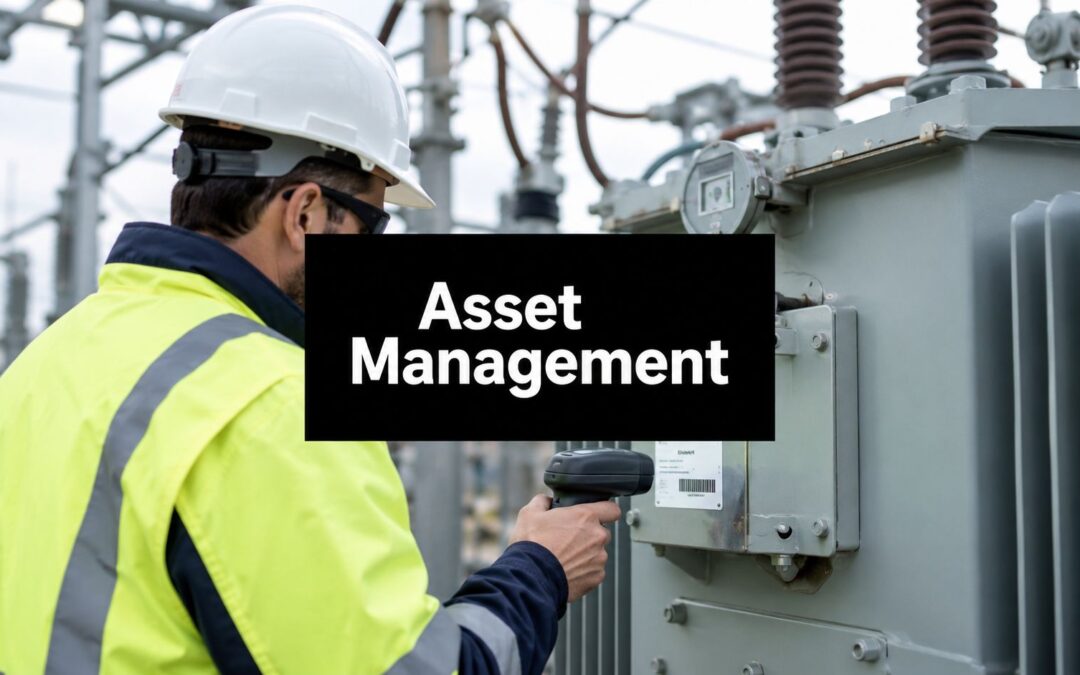
You're standing in a busy facility while an electrician searches for one switchboard. The label has faded, the asset register uses a different name, and three spreadsheets contain partial records that don't agree. Nobody lacks effort. The problem is that the physical asset and the information describing it have drifted apart.
That gap sits at the centre of infrastructure asset management. Australian councils, utilities, manufacturers, healthcare organisations and government agencies need more than maintenance schedules. They need a governed system that connects service expectations, risk, lifecycle cost, condition, capacity and reliable identification in the field. Durable labels and signage are not decoration. They're part of the control that keeps the register usable.
What Infrastructure Asset Management Really Means
From maintenance activity to management system
Infrastructure asset management is the disciplined coordination of planning, creating, operating, renewing and disposing of physical assets so they deliver agreed service levels at the lowest practical whole-of-life cost. Maintenance is one activity inside that system. It isn't the system itself.
That distinction matters. A maintenance team can repair a pump, replace a damaged sign or inspect a bridge without knowing whether the asset still supports the required service, whether an alternative intervention would cost less over its life, or whether the record attached to the asset is accurate. AS ISO 55000 provides the recognised Australian reference point for asset-management terminology, principles and system design. The Australian Standard was approved on 20 October 2014 and published on 11 November 2014, establishing a structured framework rather than leaving organisations to rely on ad hoc maintenance practice. The published AS ISO 55000:2014 standard gives practitioners a common basis for aligning plans, decisions and governance.
A sound management system starts before an asset exists. The owner defines the asset class, required level of service, criticality, risk profile, information requirements and acceptance criteria. Procurement and design then carry those decisions into the physical asset and its handover data.
The field test for a credible system
In practice, I test an IAM program with a simple question. Can a person on shift identify the correct asset, understand its role, find its current record and update the evidence without relying on one experienced employee's memory?
A useful system connects:
- Service requirements, such as road availability, water supply, electrical safety or clinical support.
- Asset hierarchy, so a component can be related to a pump station, network, facility or service.
- Risk and criticality, so limited renewal funds follow consequence as well as deterioration.
- Lifecycle evidence, including inspection results, interventions, failures, costs and capacity observations.
- Physical identification, using a unique identifier that remains readable in the environment where the asset operates.
This is also why terminology from architecture engineering construction can help teams working across design, delivery and operations. Shared language across those disciplines reduces the familiar handover failure where project documentation describes an asset one way and the operating team records it another.
Practical rule: If the identifier on the asset can't be matched to one authoritative record, the organisation doesn't have reliable asset intelligence. It has a collection of clues.
The practical promise is straightforward: a register anyone on shift can read, condition intelligence that supports renewal timing, and labelling that survives the asset rather than disappearing before its first major intervention.
The Asset Lifecycle from Planning to Disposal
A road may be structurally sound yet unable to carry current freight demand. A pump station may be clean and operational while its flow, controls or resilience no longer meet the service requirement. Infrastructure asset management needs a lifecycle loop that starts with service demand and ends with lessons feeding the next investment decision.

Six stages, one decision chain
Plan and define. A council can set the required level of service for its road network, identify vulnerable bridge approaches and specify the evidence needed to justify intervention. The plan should define the service outcome, not just list physical items.
Create or acquire. Design, procurement and construction must produce an asset that can be operated and governed after handover. Commissioning should capture the approved name, unique identifier, location, components, operating limits, warranties, inspection requirements and safety information in a format the operating register can accept. These asset tracking best practices show how field identification supports that handover.
Operate. Operators complete inspections, minor maintenance and condition observations. A utility pump station may keep running while motor vibration rises, controls become difficult to support, or the duty no longer matches network demand.
Renew. Renewal may involve major maintenance, refurbishment, replacement or capacity augmentation. A pump with acceptable casing condition can still require early intervention if it cannot provide the required flow, resilience or control response. The decision should weigh failure consequence, remaining physical life, service gap and whole-of-life cost.
Dispose. Decommissioning includes isolation, removal, residual-value assessment and review of contamination or environmental liabilities. Closing the record without documenting what happened leaves uncertainty for future planners, especially where buried, hazardous or interconnected assets are involved.
Review. The owner compares actual performance, cost, risk and service outcomes with the original assumptions. Those findings should inform the next strategic plan and improve specifications for future assets.
Condition is only half the renewal question
Physical condition records cracking, corrosion, wear and deterioration. Functional capacity asks whether the asset still meets demand and remains fit for purpose. The 2026 National State of the Assets reporting highlights the difference. It found that around two-thirds of local-government infrastructure remained in good condition, according to Council Magazine's reporting on the 2026 National State of the Assets findings, while assets were increasingly failing capacity and fit-for-purpose measures. The same reporting identified an immediate replacement task of A$65B–A$68B for poor or very poor assets and A$173B–A$212B in future renewal demand from assets currently rated fair.
Renewal decisions therefore need two lenses. For a road, freight demand or network capacity may trigger work before pavement failure. For a water asset, the trigger may be throughput, pressure or resilience. For a public facility, accessibility, safety or operational suitability may matter more than visible deterioration. A mature lifecycle record keeps physical condition and service capacity together, so a good condition score does not postpone an obvious fit-for-purpose problem.
Governance, Standards and KPIs That Drive Decisions
A reliable governance stack turns policy into decisions people can audit. Under AS ISO 55000, organisations commonly express that stack through an asset-management policy, an asset-management strategy, tactical plans, delivery controls and review activities. Each layer should answer a different question: what matters, how will the organisation manage it, what will happen to specific asset classes, who will deliver the work, and what evidence shows the approach is working?
For road authorities, Austroads' Guide to Asset Management for road agencies applies whole-of-organisation practice across fifteen parts. Its safety-infrastructure guidance links barriers and fences to level of service, risk, whole-of-life cost and performance feedback. Austroads' asset-management guidance is useful because it treats roadside assets as managed service components, not isolated objects that are repaired only after damage.
The Road Asset Data Standard adds consistency to the register. It identifies 988 data measures across road inventory, bridge inventory, condition, valuation and traffic information in Australia and New Zealand. Its priority sets contain 216 measures for local government, 239 measures for state road authorities and a core set of 141 measures intended to support minimum asset management and legislated responsibilities. Austroads' Road Asset Data Standard shows why common definitions are necessary before agencies can compare risk, condition or renewal needs.
KPI families serve different decisions
Teams often over-rely on inspection scores because condition data feels tangible and is relatively easy to present. A board or council, however, also needs to know whether an asset meets demand, how critical it is, what failure would affect, and which intervention offers the best lifecycle value.
| KPI family | Data cost | Auditability | Decision value | Captures capacity? |
|---|---|---|---|---|
| Physical condition | Moderate | High when inspection methods are controlled | Strong for deterioration and maintenance timing | No, not by itself |
| Fit-for-purpose | Moderate to high | Moderate to high when service thresholds are defined | Strong for early renewal and upgrade decisions | Yes |
| Criticality and risk | Moderate | High when consequence criteria are documented | Strong for prioritisation and contingency planning | Partly |
| Lifecycle cost | High | High when cost boundaries and assumptions are controlled | Strong for option comparison and investment timing | Indirectly |
The right answer isn't to discard condition scoring. It's to stop treating it as a proxy for service performance. For teams refining procurement and delivery controls, a practical reference such as 10 procurement metrics to track can help connect project performance with the asset information and outcomes required after handover.
Decision test: Condition tells you when an asset may fail. Capacity tells you whether the asset already fails the service requirement.
Data, Systems and Technology Behind a Reliable Register
Standards only become useful when the technology stack preserves their definitions from design office to field crew. A practical Australian environment may include a central asset register, GIS layers, mobile inspection applications, condition-survey outputs, maintenance history, finance integration and, for more advanced operators, a digital twin. Each system has a role, but the register must remain the authoritative record for identity, hierarchy and lifecycle status.

Architecture before software
A point-solution CMMS can work well for a defined maintenance workflow. It may schedule work, retain job history and support mobile updates. An integrated EAM platform becomes more valuable where the owner must connect maintenance with finance, procurement, GIS, capital planning and risk. The decision shouldn't start with a feature list. It should start with the information architecture.
Assess each option against:
- Open data model: Can the organisation define asset classes, parent-child relationships, controlled vocabularies and required attributes?
- Audit trail: Can users see who changed an asset record, when the change occurred and what evidence supported it?
- Financial integration: Can renewal costs, operating costs and project history be associated with the same asset identity?
- Spatial connection: Can the physical identifier map to a GIS feature without manual reconciliation?
- Field usability: Can a worker scan or enter the asset ID quickly in poor weather, low light or a restricted work area?
- Label alignment: Can the system hold a unique ID that matches the engraved plate, barcode or other physical marker?
A spreadsheet may be useful during discovery, but it becomes dangerous when it turns into a shadow register. Multiple copies create competing truths, uncontrolled naming and weak change history. Field teams then record observations against descriptions such as “north pump” or “old switchboard”, which are understandable locally but unreliable across shifts and contractors.
The industrial asset management software used by an organisation should support the agreed data architecture rather than define it accidentally. Technology is a governance decision because it determines who can create an asset, who can change its status, what evidence is retained and how a renewal recommendation is challenged.
The physical label completes that architecture. If the field identifier is inconsistent, the cleanest integration still returns uncertain data.
Where Durable Labelling and Signage Fit In
A manufacturing line demonstrates the issue quickly. Coolant, solvents, heat and repeated contact can remove ordinary printed labels from switchboards, isolators and control cabinets. A durable laser-engraved plate gives the operator a persistent identifier and clear safety information, allowing a work order, inspection and isolation record to point to the same physical item.
At a utility substation, the challenge is reconciliation. A transformer may have a GIS feature, a maintenance record and a contractor's inspection sheet, but those records are only trustworthy when the person in the field can confirm the correct asset. A barcode or machine-readable identifier on a durable data plate can connect field condition evidence to the mapped asset without relying on memory or ambiguous location descriptions.
A hospital adds another layer of consequence. Valve and medical-gas outlet signage must remain legible during cleaning, maintenance and emergency isolation work. Asset management here includes making the correct equipment identifiable under pressure, while the responsible facility team maintains the compliance evidence and isolation procedures required for the site. The label supports the control. It doesn't replace the applicable standard, inspection or authorisation process.
Councils face a less dramatic but equally persistent version of the problem. Pole, pit and pump identifiers are exposed to weather, abrasion, dirt and the occasional forklift at a depot. When each identifier follows the register's naming convention, inspection crews can attach observations to the right record and supervisors can distinguish a genuine condition change from a data-entry error.
| Sector | Typical asset | Durability need | Register link |
|---|---|---|---|
| Manufacturing | Switchboard or isolator | Solvents, coolant, abrasion and heat | Work order, isolation record and equipment hierarchy |
| Utilities | Transformer or substation component | UV, weather and field handling | GIS feature, inspection result and maintenance history |
| Healthcare | Valve or gas outlet | Cleaning chemicals, frequent handling and legibility | Location, service system and safety documentation |
| Government | Pole, pit or pump | Outdoor exposure, dirt, impact and vehicle contact | Council asset ID, inspection route and renewal plan |
Trotec Laser equipment is relevant where an organisation needs consistent, precise engraving across metal labels, data plates and safety signage. The broader capability described by Evright Industrial's engraved metal labels connects durable physical marking with the asset-record discipline discussed here. The point isn't to buy a particular machine for every site. It's to specify a marking method and material that match UV, chemicals, abrasion, heat and impact exposure, then verify that the resulting identifier works in the register and in the hands of the field team.
A Practical Roadmap and 90-Day Checklist
An IAM improvement program doesn't need to begin with an enterprise-wide data collection exercise. Start with the asset class where uncertainty creates the greatest operational, safety or financial consequence, then build a repeatable pattern that other teams can adopt.

Five phases that produce usable evidence
Assess current state. Map the systems, spreadsheets, naming conventions and field pain points. Ask operators where identification fails, planners where renewal evidence is weak, and finance teams where asset costs lose their connection to the physical network.
Build and cleanse the register. Establish the asset hierarchy, remove duplicates, agree mandatory attributes and define ownership. Don't import every historical field just because it exists. Retain information that supports service, risk, condition, capacity, cost or compliance decisions.
Deploy physical identification. Prioritise critical assets and high-confusion locations. Select materials and engraving methods for the environment, not for an indoor sample room. A tag that looks excellent on installation day but fails under UV or chemical exposure is a deferred data-quality problem.
Integrate field teams. Train crews to scan, search, update and escalate exceptions through the approved mobile workflow. The process must cover new assets, removed assets, relocated assets and identifiers that can't be read.
Report and refine. Review data quality, unresolved exceptions, condition results, capacity indicators and renewal recommendations on a regular cadence. Teams considering broader transformation can use a resource on how to prioritise digital initiatives to sequence investment around decision value rather than novelty.
A first-90-day checklist
Assign an accountable role to every action:
- Asset manager: Scope one critical asset class and define the service and risk questions the register must answer.
- Data steward: Confirm the unique-ID convention, controlled vocabulary and mandatory fields.
- Procurement lead: Specify labels sized and manufactured for the actual UV, abrasion, chemical, heat and impact environment.
- Site supervisor: Pilot installation in one zone and record access, placement, visibility and safety constraints.
- Systems owner: Validate that scanning or entering each pilot ID reaches the correct register record and returns the expected asset details.
- Operations lead: Train field staff to record condition, capacity observations and exceptions against the physical ID.
- Governance chair: Establish a monthly review for duplicate records, missing identifiers, failed scans, overdue inspections and disputed renewal recommendations.
Avoid two traps. Don't label every low-criticality object before proving the workflow, and don't allow each depot or contractor to invent its own asset names. The first creates cost without decision value. The second makes future reconciliation harder.
The roadmap is useful only if it leaves the team with a working loop: identify the asset, find the record, capture evidence, make a decision and feed the result back into the plan.
Rethinking Asset Data and Answering Common Questions
More data doesn't automatically create better infrastructure decisions. A register full of photographs, inspection notes and disconnected attributes can give managers the appearance of control while leaving the central questions unanswered: what service is at risk, how large is the capacity gap, what happens if the asset fails, and which intervention changes the outcome?
The 2026 Australian Infrastructure Investment Monitor frames the investment environment around cost and schedule performance, capital allocation discipline and stronger evidence for decision-making. Australia was selected as the most attractive infrastructure investment region by 56% of respondents in the 2025 Investment Monitor, according to the 2026 Australian Infrastructure Investment Monitor. That context raises the standard for asset owners. They need decision-grade evidence tied to specific assets, not a larger dump of unprioritised inspection material.
Information that changes a decision
A useful data field earns its place by changing an action. Probability of failure, consequence of failure, service capacity, demand exposure, intervention cost and remaining life can support a renewal choice. A photograph that cannot be located, dated or connected to a condition method may satisfy a checklist without improving the choice.
A durable identifier strengthens the chain of evidence because it lets the organisation connect the observation to the correct asset. It also makes exceptions visible. If a crew can't find the label, scans the wrong item or discovers that the physical asset doesn't match the record, that isn't an inconvenience to hide. It's a data-quality event to resolve.
Common questions from operating teams
Will an engraved label remain readable outdoors or around chemicals?
No single material suits every environment. Specify the label around the exposure profile, including UV, moisture, abrasion, cleaning agents, solvents, heat and impact. Test placement and readability in the operating environment, and include a replacement process for damaged or inaccessible identifiers.
Does labelling prove AS ISO 55000 compliance?
No. A label supports identification, traceability and field control, but it doesn't demonstrate that the organisation has an effective asset-management system. An audit also needs evidence of governance, objectives, risk management, lifecycle planning, responsibilities, performance evaluation and continual improvement aligned with the organisation's adopted framework.
How quickly should an IAM program show return?
The first return should be operational clarity, not a promised financial percentage. Teams may see fewer identification errors, faster field verification and cleaner work-order history before they can credibly quantify renewal optimisation. Set a baseline for those activities, then measure whether better evidence changes maintenance, risk or capital decisions.
When does outsourced labelling beat in-house printing?
Outsourcing is often more practical when labels need specialised engraving, material selection, consistent artwork, machine-readable codes, batch production or environmental testing. In-house printing can suit controlled indoor applications with frequent changes, but it can become inefficient when the organisation must manage multiple sites, demanding exposure conditions and strict identification consistency.
Infrastructure asset management works when physical assets, information and decisions remain connected. Start with one important asset class, make the identifier unambiguous, capture only decision-useful evidence and review condition and capacity as separate signals.
Evright Industrial provides durable asset labels, data plates, safety signage and precision laser engraving for demanding industrial, healthcare, utility and government environments. Visit Evright Industrial to discuss a labelling system that connects your physical assets with a cleaner, more dependable register.
Recent Comments