
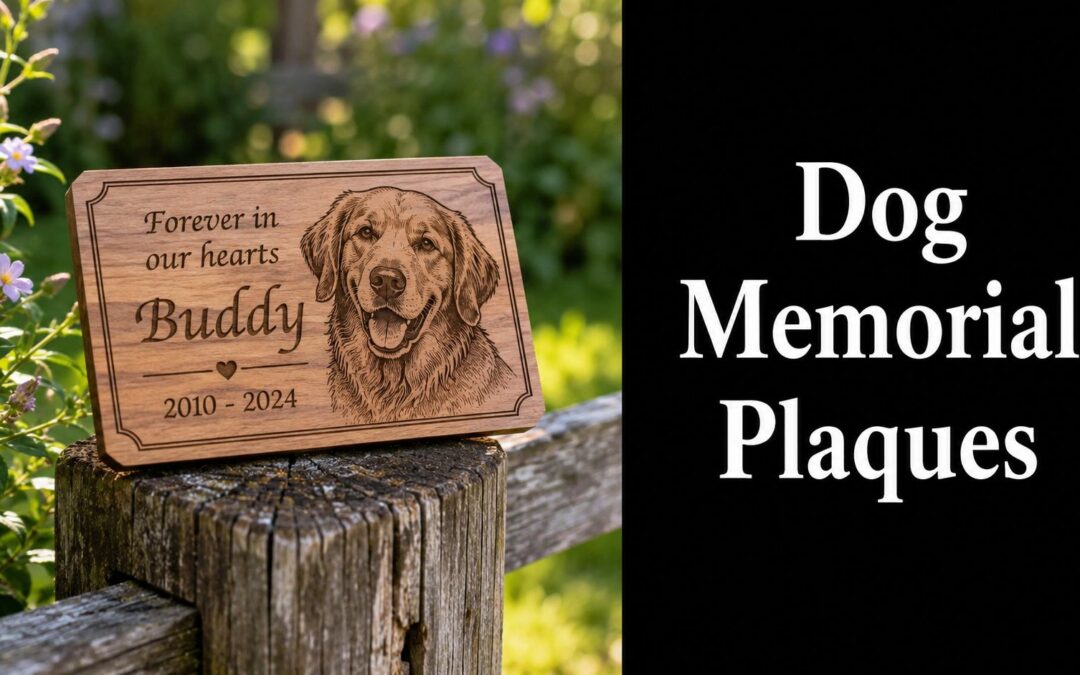
You're in the garden centre, or maybe at the kitchen table, and the dog bowl is still by the back door. You know the plaque has to be right, because this isn't decoration. It's the piece that stays after the rest of the room has changed.
That's why personalized memorial plaques for dogs need to be treated like a real outdoor product decision, not a sentimental impulse buy. The right plaque has to survive Australian weather, fit the place you want to put it, and still read clearly years from now. If you want a wider sense of the kinds of tribute products people often consider alongside plaques, the memorial gift guide by That Blanket Co is a useful companion read, especially if you're comparing keepsakes versus something fixed in stone or metal.
Why Personalised Memorial Plaques for Dogs Matter
A lot of people start in exactly the wrong place, with fonts and borders, before they've answered the only questions that matter. The plaque might end up on a fence in a salty coastal suburb, under a tree in full sun, on a kennel wall, or in a formal memorial garden. Each location changes the material, the fixing method, and how much detail will still be readable in ten years.
That's the value of a good buying guide. It gives families, veterinarians, funeral homes, and memorial planners a practical framework instead of a pretty catalogue mentality. If you're helping someone choose a plaque after a farewell, the job is to keep them from buying something that looks fine at handover and then degrades the first summer it sits outside.
For Australian buyers, the market isn't niche. Animal Medicines Australia's 2022 national survey found that 48% of Australian households owned at least one dog, with dogs present in about 6.4 million households and a dog-owning population of roughly 7.7 million. The same survey estimated Australians spent about A$33.2 billion on pets in 2022, which tells you companion animals sit in the household budget as something important, not incidental. Those figures are why memorial plaques for dogs are a genuine product category, not a novelty line. Animal Medicines Australia's 2022 survey summary gives the clearest snapshot of that base.
Practical rule: decide where the plaque lives before you decide how it looks.
The buyer should answer three things before browsing. First, where will the plaque live. Second, what must it survive, including sun, rain, salt, cleaning, and handling. Third, how should it still read twenty years from now if the family keeps it outside.
The rest of the purchase flows from those answers. If you skip them, you end up choosing style first and durability later, which is backwards for a memorial product.
How Laser Engraving Outlasts Printing and Stickers
Think of the difference like this. A printed or stickered design sits on top of the plaque like an ink label on a lunch container. A laser-engraved mark is more like a tattoo, the image is formed into the material itself, so the surface can weather while the message stays.
That matters in Australian conditions because sun, rain, heat, and abrasion punish anything applied on top. Printed graphics fade, edge-lift, and peel. Vinyl stickers are worse outdoors. Once the adhesive starts to fail, the memorial starts looking tired long before the family is ready for that.
A Trotec Laser changes the equation because the mark is made by physically removing, oxidising, or etching the surface layer depending on the substrate. On black anodised aluminium, the top layer is removed to reveal a high-contrast mark. On natural stone, the laser darkens the engraved area. On engineered composites, it etches a clean, stable image that doesn't sit as a vulnerable film on top. If you want a laser production example for outdoor plaques, the product range at Evright Industrial custom outdoor memorial plaques is the kind of workflow you want to be comparing against, because the output is the engraved mark itself, not a printed imitation.

What that means in practice
- Choose engraved text for outdoor use. If the plaque will live on a fence, kennel, garden post, or grave marker, engraved lettering keeps its edge longer than a printed finish.
- Treat the substrate as part of the design. The plaque material is not just a backing board. It's the thing that determines whether the engraving stays legible under heat and UV.
- Avoid surface-applied graphics when longevity matters. A nice-looking sticker can fail faster than the family expects, and once it starts lifting, the whole plaque looks neglected.
The short version is simple. If the plaque is meant to last outdoors, the engraving method is the quality decision that matters most. Fonts, borders, and shapes come after that.
Choosing the Right Material for Australian Conditions
A plaque that looks fine in a showroom can fail quickly outdoors in Australia. Coastal air attacks metal, UV beats up finishes, and constant heat and rain cycling exposes every weak coating, edge, and adhesive. The material choice has to be practical first, attractive second. The main options are anodised aluminium, marine-grade bronze, granite, and engineered stone such as Corian, and each one behaves differently once it leaves the studio.
Match the substrate to the setting
Anodised aluminium suits lighter plaques and cleaner modern layouts. Australian suppliers commonly specify it at around 1.5 mm thick, with the top layer engraved through for contrast, so the mark stays sharp and easy to read without the weight of stone. It works well for fences, kennels, and wall-mounted memorials when you want a neat finish and easier shipping. On the coast, I would only use it if the finish is made for weather exposure and the engraving is recessed, not printed. That lines up with Australian memorial plaque advice from MMS Stone's dog memorial plaque guidance.
Marine-grade bronze is the formal metal choice. It suits memorials that need a traditional presence and a stronger sense of permanence, but it is heavier and usually costs more. I'd choose it for a cemetery-style presentation or a family that wants a classic memorial look and accepts the extra mass.
Granite is the safest pick for long-term durability. It is heavy, stable, and visually quiet, which suits cemetery placements and garden memorials where longevity matters more than lightness. The trade-off is straightforward, it needs heavier mounting hardware and more effort to install.
Engineered stone gives a clean, contemporary finish with solid outdoor performance. It sits in the middle ground for people who want a polished look without the visual weight of granite. For that kind of production workflow, custom outdoor memorial plaques is a useful reference because it shows the plaque as a finished outdoor object, not a printed panel pretending to be one.
| Material | Weather Resistance | Typical Weight | Finish Look | Best Placement |
|---|---|---|---|---|
| Anodised aluminium | Good when properly specified | Light | Crisp, modern | Fence, kennel, wall |
| Marine-grade bronze | Strong outdoors | Medium to heavy | Formal, traditional | Cemetery, memorial garden |
| Granite | Excellent | Heavy | Natural, permanent | Grave marker, garden memorial |
| Engineered stone | Strong | Medium | Clean, contemporary | Wall, garden, indoor shelf |
My recommendation: if the plaque is going near the coast, pick a material that won't make you worry every time the weather turns.
A Trotec laser does not make every material behave the same way. On the right metal or engineered substrate, it produces a clean engraved mark with depth and contrast. On the wrong surface, you get weak visibility, edge wear, or a finish that starts looking tired far too soon. That is why material choice has to come before decorative decisions, because the substrate determines whether the engraving stays legible, not just whether the plaque looks good on day one.
Sizes, Shapes and Mounting Options That Actually Work
Most plaque problems start with sizing mistakes. Buyers either go too small because they're trying to keep it discreet, or too large because they're designing for impact instead of placement. The correct size depends on viewing distance, and the plaque should be readable from the place where people will stand.
Start with where the eyes will be
A 200 mm plaque reads well at arm's length on a kennel, a fence panel, or a wall just outside a doorway. A 300 mm plaque is the safer minimum for a grave marker meant to be seen from a standing position. Anything larger should be justified by the site, not by a vague idea that bigger feels more respectful.
Shapes should follow the setting. Rounded rectangles are the cleanest choice for modern homes and fence mounting. Ovals soften the look without becoming ornate. Hearts suit indoor shelves and small garden tributes, while shields bring a classic memorial feel. A natural stone edge works when you want the plaque to look less manufactured and more like part of the setting.
Mounting is where a lot of nice-looking plaques fail. Use stainless screws and stand-offs for fences or walls when the plaque needs airflow behind it. Use a garden stake assembly for soft ground, but only if the substrate can handle the load without flexing. For wall displays, keyhole slots keep the back clean and make alignment easier. If the plaque is going into a cemetery setting, the base depth and fixing method need to fit cemetery or council requirements, not just the buyer's preference.
A plaque can be beautifully engraved and still be the wrong product if the fixing method doesn't suit the site.
Quick match guide
- Fence or kennel: choose 200 mm to 300 mm, medium-weight substrate, stainless fixings.
- Garden bed: choose stone or engineered stone, use a stake or base that resists movement.
- Wall display: choose a lighter plaque with keyhole slots or stand-offs.
- Cemetery or memorial garden: choose a formal size, confirm base depth and fixing rules first.
If you're comparing layouts, the memorial plaque wording examples page helps you see how size and text density need to work together before anything gets engraved. And if you're also looking for a complementary house-style tribute rather than a ground-mounted plaque, buy family name wall decor is a useful reference for how wall pieces are usually composed.
Wording, Photos and What You Can Legally Engrave
Good wording does two jobs at once. It says enough to feel personal, and it leaves enough breathing room for the plaque size you've chosen. On a small plaque, clutter kills the design. On a larger plaque, too little text can make the whole thing feel unfinished.
Wording that fits the plaque, not the other way around
For a simple name-and-dates layout, keep the structure tight. That is the safest choice for smaller plaques and for families who want a clean memorial without extra ornament. A short verse layout suits medium plaques, because it gives one focal line and enough space around it to breathe. A longer tribute layout only works if the plaque is large enough to hold the line breaks without making the engraving look crowded.
The rule is blunt. If the wording forces tiny text, the plaque is undersized for the message. If the wording leaves half the surface empty, the tribute probably needs either a smaller size or a different composition.
If you need a starting point for balance and phrasing, the memorial plaque wording examples page shows how text length changes the layout before anything is engraved.
Photo engraving needs proper source material
For photo work, start with a 300 dpi scan at print size as the working minimum. Then adjust contrast for grayscale engraving so the facial features do not collapse into a flat blur. Small headshots usually engrave better than full-body shots because the face carries the emotional detail the viewer recognises first.
The physical result depends on the source image more than people think. A crisp photo of the dog looking toward camera will usually reproduce far better than a busy outdoor shot with grass, leads, and background clutter. If you want the plaque to feel calm and readable, simplify the artwork before production.
Useful rule: if the image looks muddy on screen at full size, it'll look muddy engraved.
Australian trade mark and copyright law also matters here. IP Australia explains that trade marks can protect words, logos, and other signs used to distinguish goods or services, and copyright protects original artistic works and literary text automatically upon creation, so permission may be required before engraving protected logos, paw-print artwork, or copied verses. That applies even on a personal memorial plaque, because reproduction rights still matter when artwork is being produced in Australia. For a production example that handles custom wording and proofing before engraving, the Evright Industrial laser engraved memorial plaques page is the kind of service model to study.
For a wall-based tribute rather than a ground-mounted plaque, buy family name wall decor is a useful reference for how a cleaner family-name layout is usually composed.

Lead Times, Shipping and Cemetery Approval in Australia
The fastest way to derail a memorial order is to ignore logistics until the end. In practice, the bottleneck is usually artwork approval, not machine time. Once the proof is approved, a laser shop working cleanly on a Trotec Laser can move quickly, but only if the plaque size, substrate, and fixing method are already locked in.
What delays the order
You need to plan around three realities. First, custom plaques have to be checked before production because a misspelt name or wrong date means the whole job is wrong. Second, Australia Post parcel size and weight limits affect what can be shipped economically, especially when the plaque is thick, heavy, or awkwardly shaped. Third, remote-area delivery can take longer, so regional and rural buyers need a little more patience and a better packing plan.
Custom memorial plaques should be packed so the engraved face doesn't rub, chip, or scuff in transit. That means rigid outer packaging, internal separation, and enough protection at the edges to stop knocks from marking the finish. If the plaque is being sent to a cemetery caretaker or funeral home, label the package clearly so site placement is straightforward.
Cemetery approval is not optional
If the plaque is going into a cemetery or memorial garden, the cemetery authority usually controls the final say. Dimensions, base depth, inscription content, and fixing method can all require prior approval, and a plaque that works perfectly in a home garden may still be rejected on site. That's why formal placement needs confirmation before you order, not after the engraving is done.
Do the approval step first if the plaque is going into shared cemetery ground.
The delivery side is part of the product, not an afterthought. The same is true for local rules, which is why Australian buyers need to treat freight, site access, and cemetery approval as one decision. The infographic timeline above is the simplest way to keep that sequence straight.
Care, Maintenance and Why Production Quality Matters
Outdoor memorials do not fail all at once. They fade slowly, loosen at the fixings, gather grime, or pick up damage from being cleaned too aggressively. NSW heritage guidance on monuments is clear that outdoor stone and metal memorials face weathering, biological growth, salt, pollution, and physical damage, so inspection and maintenance are part of owning the plaque, not optional extras. NSW heritage monument guidance summary is a good reminder of why durable materials and routine checks matter.
Keep the maintenance routine simple
A fresh-water rinse is enough for coastal zones when salt starts to build up. Use a gentle, non-abrasive cleaner if the surface needs more than water. Check fasteners once a year, because loose screws and shifting stakes do more damage than many owners anticipate.
That is all most plaques need if they were specified correctly in the first place. If the substrate was wrong, or the marking method sat on top of the surface, no amount of careful cleaning will turn it into a durable memorial.
The production side decides whether the plaque holds up. A plaque cut and engraved on Trotec laser machinery gives a more consistent result than a generic print-first workflow, especially when the finish has to survive outdoors. A proper laser engraving process removes material cleanly, so the marking is part of the plaque, not a layer sitting on it. Evright Industrial, a division of Australia's leading laser engraving company evright.com, uses that kind of production discipline for custom memorial work, along with premium materials and energy-efficient processes. For a closer look at the service category, the laser engraved memorial plaques page shows the type of output and control buyers should expect.

A plaque in a coastal yard faces salt, sun, and frequent cleaning. A plaque in a cemetery plot faces weather, site rules, and the risk of being handled more than once. Pick the production method that survives those conditions without asking you to baby it.
If you are choosing a plaque for a dog you loved, work with a team that understands outdoor durability, proper engraving, and Australian placement rules from the start. Visit Evright Industrial to discuss a custom memorial plaque that is built for the site it will live in, not just the photo it looked good in.
Recent Comments