

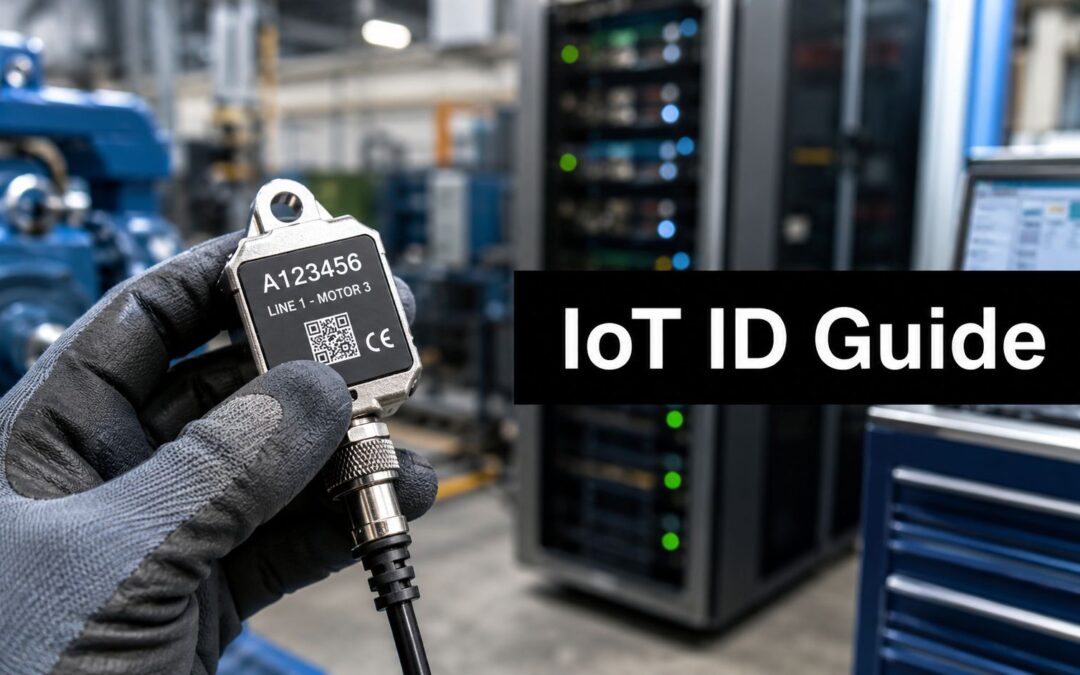
An operations lead can feel the problem before they can name it. A line goes quiet, a dashboard throws an unfamiliar alert, and the question lands fast, which device is this, where is it, and can we trust it? In a plant, hospital, or utility depot, that confusion wastes time, slows troubleshooting, and opens a security gap that no one planned for.
IoT Device Identification is the discipline of giving each connected device a reliable identity that people and systems can recognise with confidence. In practice, that means linking a physical asset, such as a tagged controller, pump, sensor, or scanner, to a digital record that survives network changes, maintenance cycles, and staff turnover. The scale of the challenge is immense, with IoT Analytics reporting 16.6 billion connected IoT devices globally by the end of 2023 and forecasting this number to grow to nearly 29 billion by 2030 (IoT Analytics release).
The Unseen Challenge of a Connected World
A supervisor walks into a control room and sees a new alert tied to an unnamed sensor. The device is online, but the label in the software is vague, the cabinet tag is missing, and the technician on shift has never seen it before. That is how a small inventory gap turns into a delay, then a compliance concern, then a security question.
In busy industrial environments, devices are often added by different teams over time. One crew fits the hardware, another configures the network, and a third maintains the asset register months later. Without a dependable way to match the object on the floor with the entry in the system, teams lose time chasing the wrong asset, especially when the same model appears in multiple locations.
The practical answer starts with a simple idea, give every device a nameplate that can't be argued with. A durable physical tag gives the human side of the process something permanent to read, while a digital identity gives the software side something stable to trust. That combination is what turns a loose collection of connected gadgets into a managed fleet.
For operations teams, that matters because the risk isn't only failure, it's uncertainty. You can't patch, isolate, maintain, or decommission what you can't confidently identify. The basic discipline of asset tracking best practices becomes much more powerful when the physical tag and the digital record are designed as one system.
Core IoT Identification Techniques Compared
The easiest way to think about device identification is as a stack of nameplates. Some are physical and visible, like a barcode on a metal tag. Others are digital and hidden, like a certificate or traffic fingerprint that only the system can see.
The familiar methods still matter
Basic methods such as RFID, barcodes, QR codes, and NFC are often the first layer because they are simple to deploy and easy for staff to use. Literature on IoT identity methods also lists IP address and EPC among the established identifiers, while newer approaches increasingly use fingerprinting and machine learning (identity method review). For industrial sites, these older methods are not obsolete, they're just not enough on their own.

A QR code on a pump housing may point to service history. An RFID tag on a pallet asset may speed scans during receiving. An NFC tap can help a technician confirm they're standing in front of the right unit. These methods are useful because they connect the physical item to a digital record without forcing the operator to guess.
Digital identity goes deeper than labels
Once the asset is on the network, the device still needs a form of digital identity that can survive reboots and network changes. Research shows that network fingerprinting methods can achieve more than 97% accuracy in identifying device types based on traffic patterns alone, while basic identifiers such as MAC or IP addresses are much weaker as stable identity features (survey repository). That distinction matters because a device that looks “known” at the network edge may still be the wrong device entirely.
Practical rule: if an identifier changes when the network changes, it's not a dependable identity anchor for operations.
For access control, it can help to compare the logic with systems like cellular vs NFC gate access. The entry point may be different, but the underlying question is the same, does the system recognise a trusted identity quickly and consistently?
Comparison of IoT Device Identification Methods
| Method | How It Works | Pros | Cons | Best For |
|---|---|---|---|---|
| RFID | Uses radio waves to read a tag | Fast, contactless, useful for inventory | Needs tags and readers, limited context | Warehouses, tool tracking, asset movement |
| Barcodes | Optical scan of a printed code | Cheap, widely understood | Needs line of sight, labels can wear | Basic asset registers, receiving, audits |
| QR Codes | 2D code links to richer data | Stores more data than barcodes, easy to scan | Still visible and can be damaged | Service manuals, equipment records, mobile access |
| NFC | Short-range tap interaction | Convenient, controlled proximity | Very short range, device support varies | Technician workflows, secure tap-to-identify actions |
Used well, these methods complement each other. A physical code confirms the item, while a digital fingerprint confirms behaviour, and a certificate confirms trust. That layered approach is much stronger than relying on a single label or a single network attribute.
The Critical Role of Durable Physical Asset Labels
A digital record is only as good as the physical object it points to. If the tag falls off, fades, or gets replaced with the wrong one during maintenance, the database becomes a mirror of guesswork. In harsh sites, that's not a theoretical flaw, it's a daily operational risk.

Laser-engraved metal tags solve a problem that printed labels can't. When a tag has to survive heat, moisture, chemicals, abrasion, or outdoor exposure, the physical mark needs to stay readable for years, not weeks. That is where Trotec Laser systems are especially relevant, because they're used to create permanent marks on durable materials such as stainless steel and anodised aluminium.
A serious identification system starts with the object in the hand, not the record in the cloud. If a technician can scan a tag, match the unit, and trust that the code will remain legible through service life, the digital record finally has a stable anchor. A laser-engraved QR code or serial number also reduces ambiguity when multiple similar assets are installed in the same bay or cabinet.
After that physical anchor is set, the digital lifecycle becomes much cleaner. The service history, calibration notes, and location changes all hang off the same fixed point of reference. For teams managing critical equipment, custom metal asset tags are often the difference between a tidy register and a register that drifts away from reality.
Durable labels don't replace digital systems. They make digital systems believable.
The link matters because the server can only manage what the floor can identify. When a tag is permanent and the digital record is disciplined, maintenance staff, auditors, and network tools all speak about the same asset with far less confusion.
Later in the workflow, that same physical tag becomes the first checkpoint for commissioning, inspection, and replacement. In other words, the label is not a sticker, it's the starting point of identity.
Security and Compliance in IoT Identification
A weak identity scheme turns every unknown device into a possible blind spot. If a network team can't tell whether a device is legitimate, outdated, or rogue, they can't apply policy with confidence. That uncertainty is where attackers look for space to move.

The technical warning is clear. MAC/IP addresses are easily spoofed and identify a session, not a device, so security guidance increasingly pushes organisations toward stable, cryptographic credentials as the foundation of true identity (cryptographic identity guidance). That matters because a device that looks familiar on the network can still be counterfeit, misconfigured, or moved into the wrong place.
Why identity supports better security decisions
A reliable identity lets teams decide what a device is allowed to do. It supports authentication, access control, audit trails, and incident response, all of which become harder when the identifier changes with the network. It also helps with lifecycle tasks like renewal, replacement, and decommissioning, because the same trusted identity can be tracked from commissioning to retirement.
In regulated settings, that traceability is especially important. Healthcare equipment, essential infrastructure, and industrial control environments all rely on clear inventory, controlled access, and evidence that the right device was handled the right way. A strong identity framework makes that evidence easier to produce and defend.
For teams that need a practical disposal reference, NIST SP 800-88 is a useful guide to secure sanitisation and asset retirement decisions, especially when devices leave service and their data-bearing components still matter.
What a stronger policy looks like
- Cryptographic credentials first: Use certificates or other stable device-specific credentials rather than mutable network labels.
- Identity-bound logging: Tie alerts and audit records to the device, not just the port or IP environment.
- Clear retirement steps: Remove or sanitise devices in a way that matches their data sensitivity and role.
- Controlled exception handling: Treat unknown devices as items to investigate, not as acceptable background noise.
An industrial asset management software environment works best when the security team and the operations team are looking at the same source of truth. That shared view reduces the chance that a risky device stays hidden because its label changed.
The main point is simple. If identity can be copied, changed, or inferred from a session, it's not strong enough on its own. Security needs identity that stays with the device, not the network path it happens to use today.
An Implementation Checklist for Your Facility
A facility does not need to fix everything at once. It needs a sequence that starts with the asset you can physically verify and ends with reliable digital control. The best rollouts are the ones where the floor team, the network team, and the asset register are all working from the same starting point.

Start with the asset you can touch
Begin with a physical audit. Walk the site, list what exists, and attach a durable tag to every unit that matters operationally. If a device cannot be read in the field, it cannot be managed well in the field.
That tag is the bridge between the machine on the floor and the record in your system. Without it, technicians end up guessing which controller, sensor, or cabinet they are dealing with.
Link the tag to the record
Next, connect the physical tag to a digital register. That could be a CMMS, an asset platform, or another operational database, but the main point is consistency. The same code on the asset should point to the same record everywhere.
If one label maps to one asset in the register, the team spends less time reconciling mismatches and more time maintaining equipment. If the label and the record drift apart, the whole identification process starts to lose value.
Choose identification methods by use case
Not every device needs the same identity method. A handheld scanner may work well with a QR label, while a hidden control unit may need passive discovery or a network fingerprint in addition to a visible tag. Recent passive discovery research shows approximately 95% detection accuracy for unmanaged or hidden devices, which is valuable in areas where installed assets are hard to reach or poorly documented (passive discovery study).
A good deployment rule is simple. If the device is hard to access, the identity method has to do more work, not the technician.
Pilot before you scale
Test the process in one area first. Check whether labels scan properly, whether records match what is on site, and whether staff can follow the workflow without extra confusion. Only then roll it out across the rest of the facility.
A small pilot also shows where the physical and digital sides break down. A label that looks fine on paper may fail under dust, heat, vibration, or cleaning routines, and that is better discovered in one zone than across the whole plant.
Train the people who will live with it
The strongest system still fails if staff ignore it. Teach technicians, supervisors, and contractors how to read the tag, update the record, and flag anything that does not match. If the site runs on mixed hardware, mixed vendors, or mixed shifts, training matters even more.
For organisations looking for a practical foundation, evright.com brings nearly six decades of engraving and asset labelling experience to the physical side of the job, which is often where the entire identity system either holds together or falls apart.
The most useful checklist is the one people follow. If the physical audit is clean, the labels are durable, and the digital register is disciplined, the rest of the program becomes far easier to manage.
Building a Resilient and Secure IoT Ecosystem
A connected site can look organised on a dashboard while still being hard to manage on the floor. One valve, sensor, or controller may appear in the system, yet the tag on the asset is faded, missing, or tied to the wrong record. Once that happens, IoT Device Identification becomes more than a technical label. It becomes the link that keeps maintenance, security, and compliance pointed at the right physical device.
A strong setup uses three layers together. The first layer is a durable physical tag that can survive the local environment, whether that means heat, dust, cleaning, vibration, or repeated handling. The second is a digital identity that stays stable even when the device changes network details or gets moved between systems. The third is a monitoring process that checks the record against the asset over time so the register does not drift away from reality.
That physical-digital bridge is what keeps operations grounded. A QR code engraved on metal, a certificate tied to the hardware, and a clean asset register all point to the same outcome, a device that can be trusted during daily work, found quickly during a fault, and retired without confusion. For manufacturing, healthcare, utilities, and infrastructure teams, that connection supports resilience because people can see what the system says and verify that it matches the equipment in front of them.
A site that treats identification as paperwork alone usually ends up with gaps. A site that connects the physical label to the digital identity gives technicians a clearer starting point, gives auditors a record they can follow, and gives security teams fewer blind spots to chase.
A CTA for Evright Industrial. If you are tightening the link between physical tags and digital identity, start by reviewing your current asset labels and commissioning process, then speak with Evright Industrial about durable engraving and asset labelling that can support a cleaner, more secure IoT environment.
Recent Comments