
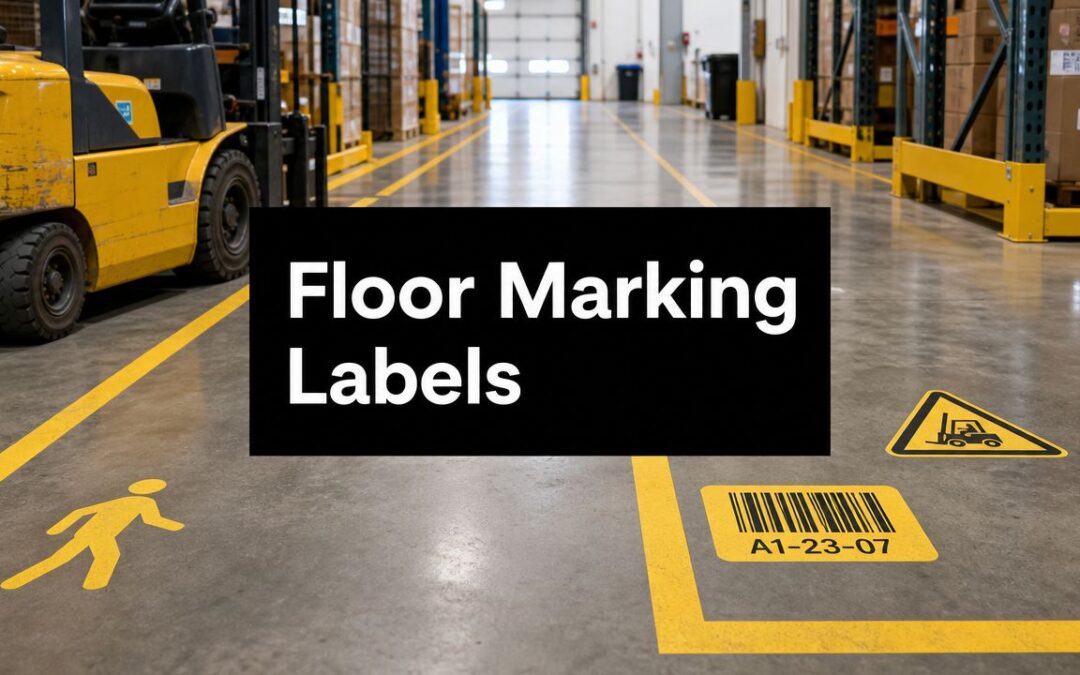
A lot of operations managers are dealing with the same nagging problem right now. The floor still looks marked, but the message isn't clear anymore. A forklift lane has lost its edge. A pallet location number is half missing. A warning label near a washdown area has started to curl, and everyone on shift has learned to “work around it”.
That's how near misses happen. Not because people ignore safety, but because the workplace stops communicating clearly. On a busy factory floor, a worn floor label can create the same confusion as a faded stop line at an intersection. People hesitate, guess, or assume. In industrial settings, that's enough to cause a collision, a blocked egress path, or equipment ending up in the wrong zone.
Floor marking labels sit at the intersection of safety, organisation, and tracking. They help separate pedestrian paths from mobile plant movement, identify staging and quarantine areas, and support barcode, QR code, or RFID-based asset systems. The global floor labeling systems market was valued at $1.8 billion in 2025 and is projected to reach $2.9 billion by 2034, growing at a 6.2% CAGR, which shows how widely these systems are being adopted for safety and tracking needs across industry (Market Intelo floor labeling systems market report).
The hard part is that many sites still treat adhesive labels, painted lines, and engraved identifiers as if they're interchangeable. They aren't. Each solves a different part of the problem. In harsh environments, the best result often comes from a hybrid approach, with permanent zoning supported by durable, high-clarity identification.
Trotec Laser machines matter here because they make precise, repeatable engraved labels possible, especially where barcodes, symbols, or small text need to stay legible after cleaning and abrasion. If you want to see how a specialist engraving workflow fits industrial identification, evright.com shows how laser-based production is used to create durable, custom marking solutions for demanding applications.
Introduction
A warehouse can run smoothly for months, then one faded marking exposes a weak point. A pallet gets left just outside its bay because the floor ID is hard to read. A forklift operator swings wider to avoid it. A pedestrian steps into the same area because the walkway boundary has worn back. Nobody planned to create risk, but the visual system stopped doing its job.
That's why floor marking labels deserve more attention than they usually get. Most teams think of them as simple stickers on concrete. In practice, they act more like traffic controls, work instructions, and asset references built into the floor itself. When they're chosen well, they guide movement, define ownership of space, and reduce the mental load on everyone in the area.
There's also a legal side that many facilities underestimate. In Australia, floor marking, including labels and tape, is a legal requirement under workplace safety regulations that require clearly marked pathways, exits, and hazard zones. Those expectations sit alongside AS4586 surface classifications and recognised ISO colour frameworks for visual communication (Australian safety line marking requirements).
Clear markings don't just make a site look organised. They remove guesswork at the exact moment people need a fast decision.
The hidden problem is false confidence. A label may still be physically attached to the floor, yet no longer be visible enough, slip-resistant enough, or durable enough for the environment. That's where many sites drift into compliance gaps without realising it.
Trotec Laser equipment adds a different option. Instead of relying only on printed surfaces, sites can use engraved identifiers, symbols, and asset markers that hold detail better under abrasion and cleaning. That doesn't replace every floor marking method. It strengthens the parts of the system that fail first.
Understanding Floor Marking Labels
Floor marking labels are durable visual identifiers applied to floor surfaces to communicate where people should walk, where equipment should stop, where stock belongs, and where hazards begin. If wall signs tell workers what to know, floor marking labels tell them where to act.
Think of them as the road markings inside a facility. A centre line on a road doesn't explain the whole traffic code, but it makes safe movement obvious. Floor labels do the same job inside warehouses, plants, hospitals, and service depots. They turn space into instructions.

What they do on the ground
A good floor label usually serves one or more of these roles:
- Traffic guidance for pedestrians, forklifts, trolleys, and staging flows
- Hazard communication around exclusion zones, emergency equipment, fire controls, or no-step areas
- Location identification for bays, work cells, pallets, tools, and mobile assets
- Process discipline for 5S layouts, quarantine zones, inspection points, or dispatch lanes
Readers frequently encounter a point of confusion. A floor marking label is not automatically a full floor marking system. A printed location marker might help stock control, but it won't replace the need for broader zone definition when people and vehicles share space.
Why labels aren't just tape with text
Most floor marking labels have three practical layers, even if buyers don't describe them that way:
| Layer | Job on site | Why it matters |
|---|---|---|
| Surface face | Carries colour, symbols, text, barcode, or QR code | Determines readability and wear visibility |
| Adhesive layer | Bonds the label to the floor | Affects edge lift, failure in washdown areas, and installation reliability |
| Base or body material | Gives the label structure | Influences abrasion resistance, chemical tolerance, and shape stability |
That layered view helps explain why two labels that look similar on day one can behave very differently after forklift traffic, scrubbing, or chemical exposure.
The compliance role people overlook
In Australia, floor marking is not optional decoration. It supports legal workplace safety obligations. The same Australian guidance also ties colour choices to standard safety meaning. Yellow marks caution and physical hazards such as trip or fall risks. Red identifies fire safety equipment areas, emergency exits, and no-entry zones. Blue is used for mandatory information such as PPE requirements, and green marks emergency assembly points. These colour cues align with ISO 7010 and ISO 3864 so the visual message stays consistent across sectors (Australian floor marking colour framework).
Practical rule: If a floor label carries a safety message, judge it by what workers can recognise at a glance, not by whether purchasing got a good unit price.
Where laser engraving changes the conversation
Printed labels can communicate well, but engraved identifiers add durability where fine detail matters. Trotec Laser machines are especially useful when a site needs sharp barcodes, machine-readable QR codes, or compact alphanumeric asset IDs that must remain clear after hard use.
That's why many facilities use a mixed system. Permanent line marking handles zone boundaries. Laser-produced identifiers handle the precise information layered into those zones.
Materials Adhesives and Selection Criteria for Harsh Environments and Compliance
Buying floor marking labels by appearance is a common mistake. The right question is simpler: What will attack this label first? In one facility it's forklift turns. In another it's sanitiser. In another it's hot washdown, cold storage, or aggressive scrubbing.
In regulated Australian manufacturing environments such as food, beverage, and pharmaceutical plants, floor marking labels must meet strict performance criteria. That includes resistance to caustics, acids, and oxidising sanitisers, thermal stability from refrigeration through hot-water sanitisation, non-porous finishes that avoid bacterial harborage, and impact and abrasion resistance against mechanical cleaning equipment, as outlined with reference to AS 1318:1985 and enforced through FSANZ, HACCP, and TGA expectations (Australian line marking standards for regulated environments).
Start with the environment, not the label catalogue
A label that works well in a dry warehouse may fail quickly in a bottling plant. A label that survives pedestrian traffic may shred under pallet jack pivot points. Material selection needs to follow the operating condition.
Here's a practical comparison framework.
| Material | Adhesive | Durability | Ideal Use |
|---|---|---|---|
| PVC film | Acrylic | Good general indoor performance | Warehouses with moderate traffic and limited chemical exposure |
| Polyurethane film | High-performance acrylic | Strong abrasion and impact tolerance | Mixed traffic areas needing better surface resilience |
| Epoxy-based marking surface | Industrial bonding system | High durability in demanding industrial settings | Heavy traffic zones where long-term wear matters |
| Laminated engraving stock | Permanent adhesive or mechanical fixing depending on application | Strong detail retention and good resistance to harsh conditions when properly specified | Asset IDs, safety identifiers, and hybrid marking systems |
How to judge adhesives properly
People often focus on the visible face of a label and ignore the adhesive. That's backwards. Most early failures begin at the bond line. Edge peel, corner lift, trapped moisture, and adhesive breakdown all start underneath.
Use this decision lens:
- Dry internal floors: Acrylic adhesives usually make sense where the substrate is stable and cleaning is mild.
- Rough or variable surfaces: High-performance adhesive systems cope better where texture or contamination risk is harder to control.
- Frequent chemical exposure: The adhesive must resist the cleaning chemistry, not just stick on day one.
- Temperature swings: Cold rooms and hot wash areas can stress both the face material and the bond.
For facilities also reviewing the substrate itself, guides on durable floor coatings are useful because the coating beneath the label affects adhesion, wear behaviour, and cleaning response.
Slip, visibility, and wear are part of selection
Operations teams sometimes separate safety markings from asset labels too sharply. On the floor, they interact. If a label sits in a high-traffic area, slip resistance and visibility matter, even when the label's primary purpose is identification.
Australian floor safety expectations connect to AS4586:2013, which classifies pedestrian floor surfaces from P1 to P5, where P1 indicates very high slip risk and P5 indicates very low slip risk (AS4586 overview in Australian floor marking guidance). That classification affects how you think about finishes, overlays, and whether a glossy printed face is suitable in the first place.
For high-traffic benchmark thinking, Australian pavement marking standards specify performance measures such as minimum dry retroreflectivity of ≥150 mcd/lux/m², wet retroreflectivity of ≥80 mcd/lx/m², average skid resistance ≥45 BPN, and wear tolerance requiring ≥70% area intact after AS 4049.4 Appendix L testing (Austroads ATS-4110-21 pavement marking benchmarks). Those are road-oriented standards, but they help frame what durable visibility and traction look like when labels are exposed to constant movement.
The selection mistake that causes false compliance
Some buyers choose an asset label and assume they've also solved floor safety zoning. That's risky. In Australian industrial settings, 40% of workplace incidents occur due to unclear physical boundaries rather than missing asset tags, and relying on labels without corresponding permanent line marking can create a false sense of compliance (analysis of safety markings where labels alone are not enough).
A bay number on the floor can tell people where stock belongs. It doesn't automatically tell them where not to stand, where a fire control zone starts, or where an electrical clearance must remain open.
If you're planning machine-readable floor IDs, it also helps to review industrial asset tracking labels so the identification format matches your scanning, cleaning, and lifespan requirements.
Use Cases for Industry 5S Safety and Asset Tracking
Floor marking labels earn their keep when they remove hesitation. A worker shouldn't need to stop and decode where a trolley belongs or whether a path is shared with forklifts. The better the floor communicates, the less verbal correction supervisors need to give.

5S visual management
In 5S environments, floor marking labels turn “a place for everything” into something people can follow. A shadow board helps at eye level. The floor finishes the instruction by showing where bins, pallets, waste streams, mobile ladders, or inspection carts must return.
Common examples include:
- Numbered footprints under mobile equipment so missing items stand out immediately
- Coloured staging squares for inbound, work-in-progress, and completed stock
- Named parking positions for pallet jacks, bins, and maintenance trolleys
The key is consistency. If every zone shape, colour, and text style changes from one area to the next, workers have to relearn the system every time they move.
Safety and compliance zoning
Floor labels often get overloaded. Teams try to use one sticker to handle hazard messaging, exclusion rules, and location ID all at once. A better approach is layered communication.
Use labels to reinforce, not replace, broader zoning. For example, a red-marked fire equipment area may also need a floor label that identifies the extinguisher type or keeps a zone number consistent with an inspection log. A blue PPE area may benefit from a symbol label at the point people enter the zone. The floor works best when the message is immediate and specific.
For planning traffic-heavy environments, broader guides on choosing resilient flooring materials can help teams think through wear patterns before they finalise floor label placement.
Asset tracking and inventory flow
This is the fastest-growing use case, and the market figures support that direction. The global floor labeling systems market, including barcode, RFID, and QR code-enabled labels, was valued at $1.8 billion in 2025 and is projected to reach $2.9 billion by 2034 at a 6.2% CAGR (floor labeling systems market projection).
Why floor-based asset IDs work well:
| Application | What the label identifies | Practical result |
|---|---|---|
| Rack bay markers | Storage lane, row, and position | Faster picking and putaway accuracy |
| Floor pallet locations | Temporary or fixed stock positions | Better overflow control |
| Tool or equipment zones | Mobile assets or shared devices | Less searching and cleaner accountability |
| Dispatch or quarantine zones | Process status location | Stronger material flow discipline |
Where Trotec Laser fits
Trotec Laser machines become valuable when the tracking detail must stay crisp. A blurred barcode is useless. A QR code with damaged contrast won't scan reliably. An engraved identifier can hold shape and clarity better than many printed surfaces in rough conditions.
That matters most when the floor label has two jobs at once. It has to be readable by people and reliable for scanners. Sites building that kind of system can use asset tracking best practices for industrial facilities to align naming, placement, and scanning logic before rollout.
The strongest floor systems don't ask people to remember more. They make the right action obvious where work actually happens.
Installation Maintenance and Troubleshooting Best Practices
A premium floor label can still fail in a week if the floor wasn't prepared properly. Most problems blamed on “bad labels” are really installation or maintenance failures. Dust, residual cleaner, damp concrete, or rushed placement will defeat even a strong adhesive system.

In Australia, floor marking, including labels and tape, is a legal requirement where workplaces must maintain clearly marked pathways, exits, and hazard zones, aligned with AS4586 classifications and recognised ISO colour frameworks (Australian workplace floor marking obligation). That means maintenance isn't cosmetic. If a critical marking has failed, the site may have both an operational issue and a compliance issue.
A simple installation workflow
Treat floor label installation like a controlled task, not a quick housekeeping job.
Clean the substrate thoroughly
Remove dust, grease, residue, and any cleaner film. A floor can look clean and still reject adhesive if detergent remains.Check dryness and surface condition
Moisture trapped under a label often shows up later as lift or bubbles. Rough, damaged, or flaky coatings can also break the bond.Dry fit before removing the liner
Mark alignment points first. This matters even more when labels sit beside painted lines or machine bases.Apply with even pressure
Start from one edge and work across the face to push out air. Pay extra attention to corners and edges.Protect the bond early
If possible, keep traffic off the area until the adhesive has settled properly.
Why templates help
For repeated installs, templates reduce human variation. Trotec Laser-cut templates are useful where identical spacing, shape placement, or symbol alignment must repeat across multiple aisles or rooms. That's especially helpful in 5S layouts and healthcare or utilities sites where labels must match a standard plan.
A short demonstration of precise label application and marking workflow is worth watching before a rollout:
Maintenance that actually extends service life
A maintenance schedule should focus on condition, not just presence. A label may still be attached but already failing as a communication tool.
Use a simple inspection checklist:
- Look for edge lift near turning points, washdown zones, and doorways
- Check readability of text, symbols, and machine-readable codes
- Watch for gloss change or surface scuffing that affects slip or visibility
- Confirm surrounding markings still make sense together after layout changes
Field check: Stand where a forklift operator or pedestrian first approaches the zone. If the message isn't clear from that angle, the label has already lost value.
Troubleshooting common failures
| Problem | Likely cause | Practical fix |
|---|---|---|
| Edge peeling | Poor prep, moisture, aggressive scrubbing | Remove and replace after correcting substrate condition |
| Bubbling | Trapped air or moisture | Reapply only if the bond is still sound. Otherwise replace |
| Rapid face wear | Wrong material for traffic or chemical exposure | Upgrade to tougher surface or hybrid marking method |
| Poor barcode scanning | Surface abrasion or low contrast | Use engraved or more durable high-contrast marking |
| Repeated replacement in the same spot | Layout or traffic conflict | Reassess placement, not just the label specification |
The main lesson is simple. Replacing the same failed label over and over isn't maintenance. It's a sign the marking system and the environment don't match.
Customisation Design Tips and Longevity Estimates
Most floor labels fail long before the material is fully gone. They fail when workers can't read them quickly, scanners can't recognise them, or the colour no longer signals the right message. Good design extends useful life because it protects clarity, not just adhesion.

Design for speed of recognition
People read floors differently from wall signs. They glance down while moving, often carrying something or steering equipment. That means the design needs to do three things immediately:
- Create contrast so the message separates from the floor
- Keep wording short so the eye can process it quickly
- Use familiar symbols where a symbol can replace text
This matters in mixed environments. A floor label near a loading point may be seen by warehouse staff, contractors, visitors, and cleaners. The clearest label is the one that needs the least interpretation.
Where laser engraving gives more control
Laser engraving is persuasive for one reason. It separates the information from the weakest part of many labels, which is the printed surface. When a site needs aisle IDs, QR codes, serialised markers, directional symbols, or fine text, engraved laminate can hold cleaner edges and stronger consistency.
For laminate labels such as TroLase produced on Trotec Laser machines, 500 dpi is recommended to retain fine detail clarity, and for intricate details such as 4-point font, no Z offset should be applied (Trotec laminate engraving guidance). That specification matters when tiny characters or dense QR modules must remain readable.
Practical customisation choices
The best custom floor marking labels usually share a few traits:
| Design choice | Why it helps | Best use |
|---|---|---|
| Large alphanumeric codes | Easier manual identification from a distance | Aisles, bays, floor locations |
| QR or barcode integration | Connects physical space to digital records | Asset and inventory systems |
| Shape coding | Adds meaning before text is read | Quarantine, waste, inspection, fire zones |
| Black on yellow warning format | Strong hazard visibility where required | Caution-based markings and technical labels |
In laser-related technical environments, the colour format is not optional. Under AS/CA S009:2020 Wiring Rules, optical fibre panels and enclosures must carry a triangular warning label with the star-burst laser symbol and a rectangular explanatory label stating “CAUTION VISIBLE AND INVISIBLE LASER BEAM AVOID EXPOSURE TO THE BEAM”, with markings in black on a yellow background and sized for legibility (AS/CA S009 laser warning label requirement). Australian laser safety guidance also requires non-Class 1 laser labels to be durable, permanently affixed, legible, visible during operation or maintenance, and presented with black borders, text, and symbols on yellow backgrounds (Australian laser label durability and visibility guidance).
Longevity planning without guesswork
Exact lifespan depends on traffic, chemical exposure, floor texture, and cleaning routine, so blanket promises are unreliable. A better way to estimate longevity is to group areas by stress:
- Low stress areas: Dry zones with pedestrian traffic only
- Moderate stress areas: Mixed carts or pallet jacks, regular cleaning
- High stress areas: Forklift turning, washdown, chemical exposure, mechanical scrubbing
If you already know the area is chemically aggressive, it often makes more sense to start with chemical-resistant labels for industrial environments rather than treating replacement as normal.
A cheap label isn't economical if your team has to shut down an area, scrape adhesive, and relabel the same spot every few months.
Real-world Case Examples
The most useful case examples aren't the dramatic ones. They're the ordinary situations where a site keeps replacing labels, keeps patching traffic zones, and keeps wondering why the floor never stays under control.
Manufacturing where labels alone weren't enough
A common manufacturing problem looks like this. Asset location labels are added to help with stock placement, but the wider travel path remains loosely marked or worn. Workers can identify where something belongs, yet the physical boundary between vehicle space and pedestrian space stays unclear.
That mismatch matters because Australian industrial analysis notes that 40% of workplace incidents occur due to unclear physical boundaries rather than missing asset tags (industrial safety markings analysis). The lesson is straightforward. Asset ID and safety zoning solve different problems. A hybrid layout works better, with permanent line marking defining the zone and durable labels adding the specific identification.
Healthcare where replacement became the real cost
Hospitals and healthcare facilities often expose labels to exactly what adhesives dislike most. Frequent disinfectant use, repeated scrubbing, and constant traffic. That's why the hidden cost isn't the first install. It's the relabelling cycle.
Australian workplace safety audit data cited in industry guidance shows that 65% of floor marking labels in healthcare facilities require replacement within 18 months due to chemical disinfectant degradation, creating $12,000+ in annual maintenance for mid-sized hospitals. The same guidance notes that laser-engraved alternatives can become more cost-effective across a 5+ year lifecycle (Australian safety marking maintenance costs in healthcare).
A practical takeaway for healthcare managers:
- Don't price labels by unit only
- Include labour for removal and reapplication
- Count the disruption to clinical or service areas
- Prioritise materials that resist cleaning chemistry from the start
Electrical and essential services where legibility is non-negotiable
Electrical contractors and essential service providers face a different challenge. The label may be small, but the consequence of unreadable identification can be serious. In fibre and laser-related installations, warnings must remain legible, durable, and correctly coloured. In plant rooms or service corridors, floor and equipment identification also needs to survive maintenance activity.
That's where Trotec Laser output makes practical sense. Engraved, high-contrast identifiers help maintain clarity when printed faces would wear back too quickly. The value isn't visual polish. It's dependable legibility when a technician is tracing equipment under time pressure.
The strongest real-world result usually comes from combining methods. Use permanent floor zoning for space control, and use durable engraved labels for the information that must stay exact.
The pattern across sectors
The same pattern shows up in manufacturing, healthcare, and essential services:
| Sector | Main failure point | Better approach |
|---|---|---|
| Manufacturing | Asset IDs used without clear zone control | Pair labels with permanent boundary marking |
| Healthcare | Chemical cleaning shortens replacement cycle | Use more durable materials and engraved identifiers where possible |
| Essential services | Small technical labels lose clarity under harsh use | Use durable, high-contrast engraved marking |
What ties these examples together is simple. The floor marking label should match the job it's being asked to do. If it's carrying a safety message, a tracking function, and a compliance obligation at the same time, the specification needs to be much tougher than a standard adhesive decal.
Conclusion
Floor marking labels do much more than tidy up a workspace. They define movement, reinforce safety, support compliance, and connect physical locations to digital tracking systems. When teams choose them by appearance or unit price alone, they usually miss the bigger costs. Rework, unclear boundaries, relabelling labour, and avoidable downtime.
A smarter approach starts with the environment. Then it matches the floor surface, traffic level, cleaning method, and compliance need to the right mix of line marking, label material, and engraved identification. Trotec Laser production stands out where detail, contrast, and durability need to hold up under real industrial use.
If you want fewer replacements and clearer communication on the floor, treat labelling as part of your operating system, not as an afterthought.
Evright Industrial brings laser precision to industrial identification, safety signage, and durable marking systems across Australia. Backed by the broader capability of Evright Industrial, the team applies specialist engraving expertise from evright.com to help facilities create long-lasting labels and signage that stay readable in harsh environments. If your site needs asset tracking labels, chemical-resistant marking, or custom laser-engraved solutions built around Australian compliance demands, they're a practical partner to speak with.
Recent Comments