
A lot of people looking for glass engraving in Melbourne are in one of two situations.
They're standing on a factory floor, trying to label equipment clearly enough that nobody misreads a sign six months from now. Or they're planning a memorial plaque and want something that looks calm, precise and lasting, not rushed or generic. Those two jobs feel very different, but they share the same requirement: the engraving has to be accurate, readable and appropriate for where it will live.
That's why this topic matters more than it first appears. The Australian Glass & Glass Product Manufacturing industry has a projected market size of $4.9 billion in 2026, with 576 businesses operating nationwide, which gives you a sense of the scale and variety around glass work in Australia, including Melbourne (IBISWorld industry profile). In practice, that means buyers have options, but not every provider handles industrial marking and memorial work with the same level of care.
Introduction to Glass Engraving in Melbourne
Melbourne has a broad mix of engraving needs. A hospital may need durable room identification or equipment marking. An electrical contractor may need panel labels that stay legible in a demanding environment. A funeral director may need a plaque with restrained, clean lettering that families can trust on an important day.
Glass works in these settings because it can carry detail without looking heavy. Done well, it gives you a crisp, frosted mark that reads clearly and suits both technical and commemorative uses. Done poorly, it can chip, crack, or become hard to read.
Why the trade matters
Engraving isn't an informal add-on service. In Australia, engravers are a recognised trade, responsible for inscribing letters, figures and designs on materials including glass, metal, wood and plastic for both industrial and memorial applications (Australian Jobs and Skills occupation profile for engravers). That matters because it tells you this work sits inside a defined skill set, not just machine ownership.
If you're buying glass engraving in Melbourne, the first thing to understand is simple: the material may be elegant, but the process is technical.
Practical rule: If the supplier talks only about artwork and not about heat control, material choice and legibility, you're probably hearing only half the story.
Where buyers usually get confused
Many people use the phrase “engraving” to describe several different processes. Some mean laser etching. Others mean abrasive blasting. Others mean a mechanical cut. Those methods don't behave the same way on glass, and they don't produce the same finish.
That's why the smart approach is to start with the end use. If the item will sit in a reception area, your priorities may be appearance and tone. If it will sit in a plant room, your priorities may be readability, durability and compliance. Melbourne buyers often need one supplier who understands both.
Key Techniques and Materials
The three most common methods in glass engraving are CO₂ laser engraving, sandblasting, and diamond-point engraving. They all mark glass, but they do it in very different ways.

How each method behaves
Think of CO₂ laser engraving as controlled frosting. The beam changes the top surface so the mark appears pale and clean. On glass, this is usually the most useful method when you need detail, repeatability and digital file control.
Sandblasting works more like surface abrasion. A resist masks the design, then abrasive media cuts the exposed areas. It can produce a deeper or more textured look, but setup is different and fine detail can be harder to manage depending on the design.
Diamond-point engraving is closer to precise carving. A diamond-tipped tool scratches or scores the surface. It can look refined on some decorative pieces, though it behaves differently from the softer frosted finish many buyers expect from laser work.
Why CO₂ matters
For true glass surface marking on Trotec systems, CO₂ lasers handle 99% of glass engraving applications, while fibre lasers generally don't engrave the glass itself and are more suited to removing mirror coatings or paint (Trotec Laser video on glass engraving applications). That's the technical reason experienced suppliers separate “laser engraving” into laser types instead of treating all lasers as interchangeable.
For industrial-grade work, settings matter. CO₂ lasers run at 40 to 80 W with a beam resolution of 0.1 mm and 300 to 600 DPI at 10 to 20% speed to create a precise frost-like etch without cracking (Gravotech glass engraving guidance). If that sounds abstract, use this analogy: engraving glass is a bit like toasting bread under a grill. Too little energy and nothing changes. Too much in one spot and the surface fails.
A useful explanation of that workflow appears in Evright's guide to glass engraving techniques, which shows how digital artwork becomes a controlled engraved result through a laser-based process.
Here's a quick comparison:
| Method | Best suited to | Typical look | Main caution |
|---|---|---|---|
| CO₂ laser | Detailed text, logos, repeat jobs | Frosted white mark | Heat must be managed carefully |
| Sandblasting | Bold designs, deeper texture | Abraded, matte surface | Masking and consistency matter |
| Diamond-point | Decorative line work | Fine cut line | Different visual effect from frosting |
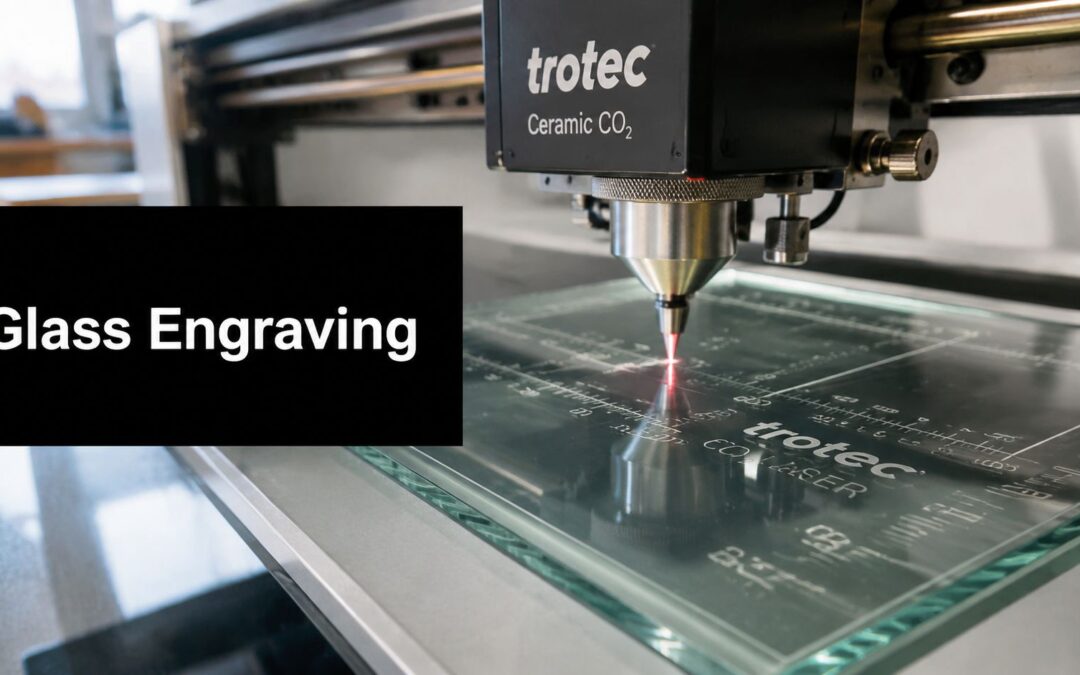
A closer look at Trotec Laser machine operation helps make those differences easier to visualise:
Applications and Examples
A Melbourne facilities manager ordering engraved glass for a plant room and a family arranging a memorial plaque appear to have very different jobs. In practice, both are solving the same problem. They need words and symbols to stay clear, accurate and appropriate for the setting.
Industrial identification
Industrial glass engraving is usually less about decoration and more about controlled communication. In a switchboard room, service corridor or plant area, the engraved piece may identify equipment, mark a control point or support a formal display panel. If the layout is crowded, the message weakens. Letters that look crisp on a screen can merge into a light grey haze on glass if spacing, size and contrast are handled poorly.
That is why experienced buyers treat engraving like specification work. The process works much like drafting a technical drawing. Small decisions about line weight, margins and text hierarchy have a large effect once the part is installed and viewed from a few steps away.
Melbourne's industrial market adds another layer. Some projects sit in offices or reception areas. Others support manufacturing, utilities, transport or site compliance, where identification has to fit a wider sign system and sustainability targets. A polished result is useful, but clarity, repeatability and material suitability usually matter more.
If a site needs fifty matching identifiers across multiple panels, engraving has to be managed like production, with artwork control, naming consistency and checking before release.
Memorial plaques
Memorial engraving asks for a different tone, but the same discipline.
On glass, names, dates and short messages need room to breathe. A plaque with tight spacing or ornate fonts can feel crowded even if every word is correct. By contrast, a balanced layout gives the eye a clear path from one line to the next, much like good wayfinding signage does in an industrial building. The purpose changes. The need for readable structure does not.
In Melbourne, engraved glass is often chosen for indoor remembrance displays, commemorative installations and formal plaques where a restrained finish suits the setting. Production accuracy matters here for obvious reasons. A misspelt name, uneven alignment or inconsistent finish is not a small defect. It changes the meaning of the piece. One practical reference point is this example of laser engraved memorial plaques, where fine text and layout control are central to the finished result.
What these jobs have in common
Industrial and memorial applications sit at opposite ends of the emotional spectrum, yet the buying questions are surprisingly similar:
- Readability comes first. Equipment IDs, names and dates all fail if people have to strain to read them.
- The location shapes the design. Indoor display glass can allow more subtle visual choices than glass used near active operations or public-facing traffic paths.
- Consistency matters. A one-off plaque needs accurate spelling and alignment. A batch of industrial markers needs the same level of control across every item.
- Compliance and sustainability should be considered early. Industrial buyers in Melbourne often need engraved elements to fit broader signage, asset identification or procurement requirements, while memorial buyers may also prefer durable materials and production methods that avoid unnecessary waste.
That overlap is easy to miss if guides treat glass engraving as either a gift product or a purely decorative finish. In Melbourne, many real-world jobs sit closer to specification work, where appearance, legibility, compliance fit and responsible production all need attention at the same time.
Durability Quality and Sustainability
Durability is where many Melbourne guides become too vague. Decorative engraving advice doesn't always help a facilities manager choosing signage for a harsh environment.
Why durability is not optional
Recent data cited in Melbourne glass engraving content states that 28% of industrial incidents involve misread or degraded signage, which underlines why durable marking matters in demanding conditions (Melbourne City Engraving glass and crystal page). That doesn't mean glass is right for every sign. It does mean material choice should be tied to readability over time, not only first-day appearance.

Glass compared with alternatives
Buyers often compare engraved glass with stainless steel because both can suit formal environments. The better choice depends on the exposure and the message.
Glass can be an excellent option where you want a clean face, stable appearance and a refined engraved finish. Stainless steel may make more sense where impact resistance or a more industrial aesthetic takes priority. For safety signage, buyers also need to think about whether the final sign system supports AS 1319 requirements for durable, legible communication in the actual installation environment.
A useful way to assess materials is to ask four questions:
| Question | Why it matters |
|---|---|
| Will sunlight hit it regularly? | UV exposure can affect how readable some sign systems remain over time |
| Will cleaning chemicals contact it? | Healthcare and industrial sites often expose surfaces to aggressive cleaning routines |
| Could it be knocked or scratched? | Physical wear changes the right substrate choice |
| Does the sign need formal compliance review? | Some locations need tighter control over sign format and legibility |
Quality control and sustainability
Quality in glass engraving often comes down to restraint. Overdriving the process can create a dramatic mark at first, but it may also increase the risk of cracking or edge stress. A careful process usually produces a cleaner and more dependable result.
Sustainability enters the discussion in two places. The first is material selection. If a plaque or sign lasts longer and doesn't need replacement as quickly, that reduces waste. The second is process efficiency. Trotec Laser systems are commonly referenced in professional engraving workflows because controlled digital production helps reduce trial-and-error scrap when operators know the material well.
A sustainable engraving job isn't only about recycled content. It's also about making the right item once, instead of remaking the wrong item twice.
Cost Turnaround and Planning
Cost is the question nearly everyone asks first, but it's usually the wrong starting point. In glass engraving, price follows scope.

What changes the price
Three factors shape most quotes more than anything else.
- Material choice: Clear glass, coated glass, thicker pieces and shaped blanks don't behave the same way in production.
- Design complexity: Fine text, logos, photos and layout revisions all affect preparation time.
- Order volume: One plaque is a different production job from a repeat batch of identification plates.
That's why two projects that look similar from a distance can price very differently. A simple rectangular item with one line of text is easy to process. A memorial panel with multiple lines, artwork placement and proofing rounds takes more care before the laser even starts.
Why lead times vary
Turnaround depends on artwork readiness, material availability and inspection requirements. Small, straightforward jobs can move quickly if the artwork is approved and the substrate is in stock. Larger memorial orders or multi-item industrial programs usually need more proofing, batching and quality checks.
Rather than relying on generic timing promises, ask the supplier how they schedule these stages:
Artwork review
Spelling, sizing and file suitability are checked first.Material preparation
The blank has to be clean, suitable and correctly sized.Machine setup
Glass is sensitive, so settings should match the exact substrate and finish.Inspection and packing
This matters more than many buyers expect, especially for plaques and labelled sets.
A better planning approach
If you need glass engraving in Melbourne for an operational site, order samples before you need the full batch. If you need it for a memorial date, approve wording early and leave room for proofing. Most delays don't come from the engraving itself. They come from late copy changes, uncertain specifications or unsuitable artwork.
How to Choose a Supplier
A supplier list looks simple until you know what to look for. Then the differences become obvious.

The checklist that matters
A serious supplier should be able to answer practical questions without drifting into vague marketing language.
- Machine capability: Ask whether they use Trotec Laser CO₂ equipment for glass work and whether they can explain why that matters for the finish you want.
- Material knowledge: They should discuss substrate choice, not just “glass” as one broad category.
- Quality process: Ask how they proof text, check alignment and inspect the final mark.
- Application fit: A good supplier should ask where the engraved item will be installed or displayed.
- Sample confidence: They shouldn't resist a sample order for a critical project.
What good vetting sounds like
A capable engraver usually explains trade-offs clearly. They'll tell you when glass is suitable, when another substrate may be safer, and how the final result will look under real lighting. They'll also speak comfortably about file formats, text size, spacing and production limits.
A weaker supplier often stays at the level of “we can engrave anything”. That sounds reassuring, but it doesn't help you make a technical decision.
Ask to see examples that match your use case. A beautiful award doesn't prove a supplier can handle industrial identification. A neat machine label doesn't prove they understand memorial presentation.
One useful benchmark
If you're comparing providers, it helps to review a specialist industrial offering such as industrial engravers in Australia and use it as a checklist reference. Look for the underlying signals: equipment transparency, process detail, substrate range and the ability to speak to industrial requirements without oversimplifying the work.
Evright Industrial Solutions
For buyers who need a process-driven option, Evright Industrial is one provider in this space that focuses on asset labelling, engraving and identification work for industrial applications, with support for memorial plaque projects as well. The broader business behind it, evright.com, brings nearly six decades of engraving experience, which matters because repeatability and proofing discipline often come from long production experience rather than from the machine alone.
A detail worth noting from Trotec Laser guidance is that, for glass engraving on Trotec CO₂ systems, using a grayscale matrix of 70% black helps prevent cracking while still producing a clear white etched result (Trotec Laser glass engraving material guidance). That kind of setting choice is a good example of why glass work depends on process control, not just artwork.
If you want to understand how the workflow functions from file preparation through engraving and inspection, the Evright website gives context on the company and its broader engraving operations. In practical terms, the workflow usually starts with approved artwork, moves into machine setup on Trotec Laser equipment, then finishes with visual checking so the final engraved piece matches the intended application.
Conclusion and Next Steps
Good glass engraving in Melbourne sits at the intersection of design, material behaviour and disciplined production. Industrial labels need clarity and durability. Memorial plaques need accuracy and visual balance. The right method, usually CO₂ laser engraving for true glass marking, depends on controlled settings and a supplier who understands the final environment.
If you're planning a project, ask for a sample, review the artwork carefully, and choose a provider that can explain both the process and the limitations in plain language. That's usually the clearest sign you'll get a result worth installing or presenting.
If you need guidance on an industrial label, a compliant sign component, or a memorial plaque, contact Evright Industrial for a practical discussion about materials, artwork and laser engraving options.
Recent Comments