
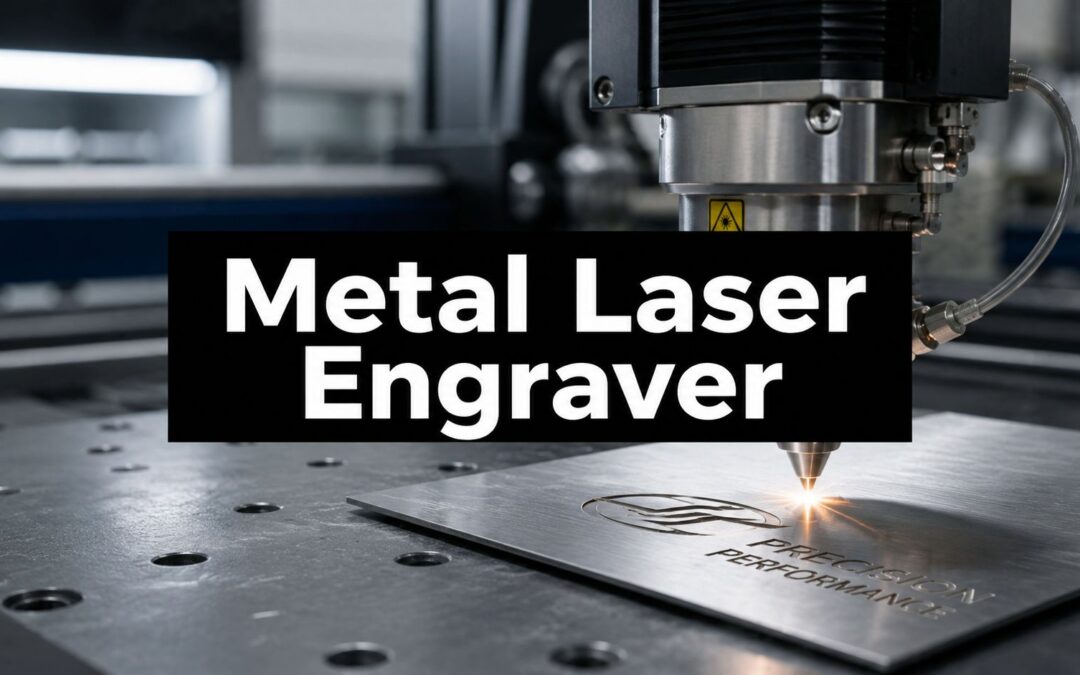
If you're pricing an industrial laser engraver for metal right now, you're probably balancing two pressures at once. You need marks that won't peel, fade, or fail an audit, and you also need to avoid buying a machine that sits idle most of the year.
That's the key decision. It isn't just about whether laser marking works on metal. It does. The practical question is whether your business should own the equipment, or use a specialist service that already runs industrial-grade systems such as Trotec Laser machines for production marking, labels, plaques, and compliance work.
For many Australian operations, the smartest choice comes down to durability, traceability, and total cost of ownership. Once you understand how the technology works, the buying decision gets much clearer.
Why Permanent Metal Marking Is Critical for Industry
A printed asset sticker looks fine on day one. Six months later, it's often lifting at the corners, stained with oil, or rubbed blank by handling. On a workshop floor, in a plant room, or out in the weather, that isn't a small annoyance. It's a traceability failure.
Permanent metal marking solves that by putting the identifier into the material itself, not onto it as an afterthought. Serial numbers, equipment IDs, safety instructions, material specs, and machine labels stay readable because the mark becomes part of the metal surface. That's why industries with strict compliance and maintenance requirements rely on engraved plates and direct part marking rather than adhesive labels.
The scale of adoption shows how central this has become. The global metal laser engraving machines market reached an estimated value of $1.3 billion USD, and in Australia the technology is increasingly favoured for metal fabrication, with systems achieving tolerances as tight as 0.1mm, according to Research and Markets' metal laser engraving machines market analysis.
Where permanent marking matters most
Some environments punish weak labels very quickly:
- Manufacturing floors where grease, abrasion, and frequent cleaning wear away printed information
- Healthcare settings where legibility matters for identification and equipment management
- Infrastructure and essential services where outdoor exposure can destroy temporary labelling
- Asset-heavy operations where every missing ID creates friction for audits, servicing, and replacement
A simple way to think about it is this. A temporary label tells you what something is today. A laser-marked plate helps you prove what it is for the life of the asset.
A readable mark saves time twice. First when a technician needs the information fast, and again when an auditor asks where your identification system breaks down.
For operations that need durable plates rather than short-life stickers, engraved metal labels for industrial identification are often the practical starting point. They give you a stable surface, consistent layout, and a marking method designed for harsh use.
What clients usually get wrong
Many buyers focus first on the machine and only later on the marking requirement. Start the other way around:
- Define the environment. Indoor, outdoor, chemical exposure, abrasion, washdown, sterilisation.
- Define the information. Text only, logo, serial number, QR code, variable data.
- Define the life span. Short project use, long-term asset management, or lifetime identification.
Once those three are clear, the right marking process becomes easier to choose.
Fiber vs CO2 What Laser Type Is Right for Metal
When people first compare laser systems, they often assume all lasers do roughly the same job. They don't. For metal, the difference matters immediately.
The easiest analogy is a fine-point pen versus a broad marker. A fiber laser behaves like the fine-point tool. It concentrates energy where you need it for direct metal marking. A CO2 laser is better thought of as the broader tool. It's useful in many workshops, but it isn't the standard choice for directly marking bare metals.
If your main work is stainless steel tags, aluminium asset labels, control panels, machine plates, QR codes, and serial numbers on metal parts, fiber is the normal industrial answer. Fiber lasers are the most efficient type of laser for engraving metal, which is why they're the preferred option for high-volume production even though they're also the most expensive category, as noted by Xometry's guide to the best laser engraver for metal.
Why fiber dominates metal work
A fiber laser is built for direct interaction with metal surfaces. That gives you cleaner marking on uncoated metals and better suitability for production environments where speed and repeatability matter.
CO2 systems still have a place. Trotec Laser, for example, is known for high-performance systems across both categories. But if a client asks me which technology they should investigate first for industrial metal identification, I don't start with CO2. I start with fiber, then narrow it down by material, depth requirement, and throughput.
Comparison of Laser Technologies for Metal Engraving
| Laser Type | Best For | Marking Speed on Metal | Limitations |
|---|---|---|---|
| Fiber laser | Direct marking on stainless steel, aluminium, coated metals, serial numbers, QR codes, production asset labels | Well suited to industrial metal marking and high-volume work | Higher equipment cost |
| CO2 laser | Broader workshop use, especially where non-metal materials are also part of the workflow | Less suited to direct marking on bare metal | Not the standard choice for uncoated metal identification |
| MOPA fiber laser | Advanced metal marking, including more parameter control and specialised finishes on stainless steel | Strong option where mark appearance and process control matter | More complex to specify correctly |
A quick rule for buyers
Use this shortlist when you're screening options:
- Choose fiber if metal is the main job and the marks must be permanent.
- Look at MOPA fiber if you need more control over finish, contrast, or specialised marking outcomes.
- Consider CO2 only if your workflow is broader than metal and direct marking on bare metal isn't the primary requirement.
Practical rule: If your buying brief says "metal first", start with fiber. If it says "mixed materials first", then compare broader system options.
That one decision removes a lot of confusion early.
How Laser Power and Material Choice Affect Your Results
Once you've narrowed the field to fiber, the next question is power. It's common for buyers to overcomplicate this choice. Wattage isn't a status symbol. It's a production tool.
For metal engraving, power determines how quickly you can mark, how deep you can go, and what kind of finish you can achieve on a given alloy or coated surface. According to OMTech Australia's guide to metal engraving lasers, 20W optical power is the minimum for permanent marking on stainless steel and aluminium, 50W is optimal for high-speed engraving of QR codes and serial numbers, and 60W to 100W is used for deeper engraving.

What those power levels mean in practice
Here's the plain-English version.
- 20W suits permanent surface marking where you need legibility but not heavy depth.
- 50W is the production sweet spot for many industrial IDs because it handles fast marking of QR codes and serial numbers.
- 60W to 100W makes sense when the mark needs more depth or when the job moves beyond light marking into more aggressive material removal.
A good comparison is paint versus engraving into timber. One changes the appearance. The other changes the surface itself. In laser work, more power lets you move further toward that second outcome when the application demands it.
Material changes the answer
A stainless steel plate, an anodised aluminium tag, and a powder-coated panel don't respond in exactly the same way. The base material, the surface finish, and the required contrast all affect settings.
That matters when clients ask, "What power do I need?" The honest answer is, "For which metal, with what finish, and what result?" If you're still deciding between coated and treated surfaces before engraving, this comparison on choosing between powder coat or anodizing is a useful primer because surface finish affects readability, contrast, and wear behaviour.
Match the mark to the job
Think in terms of use case:
- Branding plate in a sheltered environment. Surface marking may be enough.
- Asset label on equipment handled daily. A stronger, faster production setup is usually the safer choice.
- Part ID exposed to abrasion or harsh service. Deeper engraving becomes more relevant.
The mistake isn't choosing a low-power machine. The mistake is expecting a light-duty setup to deliver harsh-environment performance.
Achieving Precision and Durability in Metal Engraving
A mark can be dark and still be poor quality. Industrial marking needs more than visibility. It needs precision, repeatability, and durability.
That becomes obvious on small text, dense QR codes, medical identifiers, and panels with tightly spaced information. If the beam placement drifts, edges soften. If repeatability slips, one batch scans cleanly and the next doesn't. In such cases, machine architecture matters far more than marketing language.
The role of the scanning system
At the heart of high-quality laser marking is the galvanometer scanning system. This controls how accurately the beam is positioned across the workpiece. According to OMTech's specifications for precision metal engraving systems, precise metal engraving relies on systems achieving positioning accuracy of ±0.1 μm and repeatability under 0.005mm, aligned with ISO 2768-vh requirements for applications such as medical device ID markings.
Those numbers matter because they translate into stable results on real jobs. Fine characters stay crisp. Code modules remain distinct. Repeated parts look the same from one run to the next.
On industrial work, consistency is often more valuable than a single impressive sample. The first plate and the five-hundredth plate both need to read the same way.
Why MOPA changes what's possible
Standard fiber systems already handle a large share of industrial marking. MOPA fiber lasers add another layer of control through pulse width adjustment. That gives the operator more flexibility over how energy interacts with the surface, which is especially useful for advanced marking outcomes.
On stainless steel, for example, that control can support specialised finishes and colour marking while maintaining a permanent result. For jobs where contrast, cosmetic finish, or fine process tuning matter, MOPA isn't a gimmick. It's a process advantage.
If your work includes stainless parts, control panels, or long-life identification plates, it helps to review examples of stainless steel engraving applications because the material rewards precise parameter control and exposes weak process setup quickly.
What durability actually depends on
Durability doesn't come from the word "laser" alone. It comes from the combination of:
- Correct laser type for the material
- Appropriate power for the required mark depth or finish
- Stable beam control for edge definition and repeatability
- Proper setup and fixturing so focus remains consistent
That's why two marks made on the same metal can perform very differently in service. One survives cleaning, handling, and weather. The other becomes hard to read long before the asset reaches end of life.
Calculating the True Cost of an Industrial Laser Engraver
Most buying discussions start with machine price. That's understandable, but it's incomplete. In Australia, the sticker price on an industrial laser engraver for metal is only the first layer of cost.
The hidden part is total cost of ownership, or TCO. That's the cost to buy, import, certify, install, operate, maintain, and eventually replace the machine. When buyers skip that full calculation, they often compare "buying a machine" against "paying per job" and convince themselves ownership is automatically cheaper. It often isn't.
According to Evright Industrial's analysis of laser etching machine ownership in Australia, an in-house fiber laser can carry a 30 to 45% higher effective cost than the purchase price because of import duty, GST, and mandatory AS/NZS 60825 compliance certification. The same source states that a US$15k to US$40k purchase price is commonly promoted, but those add-on ownership costs are frequently left out. It also cites a 2025 AU Industry Partners report showing outsourcing is financially superior for 80% of Australian firms engraving fewer than 5,000 assets per year.

The costs buyers usually miss
The machine itself is only one line item. Ownership also pulls in several surrounding costs:
- Compliance requirements. Australian safety and certification obligations aren't optional.
- Training time. Someone has to learn setup, materials, maintenance, and safe operation.
- Facility changes. Ventilation, space allocation, and electrical considerations can all come into play.
- Downtime risk. If the operator is away or the machine needs service, production doesn't pause politely.
- Underutilisation. A capital asset that runs occasionally is still depreciating while it waits.
This is why machine ownership often makes most sense for businesses with steady, predictable marking volume and a clear internal operator workflow.
When outsourcing makes better financial sense
If your demand is irregular, project-based, or spread across different materials and plate styles, outsourcing often gives you a better cost profile. You're paying for output, not for idle capacity.
For businesses that want a reality check before committing to equipment, tools like SEA's investment justification calculator can help frame whether an automation purchase is likely to earn its keep. It isn't laser-specific, but it's a useful discipline because it forces you to compare capital cost against actual throughput, labour use, and utilisation.
One practical option in the Australian market is using a specialist production service rather than buying a machine outright. For teams assessing that path alongside ownership, industrial etching equipment options and service alternatives show how the decision isn't just machine versus no machine. It's often capital ownership versus access to established production capability using Trotec Laser systems.
If you engrave every day at stable volume, ownership may fit. If your jobs come in waves, service access is often the cleaner business decision.
A simple TCO checklist
Before you approve a purchase, answer these questions:
- How many assets do you engrave in a typical year?
- Who will run the machine when your trained operator is absent?
- What does compliance add to your landed cost?
- Will the machine be busy enough to justify depreciation and maintenance?
- Do you need a machine, or do you need finished engraved parts on time?
That last question usually clarifies the whole conversation.
Practical Applications for Laser Engraved Metal
Industrial laser marking becomes much easier to understand when you look at the jobs people send through production. The same technology can solve very different problems, provided the mark, the metal, and the environment are matched properly.
In Australia, industrial laser engraving services commonly produce permanent, high-precision marks on stainless steel, anodized, or powder-coated metals, often with 24-hour turnaround windows for engineering and manufacturing customers, as described by Lasermark's industrial engineering laser cut and engraving service.

Common jobs that suit laser engraving
Asset tags for equipment
These need legible serial numbers, equipment IDs, or location references that survive handling and exposure. This is one of the most common industrial uses because it directly supports maintenance and traceability.
Safety signage and control panels
Laser engraving works well where labels need to stay clear over time. Plant signage, switch labels, warning panels, and machine instruction plates all benefit from permanent marking.
Medical and technical identification
Where small text, clean edges, and repeatability matter, laser marking gives much tighter control than temporary labels or printed overlays.
Memorial plaques and commemorative plates
This is a different application, but the same principle applies. The mark needs to stay legible and stable over time, often outdoors.
Why turnaround matters
A lot of industrial work isn't planned months in advance. A site upgrade, equipment changeout, or compliance correction can create an urgent need for labels and engraved plates.
That's why fast service matters almost as much as mark quality. A beautiful plate delivered too late can still delay a handover, a maintenance task, or a commissioning schedule. Trotec Laser production workflows are often favoured in these environments because they support detailed engraving with the repeatability industrial clients expect.
If you want to see the process in action, this production video gives useful visual context.
Matching the application to the marking style
A smart specification starts with the actual use condition:
- For daily-use equipment tags, prioritise contrast and toughness.
- For branded plates, visual finish may matter as much as depth.
- For technical panels, fine detail and layout control become more important.
- For commemorative work, material choice and appearance often lead the decision.
The laser itself doesn't solve the whole job. The result depends on choosing the right plate, finish, layout, and marking method for the way the item will be used.
Partnering with Evright Industrial for Your Engraving Needs
By the time most buyers reach a decision, they realise the question isn't just "Which industrial laser engraver for metal should I buy?" It's "What's the most sensible way to get durable, compliant, readable marks into my operation?"
For some companies, that will be ownership. For many others, especially when volume is variable or compliance requirements are strict, working with a specialist is simpler and financially cleaner. You avoid the imported-equipment cost stack, the operator learning curve, and the problem of owning capacity you don't fully use.
Evright Industrial is one service-based option for Australian businesses that need production engraving, asset labelling, safety signage, and engraved metal components made on Trotec Laser equipment. Through its connection with Evright, the wider business brings nearly six decades of group experience in laser engraving and identification work. In practical terms, that means clients can send a requirement, confirm materials and artwork, approve the layout, and receive finished engraved items without having to build an in-house laser capability from scratch.
The best marking setup is the one that gives your team reliable identification without turning you into a machine maintenance department.
If you're weighing quality, compliance, and ROI, keep the decision grounded in your actual workload. Look at how many assets you mark, how often you need them, what standards you need to meet, and whether speed matters more than ownership. That framework usually points to the right answer quickly.
If you need durable metal labels, engraved asset plates, or industrial marking support without taking on the full cost of machine ownership, talk to Evright Industrial. They can help you assess the job, choose the right material and marking method, and explain how the production process works from artwork approval through delivery.
Recent Comments