
You're usually not thinking about switch plates until something goes wrong. An auditor points out faded circuit labels on a switchboard. A maintenance technician can't read a room isolation switch after years of cleaning. A contractor installs a clean new panel, then loses time chasing inconsistent naming across plates, schedules, and asset records.
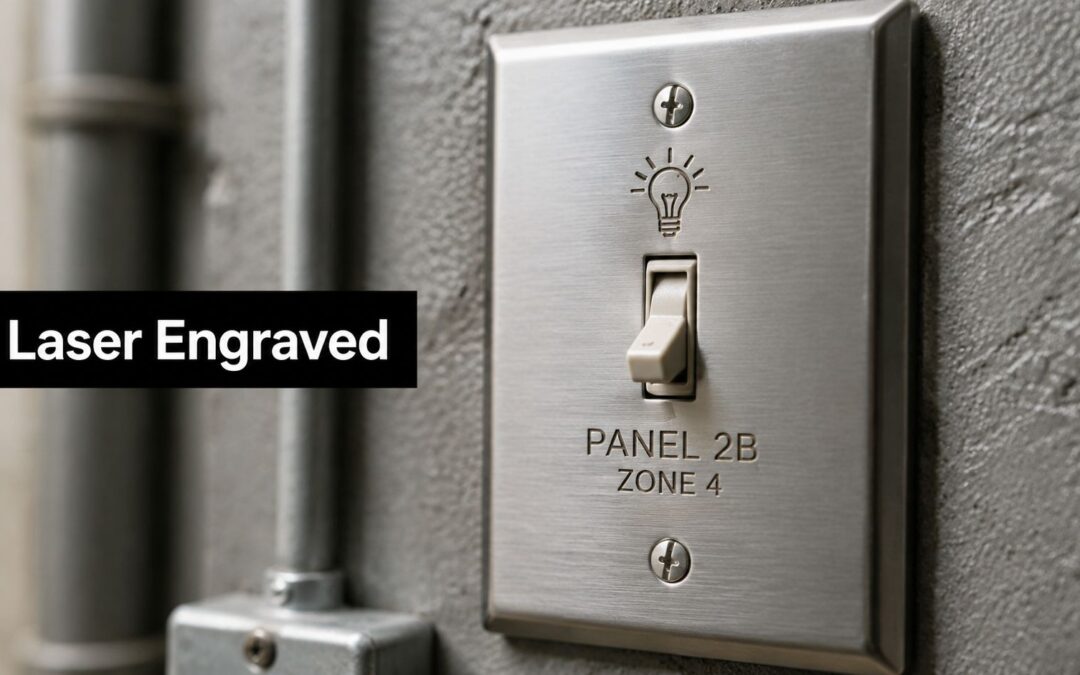
That's where laser engraved switch plates stop being a finishing touch and start being part of risk control.
In industrial sites, healthcare facilities, and essential services, the cheapest label often becomes the most expensive one to live with. Adhesive labels peel. Printed text fades. Marker pen fails the moment the environment gets harsh, the cleaning regime gets serious, or the compliance bar gets tighter. A permanently marked plate changes that equation. You get clarity, repeatability, and a result that still looks intentional years after handover.
Why Professionals Choose Permanent Engraving
A failed label rarely fails on its own. It usually sits inside a chain of avoidable problems. Someone misreads a circuit. A technician stops to verify a board manually. A compliance inspection slows down because identification is patchy. Then the site pays twice, once for the original shortcut and again for the rework.
That's why permanent marking matters. It isn't about making a switch plate look premium for its own sake. It's about giving electricians, facilities teams, and auditors a marking method they can trust when the environment is dirty, wet, bright, chemical-heavy, or old.
What tends to fail first
Short-life marking methods usually break down in predictable ways:
- Adhesive labels: They lift at the edges, trap grime, and lose legibility after repeated wipe-downs.
- Printed surfaces: They look fine at install, but surface-applied text wears away under abrasion and cleaning.
- Hand-marked plates: They're fast for temporary work, but inconsistent naming and poor readability create avoidable confusion.
In practice, none of those methods age well on critical infrastructure.
Practical rule: If the plate identifies a safety function, an essential circuit, or a frequently serviced point, treat the marking as permanent infrastructure, not stationery.
Why laser engraving changes the risk profile
Laser engraving gives you a mark that becomes part of the plate rather than sitting on top of it. That distinction matters. When the identification is built into the material, daily use doesn't strip it away the way it strips ink or adhesives.
For operations managers, the benefit is straightforward. You reduce ambiguity. For electrical contractors, you hand over a job that still reads clearly after the site settles into normal use. For healthcare and government work, you also present a more controlled, professional finish, which matters when every detail gets scrutinised.
Permanent engraving isn't the cheapest line item on the day of purchase. It's often the cheapest option across the life of the installation.
Understanding Laser Engraved Switch Plates
Laser engraving is best understood as high-precision marking with light. Instead of a cutter dragging across the plate, or ink being laid onto the surface, a laser directs controlled energy exactly where the mark needs to be. That lets the operator produce text, symbols, numbering, branding, and equipment identifiers with a level of consistency that's hard to match by hand.

How the process works in practical terms
Different materials respond differently to the beam. On some plastics, the laser removes a top layer to expose a contrasting core. On coated metals, it can remove a finish selectively. On some metal applications, the process creates a dark, high-contrast mark through controlled surface change rather than deep cutting.
That's why the same machine can produce clean asset tags, switch legends, stainless plates, and industrial identifiers with tight alignment and repeatable output.
A useful benchmark comes from Trotec Laser data plate and tag production guidance, which notes that Trotec Laser technology enables the production of permanent data plates and metal tags without consumables, contact, or wear, making it well suited to durable, legible industrial switch plate marking.
Why it beats mechanical engraving for this job
Mechanical engraving still has its place, but it comes with trade-offs. A cutter makes physical contact. Tool wear affects consistency. Fine details and small text can become more difficult on some materials and layouts. On finished plates, contact processes can also limit how delicate or intricate the result can be.
Laser systems avoid that contact altogether. They're precise, repeatable, and easier to standardise across batches. That matters when a project includes multiple boards, room identifiers, plant areas, or staged fit-outs.
Here's a look at a Trotec-focused process in action:
What the finished result should do
A properly produced engraved switch plate should deliver four things at once:
| Requirement | What good laser work achieves |
|---|---|
| Legibility | Clean text and symbols with consistent contrast |
| Repeatability | Matching output across one plate or hundreds |
| Material control | Marking without unnecessary damage to the plate |
| Longevity | Identification that stays readable under real site conditions |
Good switch plate engraving isn't just about making a mark. It's about making the same mark accurately, every time, on the right material for the job.
Choosing Your Material and Finish
Material choice decides whether the plate will still make sense after years on the wall or panel. The wrong substrate can turn a neat install into a maintenance nuisance. The right one gives you contrast, durability, and the finish quality the site expects.

Common materials and where they work best
Stainless steel suits hard-use environments. It's a strong choice for healthcare, food-related areas, utilities, wash-down zones, and industrial settings where corrosion resistance and cleanability matter. It also presents well in premium fit-outs and critical service areas.
Anodised aluminium works well when you want a crisp, professional appearance with lower weight than stainless. It's often a good fit for control panels, equipment identification, and internal service areas where appearance and readability both matter.
Laminated plastics such as Traffolyte-style materials remain practical for many commercial and industrial applications. They offer strong contrast because the laser exposes a different core colour, which is useful for legends, board labels, and general identification.
Acrylic can work where aesthetics or light transmission matter, particularly for decorative or backlit applications, but it's not always the first pick for harsh industrial conditions.
Real trade-offs you should weigh
No single material wins everywhere. The better question is what the plate needs to survive.
- For healthcare and repeated cleaning: Stainless is often the safest call because it handles sanitisation better than many surface-finish alternatives.
- For general switchboard and plant labelling: Laminated plastics can give excellent readability and efficient production.
- For premium equipment or architectural projects: Anodised aluminium often lands in a good middle ground between presentation and practicality.
If the environment is harsh, select the material first and the appearance second. That order avoids expensive regret.
Metal marking and contrast
On stainless steel and similar metals, contrast is the main challenge. The cleanest black marks often come from a marking compound rather than deep removal of material. According to this metal marking compound demonstration for laser engraving on switch plates, applying a dark marking compound 5–8 inches away, letting it dry fully, and washing it off with cold water after lasing produces a high-contrast permanent black mark by localised oxidation rather than heavy material removal.
That process is useful because it protects the plate while still delivering readability.
A simple material selection guide
| Environment | Best-fit material | Why |
|---|---|---|
| Hospital or clinical area | Stainless steel | Hygienic, durable, strong long-term legibility |
| Industrial plant room | Stainless steel or laminated plastic | Depends on exposure, abuse, and budget |
| Commercial fit-out | Laminated plastic or aluminium | Good contrast and clean presentation |
| Architectural or branded install | Aluminium or stainless steel | Better visual finish and consistency |
For projects where corrosion resistance and long-term readability are the priority, laser engraved stainless steel options are usually where the conversation should start.
Ensuring Durability and Regulatory Compliance
A failed inspection rarely starts with a major equipment fault. More often, it starts with something small: a switch plate that can no longer be read, a circuit identifier softened by cleaning chemicals, or a room control label that does not match the current schedule. On industrial and healthcare sites, those small faults create real cost through rework, delayed handover, maintenance confusion, and avoidable compliance risk.

Durability is a compliance issue
Australian electrical work has to be identified clearly enough for safe operation and maintenance. In practice, that means the marking must stay legible in the actual service environment, not just look tidy at practical completion. Cleaning, abrasion, UV, moisture, solvents, and repeated handling all matter.
That standard catches out low-cost labels very quickly.
A printed or surface-applied label may be acceptable in light-duty areas, but it often becomes a maintenance item in plant rooms, hospitals, workshops, and public-access spaces. Once the wording starts to fade, peel, or stain, the plate stops doing its job. The replacement cost is not just the new label. It includes labour, access time, documentation checks, and disruption to occupied areas.
What inspectors and maintenance teams look for
Good engraved plates reduce uncertainty during audits because the identification remains readable and fixed to the asset. That matters during testing, isolation, fault-finding, and emergency response, where staff need to identify the correct switch or circuit without second-guessing old handwritten changes or half-removed stickers.
In practical terms, durable switch plate marking supports:
- Safer maintenance: Clear identification reduces the chance of isolating the wrong service or circuit.
- Cleaner audits: Permanent, legible marking is easier to verify against schedules and as-built records.
- Lower rework exposure: Facilities teams spend less time replacing failed labels during reactive maintenance or pre-audit cleanup.
- Better whole-of-life cost control: A plate that lasts through cleaning cycles and normal wear usually costs less over the asset life than a cheaper plate that needs repeated replacement.
Where premium plates pay for themselves
The trade-off is straightforward. Higher-grade engraved plates cost more at procurement, especially in stainless steel or specified industrial laminates. They usually save money later on sites where compliance, cleaning, and service life matter.
I have seen this decision go wrong when procurement buys on unit price alone. The plate might be cheaper on day one, but the site pays again through relabelling, call-backs, and patchwork fixes that make the installation look inconsistent. On regulated sites, that inconsistency also raises questions about the quality of the broader identification system.
The better approach is to specify the plate for the environment and expected life of the installation. If the area is exposed to harsh cleaning agents, frequent touch points, or critical maintenance activity, permanent laser engraving is the safer long-term choice.
For project teams checking identification obligations before sign-off, these switchboard labelling requirements for compliant electrical identification are worth reviewing before artwork is released to production.
Customisation and Artwork Specifications
Most delays in custom switch plate work don't happen at the laser. They happen before production starts, when the supplied information is incomplete, inconsistent, or difficult to interpret. Clean artwork and clear naming save time, prevent proofing loops, and reduce the risk of getting a whole batch wrong.
What to provide up front
For a smooth job, send the plate schedule as if someone else has to install and verify it without calling you.
Include:
- Plate size and brand format: Standard faceplate types, cut-outs, hole positions, and whether the layout suits Clipsal, HPM, or another system.
- Exact wording: Circuit IDs, room names, asset numbers, warning text, function labels, and any line breaks you want preserved.
- Mounting details: Screw holes, adhesive backing, panel fixing, or special fitment constraints.
- Finish expectations: Brushed metal, black-on-silver contrast, two-layer laminate, or another specified look.
Why vector artwork matters
Vector files are preferred because they define lines and shapes mathematically. That means logos, icons, and text edges stay crisp when scaled. Typical useful formats include AI, EPS, SVG, and DXF, depending on the job and the machine workflow.
Raster artwork can still be workable for some graphics, but it often arrives with problems. Low resolution, compressed edges, and unclear outlines don't translate well when the mark needs to look sharp on a small plate.
A practical rule is simple:
| Artwork type | Suitability |
|---|---|
| AI / EPS / SVG / DXF | Best for text, logos, symbols, linework |
| PDF with vector content | Often suitable if prepared properly |
| JPG / PNG screenshots | Only useful as visual reference unless high quality and approved |
Workshop advice: If a logo came from a screenshot in an email signature, expect delays. If it came as vector artwork, production usually moves faster.
Layout choices that improve legibility
Small plates punish clutter. If you try to fit too much onto one faceplate, readability drops fast. Prioritise the information a technician or user needs first. Use hierarchy. Put the critical identifier in the strongest position, then secondary text beneath or beside it.
For custom jobs with mixed text, logos, and technical identifiers, it helps to start with custom laser engraving options and build the brief around the actual installation conditions, not just the artwork itself.
The Evright Ordering and Workflow Process
A switch plate order usually goes wrong before the laser starts. The common failure points are mismatched room names, incomplete schedules, hole positions that do not match the device, and approvals given without anyone checking the plate against the actual installation. On a live industrial or healthcare project, those mistakes cost more than the plate itself. They create rework, hold up handover, and can leave non-compliant identification in place longer than it should be.
A controlled workflow cuts that risk and lowers total ownership cost over the life of the facility.
How the job typically moves
The process starts with job data, not decoration. Plate type, material, quantity, fixing method, legend schedule, environmental exposure, and any site standards need to be confirmed first. If the project has compliance requirements for isolation points, essential services, plant identification, or cleaning protocols, those need to be captured at the start as well.
Then the artwork and schedule are checked against the actual plate size and hardware layout. That is the point where a disciplined supplier catches text that is too long, inconsistent abbreviations, duplicate names, and device cut-out conflicts. On multi-board or multi-room projects, that review work prevents expensive repeat errors across an entire batch.
Proofing is the control point that saves money. Every proof should confirm dimensions, text, line spacing, orientation, hole locations, and naming conventions before production approval. Facilities teams that already value preventative maintenance usually understand this logic. The same discipline that reduces callouts and asset failures also reduces plate reorders. The broader principle is covered well in Access Electrical maintenance insights.
Production on Trotec systems
Once approved, the job moves into laser production with settings matched to the material and the required mark. For metal marking, process control determines whether the result is readable, durable, and consistent across the batch. According to this Trotec laser machine metal marking example, the method includes selecting “Metal Marking Compound Dark”, applying the compound, and using settings of approximately 9.5% power with the appropriate speed parameters to produce a clean black outline without damaging the plate.
That repeatability matters on specification work. A supplier needs machine control that produces the same contrast, alignment, and edge quality from plate one to plate one hundred. Consistent output means fewer rejects, fewer remakes, and fewer installation delays.
What clients should expect from the workflow
A supplier handling industrial switch plates should provide:
- File and schedule review: Production should not start until drawings, legends, and artwork are checked for conflicts.
- Proof approval before manufacture: Site-wide naming errors are cheaper to fix on screen than after dispatch.
- Material advice tied to the environment: Wet areas, washdown zones, public spaces, and plant rooms do not place the same demands on a plate.
- Quality checks before dispatch: Legibility, finish, alignment, fixing details, and count accuracy should be confirmed before the order leaves the workshop.
That background matters because long-life identification depends on controlled production. The gain is practical. Fewer replacements, cleaner audits, faster maintenance response, and less avoidable spend across the service life of the installation.
Applications and Return on Investment
A shutdown crew standing in front of a crowded panel does not have time to second-guess a faded legend. In a hospital plant room, maintenance staff need the same certainty after months of cleaning chemicals and repeated wipe-downs. That is where the return on a laser engraved switch plate shows up first. It reduces hesitation, avoids misidentification, and cuts the rework that follows poor labelling choices.

Where the return shows up
The return is rarely about the plate alone. It sits in labour, compliance, downtime, and replacement frequency over the life of the installation.
- Less replacement work: Engraved plates stay legible far longer than adhesive labels or light-duty printed alternatives in hard-use areas.
- Faster fault-finding and isolation: Clear identification helps electricians and maintenance teams locate the right circuit, device, or asset with less backtracking.
- Lower risk during audits and handover: Consistent, durable legends support cleaner inspections and reduce questions about missing or unclear identification.
- Lower whole-of-life cost: A plate that remains readable for years avoids repeat purchasing, repeat site visits, and the admin that comes with both.
That last point matters more than unit price. A cheaper plate can become the expensive option once replacement labour, access equipment, shutdown coordination, and documentation updates are added back in.
Practical examples by sector
In manufacturing, engraved switch plates are often specified for machine isolators, distribution boards, local control stations, and service points. The gain is practical. Shutdown work moves faster when every label is still readable and matches the schedule.
In healthcare, permanent marking supports reliability under aggressive cleaning regimes. Stainless and other suitable base materials cost more upfront, but they usually reduce replacement cycles and help maintain legibility in clinical and back-of-house environments where identification errors create operational risk.
In infrastructure, utilities, and commercial maintenance programs, durable identification fits the same maintenance logic covered in these Access Electrical maintenance insights. Preventative work costs less than reactive correction. Good marking follows the same rule because it removes an avoidable source of service delay and site confusion.
The cheapest label often becomes the next callout.
Total cost of ownership, not unit price
Facilities managers and contractors who buy on whole-of-life cost usually make better plate decisions. They look past the purchase price and ask four harder questions. Will the legend still be readable after cleaning, abrasion, and daily use? Will it support compliance checks without argument? Will it avoid replacement work in restricted-access areas? Will it reduce the chance of someone isolating or servicing the wrong point?
If the answer is yes, the higher upfront cost is usually justified.
That is why premium laser engraved switch plates are common on industrial, healthcare, and essential-service projects. They help control maintenance costs, support clear identification for compliance, and reduce the long-tail expense of fixing preventable labelling failures.
Recent Comments