

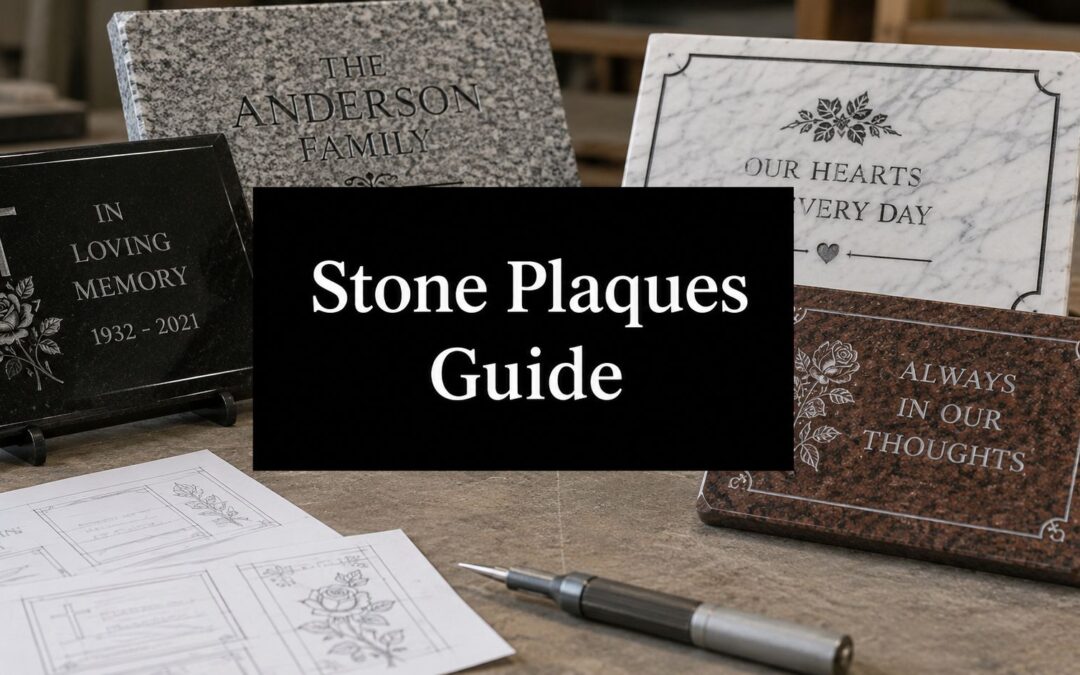
You're probably here because the plaque matters more than it first sounded on paper.
It might be a memorial that needs to hold its dignity for decades. It might be a dedication plaque for a building handover, a stone marker in a garden, or a permanent identification plate in a demanding outdoor setting. In every one of those jobs, the same questions show up fast. Which stone lasts. Which engraving method stays legible. What works near the coast. What looks refined on day one and still reads cleanly years later.
Those questions aren't minor. A plaque is usually commissioned once, installed once, and expected to keep doing its job without excuses. That's why buyers who start with appearance nearly always end up comparing material density, engraving depth, mounting, edge finish, and exposure conditions.
Some clients also look at adjacent custom signage options before deciding that stone is the right permanent medium. For decorative applications, Farmhouse World custom signs can be useful to review because they highlight how different materials suit different purposes. Metal suits many home décor settings. Stone suits permanence, weather exposure, and gravitas in a different way.
The Definitive Guide to Personalized Stone Plaques
A high-stakes plaque order usually begins with a practical problem, not a design brief. A family wants a memorial that won't fade into grey mush after a few summers. A facilities manager needs an exterior plaque that still reads clearly after constant sun, rain, and cleaning. A contractor wants something that won't look cheap at practical completion.
That's where most plaque projects are won or lost. Not in the wording. Not in the font. In the early technical choices.
What clients usually get wrong first
The most common mistake is choosing stone by colour alone. Black granite looks formal and photographs well, so it often becomes the default. Sometimes that's exactly right. Sometimes it isn't. A coastal site, a shaded garden, a polished foyer wall, and an exposed memorial lawn all ask different things of the material and the engraving method.
The second mistake is assuming every engraving process performs the same outdoors. It doesn't. Fine portrait detail, bold lettering, and long-distance readability each favour different approaches.
Practical rule: If the plaque must remain readable outdoors for years, choose the stone and engraving method before you finalise artwork.
What separates a good plaque from a lasting one
A lasting plaque does four things well:
- Uses the right substrate: The stone has to suit the environment, not just the style brief.
- Matches method to message: Portraits, logos, long inscriptions, and industrial identification all respond differently to laser work, sandblasting, and carved finishes.
- Keeps the layout disciplined: Legibility always beats overcrowding.
- Installs properly: A first-rate plaque can still fail early if mounted badly, sealed incorrectly, or placed where drainage and salt exposure are ignored.
That combination is why personalized stone plaques still command serious attention in Australia. At scale, demand is visible in the memorial sector alone. Sacred Melbourne Cemeteries Trust arranges over 4,000 Australian-made memorial plaques each year across its Melbourne sites according to its plaque service information. That tells you something important. Buyers still want locally produced, permanent markers, and they're ordering them in significant volume.
What to expect from the decisions ahead
The right plaque choice usually comes down to three linked decisions:
| Decision area | What matters most |
|---|---|
| Stone selection | Weather resistance, finish, colour contrast, maintenance |
| Engraving method | Detail level, durability, visual style |
| Installation | Fixing method, location exposure, cleaning access |
Get those right and the plaque does what it's supposed to do. It communicates clearly, carries weight, and doesn't need apologetic maintenance advice attached to it.
Choosing Your Ideal Stone Material
Stone selection isn't a style exercise. It's a performance decision with visual consequences.
Granite, marble, and slate all have a place in plaque work. But they don't age the same way, they don't engrave the same way, and they don't ask for the same level of care. If a plaque will live outdoors, especially in exposed Australian conditions, material choice deserves far more attention than most buyers give it.
Granite, marble, and slate side by side

Here's the practical comparison most clients need early.
| Material | Durability | Appearance | Cost position | Engraving suitability | Best fit |
|---|---|---|---|---|---|
| Granite | High | Speckled, varied, formal | Medium-high | Excellent contrast | Outdoor memorials, civic plaques, premium identification |
| Marble | Medium | Veined, classic, softer visual feel | High | Good, subtler contrast | Interior dedications, sheltered settings |
| Slate | Medium-high | Fine-grained, matte, understated | Medium | Good, lighter contrast | Garden plaques, rustic settings, selective exterior use |
Granite is usually the safest recommendation when durability sits at the top of the brief. It's dense, stable, and visually reliable. Dark granite also gives strong contrast for laser-etched imagery and text, which matters if the plaque includes portraits or fine line detail.
Marble remains attractive for ceremonial and architectural work, but it isn't my first pick for punishing exposure. It brings elegance and a classic finish, yet it asks for more protection and more realistic expectations over time.
Slate occupies a useful middle ground. It can look refined without becoming too formal, and it suits many garden or outdoor applications. But it doesn't always deliver the same visual punch as polished black granite when very fine detail is required.
What fabrication quality changes
Material isn't the whole story. Workshop process matters.
In Melbourne-based workshops, premium granite plaques go through a multi-stage technical process including surface polishing and precision carving via sandblasting or cutting tools, with etching used for finer detail in imagery or portraits. That localised artisan process improves quality control and helps produce outdoor plaques that withstand decades of exposure, as described in this overview of engraved granite plaque craftsmanship.
That matters because even a strong material can be let down by poor preparation. Uneven polishing, weak edge finishing, and sloppy artwork transfer all show up later.
A simple material decision filter
Use this as a practical screen before you approve artwork.
- Choose granite if: You need the strongest all-round outdoor performer, especially for memorial work, black-and-white imagery, or long-term legibility.
- Choose marble if: The plaque is largely protected and visual softness matters more than hard-wearing performance.
- Choose slate if: You want a more natural, understated finish and the plaque design is bolder rather than highly intricate.
Stone choice should follow exposure first, then engraving detail, then appearance.
For buyers comparing granite options in more detail, this page on granite plaque engraving is a useful reference point for how the material is typically specified and finished.
The Art of Engraving Techniques
Stone gives you the canvas. The engraving method decides whether the message survives.
That's where many plaque buyers oversimplify the job. They ask whether they want engraved or etched, as if it's a cosmetic distinction. In practice, the process determines edge sharpness, image fidelity, longevity, and how the plaque behaves after years of weather.

Why laser engraving leads on precision
For fine work, laser is the modern benchmark. On black granite in particular, laser etching produces detail that older methods struggle to match cleanly.
A key reason is durability combined with image quality. Forever Shining's technical note on laser-etched black granite plaques states that laser etching is recognised as the most durable method for personalized stone plaques, achieving a penetration depth at 200 dots per inch that delivers black-and-white photographic quality on black granite, with minimal surface fleck and stronger resistance to environmental degradation than sandblasting or traditional bronze engraving.
That aligns with what experienced engravers see in production. If the plaque includes a portrait, intricate crest, or tightly set lettering, laser is usually the cleaner answer.
Why Trotec Laser systems matter
Not all laser output is equal. Machine quality changes line sharpness, repeatability, and setup control.
Trotec Laser systems are widely valued in professional engraving because they handle detailed production with consistency. For plaque work, that means cleaner tonal rendering, better repeat results across batches, and tighter control on artwork that has to be both respectful and exact. When buyers ask why one laser-engraved plaque looks crisp and another looks muddy, the answer is often machine quality plus operator discipline.
Where sandblasting still earns its place
Laser isn't the answer to everything.
Sandblasting remains useful when you want bold, deep-cut lettering with a carved visual presence. It suits plaques where the text is simple, the viewing distance is greater, and the design benefits from depth rather than tonal detail. A lot of traditional memorial and building plaques still look right when sandblasted.
But sandblasting has limits. Fine photographic imagery, subtle grey values, and tiny serif details usually don't come through with the same clarity.
If you want a portrait on black granite, laser normally wins. If you want bold capitals that read from a distance and feel carved into the stone, sandblasting may suit the design better.
Why mechanical methods have narrowed
Mechanical rotary engraving still has niche uses, especially in some industrial and hard-surface identification contexts. On stone, though, it's rarely the first recommendation for premium visual work. It can mark, but it doesn't usually deliver the same finish quality as a well-run laser process or a well-executed blasted cut.
For readers who want to see a laser workflow in action, this Trotec-focused process video is useful:
The practical trade-off table
| Method | Strength | Limitation | Best use |
|---|---|---|---|
| Laser engraving | Fine detail, portraits, crisp text, durable finish | Less visual depth than carved blasting | Memorial portraits, logos, premium detailed plaques |
| Sandblasting | Deep-cut lettering, classic carved look | Less suited to photographic detail | Bold text, traditional memorials, architectural plaques |
| Mechanical engraving | Direct marking in selected applications | Less refined on premium stone work | Utility-oriented marking where aesthetics are secondary |
If the job calls for nuanced artwork and long-term clarity, laser is usually the method I'd put in front of a client first. If it calls for tactile depth and visual weight in simple text, sandblasting still deserves respect.
Designing an Effective Stone Plaque
A well-made plaque can still fail if the design is crowded, weakly structured, or hard to read from where people stand.
Design for stone is different from design for paper or screen. Stone doesn't forgive clutter. Every extra line, every ornate font, every low-contrast image asks the material and the engraving process to do more than they should.

Start with message hierarchy
Most effective personalized stone plaques have a clear reading order. The viewer should know what to read first without thinking about it.
That usually means:
- Primary line. Name, title, dedication, or asset identifier.
- Secondary information. Dates, subtitle, location, equipment reference.
- Supporting text. Inscription, formal wording, or technical detail.
- Graphic element. Crest, logo, religious symbol, portrait, or decorative motif.
When everything is given equal visual weight, nothing stands out. Good plaque design uses size, spacing, and contrast to lead the eye.
Choose fonts for distance, not sentiment
The wrong font is one of the fastest ways to cheapen a plaque.
Script fonts can work for a short memorial line or a gentle accent, but they become difficult when used for full inscriptions. On stone, especially outdoors, simple serif or clean sans serif typefaces usually age better. Letterforms stay legible when light changes, dust builds up, and surface contrast softens over time.
A practical rule is to keep decorative fonts to one short line at most. Let the rest of the plaque do its job in a stable, readable typeface.
Don't choose a font because it looks elegant on a screen proof. Choose it because it still reads cleanly once engraved in stone.
Give the layout room to breathe
White space isn't wasted space on a plaque. It's what gives the inscription dignity.
Use these layout checks before approval:
- Check line breaks: Avoid splitting phrases awkwardly.
- Leave edge margin: Text pushed too close to the border always looks compressed.
- Resist overfilling: If the wording feels too long, edit the message before shrinking the type.
- Balance imagery carefully: A portrait or emblem should support the text, not overpower it.
For memorial inscriptions in particular, wording often needs just as much thought as material and layout. This collection of memorial plaque wording examples is a practical starting point if you're refining text for a commemorative piece.
Prepare images properly for engraving
Image quality determines whether engraved detail looks distinguished or disappointing.
Portraits and logos should have strong tonal separation and clean source files. Busy backgrounds, low-resolution phone images, and weak contrast don't magically improve in production. They usually become flatter once translated into stone.
For image-led plaques, the strongest results usually come from:
| Design element | What works | What causes trouble |
|---|---|---|
| Portraits | High-contrast, clear facial detail | Dark shadows, cluttered background |
| Logos | Vector artwork, clean edges | Compressed web images |
| Long text | Short paragraphs, disciplined spacing | Dense blocks of wording |
The best plaque designs feel calm. They don't shout. They hold attention because every element has a reason to be there.
Practical Specifications Mounting and Maintenance
A plaque can leave the workshop perfectly engraved and still fail early on site. I see that most often on foreshore memorials and exposed building facades, where salt sits on the face, moisture tracks behind the stone, and low-grade fixings start staining long before the engraving shows any wear.
Australian coastal installs need a tighter specification than inland work. Salt spray, UV, humidity, and wind-driven grit attack the plaque as a system, not just the stone surface. The practical question is not whether a plaque is "outdoor suitable". It is whether the stone, finish, anchors, sealants, and mounting gap are suited to that exact exposure.
Why coastal conditions need different decisions

Some suppliers talk about weather resistance in general terms and stop there. That is not enough for sites near the ocean, where the failure pattern is predictable. Salt crystals build in pores and micro-cracks. Metal components corrode. Water held behind a flush-mounted plaque leaves staining, adhesive breakdown, or pressure points that show up months later.
For coastal Queensland, Sydney's eastern suburbs, Perth's western corridor, or South Australian foreshore sites, I recommend dense granite first. It absorbs little moisture, holds edge definition, and copes better with repeated wet-dry cycles than softer sedimentary stones. Slate can work in selected sheltered positions, but only if the grade is stable and the lamination is tight. Marble is usually the wrong choice close to salt air because surface erosion and loss of polish appear sooner.
Distance from the shoreline matters. So does orientation. A plaque 300 metres from the water on a protected wall may age better than one 2 kilometres inland that faces prevailing salt-laden wind.
Mounting options that suit the site
Different sites need different fixing methods, and the best-looking option is not always the longest-lasting one.
| Mounting style | Best use | Main watchpoint |
|---|---|---|
| Flush wall mount | Buildings, mausoleums, structured vertical surfaces | Drainage and clean substrate contact |
| Standoff mount | Architectural plaques where shadow line matters | Fixing quality and wind exposure |
| Ground or garden installation | Memorial gardens, landscape settings | Soil movement, moisture, mower contact |
| Plinth mount | Formal commemorative settings | Base stability and visual alignment |
Flush mounts suit sound masonry or concrete, but I do not like trapping moisture behind stone in marine exposure. A controlled stand-off or concealed spacer system often performs better because it lets the back of the plaque dry out.
Standoffs look sharp on architectural work, though hardware selection decides whether that detail stays clean. Use marine-grade stainless where exposure is high, and separate dissimilar metals to reduce corrosion risk. Ground-set plaques need clearance from irrigation overspray and enough height to avoid constant splashback from paving or mulch.
If you're drilling or fixing into stone or masonry on site, a practical reference like this diamond drill bit guide helps explain the tooling considerations that affect clean installation and crack avoidance.
For commemorative projects in exposed public settings, reviewing finished laser engraved memorial plaques for Australian conditions can help you compare face finishes, mounting styles, and contrast levels before you approve production.
Maintenance that actually protects the plaque
Maintenance is usually simple. Incorrect maintenance is what causes trouble.
Use soft cloths, clean water, and stone-safe cleaners matched to the material. Do not use acidic products on calcareous stone. Do not use abrasive pads on polished faces or engraved infill. On coastal sites, routine rinsing to remove salt film can do more good than aggressive scrubbing done twice a year.
A useful maintenance schedule includes:
- Routine inspection: Check for movement, tea staining, edge chips, joint failure, or buildup around fixings.
- Gentle cleaning: Remove salt, grime, bird droppings, and organic residue before they mark the surface.
- Site review: Confirm that sprinklers, runoff, or planter drainage are not wetting the plaque more than intended.
- Hardware check: Look for early corrosion, loose anchors, or staining bleeding from the fixing points.
Sealants need care as well. Some help on honed or more porous stones. Others trap moisture, patch weather unevenly, or change the appearance in ways clients do not expect. I prefer to specify sealers only where the stone and exposure justify them, not as a default add-on.
What matters most in harsh locations
For exposed coastal settings, I'd prioritise these choices:
- Dense granite over softer or more absorbent stone
- Marine-grade, corrosion-resistant mounting hardware
- A mounting method that allows drainage and drying
- Simple, high-contrast layouts that stay readable as the plaque weathers
- Placement that reduces direct salt loading, overspray, and standing water
A plaque in a harsh coastal site does not need constant intervention. It needs the right stone, the right fixings, and an installation method that respects how Australian coastal exposure works.
Use Cases From Memorials to Industrial Assets
A plaque beside the coast faces a different job from one inside a plant room or at a cemetery wall inland. Salt film, wind-driven grit, UV, washdowns, and public contact all change what will hold up. The use case shapes the specification.
Memorial plaques that need permanence, not just sentiment
Memorial plaques are often judged first on feeling, but long-term performance matters just as much. In coastal parts of Australia, I steer families toward dense black or dark grey granite far more often than marble or softer sedimentary stone. It keeps edges sharper, resists surface breakdown better, and holds legibility after years of exposure.
Memorial clients usually want detail without fuss. That means controlled wording, balanced spacing, and a finish that suits the setting rather than dominating it. For portrait work, fine line art, or tighter inscriptions, examples of laser engraved memorial plaques help show what level of detail is realistic on stone.
The earlier section already established how active the memorial plaque market remains. What matters here is why stone continues to be chosen. It gives families a material that can stay readable and dignified for decades when the right stone and engraving method are specified from the start.
Industrial identification where the plaque has a job to do
Industrial plaques are built around function. Asset tags, machinery markers, site identification panels, and dedication stones for infrastructure all need clear information hierarchy before they need visual flourish.
On these jobs, I usually reduce the brief to a few hard requirements:
- Fast reading at practical distance
- High contrast between engraved content and stone face
- Text sized for gloves, grime, and poor lighting
- Fixing methods suited to vibration, washdown, or public exposure
Stone is not the first choice for every industrial label. Stainless steel or anodised aluminium often suits dense data plates better. Stone earns its place where permanence, vandal resistance, civic presentation, or architectural integration matter more than packing in serial numbers. For gate entries, infrastructure dedications, plant commemorations, and long-life site markers, granite is usually the stronger fit.
Healthcare and civic settings with constant public use
Hospitals, remembrance gardens, councils, schools, and public buildings sit in the middle ground. The plaque has to look settled and professional, but it also has to survive cleaners, touch contact, and outdoor exposure without becoming hard to read.
In these settings, overdesign causes problems. Fine scripts, light etches on pale stone, and decorative borders often look attractive on proof approval and weaker on site. A cleaner solution works better. Formal typography, controlled spacing, and a stone colour that carries contrast in changing light.
For outdoor settings near the coast, I would still specify granite first. It handles salt exposure far better than more porous options, and that matters whether the plaque marks a donor wall, a commemorative tree, a hospital wing, or a public memorial seat.
Matching the plaque type to the job
The strongest results come from aligning the stone and engraving method with the actual duty of the plaque.
| Use case | Main priority | Typical best-fit approach |
|---|---|---|
| Memorial | Long-term readability and respectful presentation | Dark granite, restrained wording, fine laser or carved engraving matched to detail level |
| Industrial | Clear identification and physical durability | Bold layout, high contrast, practical mounting, granite where permanence matters |
| Healthcare or civic | Professional appearance under regular public use | Clean typography, formal stone finish, easy-to-read layout, low-maintenance specification |
The common mistake is treating every plaque as a design exercise first. In practice, service conditions decide the right answer. A coastal memorial plaque, a hospital dedication plaque, and an industrial site marker can all be made from stone, but they should not be specified the same way.
Your Ordering Checklist and Cost Factors
A plaque order runs smoothly when the buyer answers the right questions before artwork is approved. Most delays and disappointments come from unresolved basics. Wrong material for the site. Too much text for the size. An engraving method chosen on assumption rather than outcome.
The ordering checklist that prevents rework
Use this short checklist before you request final production:
Confirm the environment
Is the plaque indoors, sheltered outdoors, fully exposed, or near the coast?Select the stone accordingly
Choose based on durability first, then finish and colour.Match the engraving method to the design
Laser for fine detail and portraits. Sandblasting for bold carved text.Lock the wording early
Last-minute text changes often affect layout more than clients expect.Approve mounting details
Wall, plinth, standoff, or ground installation should be specified before fabrication.Review the proof at real-world reading distance
Not just on screen at zoom level.
What usually drives cost
Cost is shaped by specification, not by one single factor.
The main influences are material choice, plaque size, artwork complexity, engraving method, and mounting hardware. A simple text plaque on standard stone is a very different production task from a polished granite memorial with portrait etching, shaped edges, and custom installation requirements.
Lead time follows the same logic. Straightforward jobs move faster than plaques requiring artwork cleanup, image preparation, specialty finishes, or custom mounting arrangements.
There's also a larger market signal behind that. The global tombstone market, which includes related memorial stone products, is projected to grow from USD 13.86 billion in 2026 to USD 27.69 billion by 2033, with a 10.4% CAGR, according to Coherent Market Insights' tombstone market projection. As a projection, it points to continuing demand for durable, high-quality memorial products rather than a shrinking specialist niche.
How evright.com fits into the process
For buyers comparing providers, it helps to understand how the broader engraving capability connects to stone plaque work. evright.com reflects the parent company's long-running engraving and awards background. In practical terms, that means clients draw on established artwork handling, precision production knowledge, and disciplined finishing standards when a project moves into specialised industrial or commemorative engraving.
The best plaque orders aren't the ones with the most decoration. They're the ones where every choice holds up under use, weather, and time.
If you need a plaque that has to last, not just look good in the proof, Evright Industrial is a dependable place to start. The team combines precision laser capability, durable material knowledge, and practical experience across memorial, industrial, healthcare, and compliance applications, helping you specify the right plaque from the beginning and avoid expensive mistakes later.
Recent Comments