
You're usually looking at the same problem from one of two angles.
Either a site is nearly finished and the address element now looks cheap next to everything around it, or an existing plaque has already failed. The numbers have faded, the fixing points are staining the wall, or the substrate has started to warp. On a house, that hurts kerb appeal. On a commercial or industrial site, it creates a wayfinding problem and makes the whole frontage look under-specified.
That's why laser cut address plaques sit in a different category from peel-and-stick numbers or off-the-shelf plates. A good plaque isn't just decoration. It's part identification, part architectural finish, and part long-term asset. In Australian conditions, those three jobs only line up when the material, cut quality, finish, mounting method and compliance requirements are considered together.
Retail guides usually stop at style. But the critical work begins earlier and lasts longer than that. You need to know what the sheet stock will do in salt air, how the edges will present under direct light, whether the font will still read cleanly from the street, and whether the finished plaque belongs on a home entry, a plant room, a hospital corridor or a public-facing facility.
Beyond the Peel and Stick Plaque
A modern façade can be let down by one small detail. It happens all the time. Fresh cladding, crisp landscaping, good lighting, then a set of thin plastic numbers that already look tired.
The problem isn't just appearance. Cheap applied numbers often fail at the edges first. Adhesive gives up, corners lift, dirt builds behind the face, and the whole thing starts looking temporary. On darker substrates, low-cost numbers can also lose contrast and become harder to read from the street or driveway.
A laser cut plaque changes that immediately. Instead of separate stick-on characters, you get a unified piece with deliberate line weight, controlled spacing, and a finish that suits the building rather than competing with it. The result looks specified, not improvised.
What the upgrade actually changes
The first difference is edge quality. Laser-cut components present with cleaner outlines and tighter internal detail than most low-cost alternatives. That matters on narrow numerals, complex street names, and custom shapes where roughness becomes obvious.
The second difference is permanence. Industry data cited by Associated Plastics on laser-cut acrylic numbers in Australian interior design reports a 35% increase in adoption since 2018 for residential interior and exterior signage. The same source notes ±0.05mm precision in design cuts, weather resistance for up to 10 years in coastal environments, and says laser-cut acrylic and metal plaques are used in over 60% of new home constructions in urban areas like Sydney and Melbourne.
Those figures line up with what fabricators and project managers already know in practice. Once a frontage is designed with clean lines and durable materials, a flimsy address marker stands out for the wrong reason.
Practical rule: If the building finish is permanent, the address element should be permanent too.
Where laser cut plaques make the most sense
Laser cut address plaques work well when the sign has to do more than display a number.
- Residential entries: They suit contemporary homes, architectural renovations and coastal builds where the plaque has to match better hardware and finishes.
- Commercial frontages: They give office suites, mixed-use sites and tenant entries a sharper first read.
- Industrial and service environments: They help where the plaque also needs to function as durable identification, not just decoration.
The key shift is mindset. Treat the plaque as a fabricated component of the site, not a last-minute accessory.
The Art of Precision How Laser Cutting Works
A project manager usually sees the problem after installation. Unit 1 through 20 are mounted in a neat row, but the counters inside the 6s vary, one plaque sits a fraction out of square, and a dark heat mark shows on the lighter material. Laser cutting avoids that outcome when the file, machine setup and material are treated as one production system instead of separate steps.

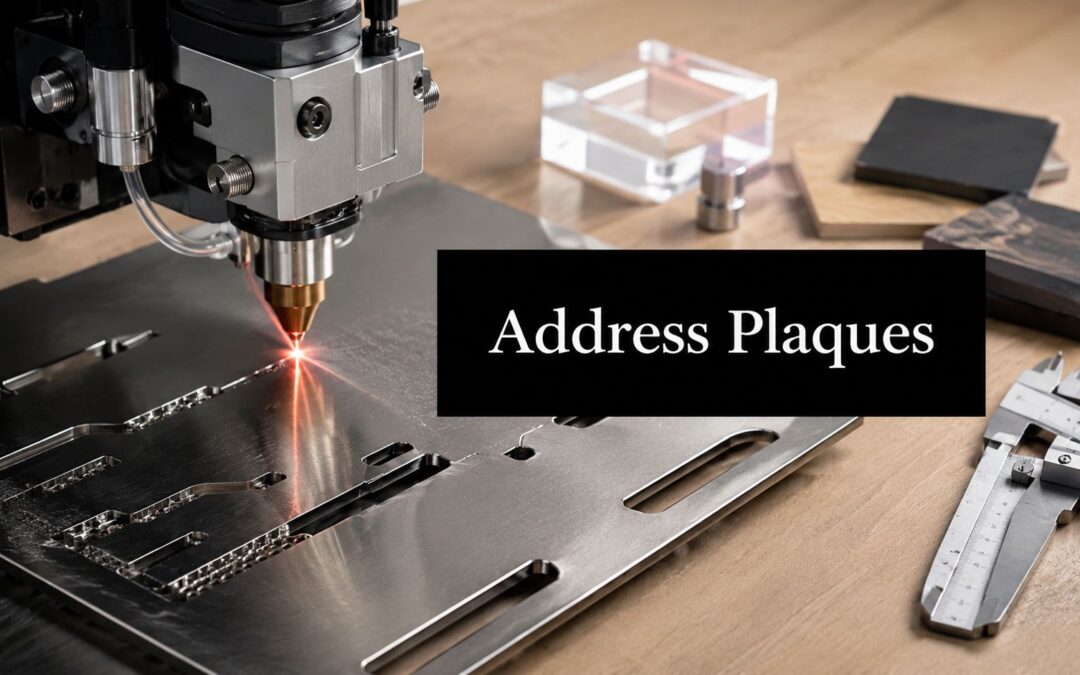
A laser follows vector geometry with a focused beam, so the cut quality depends on digital accuracy first and machine control second. For address plaques, that matters most on tight internal corners, narrow stroke widths, alignment holes, and repeat jobs where every unit has to match. The advantage is not just appearance. Better cut accuracy reduces hand finishing, improves fit-up during assembly, and helps the plaque perform properly once it is exposed to weather, cleaning, and day-to-day contact.
Trotec systems are well suited to this kind of work because they produce repeatable output across production runs. On a single custom plaque, that means crisp edges and consistent detail. On a multi-lot residential or commercial project, it means the twentieth plaque still matches the first, which is what project teams need.
What happens on the machine
The process starts long before the beam fires. Vector artwork must be clean, closed where required, scaled correctly, and organised into a cut sequence that suits the material. If the file contains overlapping paths, open shapes or unnecessary nodes, the machine will cut exactly what it is given, including the mistakes.
Focus height, power, speed and assist settings then have to match the substrate. Acrylic, coated aluminium laminates, stainless face layers and adhesive-backed composites all respond differently to heat. Some materials polish at the edge. Others char, burr, distort or show a wider heat-affected zone if settings are rushed. That is why experienced operators run test coupons and adjust for the actual sheet on the bed, not just the nominal material name on the purchase order.
The UNSW laser cutting quick start guide describes a Trotec workflow where the focusing tool is used to set the bed height accurately, and it notes the importance of vector ordering for speed and consistency. On plaque work, correct focus does more than improve appearance. It helps maintain dimensional control on mounting holes, keeps fine detail intact, and reduces avoidable rework at assembly.
Layered plaques add another level of discipline. As shown in this Trotec video on layered TroLase ADA sign production, the production sequence has to account for face stock thickness, adhesive build, registration, and the order in which elements are cut and bonded. Those same principles apply to address plaques with raised numerals, backing plates and stand-offs. If the stack-up is wrong by a small amount, the finished sign can trap water, telegraph adhesive lines, or sit unevenly against masonry.
For projects using metal components, the fabrication method also affects lifecycle performance. A well-made stainless steel address plaque starts with accurate cutting, but it also depends on sensible edge treatment, clean handling after processing, and mounting details that suit the site conditions.
A short process view makes the production logic clear:
- File preparation: Clean vectors, correct scale, and a cut order that suits the material and assembly method.
- Machine setup: Accurate focus, stable sheet hold-down, and settings tested on the actual substrate.
- Cut execution: Controlled heat input to preserve edge quality, hole size and fine detail.
- Post-cut work: Deburring, cleaning, bonding, stand-off fitting or protective finishing as required.
- Installation fit: Mounting points and tolerances checked against the wall surface, exposure level and maintenance access.
For a broader view of how professional fabrication workflows turn concept files into durable engraved and cut products, Evright's main site is a useful reference point. Their process shows how design prep, material choice and production discipline work together, which is exactly what separates a display-grade plaque from a short-lived one.
The machine matters. The finished result depends just as much on file discipline, correct focus, heat control, assembly tolerances and whether the plaque was designed for Australian service conditions from the start.
Choosing the Right Material and Finish
Material choice decides most of the plaque's lifecycle. If the substrate is wrong, no amount of careful design will rescue it once it's outside in sun, rain or salt air.
For Australian projects, 316 marine-grade stainless steel remains the safest default where long-term outdoor exposure is a concern. According to Letterbox King's stainless steel plaque range, laser-cut address plaques for Australian industrial and residential use are typically made from 316 marine-grade stainless steel at 1.2mm thickness, a specification used to maintain corrosion resistance and structural integrity over a 7-year exposure period in Australian weather conditions.
That doesn't mean every plaque should be stainless. It means stainless is the benchmark when the environment is aggressive and failure isn't acceptable.
Material Comparison for Laser Cut Plaques
| Material | Durability/Weather Resistance | Aesthetic | Best For |
|---|---|---|---|
| 316 marine-grade stainless steel | Strong choice for outdoor and coastal exposure. Handles corrosion risk better than lighter-duty metals. | Clean, architectural, available in brushed or polished looks. | Coastal homes, industrial sites, exposed commercial entries |
| Aluminium | Lightweight and easy to mount, but finish quality and coating system matter. | Contemporary, versatile, works well when colour is needed. | Sheltered exterior use, lighter wall constructions, budget-conscious projects |
| Acrylic | Good visual flexibility, especially for colour and layered effects. Better when exposure conditions are moderate. | Sharp, modern, broad colour range, suits illuminated or layered designs. | Residential plaques, internal signage, sheltered entry points |
| Brass | Visually rich but needs realistic expectations around ageing and maintenance. | Traditional, premium, heritage-oriented. | Boutique commercial sites, heritage styles, commemorative use |
| Timber or timber-look composites | Dependent on treatment and placement. Usually more vulnerable outdoors than metal. | Warm, architectural, suited to softer or natural palettes. | Sheltered residential applications, design-led interiors |
What works and what doesn't
If the plaque is going near the coast, unprotected decorative metals are rarely worth the risk. Stainless costs more upfront, but replacement labour, patching and refixing are usually the hidden cost people ignore.
Aluminium can work well where weight matters or where the plaque needs colour through coating. The weak point is usually not the metal itself, but edge exposure, coating damage or poor specification for the site. It's a reasonable material, but it isn't a universal substitute for 316.
Acrylic gives you design freedom that metal can't always match as economically. It cuts cleanly, takes colour well and works nicely in layered plaques. Where people get into trouble is treating acrylic as a one-size-fits-all outdoor solution. Placement matters. So does thickness, backing support and exposure.
Matching the finish to the environment
Finish isn't only visual. It changes maintenance demands, glare, and how small marks show up over time.
- Brushed finishes: Usually the safest architectural choice. They mute fingerprints and look consistent under changing light.
- Polished finishes: More reflective and more formal, but they show marks and surface disturbance more readily.
- Powder-coated colour: Useful when contrast or brand alignment matters, provided the coating system and substrate are suitable.
- Raw decorative metals: Better reserved for controlled contexts where natural ageing is acceptable.
If the brief leans toward stainless for outdoor longevity, stainless steel plaques for industrial and architectural applications are a good benchmark for what a properly specified plaque category looks like.
Don't choose the material by colour card alone. Choose it by location, exposure, mounting surface and who will have to maintain it in three years.
Design and Customisation Possibilities
A plaque gets judged in seconds. The courier looks from the street, the visitor checks the gate at dusk, and the installer has one chance to set it level against whatever substrate is already there. Good customisation accounts for all three stages. It is not only about choosing a font and a finish.

Start with legibility under real conditions
Screen proofs flatter bad decisions. A number that looks sharp at 300 percent on a monitor can lose clarity once it is cut, mounted, and viewed through rain, glare, or headlights.
The layout has to work at the distance and angle people will use. For address plaques, that usually means prioritising the house number over decorative elements, keeping counters open in characters like 6, 8, 9 and 0, and avoiding thin joins that become weak points in metal or disappear in dark colours. Tight spacing causes trouble too. It can look polished on screen and still read as a blur from the kerb.
Precision cutting helps, but it does not fix poor hierarchy. A laser will reproduce every good and bad choice in the file.
Depth, layering and shadow
Layered construction is one of the most useful design tools in laser-cut plaques because it changes both appearance and readability. A cut face over a contrasting backer gives clean edges and stronger contrast. Standoff-mounted elements create shadow lines that make numbers easier to pick up on textured walls. Cut-through designs can also hide fixings neatly if the spacing is planned early.
Those choices affect fabrication and installation. Extra layers add visual depth, but they also introduce more alignment points, more trapped dust, and more places for water to sit if the detail is too tight for the site. On a covered entry, that is often manageable. On an exposed coastal frontage, simpler geometry usually ages better.
File quality matters more than clients expect
A large share of production delays start in the artwork, not on the machine. Duplicate vectors, open paths, uneven offsets and badly expanded fonts all create avoidable rework. For a one-off residential plaque that may only cost time. For a grouped rollout across multiple lots or buildings, it affects nesting, consistency, and install sequencing.
I usually check whether the file can go from approval to cutting without manual redrawing. If it cannot, the design is not production-ready. Tools such as File Studio's SVG optimizer can help clean SVG artwork before it reaches fabrication, especially when logos or address numbers have passed through several design programs.
Customisation that holds up after installation
The best custom plaques are disciplined. Shape, mounting method, finish contrast and any logo work should support the primary task of identification.
- Shape: Custom outlines can work well if they suit the building geometry and leave enough margin around the text.
- Mounting: Standoffs suit rendered, brick or feature walls where shadow improves readability. Flush mounting is cleaner, but it depends more on a flat substrate and accurate fixing points.
- Information hierarchy: Street numbers need visual priority. Family names, unit IDs or icons should not compete with them.
- Lighting and contrast: Matte and brushed surfaces are usually easier to read outdoors than highly reflective combinations.
- Future maintenance: Deep recesses, very fine cutouts and exposed adhesive lines collect grime and show age faster.
Good custom work looks resolved on day one and stays readable years later. That outcome comes from treating design as part of the full plaque lifecycle, from vector prep and cut tolerance to cleaning access, mounting method and the conditions the plaque will face in Australian service.
Durability and Environmental Suitability
Australian exposure conditions are where marketing language gets tested. “Weather resistant” can mean almost anything unless you know the material, finish, thickness and site conditions behind the claim.
Coastal exposure is the obvious pressure point, but it isn't the only one. High UV, wind-driven rain, and repeated moisture cycling will expose weak coatings, poor edge finishing and underspecified metals. A cheap plaque then stops being cheap. Someone has to remove it, patch the fixing points, order a replacement and reinstall it.
The failures that show up first
In practice, plaque failure usually appears in a few predictable ways:
- Corrosion at edges or fixings: Common where unsuitable metals or hardware are mixed.
- Discolouration: More likely on materials chosen for appearance first and exposure second.
- Warping or face movement: Often tied to thin stock, poor support or unsuitable layering outdoors.
- Loss of legibility: Contrast drops as finishes age, stain or chalk.
A gap in the market is that many sellers talk about durability without giving a serious long-term picture for Australian environments. One of the few specific warnings in the available data appears in an Etsy market reference discussing laser cut metal address plaques in Australia, which cites a 2025 report by the Australian Institute of Materials stating that 68% of uncoated aluminum or thin-brass plaques installed in coastal zones show significant corrosion or discolouration within 3 years.
That statistic matters because it confirms what many project teams already learn the hard way. Decorative metal choices can look good on day one and still be wrong for the site.
What long-term value actually means
The sensible approach is to buy lifecycle performance, not just visual appeal.
That usually means selecting materials that match the environment, using finishes with realistic maintenance expectations, and avoiding details that trap water or create galvanic issues at the fixing points. It also means manufacturing efficiently. Precision laser processing generally produces less waste than rough-cut methods that need more corrective finishing, and a well-run fabrication workflow makes better use of premium sheet stock.
If a plaque is meant to stay in service for years, specification discipline matters more than novelty. The front gate, façade or equipment enclosure doesn't care what looked fashionable in the mock-up.
Applications and Compliance Across Sectors
Laser cut address plaques are often treated as a residential product, but that misses the broader value of the format. The same fabrication methods support house numbers, tenancy identification, memorial pieces, wayfinding panels, asset labels and public-facing signs.
The common denominator is controlled detail. A plaque has to present clearly, stay put, and remain legible in its actual operating environment.
Where the format fits
Different sectors use plaques differently, but the decision logic is similar.
- Industrial sites: Entry identification, asset marking, control room labels and area designation all benefit from durable cut or engraved formats.
- Healthcare facilities: Room identification and wayfinding need clean typography and predictable presentation.
- Government and infrastructure: Public-facing signs need durability and a stronger compliance mindset.
- Memorial applications: Precision cutting allows restrained, respectful detailing without visual fuss.
For these applications, laser cutting is useful because it handles both simple and highly customized formats without sacrificing repeatability. That matters when one site needs a single architectural plaque and another needs a coordinated set.
Compliance is not an optional extra
The overlooked issue is compliance. A plaque can look excellent and still be wrong for the job if it fails on contrast, reflectivity, durability or legibility in a regulated environment.
As noted by Sassy Signs in its discussion of custom metal house signs and Australian standards considerations, a critical question is what material and finish comply with Australian safety standards like AS 1319. The same source points out that most content ignores regulatory requirements for durability, contrast and reflectivity, which is a major gap for industrial and government clients.
That gap gets larger when signage is treated as a design purchase instead of a specification item.
For projects that sit closer to safety, compliance and operational use than simple street presentation, it helps to review examples of custom safety signs used in Australian industrial settings. The design language is different, but the underlying lesson is the same. Material, finish and visibility criteria need to be considered together.
Good-looking signage is easy. Good-looking signage that remains compliant in service is harder, and that's where experienced fabrication input pays off.
Partnering with Evright Industrial for Your Project
A reliable plaque doesn't come from the machine alone. It comes from knowing which material belongs in which environment, how to prepare files so the cut quality stays clean, and when a design needs to shift from decorative to compliant.
That's where experienced fabrication teams make a difference. Evright Industrial draws on the broader capability of industrial engravers in Australia, backed by nearly six decades of expertise through the evright.com business. For project managers, that matters because it means the conversation doesn't stop at shape and finish. It includes asset identification, durable engraving, memorial work, safety applications and the practical realities of installation.

Trotec Laser also remains central to the quality end of this work. That ecosystem continues to strengthen locally. Trotec Australia's September 2024 Perth facility expansion increased operational capacity in Western Australia and gave customers broader access to testing different laser cutting and engraving systems and materials for locally customized solutions.
That combination matters. Strong machine capability, disciplined fabrication and material knowledge are what turn a laser cut address plaque into a long-service product instead of a short-term cosmetic fix.
If the project involves exposed outdoor conditions, industrial use, wayfinding, memorialisation or compliance-sensitive signage, it's worth working with a fabricator that understands the full lifecycle rather than just the front-face appearance.
Evright Industrial helps organisations specify and produce durable, precise plaque and engraving solutions for Australian conditions. If you need laser cut address plaques, asset labels, memorial plaques or compliant industrial signage, talk to Evright Industrial about the site conditions, material options and production approach that best fit your project.
Recent Comments