

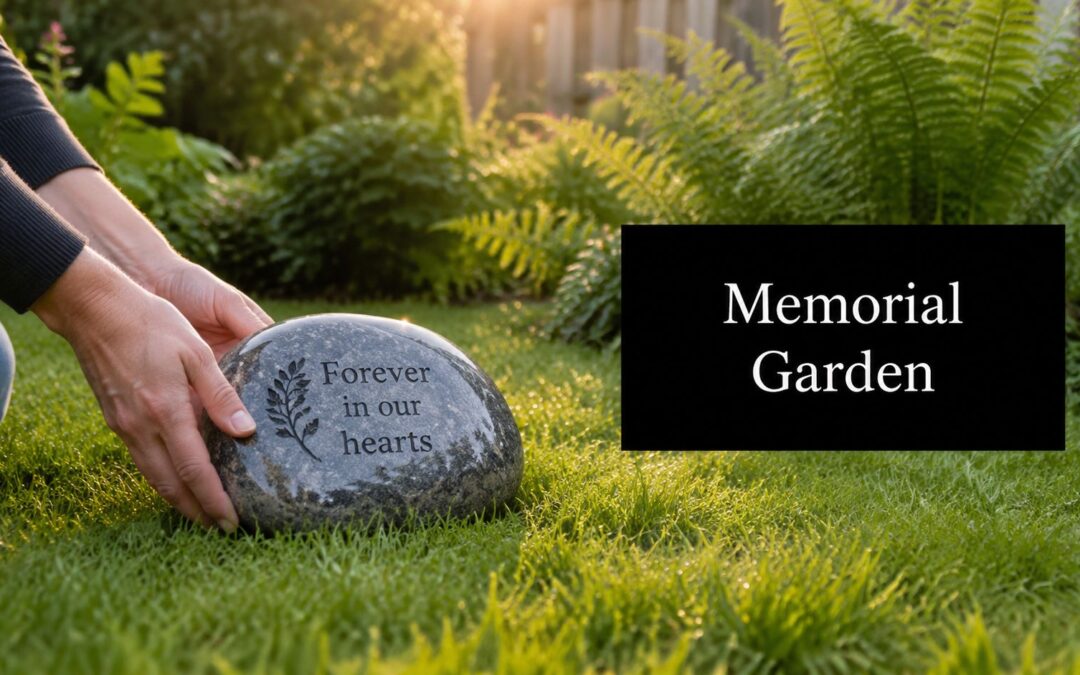
Those looking for personalized memorial garden stones near me are rarely browsing casually. They're standing in a garden that feels a little empty, looking at a corner near a rose bed, under a tree, or beside a path, and believing that spot is where the memory belongs. The right stone doesn't just mark a place. It gives that place meaning.
In Australia, that decision also comes with a practical reality. A memorial stone has to survive strong sun, rain, coastal air, shifting temperatures, and years of exposure without losing its clarity or dignity. That's why the material, the engraving method, and the workshop you choose matter far more than most buyers realise at first.
Creating a Lasting Tribute in Your Garden
A garden memorial often begins with a simple need. You want somewhere to pause. Somewhere private. Somewhere you can visit without driving to a cemetery or waiting for a formal moment. For many families, that place is a patch of lawn near the back fence, a favourite flowering bed, or the path they walk every morning.

That's especially true after the loss of a pet. In Australia, nearly 60% of pet owners who lose a pet seek a permanent outdoor memorial within the first three months, with engraved stone markers being the most preferred format due to their durability in outdoor garden conditions (pet memorial providers in Australia). That preference makes sense. A stone feels settled. It belongs outdoors. It doesn't need ceremony to matter.
Why a garden setting works so well
A memorial in the garden becomes part of everyday life. You see it while watering plants, pruning hedges, or sitting outside with a cup of tea. That regular contact matters. It turns remembrance into something gentle and ongoing rather than occasional and distant.
A good memorial stone shouldn't feel like an object dropped into the garden. It should feel like the garden made space for memory.
The surrounding environment plays a role too. Placement near gravel, native planting, or a quiet seating area can make the tribute feel calm and intentional. If you're shaping the wider area as well, these rock landscape designs show useful ways stone, planting, and pathway elements can work together without making the space feel formal or heavy.
What people usually want from the stone
Most buyers aren't looking for something ornate. They want a marker that feels personal and steady.
Common priorities include:
- A clear inscription that can still be read years from now
- A natural look that sits comfortably among plants and soil
- Enough customisation for a name, short message, date, or symbol
- Low maintenance so the tribute stays dignified without constant upkeep
That combination is why personalized memorial garden stones near me remains such a common search. People want closeness, permanence, and something made with care, not just something available for quick delivery.
Where to Find Personalised Memorial Stones Near You
If you're searching locally, the best results often come from looking beyond the obvious phrases. Many of the most capable memorial makers don't describe themselves only as memorial businesses. They may operate as stone engravers, monumental masons, awards and engraving specialists, or plaque makers with memorial capability.
Search terms that produce better results
Typing only “memorial stone near me” can bring up gift shops, dropship websites, and mass-market resin products. More targeted searches usually lead to workshops that engrave and finish the work themselves.
Try combinations like these:
- Personalised memorial stone engraver
- Monumental mason near me
- Laser engraved memorial plaque Australia
- Stone engraving for garden memorials
- Pet memorial stone maker
- Bronze memorial plaque engraver
- Awards and engraving specialist memorial plaque
The reason this works is simple. Workshops that already engrave plaques, awards, industrial tags, or commemorative markers often have better machinery, deeper materials knowledge, and tighter proofing processes than general online gift retailers.
Places worth checking besides Google
A local search is only the starting point. Some of the most reliable suppliers come through referral networks.
A practical shortlist usually comes from:
Funeral homes
They often know which local engravers deliver clean work and reliable turnaround.Cemeteries and memorial parks
Staff can often point you toward approved or commonly used stone and plaque suppliers.Monument and headstone workshops
Even if they mainly produce cemetery work, many will create garden stones or refer you to someone who does.Awards and engraving businesses
These shops sometimes handle memorial plaques and can advise on laser engraving options for stone or attached plaques.
Ask one direct question early: “Do you engrave natural stone in-house, or do you outsource it?”
The answer usually tells you a lot about quality control and lead time.
Local workshop or specialist online provider
There's no single right answer here. A local workshop lets you inspect material, colour, thickness, and finish before committing. That matters if you want to compare slate against granite or see how a river stone curves.
An online specialist can still be a solid option if they show real examples, provide layout proofs, explain materials clearly, and answer detailed questions without vague sales language.
Here's a simple comparison:
| Option | Best for | Watch for |
|---|---|---|
| Local workshop | Seeing the stone in person, discussing finishes face to face | Limited range in smaller towns |
| Online specialist | Wider design choices and Australia-wide delivery | Poor material transparency or generic mock-ups |
What to vet before you order
Before you commit, check whether the supplier can explain:
- Material type and whether it's natural stone or moulded resin
- Engraving method, especially whether they use laser engraving or another process
- Proof approval, including font, layout, and spacing
- Outdoor suitability for Australian conditions
- Installation advice for gardens, lawns, or gravel beds
A careful buyer usually gets a better memorial. Not because the process has to be difficult, but because the quality differences are real once the stone has been outside for a year or two.
Choosing a Stone That Will Endure the Elements
Material is where a memorial either earns its permanence or fails it. Buyers often spend more time choosing wording than choosing stone, but the substrate determines how well that tribute will survive Australian conditions.

Natural stone and artificial resin may look similar on a product page. Outdoors, they don't age the same way.
Why natural stone usually holds up better
Granite, basalt, slate, and selected river stones have the main advantage that matters in a memorial. They're real stone. They don't rely on a decorative outer finish to appear substantial. When properly engraved and placed well, they keep their character over time.
By contrast, a 2025 report found that 68% of artificial resin memorial stones purchased from big-box retailers in the AU region show significant weathering, discoloration, or structural failure within 2 years due to UV exposure and salt air (Australian report on outdoor commemorative products). That's the durability gap many buyers don't see until the tribute has already faded, chalked, or cracked.
Comparing common memorial stone options
Each stone has a different look and working behaviour. The right choice depends on location, design complexity, and whether you want the memorial to feel formal or organic.
| Stone | Strength outdoors | Visual character | Engraving considerations |
|---|---|---|---|
| Granite | Excellent resistance to weathering | Clean, classic, available in darker tones | Suits precise text and detailed artwork |
| Slate | Good when quality is high | Layered texture, softer natural appearance | Best with simpler layouts and careful handling |
| Basalt | Very durable and dense | Dark, modern, understated | Takes crisp engraving well |
| River stone | Good for sheltered to moderate conditions | Natural, rounded, informal | Surface curvature limits text and layout |
| Sandstone | Softer and more porous | Warm, earthy, traditional | Better for sheltered locations and simpler designs |
The false economy of cheap substitutes
Resin products often win on convenience. They're widely available, lightweight, and usually fast to order. The problem is that memorials aren't seasonal décor. You're choosing something meant to stay in place through summers, storms, and years of exposure.
Practical rule: If a memorial stone is sold mainly on price and appearance, ask what happens after prolonged UV, rain, and coastal air exposure.
For many gardens, granite is the safest premium choice because it combines hardness, stable colour, and strong engraving performance. Basalt also performs well where a darker, understated finish suits the space. Slate can be beautiful, especially in cottage gardens, but the quality of the slate matters. Poor slate can delaminate or weather unevenly. River stones work well for pet memorials and informal settings, though their rounded faces restrict the amount of wording you can fit cleanly.
If you're considering a stepping-stone format rather than a freestanding marker, these personalized memorial stepping stones show the kind of application where material stability and engraving clarity both need to be considered together.
Match the stone to the site
A memorial beside the coast needs a different level of resilience than one in a shaded inland courtyard. The right decision comes from matching the stone to where it will live.
Use this quick guide:
Coastal gardens
Choose dense natural stone with proven weather resistance and avoid decorative resin.Full-sun locations
Prioritise materials and engraving that won't bleach, distort, or lose contrast.Informal native gardens
River stones and darker natural stones often sit more comfortably than polished formal plaques.High-traffic pathways
Use a stone with enough thickness and toughness to avoid chipping or instability.
A lasting tribute starts with accepting one hard truth. The cheapest option is often the one you replace.
Designing Your Meaningful and Personalised Tribute
The design stage is where emotion meets physical limitation. A stone can carry a lot of feeling, but it can't carry unlimited text, especially on small natural surfaces. The best memorials are usually the clearest ones.

Start with the core message
Most strong designs begin with one anchor element. That might be a name, a short phrase, or a relationship marker such as “Our beloved girl” or “Always with us”. Once that's chosen, the rest of the layout becomes easier.
A simple structure often works best:
- Name or main dedication
- Optional date or year range
- One short line of sentiment
- A small symbol, if it adds meaning rather than clutter
If you're struggling to condense your wording, it helps to review examples before drafting your own. These memorial plaque wording examples show the difference between wording that reads cleanly on stone and wording that feels crowded.
Work within the space you actually have
Many designs fall short in this regard. In Australia, smaller riverstones (10–15 cm) typically support up to 12 engraved characters, while larger ones (15–20 cm) can accommodate up to 16, reflecting strict physical constraints based on laser resolution and stone curvature (Australian stone engraving product reference). Those limits aren't arbitrary. Curved surfaces and readable letterforms leave very little room for excess text.
That means:
- A pet name may fit beautifully on a small river stone
- A full name plus dates may require a larger, flatter stone
- A long quote usually belongs on a plaque or larger slab, not a rounded pebble
Less text often creates more presence. A short, balanced inscription is easier to read, easier to engrave well, and more graceful in the garden.
Symbols and imagery that work well
Small motifs can add warmth if they support the message. Common choices include hearts, flowers, crosses, leaves, birds, and paw prints. The simplest graphics generally age best because they remain legible as light changes across the stone surface.
A good workshop will tell you when an image is too fine for the stone you've chosen. That advice matters. Tiny decorative details may look appealing on a screen proof but disappear visually once installed in a garden.
For families exploring alternatives that tie remembrance to transformed remains, Cremation.Green's memorial options offer another perspective on how a tribute can take physical form in a natural setting.
A practical layout check before approval
Before signing off on artwork, review these points:
Readability
Can you read the inscription from standing height, not just on a zoomed-in proof?Spacing
Are the lines breathing properly, or has everything been compressed to fit?Balance
Does one symbol or line dominate the stone awkwardly?Tone
Does the wording sound like the person or pet you're remembering?
Design restraint isn't cold. In memorial work, restraint is often what gives the piece dignity.
Why Precision Laser Engraving Matters for Longevity
A family chooses a dark granite memorial stone, approves a beautiful layout, and places it in the garden. Two summers later, the lettering looks washed out because the mark was too shallow and the detail was never cut cleanly enough for outdoor exposure. That disappointment usually comes back to the engraving method, not the wording.
A memorial stone has two jobs. The material has to hold up in heat, rain, irrigation, and salt air. The inscription has to stay readable through all of it.

What laser precision changes
On hard materials such as granite, basalt, and some coated plaque surfaces, precision laser engraving gives tighter control over line quality than rougher marking methods. That matters in memorial work because small faults become more obvious over time. A slightly ragged letter edge catches dirt. Uneven depth makes parts of a name fade visually in strong sun. Fine artwork that looked acceptable on a proof can lose definition once it is outdoors.
Good laser work improves four things that directly affect longevity:
- Letter edge clarity, so text stays crisp instead of fuzzy
- Consistency across the whole inscription, especially on multiple lines
- Control on dense materials, where cleaner marking is harder to achieve
- Reproduction of finer artwork, such as paw prints, floral outlines, and delicate symbols
I tell families to judge engraving with the same seriousness as the stone itself. The stone is the body of the tribute. The inscription is the part you return to read.
Why equipment and operator skill both matter
The machine matters, but setup matters just as much. Professional systems such as Trotec Laser are widely used because they allow repeatable control on demanding materials. In a workshop setting, that helps with fine serif lettering, smaller layouts, and detailed motifs that need clean separation between lines.
Poor settings can still ruin a good stone. Too much power can create a harsh, overburnt look on some surfaces. Too little can leave a weak mark that lacks contrast. The right workshop tests for the material, the colour, and the level of detail before production starts.
There's also value in seeing the process in motion:
Laser engraving versus rougher methods
No engraving method suits every memorial. The best choice depends on material, layout, and how fine the detail needs to be.
| Method | Strength | Limitation |
|---|---|---|
| Laser engraving | Fine detail, clean lettering, repeatable precision | Depends on correct setup and material suitability |
| Mechanical engraving | Useful for some heavy-duty applications | Can produce less refined detail on intricate layouts |
| Sandblasting | Effective for bold, larger-format work | Less suited to fine graphics and very tight text |
For a small garden memorial, precision usually gives the better result. That is especially true if the inscription includes a longer name, dates, or artwork with delicate linework. Clean definition holds its dignity better in changing light and weather.
Evright Industrial produces laser-engraved memorial plaques and similar work where controlled detail matters. In practical terms, the process starts with approved wording and artwork, then converts that file into a production-ready layout for accurate engraving on the chosen plaque or memorial surface.
A memorial inscription should still look intentional years later. Crisp linework usually ages better than coarse detail.
The common buying mistake is treating engraving as a minor finishing detail. In outdoor memorial work across Australian conditions, it often determines whether the tribute still reads clearly after years in the garden.
Finalising Your Order and Caring for Your Stone
By the time you're ready to order, most of the emotional decisions have already been made. What remains are the details that protect the result. Here, careful questions save disappointment later.
Questions worth asking before you approve
A supplier should be able to answer these clearly, without vague wording or generic assurances.
What material is this exactly
Ask whether the piece is natural stone, composite, or resin.How will the text be engraved
You want the method identified plainly, not hidden behind broad terms like “custom finished”.Will I see a proof first
Always review spelling, spacing, line breaks, and symbol placement before production.What does outdoor care involve
A good supplier will tell you how to clean it and where not to place it.Where is the material sourced from
This matters to many buyers now, and it's reasonable to ask.
Sustainability is now part of the buying decision
That last question isn't niche anymore. A 2025 survey revealed 74% of Australian consumers are concerned about the environmental impact of memorial products, yet only 12% of online retailers provide transparent data on material sourcing or sustainability (Australian sustainability survey reference). If a retailer can't tell you what the stone is, where it came from, or how it was made, that's useful information in itself.
Placement and ongoing care
Once the stone arrives, placement affects both appearance and lifespan. Set it where water won't pool underneath and where mowing, edging, or foot traffic won't constantly knock against it. If it's a plaque on a stake or stand, make sure it's fixed securely and sits level.
For care, keep it simple:
- Use water and a soft cloth for routine cleaning
- Avoid harsh chemicals that can affect finishes or surrounding planting
- Remove built-up soil gently from engraved areas
- Check stability occasionally, especially after heavy rain
A memorial stone doesn't need much maintenance when it's well made and placed properly. What it needs most is a sound material, clear engraving, and enough thought before the order is placed.
If you're planning a memorial that needs to hold up in Australian conditions, Evright Industrial is one place to start. The team applies the engraving capability of evright.com to memorial plaques and related custom work, using precision laser processes suited to durable, clearly legible tributes.
Recent Comments