

A lot of teams only start thinking seriously about asset tracking labels after one fails.
It's usually the same pattern. A generator, switchboard, pump, test instrument, mobile cart, or medical device needs service. Someone goes to scan the tag, and the barcode is bleached out, the corner has lifted, or the printed surface has been scuffed to nothing. The asset is still there, but its identity isn't. That's when a cheap sticker turns into a maintenance problem, a compliance problem, and often a downtime problem.
In Australian conditions, that failure happens faster than many buyers expect. Indoor office-grade labels might cope in a dry storeroom. They won't last on coastal infrastructure, open plant, utilities equipment, mining support assets, or any site where UV, grime, washdown, vibration, and heat all hit the same tag. Most generic guides still talk about labels as if every asset lives indoors. That advice breaks down quickly on real sites.
The True Cost of a Failed Asset Label
A failed asset label rarely causes trouble on its own. The damage shows up when a technician can't confirm service history, when an auditor can't match equipment to records, or when a replacement part gets fitted to the wrong unit because two similar assets are no longer clearly identified.
On a remote site, the smallest weak point is often the label. If the maintenance history sits behind a serial number or barcode and that mark has peeled away, the job slows immediately. Teams start searching spreadsheets, photos, old PDFs, and handwritten notes. Someone makes a phone call. Someone guesses. None of that belongs in a controlled maintenance process.
The market tells the same story. The global asset tracking market was valued at USD 21.25 billion in 2023 and is projected to grow at a 12.4% CAGR to USD 59.64 billion by 2032, according to Fortune Business Insights on the asset tracking market. That growth reflects a broader shift toward more reliable tracking systems, including in Australian industrial settings where labels have to support safety, budget control, and equipment accountability.
Practical rule: If the asset matters enough to maintain, inspect, calibrate, or replace, it matters enough to identify permanently.
Cheap paper labels often look acceptable on day one. They fail at the edges first. Then the face stock chalks, the print fades, moisture gets underneath, and scan performance drops long before the tag falls off. By the time the label looks obviously bad, the tracking system has already started losing reliability.
That's why durable asset tracking labels should be treated as a control measure, not stationery. The tag is the physical point where field work meets your database. If that point fails, the software behind it doesn't help much.
Understanding What Asset Labels Actually Track
An asset label works like a car's number plate. The plate itself doesn't carry the full ownership history, registration details, insurance data, and service notes. It carries a unique identifier that points to a larger record. Asset tracking labels do the same job for tools, machinery, medical equipment, switchboards, field devices, and movable infrastructure.

The label is the key, not the whole system
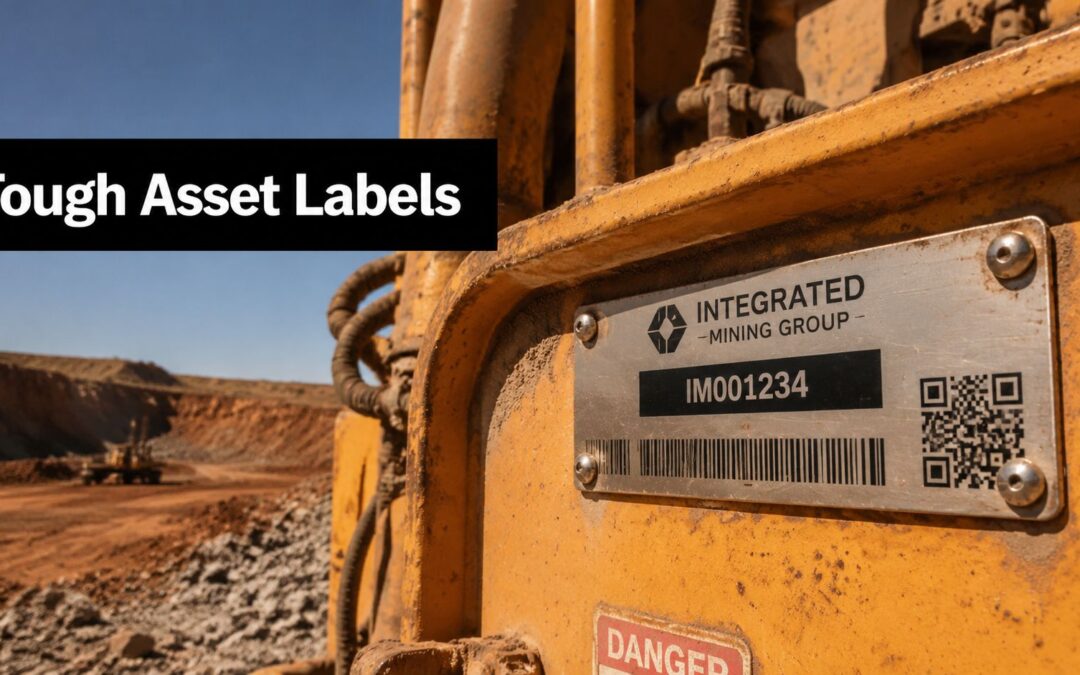
The visible part of the tag is usually simple. It might include:
- Asset ID: A unique serial or internal reference.
- Machine-readable code: Barcode or QR code for fast scanning.
- Ownership detail: Company name, logo, or department identifier.
- Basic status fields: In some environments, service class or equipment type.
What matters is what that identifier reveals in your asset register.
A well-structured system can link one tag to maintenance schedules, calibration records, warranty dates, purchase details, assigned user, installation location, operational status, and retirement history. That's why the label must remain readable. If the code fails, access to the rest of the record becomes slower and less dependable.
What teams usually need to see quickly
In practice, field staff don't want a label crowded with text. They want enough information to confirm they've got the right asset, then pull the rest from the system.
The most useful linked data usually includes:
- Maintenance history so technicians can confirm prior work.
- Inspection and test dates for regulated equipment.
- Assigned location or department for accountability.
- Warranty and procurement data for replacement decisions.
- Usage notes or status where multiple teams share the same asset.
That separation matters. The label should identify. The database should inform.
A readable code and a clean data record beat a label overloaded with tiny text every time.
This is also where asset tracking labels start influencing stock control. When assets, spares, and service items are tied together properly, teams can spot shortages and movement patterns earlier. If you're reviewing how tracking data connects to replenishment and inventory flow, Wistec's guide to software to reduce stockouts is a useful adjacent read.
Why the physical label still matters
Some buyers assume the software does the heavy lifting, so the tag can be basic. That's backwards. The software only works cleanly when the label remains attached, legible, and scannable in its operating environment.
A weak tag creates duplicate records, manual re-entry, and uncertainty in the field. A good tag creates one reliable identity for the whole life of the asset. That's the job.
Choosing Label Materials for Australian Conditions
Most label selection mistakes happen because buyers choose by price or print appearance rather than exposure conditions. A label that lives on an indoor IT asset doesn't face the same risk profile as one mounted on plant near the coast, on a ute-stored test instrument, or on outdoor infrastructure under full sun.
Australia is particularly unforgiving. Technical benchmarks show that labels using durable polyester or vinyl with UV-resistant barcodes maintain 98% readability after 12 months of outdoor Australian exposure, compared with 65% for standard paper-based labels. That gap matters when the asset has to stay identifiable through routine scanning, maintenance, and audit work.
What fails first outdoors
Standard paper labels are the wrong starting point for harsh environments. They absorb moisture, degrade under UV, and lose face stock integrity quickly. Basic printed films can last longer, but they still struggle if the surface coating is doing all the work and the site includes abrasion, salt air, solvents, or repeated cleaning.
The common failure modes are predictable:
- UV fade: Black bars lose contrast and scanners stop reading consistently.
- Edge lift: Adhesive failure starts at corners and spreads.
- Surface abrasion: Forklifts, gloves, tools, and washdown remove printed information.
- Chemical attack: Cleaners, oils, and process residues soften adhesives or damage print layers.
When buyers say a label “should be fine”, they're often describing a warehouse assumption, not a field condition.
Material comparison for real deployments
For industrial asset tracking labels, the material needs to match the asset's life and exposure. That may mean polyester or vinyl for moderate conditions, or moving to rigid plates where the environment is rougher.
| Material | Best For | Durability | Cost |
|---|---|---|---|
| Paper | Short-term indoor identification | Low | Low |
| Polyester with UV-resistant barcode | Indoor industrial use and moderate outdoor exposure | High | Moderate |
| Vinyl with UV-resistant barcode | Outdoor assets with some flex or curved surfaces | High | Moderate |
| Anodised aluminium | Long-life industrial asset tags and fixed equipment | Very high | Moderate to high |
| 316 stainless steel | Harsh chemical, abrasion, or high-heat settings | Very high | High |
| Traffolyte or multi-layer acrylic | Engraved control panels, electrical labels, plant ID | High | Moderate |
Matching the material to the job
Flexible labels still have a place. Polyester and vinyl are practical where you need adhesion to smooth equipment, lower profile tags, and good barcode performance without the cost of a metal plate.
Rigid tags earn their keep when the asset is exposed to:
- Constant outdoor UV
- Salt spray near marine or coastal sites
- Heavy abrasion or washdown
- Heat cycling on plant and infrastructure
- Long service life where relabelling is disruptive
For chemically aggressive settings, the safest route is to specify a material and construction designed for cleaners, solvents, and industrial residues. That's where specialised options such as chemical-resistant labels become relevant.
Buy the label for year three, not for the day it arrives in the carton.
The key trade-off is simple. Softer, cheaper constructions are easier to buy and easy to overuse. Harder-wearing constructions cost more upfront but stop relabelling from becoming a hidden maintenance task. In harsh Australian conditions, that trade usually favours durability.
Marking Methods Laser Engraving Versus Printing
Material choice matters, but the marking method often decides whether the label survives. Many failures blamed on “bad labels” are really failures of surface printing. The substrate may still be attached while the identification itself has already been rubbed off, bleached out, or chemically damaged.
That's the practical difference between printing and engraving. Printing puts information onto the surface. Engraving makes the mark part of the tag.

Where printing still fits
Thermal transfer and other printed methods still have valid uses. They're suitable for controlled indoor applications, shorter asset life, and situations where teams need rapid, on-demand variable data on labels that won't face much abrasion or weather.
They're less suitable when the asset label is expected to survive:
- rubbing against tools or cables
- repeated wipe-downs
- outdoor service
- harsh cleaners
- rough handling during maintenance
Printed labels can look sharp initially. That doesn't make them permanent.
Why engraved marks last longer
Laser engraving removes or alters the material itself. On metal and suitable laminates, that means the code, serial number, and text aren't dependent on a thin ink layer staying intact. Once the mark is in the substrate, abrasion has to remove the substrate to remove the information.
That's why Trotec Laser equipment is the gold standard for permanence in industrial marking. The beam control, consistency, and fine detail are what allow dense serialisation, logos, and machine-readable codes to be produced cleanly on durable stocks without relying on a fragile printed face. For asset tracking labels that need to hold up in the field, that difference is substantial.
If the environment can strip paint, it can strip print.
Trotec laser machine imagery is the right visual reference for this work because it reflects the actual permanence process. Mechanical marking imagery often confuses the issue. For industrial asset identification, the detail and repeatability of laser engraving are what matter.
The practical trade-off
Printing is usually cheaper and faster for temporary or sheltered applications. Engraving takes a more deliberate approach and usually pairs best with metal or engraving laminates. But once the label is exposed to site reality, permanence tends to outweigh the initial saving.
A typical decision path looks like this:
- Office equipment or sheltered indoor assets: Printed polyester may be enough.
- Factory-floor equipment with moderate wear: Durable synthetic labels can work if exposure is controlled.
- Outdoor, high-value, regulated, or long-life assets: Engraved metal tags are the safer choice.
For teams specifying rigid identification plates, engraved metal labels are the format to look at when print durability is no longer sufficient. Evright Industrial produces these kinds of permanent tags using Trotec Laser systems to mark serial numbers, QR codes, and identification data onto durable substrates for industrial use.
Selecting Your Data and Encoding Strategy
Once the tag construction is right, the next decision is how the asset data should be encoded. This is where many systems become either overbuilt or too basic. A clever format isn't useful if field staff can't scan it quickly, and a simple format won't help if it can't support the data you need to retrieve.

Serial numbers, 1D codes, 2D codes, and RFID
At the simplest end, a human-readable serial number gives visual identification. It's easy to understand and useful when scanners fail or when staff need to confirm an item manually. The weakness is speed and accuracy. Someone has to read it and enter it correctly.
A 1D barcode, such as a standard linear format, is still a strong practical choice for many industrial sites. It scans quickly, works well for straightforward identification, and doesn't demand a complex rollout. If your goal is fast lookup of a single asset record, 1D often does the job cleanly.
A 2D code such as a QR code holds more data in less space and usually gives you more flexibility on small tags. Technical data shows that labels incorporating barcoded identification numbers and QR codes enable organisations to reduce manual tracking errors by 72%, significantly improving asset lifecycle management and compliance with AS/NZS 4801 safety standards.
A short demonstration of machine-readable marking in practice helps make the difference clearer:
How to choose without overcomplicating it
The right strategy usually comes down to three questions.
How much data must the code carry?
If the code only needs to point to a database record, 1D can be enough. If space is limited or you want richer encoded information, 2D becomes more attractive.What scanners do your teams already use?
Don't choose a format that forces a hardware refresh unless the operational gain is clear.How rough is the scanning environment?
Dirty, scratched, or small labels often favour well-produced 2D codes because of their error-handling advantages, provided the scanners support them.
Where RFID fits
RFID can be useful when line-of-sight scanning is impractical or when bulk reading matters. It isn't automatically the right answer. It adds infrastructure, tag cost, and deployment complexity. In harsh outdoor Australian environments, it also raises survivability questions that many generic guides gloss over.
That's why many industrial systems still settle on a reliable hybrid of:
- Human-readable ID for manual verification
- Barcode or QR code for day-to-day scanning
- Database-linked record for everything else
That approach also mirrors adjacent logistics environments where physical identifiers have to stay tied to digital workflows. If you work across fulfilment and inventory handling as well, AUSFF's explanation of Amazon prep for e-commerce is a practical example of how correct labelling and handling standards affect downstream operations.
Label Placement and Lifecycle Best Practices
A good asset label can still fail if it's put in the wrong place, applied badly, or designed without the compliance fields the site needs. That's why deployment matters as much as specification.

Nearly all generic content misses the regulatory side of this. In Australia, the gap is significant. The lack of AU-specific compliance integration, including requirements tied to the WHS Act 2011 and TGA medical device rules, contributes to 25% to 35% higher compliance audit failures for industrial firms due to non-standardised label data.
Place the label where people can scan it and where it can survive
Those two requirements often conflict.
The easiest place to scan may be the first place to get hit by boots, pallets, UV, or washdown. The most protected position may be too awkward for a technician crouched beside a pump or standing at a switchboard. Good placement balances both realities.
A few rules work well on most sites:
- Avoid wear points: Don't place labels where straps, hands, hoses, or tools constantly rub.
- Keep line of sight practical: The code should be accessible without dismantling guards or moving the asset.
- Use flat, stable surfaces where possible: Curves, textured coatings, and rough castings reduce adhesion and scan consistency.
- Think about service posture: Put the label where a technician naturally stands during inspection.
Field note: If a worker has to kneel in mud, shine a torch sideways, and wipe grime off a code every time, the placement is wrong even if the label survives.
Build compliance into the label design
Many systems encounter inconsistencies when faced with diverse demands. One department wants an asset number. Another wants a serial number. A third wants a last-service date. Healthcare teams may need equipment identifiers that connect cleanly to maintenance and usage records. Electrical contractors may need inspection-linked identification that remains legible in demanding site conditions.
A disciplined label standard should define what appears physically on the tag and what sits in the database.
Common on-label data fields include:
- Unique asset ID
- Serial number or equipment reference
- Organisation or department identifier
- Machine-readable code
- Any mandatory compliance marker relevant to the asset class
The trick is resisting clutter. If the tag carries every possible field, readability suffers. If it carries too little, staff revert to guesswork. The standard needs to match the asset type.
For teams building a site-wide policy, asset tracking best practices is a useful framework for standardising design, application, inspection, and replacement.
Treat labels as part of the asset lifecycle
The label should enter the process at commissioning, not as an afterthought. From there, it needs periodic inspection just like the equipment it identifies.
A workable lifecycle approach includes:
- Surface preparation before application
- Verification after installation
- Periodic readability checks
- Prompt replacement of damaged labels
- Controlled decommissioning when the asset is retired or repurposed
This matters most in healthcare, essential services, utilities, and contracting environments where equipment identity links directly to maintenance decisions. If the label is unreadable, teams don't just lose convenience. They lose confidence in the record.
Your Partner in Permanent Asset Identification
Asset tracking labels aren't a minor purchasing item. They're part of how an organisation controls maintenance, compliance, traceability, and field efficiency. The right result comes from matching the material, marking method, encoding format, and placement to the actual environment rather than to a catalogue description.
Evright Industrial is a specialised division of evright.com, bringing nearly six decades of engraving experience into industrial identification, equipment marking, safety signage, and durable custom plates. If your broader workflow also depends on clean digital product and asset data, NanoPIM's guide to managing product content for retailers is a useful companion read because it highlights the same core principle: reliable systems depend on reliable identifiers.
If you need durable asset tracking labels that will hold up in Australian industrial conditions, Evright Industrial can help you specify the right material, marking method, and data format for the job. Their work centres on permanent laser-engraved identification using Trotec Laser technology, with solutions for plant, tools, medical equipment, infrastructure, and compliance-driven environments.
Recent Comments