
A lot of Brisbane buyers arrive at the same point for different reasons. An operations manager is replacing another failed asset label. A facilities team is tired of signs that look dated before the fitout is even complete. A memorial planner needs something that feels respectful now and still looks right years later.
That's where glass engraving earns its place. Done properly, it doesn't rely on adhesives, printed overlays, or finishes that rub away under handling and cleaning. It creates a permanent mark on a material people already associate with clarity, order, and presentation. For industrial use, that means dependable identification. For commemorative work, it means a tribute that doesn't feel temporary.
The Mark of Permanence Why Brisbane Businesses Choose Glass
Cheap labels nearly always fail in the same way. The corner lifts. Moisture gets underneath. Cleaning chemicals dull the print. Sunlight washes out contrast. Then somebody has to identify equipment, move around a site, or present a space with signage that no longer looks trustworthy.
Glass solves a different problem than plastic labels or printed stickers. It's chosen when the mark itself needs to belong to the object, not sit on top of it. In Brisbane workplaces, that matters for reception signage, recognition displays, donor walls, directional panels, and controlled environments where appearance and legibility both matter. The same logic applies in commemorative settings, where permanence is part of the message.
A lot of teams first think about engraving as decoration. In practice, it's often a risk-reduction decision. If a sign is part of safe navigation, clear identification, or brand presentation, failure becomes expensive in ways that aren't always obvious at the quoting stage. That's one reason durable engraved signage continues to sit alongside broader signage as a critical part of commerce and life.
Where permanence matters most
- Professional interiors: Reception signs, directory panels, and meeting room identifiers need to stay sharp under frequent cleaning.
- Operational spaces: Identification plates and fixed information panels must remain readable after regular handling.
- Memorial installations: Families and institutions usually want a finish that feels calm, permanent, and respectful.
- Awards and presentation pieces: The engraving needs to match the value of the occasion, not look like an afterthought.
A faded sign doesn't just look old. It makes the entire environment feel less controlled.
There's also a reason this process still carries weight. Glass engraving has a long documented history. Scenes engraved on glass vessels were already popular by the 1st century A.D., and by the 1700s the craft had been refined into diamond point and copper wheel methods, giving today's Brisbane buyers a decorative technique with continuity across well over a millennium, as outlined in this brief history of engraving.
The Art and Science of Modern Laser Engraving
A Brisbane planner ordering a memorial panel and a site manager specifying a glass identification plate often need the same thing. A mark that stays clean, readable, and consistent after installation. The application changes. The standard for precision does not.

Modern laser engraving works by changing the glass surface in a controlled way to create a frosted mark. On a good job, that finish looks even and deliberate. On a poor job, the problems show up quickly. Haze, edge breakout, patchy fill, weak contrast, or fine chips around detail.
That is why machine control and setup discipline matter more than the artwork alone. In our workshop at Evright Industrial, the file is only one part of the result. Focus height, glass type, support under the panel, surface cleanliness, and power settings all affect whether the final mark looks sharp or stressed.
What the laser is actually doing
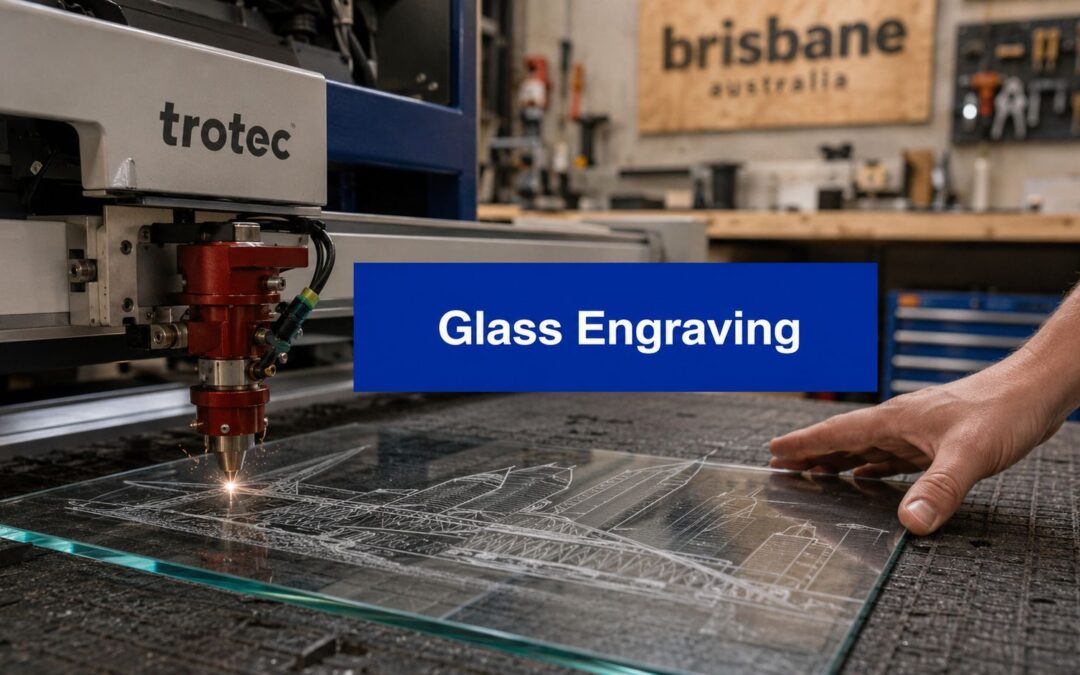
Laser engraving on glass is a surface process, not a deep cut. The beam creates a fine fractured texture on the top layer, and that texture is what gives engraved glass its pale, etched appearance. If the energy is too high, the mark can turn coarse. If it is too low, contrast drops away and detail starts to disappear.
Material preparation has the same practical weight as machine settings. Fingerprints, dust, coating residue, and poor fixturing all interfere with consistency. Trotec's guidance on engraving glass explains the same core principle. Clean material, correct focus, and controlled settings are what reduce chipping and produce a more even finish, as outlined in Trotec's advice on laser engraving glass.
Small setup errors become visible fast on glass because the substrate gives you nowhere to hide.
Why older methods still matter
Traditional methods still help define what a good result looks like. Diamond point and copper wheel engraving produced fine linework and character that many clients still respond to, especially for commemorative pieces and presentation work. Laser engraving brings a different strength. It gives repeatability, cleaner layout control, and practical production speed across one-off tributes, branded architectural pieces, and industrial identification panels.
That shared precision is what links commemorative and industrial work. The same discipline used to mark a glass panel for a controlled facility also applies when producing a memorial plaque that needs a calm, even finish and legible detail.
For a closer look at process options, this guide to glass engraving techniques compares methods by finish, application, and production suitability.
A short process video helps show that difference in a more practical way.
What works and what doesn't
| Approach | Usually works well | Usually creates problems |
|---|---|---|
| Clean, flat glass with stable positioning | Crisp frosted marks and even contrast | N/A |
| Dirty surface or residue left on glass | N/A | Patchy finish and haze |
| Correct focal height | Better detail and cleaner edges | N/A |
| Poor fixturing or uneven support | N/A | Misalignment and inconsistent marking |
| Well-prepared artwork | Legible fine detail | N/A |
| Overly dense artwork on unsuitable glass | N/A | Muddy appearance and reduced clarity |
Industrial Applications for Uncompromising Environments
A control room panel that loses legibility after routine cleaning is not a design problem. It is an operating problem. On Brisbane industrial sites, engraved glass is usually selected when the mark needs to stay clear, consistent, and professionally presented over time.
Glass earns its place in these jobs because the information is part of the surface treatment, not a printed layer waiting to wear off. That matters for equipment identification, fixed process information, control panels, architectural wayfinding inside industrial facilities, and display panels where presentation still counts.

Precision affects installation, maintenance, and replacement risk
In workshop terms, industrial glass engraving is won or lost before the laser fires. Material type, panel size, support method, focal setup, and artwork placement all affect whether the finished piece looks controlled or becomes expensive rework.
Bed size is a practical example. If a panel can be engraved in one setup, margins, hole clearances, and alignment across a set are easier to hold. If the job has to be repositioned, the risk goes up immediately. I have seen perfectly acceptable artwork become a poor industrial panel because the layout had to be picked up a second time.
The same applies to finish selection. A dense frosted graphic may suit a branded feature panel, but a cleaner layout is often better for plant signage, machine labels, and instruction panels that need instant readability under site lighting.
What industrial buyers should check before approving a job
- Ask how the panel will be set up in the machine: Large sheets, pre-cut pieces, and multi-panel runs need stable support and repeatable positioning.
- Confirm the supplier can handle the actual panel size: Large-format work is easier to keep accurate when it fits the machine bed without secondary alignment.
- Discuss the glass itself, not just the artwork: Thickness, edge condition, coatings, and drilled holes all affect how the job should be processed.
- Specify the viewing conditions: A mark that looks good on a bench can read very differently once installed behind lighting, near reflections, or at an angle.
- Match engraving density to function: Decorative coverage and high-legibility identification are different jobs, even when they use the same laser process.
A simple rule helps here. If the conversation starts and ends with artwork, the production discussion is incomplete.
Buyers looking for industrial engravers in Australia are often trying to solve a broader problem than marking alone. They need consistency across multiple panels, reliable placement relative to hardware, and a finish that will not create maintenance questions later. That is the point where industrial and commemorative engraving meet. Whether the job is a factory identification panel or a permanent tribute installed in a public space, the standard is the same. The mark has to stay precise, readable, and fit for the environment.
Creating Lasting Tributes for Memorials and Healthcare
Memorial and healthcare projects ask for something different. The mark still has to be durable and legible, but the emotional and environmental standards are higher. A memorial plaque has to feel measured and respectful. A healthcare sign has to be clear, cleanable, and easy to read without looking harsh or improvised.
Glass suits both because it carries authority without feeling heavy. In memorial settings, it can create a quiet finish that lets names, dates, and wording sit with dignity. In healthcare, it supports wayfinding, room identification, donor recognition, and display signage where hygiene and presentation matter together.
Why sensitivity still needs technical discipline
Good intentions don't fix poor production choices. If a memorial vase, curved glass item, or presentation piece is engraved without proper handling, the result can distort. One Brisbane engraving supplier notes that high-quality shops pair the glass type with the machine, and that cylindrical items such as bottles need a dedicated rotary attachment to maintain focus and prevent distortion. That's why clean, crisp marks on memorial vases and custom awards depend on process control, as noted by Lasergrave Solutions.
That same principle applies to healthcare signage. The substrate has to suit the installation, the engraving has to stay legible, and the finish has to survive regular cleaning without becoming patchy or tired-looking.
What clients usually value most
In these projects, buyers tend to care about three things first:
Clarity of wording
Small text, names, room numbers, and directional information must stay easy to read.Appropriate finish
Some jobs need a soft frosted look. Others need stronger contrast and simpler layouts.Confidence in repeatability
Memorial walls, hospital departments, and staged installations often require matching pieces produced over time.
The quality of the engraving tells people how seriously the space is being treated.
For commemorative work especially, a rushed result is obvious. Misplaced spacing, weak contrast, or inconsistent depth changes the tone of the piece. In a hospital or aged care setting, the same issues affect confidence. People read signage as a cue for whether a place is organised, calm, and well managed.
Visualising Quality Brisbane Glass Engraving Examples
A lot of buyers know what they don't want. They don't want peeling labels, generic presentation pieces, or signage that looks temporary. What helps is seeing how the same engraving discipline applies across very different jobs.

Australia's engraving market has shifted from a purely artistic craft into a scalable commercial service. Brisbane providers now commonly offer fast-turnaround engraving for awards, glassware, and signage, reflecting local demand for durable, repeatable, and personalised products for business and commemorative use, as shown by Bayside Discount Trophies' glass engraving service.
Project spotlight examples
Reception donor panel
The challenge was visual balance. The client needed multiple names laid out across clear panels in a way that stayed readable without looking crowded. The solution was restrained typography, consistent spacing, and a frosted finish that remained visible under changing interior light. The lasting benefit was a display that looked deliberate, not added on late.
Memorial plaque set
This kind of work often fails on tone rather than mechanics. The wording may be correct, but the layout feels too dense or the mark is too weak for the material. A successful outcome usually comes from simplifying hierarchy, giving the text room, and matching the finish to the setting so the piece reads subtly and clearly.
Corporate awards run
Awards expose inconsistency quickly. If names shift, logos lose edge definition, or one item has different contrast from the next, the whole set looks second-rate. Proper laser setup keeps the pieces visually aligned and presentation-ready across the batch.
What quality looks like in practice
- Edges stay clean: Fine lettering should look deliberate, not powdery or broken.
- Contrast is even: The frosted mark should read consistently across the design.
- Layouts feel balanced: Good engraving isn't just accurate. It's properly composed.
- Matching pieces match: Sets for awards, signage, or wall installations should look like one system.
One workflow across different sectors
Industrial and commemorative engraving converge. The same production discipline used for identification panels also supports memorial plaques, donor walls, and corporate recognition. Material choice, artwork preparation, focus control, and fixturing still decide the result. The application changes. The standard shouldn't.
That overlap is useful for Brisbane buyers. It means the supplier who understands tolerance, repeatability, and installation realities on the industrial side is often better prepared for high-stakes commemorative work as well.
Planning Your Project Pricing and Timelines
Most buyers ask two questions first. What will it cost, and how long will it take. The honest answer is that pricing and turnaround depend less on the word “engraving” and more on the exact production conditions behind the job.
A simple flat panel with clean artwork is different from a curved vessel, a multi-piece signage set, or a memorial item that needs careful proofing and layout refinement. The earlier those variables are clear, the faster a supplier can give a useful quote instead of a vague estimate that changes later.
What usually affects price
| Cost driver | Why it matters |
|---|---|
| Glass type | Different substrates respond differently and may need testing |
| Shape and handling | Flat items are usually simpler than curved or tapered pieces |
| Artwork complexity | Fine detail, dense fills, and logo clean-up add preparation time |
| Quantity | Repeated items can improve production efficiency |
| Proofing requirements | Approval rounds and design adjustments affect workflow |
| Installation context | Mounting holes, edge clearances, and layout constraints can add setup needs |
What usually affects lead time
Some projects move quickly because the files are ready, the material is standard, and the mark location is straightforward. Others take longer because the job includes custom glass, multiple approvals, careful packaging, or staged delivery around an event or installation date.
If you want the quoting process to move properly, send these details at the start:
- The intended use: Signage, memorial, award, asset ID, display piece.
- The glass details: Size, shape, thickness, and whether you're supplying the item.
- The artwork status: Final vector file, rough concept, or only a logo image.
- The quantity and deadline: Especially important for event work and site rollouts.
- Any installation constraints: Edge margins, fixing points, orientation, or matching existing pieces.
Good quoting starts with geometry, material, and artwork. Budget discussions are more useful after those are clear.
One practical note. A low upfront figure can hide expensive compromise. If the mark lacks consistency, if the wrong glass is chosen, or if setup assumptions are made too early, the job may need rework or won't hold up in service. The better question isn't just “What's the cheapest way to engrave this?” It's “What process will still look right after the item has been handled, cleaned, installed, or presented?”
How to Choose the Right Brisbane Engraving Supplier
A Brisbane planner ordering a memorial panel, a hospital wayfinding sign, or a batch of engraved asset plates is solving the same problem. The mark has to be accurate, readable, and fit for the setting it will live in. A supplier worth using will treat those jobs differently in execution, but with the same discipline around material, artwork, and finish.

A practical buyer's checklist
Ask what equipment they run
For glass, machine quality shows up in edge sharpness, consistency, and repeatability. Suppliers using modern Trotec Laser systems should be able to explain how they control focus, placement, and results across different glass types.Look for evidence across different job types
A supplier who only shows awards may not understand industrial identification. One who only shows labels may not understand commemorative presentation. The better sign is a body of work that covers factory use, public signage, memorial pieces, and presentation items.Test their material judgement
Ask how they approach flat glass versus curved items, what artwork detail holds up well, and how the finished mark will present after cleaning, handling, or long-term display.Check whether they ask about the specific installation
A plaque fixed to a memorial wall, a sign viewed in a corridor, and a glass piece used in an exhibition all have different readability and mounting demands.Review how they handle proofs
Good suppliers catch spacing issues, weak line weights, orientation errors, and fixing conflicts before production, not after the glass is engraved.
For teams planning a larger branded environment, related project partners can matter as well. If the engraved piece needs to work inside a broader event or display system, Exhibition Stand Builders may be useful alongside the engraving supplier.
What a reliable conversation sounds like
A capable engraving supplier asks specific questions early. What is the exact glass item. How will it be mounted or presented. What distance will people read it from. Is the piece handled often, or does it stay fixed in place. Those answers affect artwork treatment, mark size, and even whether glass is the right substrate.
They should also tell you where the limits are. Fine detail that looks good on screen may not suit every piece of glass. Some layouts need stronger contrast or more breathing room to stay readable in service. In practice, that honesty matters more than a quick yes.
Evright Industrial is one option for Brisbane buyers who need laser engraving and asset labelling across industrial, healthcare, signage, and commemorative work. The useful part of that range is not variety for its own sake. It means the same precision process can be applied to very different high-stakes jobs, from production environments to memorial installations.
If a supplier can explain why the mark will hold up in its real setting, you are usually dealing with someone who understands the work.
If you need durable, precise engraving for signage, asset identification, memorial plaques, or presentation pieces, Evright Industrial is a practical place to start. Share the intended use, material details, artwork, and deadline, and the team can help you choose a process that suits the job and the setting.
Recent Comments