
A label rarely fails at a convenient time. It peels off after months of washdown, goes dull in a dusty plant room, or becomes unreadable on equipment that still has years of service left. Then the ultimate cost appears. Maintenance slows down, audits become harder, and a simple identification task turns into guesswork.
That's why Laser Engraving Perth isn't just about making something look neat. In industrial settings, it's about keeping asset IDs, compliance plates, switchboard labels, machine tags, and safety information readable for the life of the job.
Why Permanent Marking Matters for Perth Industries
A common failure point on industrial sites isn't the machine itself. It's the information attached to it.
A pump can still run. A switchboard can still function. A fabricated assembly can still pass visual inspection. But if the serial plate is worn smooth, the asset number is missing, or the warning text can't be read, the site loses traceability. That affects maintenance records, handovers, shutdown planning, and compliance checks.
Perth operations deal with conditions that are unforgiving on temporary labels. Heat, UV, abrasion, washdown chemicals, vibration, and general handling all expose weak marking methods quickly. Adhesive stickers have their place for short-term use, but they're rarely the right answer for long-life industrial identification.
Where laser engraving fits on site
Laser engraving solves a practical problem. It creates a mark that is far harder to remove, smear, or misread than a printed surface label.
That matters in sectors where equipment changes hands, moves between crews, or needs to remain identifiable years after installation. Mining, manufacturing, construction, healthcare, and infrastructure all rely on durable marking for slightly different reasons, but the principle is the same. If people can't read the tag, the tag has failed.
A WA supplier notes that it delivers daily to Perth and across the state, which tells you this isn't a fringe requirement. It's part of a working supply chain. The same source also notes that the global metal laser engraving machines market was valued at USD 1.3 billion in 2025 and is projected to reach USD 2.03 billion by 2034 at a 5.1% CAGR, showing sustained demand for permanent industrial marking rather than occasional specialty use (WA Laser market context).
A permanent mark is often a maintenance tool first and a branding element second.
On industrial sites, identification also connects to wider risk control. If you're managing stock movement, access points, and site visibility, physical labels work alongside other protective measures such as Securitec's guide to warehouse security, especially in facilities where assets and people move constantly.
For teams specifying metal labels, engraved metal labels for industrial identification are usually chosen because they hold up where printed systems fade or detach.
The Evright Difference Precision with Trotec Lasers
Industrial engraving isn't defined by the word “laser”. It's defined by control.
A good result comes from directing energy accurately into the material so the mark is clean, consistent, and suited to the application. That includes line sharpness, contrast, repeatability, and how the engraved field behaves after handling, cleaning, or exposure to site conditions.

What a Trotec setup changes
Trotec laser systems are widely recognised in production environments because they allow fine control over the mark. That matters when you're engraving small text, QR codes, serial fields, or logos that still need to read clearly once they're installed on equipment.
Cheap marking alternatives often fail in predictable ways:
- Printed stickers work for cartons, short-term labelling, or internal staging, but they don't cope well with harsh service conditions.
- Basic surface printing can look acceptable on dispatch day and still degrade too quickly in the field.
- Poorly controlled etching can leave inconsistent depth or edge quality, especially on jobs where precision matters.
Laser engraving removes or alters material in a controlled way. That's what gives it permanence. It isn't a surface-applied ink waiting to wear off.
One practical example is The Engraving Crew at Evright Industrial, where the process is centred on producing permanent marks for industrial labels, tags, and plates rather than novelty engraving. If you want the broader background on how the business approaches engraving work, the team's parent company, evright.com, gives a useful overview of how the process works and the kinds of applications it supports.
Precision matters more than decoration
A lot of people first think of laser engraving as a branding tool. In industrial work, the bigger value is legibility that survives real use.
Small character sets, machine-readable codes, equipment IDs, and caution text all benefit from the repeatability of a quality laser platform. Trotec machines are especially useful where jobs mix variable data with consistent layout requirements. That's common in asset labelling runs where every plate shares a format but carries a different serial number or identifier.
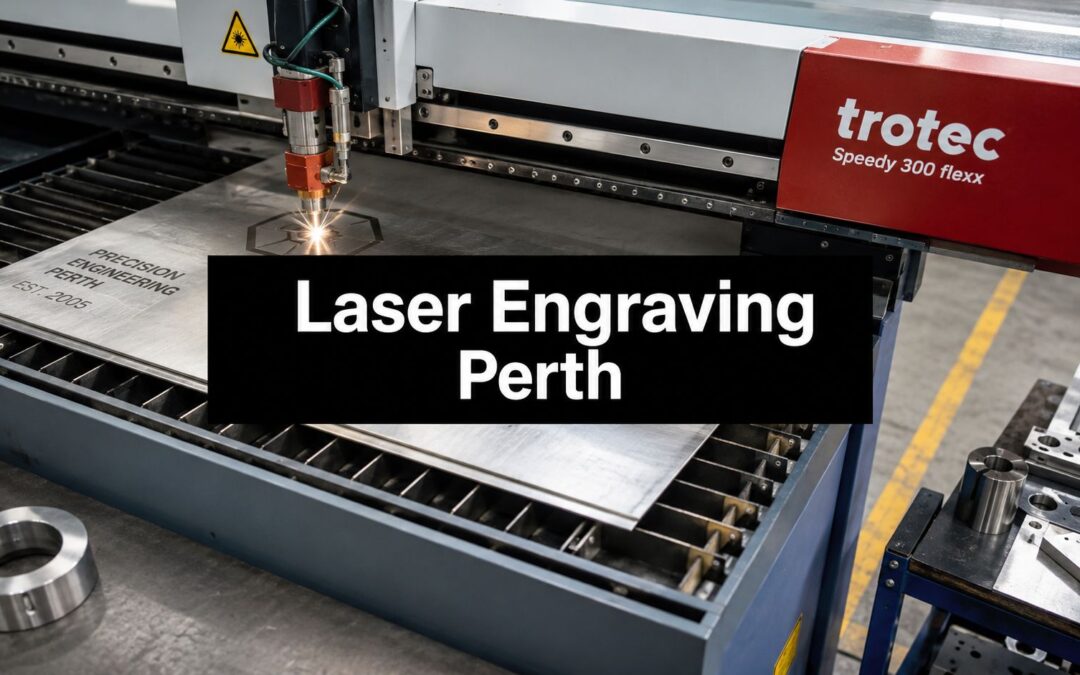
Later in the production cycle, seeing the machine in operation helps clients understand why setup quality matters.
Practical rule: If the label has to remain readable after years of handling, treat engraving as part of the equipment specification, not a finishing extra.
Choosing Your Material for Maximum Durability
The wrong material can ruin a perfectly good engraving job.
That's the part many buyers miss. They focus on the marking method, but durability depends just as much on the substrate. In Perth conditions, material choice should reflect the environment first, then the appearance, then the budget.
Matching the material to the application
For corrosive, exposed, or washdown environments, 316 stainless steel is often the safest choice. It suits compliance plates, machinery tags, marine-adjacent installations, and long-life identification where the plate needs to resist both physical wear and chemical exposure.
Anodised aluminium is a strong option when weight, clean presentation, and good contrast matter. It's commonly used for equipment plates, branded panels, and internal or semi-exposed applications where you want a crisp finish without the heavier feel of stainless.
Traffolyte and industrial laminates are especially practical for electrical work. They're widely used for switchboard labels, panel legends, and cable identification because they offer strong contrast and straightforward readability. They aren't the answer for every outdoor metal-tag application, but in electrical environments they solve a different problem very well.
For many projects, the material decision comes down to these questions:
- Exposure: Will the label face weather, chemicals, or frequent cleaning?
- Mounting method: Is it riveted, screwed, bonded, or inserted into a panel?
- Readability: Does the job need high contrast at a glance, or maximum long-term toughness?
- Risk if it fails: Is this a convenience label or a critical identification plate?
Industrial Material Comparison for Laser Engraving
| Material | Best For | Durability Rating | Available Finishes |
|---|---|---|---|
| 316 Stainless Steel | Compliance plates, machinery tags, corrosive or exposed environments | High | Brushed, polished, matte industrial finishes |
| Anodised Aluminium | Asset labels, equipment plates, branded identification panels | High | Black, silver, coloured anodised finishes depending on application |
| Traffolyte / Industrial Laminate | Switchboard labels, control panels, cable markers | Medium to high in suitable indoor or protected uses | Layered contrast finishes in multiple colour combinations |
The simplest way to avoid rework is to specify the environment in plain terms when ordering. “Outdoor” isn't enough. Say whether the label will face washdown, abrasion, chemicals, direct sun, or regular handling. That gives the engraver a proper basis for material selection.
For projects focused on metal substrates, laser engraving on metal for industrial applications is the most relevant starting point because it narrows the discussion to metals that can hold a durable mark under real operating conditions.
If the plate will live beside salt, solvents, vibration, or repeated cleaning, choose the material as if replacement will be inconvenient. Because it usually is.
The Engraving Process from Quote to Delivery
Most industrial buyers don't need a theory lesson. They need to know what happens, what files to send, and where mistakes usually occur.
The workflow is straightforward when the front-end information is clear.
Step 1 and 2 enquiry, files, and proofing
The job starts with the application. What is the plate or label for, where will it be installed, what material is preferred, and what data needs to appear on it. If the job includes serial numbers, asset registers, machine fields, logos, or barcodes, that should be defined early.
Then come the files. Vector artwork is usually the cleanest route for production because it keeps linework sharp and text positioning consistent. PDF, AI, and DXF are common starting formats, depending on the nature of the job. If the client doesn't have finished artwork, the engraver can usually work from a layout brief and build a proof for approval.

A proof matters, allowing expensive but avoidable errors to be caught. Wrong hole centres, truncated serial fields, tiny text, and mounting assumptions are common issues. Once the material is engraved, correction usually means remaking the item.
Step 3 and 4 machine setup and quality control
Laser settings depend on the material and the required result. For industrial metal marking, 20W to 50W fibre lasers are a standard range for most surface engraving, while 80W to 100W systems are used where greater speed or depth is needed. Deep engraving can reach a few millimetres into metal, and that kind of work calls for enclosed Class-1 systems with fume extraction to protect workers and maintain mark quality (Couth on laser power for metal engraving).
That's a useful benchmark because more power isn't automatically better. On thin plates or coated materials, too much energy can create distortion, excess heat effect, or poor edge quality. Good production is about matching the power, speed, frequency, and passes to the substrate.
Quality control should check more than spelling. It should confirm:
- Legibility across all text fields and codes.
- Dimensional accuracy for plate size, hole position, and layout.
- Finish quality so the mark is clean and consistent.
- Job-to-job consistency when multiple labels share a template.
Step 5 packing and dispatch
Dispatch is part of the quality process. Plates that arrive scratched, mixed, or poorly bundled create site delays even if the engraving itself is fine.
That's why industrial jobs are typically sorted, protected, and labelled for installation use rather than treated like generic retail output.
Meeting Industrial Compliance and Safety Standards
Compliance plates and safety labels aren't decorative items. They carry information that people rely on during operation, maintenance, and inspection.
If a plate identifies load limits, electrical circuits, asset references, or equipment specifications, legibility over time becomes part of the risk picture. A mark that looks acceptable on day one but becomes uncertain later is a weak choice for regulated or safety-sensitive work.
Legibility has to survive the service life
On heavy equipment, plant rooms, processing areas, and infrastructure projects, identification often has to outlast repeated cleaning, grime, abrasion, and handling. That's why process control matters so much in engraving. It isn't enough to put text onto metal. The mark needs to remain readable without damaging the substrate.
NASA's engraving specification offers a useful high-stakes benchmark. It requires engraved character depth of at least 0.003 inches (0.076 mm) and no more than 50% of the base material thickness, with defined character size ranges. The logic is practical. Too shallow and the mark can lose legibility. Too deep and the part or tag can be weakened (NASA engraving specification PRC-9003).

That doesn't mean every Perth job follows aerospace requirements. It does show the standard of thinking serious engraving work should apply. Depth, clarity, spacing, and material thickness all interact.
Safety, traceability, and liability
Cheap labels often create hidden liability. If a technician can't identify the correct asset, if a replacement part can't be matched confidently, or if warning information has degraded, the site absorbs the risk.
A few practical examples where engraving quality matters:
- Machine compliance plates on fabricated or imported equipment.
- Safety signage in processing, utilities, and plant access areas.
- Electrical identification where incorrect labelling can slow isolation work.
- Asset tags used for maintenance history and audit trails.
Teams also need to think about finishing processes around the mark itself. For example, where engraved parts move into coated or finished assemblies, broader handling and worker protection practices still matter. Guidance such as powder coating safety with NSP Coatings is useful context when multiple fabrication and finishing stages intersect.
Compliance marking should be specified for readability at the end of the asset's working life, not just for appearance at handover.
Laser Engraving Applications Across Perth Industries
Industrial engraving gets more useful when you stop thinking about “labels” as one category.
Different sectors need different outcomes. Some want traceability. Some want cleaning resistance. Some need permanent panel identification. Others need respectful, long-life presentation.
Manufacturing and resources
In manufacturing, data plates and serialised tags are often tied directly to maintenance and asset control. A fabricated machine may leave the workshop with a main identification plate, a warning plate, and individual component or panel labels. If any one of those is unclear, future servicing becomes harder than it should be.
In mining and resources support, the priority is usually toughness. Asset tags, equipment IDs, and safety markers have to cope with rough handling, dust, and exposure. The mark needs to stay readable even when the plate no longer looks new.

Electrical, healthcare, and infrastructure
Electrical contractors often need a different product entirely. Here, the job is less about deep metal marking and more about clear, durable legends for switchboards, distribution equipment, and cable identification. Traffolyte-style labels remain common because they're readable, organised, and suited to panel work.
Healthcare environments put pressure on both readability and cleanliness. Equipment labels, room signage, and instrument-related identification need to remain intact through regular cleaning cycles. The exact material choice depends on whether the item is fixed, mobile, handled frequently, or exposed to cleaning agents.
Government and infrastructure projects usually combine several needs at once:
- Asset management: Equipment IDs tied to registers and maintenance systems.
- Public-facing information: Durable signage that remains readable in service.
- Security and operations: Labels on gates, cabinets, services, and restricted areas.
Memorial and specialist work
Not every industrial engraver only serves plant and workshop clients. The same precision used for equipment plates can be applied to memorial plaques, donor boards, building signage, and commemorative markers where clarity and permanence matter for different reasons.
That crossover is useful because it reflects a broader truth about laser engraving Perth buyers often discover after a few projects. The strongest engraving suppliers aren't just machine operators. They understand layout, substrate behaviour, installation needs, and how the finished item will be used once it leaves the bench.
The most successful engraving jobs start with a real use case. “Needs to survive washdown on a switchroom door” is far more useful than “Need a label”.
Frequently Asked Questions about Laser Engraving
What affects the price of a laser engraving job
Material is a major factor, especially if you're choosing stainless steel over lighter substrates. Size, quantity, engraving depth, data complexity, hole requirements, and finishing details also affect the quote. A simple batch of identical labels is usually easier to produce than a run with variable serial numbers, mixed layouts, or custom cut profiles.
Can you order one-off plates as well as larger batches
Yes, many industrial engraving jobs are one-offs. Replacement compliance plates, plant labels, switchboard updates, and memorial plaques are often ordered singly. Larger batch work is also common where a project needs repeated asset tags or multi-panel labelling sets.
What files should you send
Clean vector artwork is ideal where available. PDF, AI, and DXF files are commonly used, and a clear spreadsheet helps when the job includes sequential or variable data. If you don't have production-ready artwork, a marked-up drawing or sample photo can still be enough to start a proof.
How long does turnaround usually take
Turnaround depends on material availability, artwork readiness, proof approval, and how complex the job is. Standard work moves faster when dimensions, mounting details, and text fields are confirmed early. Delays usually come from missing specifications, not from the engraving step itself.
Is laser engraving always the right method
No. It's the right method when permanence, clarity, and durability matter. For short-term labels or temporary staging, a printed solution may be more practical. For industrial identification that needs to stay readable in service, laser engraving is usually the safer choice.
If you need durable plates, asset tags, switchboard labels, or engraved signage that will hold up in service, Evright Industrial is a practical place to start. Send through the application, material preference, dimensions, and any artwork or variable data, and the team can advise on a suitable engraving approach for the job.
Recent Comments