

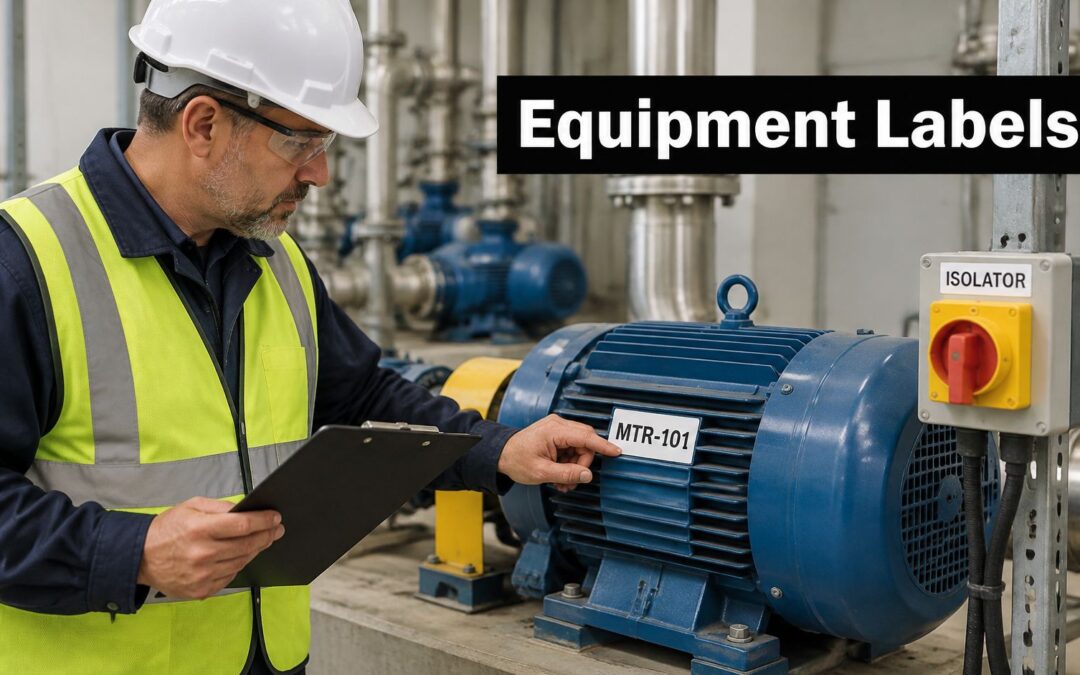
The line stops at 2.40 on a Tuesday afternoon. The supervisor knows the fault is upstream, but four near-identical motors feed the same header and the drawings were revised three years ago. Someone walks the floor with a torch, reading cable ties and a faded sticky label, trying to work out which isolator kills that circuit.
That search is the price of weak identification. Australian businesses spent $23.589 billion on equipment, plant and machinery in the September 2025 quarter, up 11.5% for the quarter and 9.9% on the same quarter a year earlier, according to the Australian Bureau of Statistics. Every asset inside that figure arrives needing three things: an identifier, a maintenance history and a hazard mark.
The industrial equipment examples below are the machines you'll meet in almost any Australian plant. Each one gets the same three-part test. How do you identify it so the right record follows the right asset. How do you track it through maintenance. How do you mark its hazards so people work around it safely.
Start with the machine that would hurt you most if it failed, not the newest one on the floor.
1. CNC Machining Centre
A CNC machining centre cuts metal with rotating tools driven by a program, usually G-code. Once the program is proven, the machine repeats the same cut to the same tolerance for an entire run. That repeatability is why the process anchors automotive engine and cylinder head work, aerospace structural parts cut from aluminium and titanium billets, and medical implants held to micron tolerances.
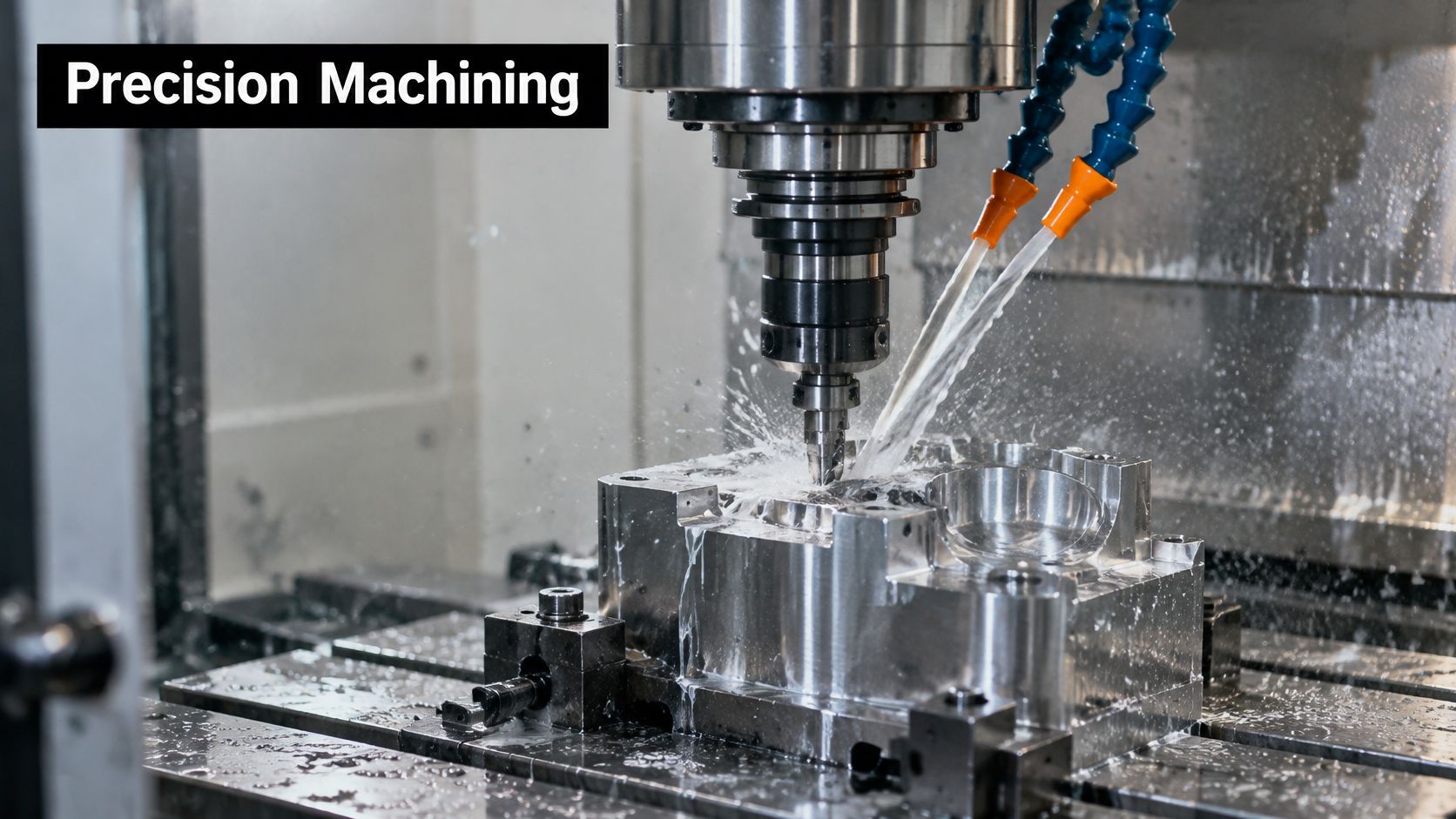
Identify the setup, not only the machine. Most dimensional faults trace back to the wrong fixture or a tool loaded into the wrong pocket. Mark fixture plates, tool holders and workpiece stations with numbers cut into the metal. A printed sticker lifts off the first time it meets coolant, and the laser engraving techniques behind a proper machine plate are what keep the number readable five years later.
Track running hours, not calendar dates. Spindle bearings and ball screws wear on running hours. A centre that idles half of each week reaches its service interval months after the wall chart says so, and way lubrication follows the same logic.
Mark hazards at reading distance. A warning nobody can read from the operator's standing position is decoration. WorkSafe ACT's guidance on occupational safety signs sets symbols at a minimum of 15 mm high per metre of viewing distance, with uppercase text at 5 mm per metre, and both sizes increase by at least 50% in poor light or viewing conditions (WorkSafe ACT). A machine you approach from three metres needs 45 mm symbols, not the 20 mm plate that came on the door.
2. Industrial Robotic Arm
Six-axis arms take the dirty, repetitive and dangerous work: spot and arc welding on automotive body lines, palletising in food and beverage plants, tending CNC lathes and injection moulders. The wide working envelope is the selling point. It's also the hazard, because the reach that lets one arm service several stations is the reach that can trap someone who steps inside the cell.
Machinery operators and drivers recorded a work-related injury or illness rate of 6.5% in 2021–22, according to the ABS work-related injuries release. Eight hours beside a moving arm means eight hours beside a mass that won't slow down because a person walked into its path.
Where the marks go on a robot cell
- Cell boundary: floor tape fades within a season. Engraved or cast floor plates at each corner of the safeguarded area hold up and give contractors a fixed reference during audits.
- E-stops and isolation points: number every stop button and match it to the isolation procedure, so a lockout sheet names a device someone can find in a hurry.
- Pedestal plate: robot serial, controller serial and the date of the last risk assessment on one stainless tag.
What I'd specify: one bolted plate at the cell entrance carrying the robot model, the controller, the safeguarding standard applied and the review date.
Reach and cycle time are cheaper to validate in simulation than during commissioning. Grease changes, cable inspections and joint calibration belong on an axis-by-axis schedule, because the wrist of a palletiser works far harder than the wrist of a welding arm.
The cell layout and guarding decisions below drive everything else about how the cell gets marked.
3. Belt Conveyor System
Conveyors fail at the joints. A belt tracking badly will grind an edge for weeks before anyone acts, and the failure usually lands on the worst shift of the week. Bulk ore transport in open-cut mining, parcel sorting in distribution centres and automated assembly lines all run on the same principle: a continuous loop of belting driven by a motor and pulley set.
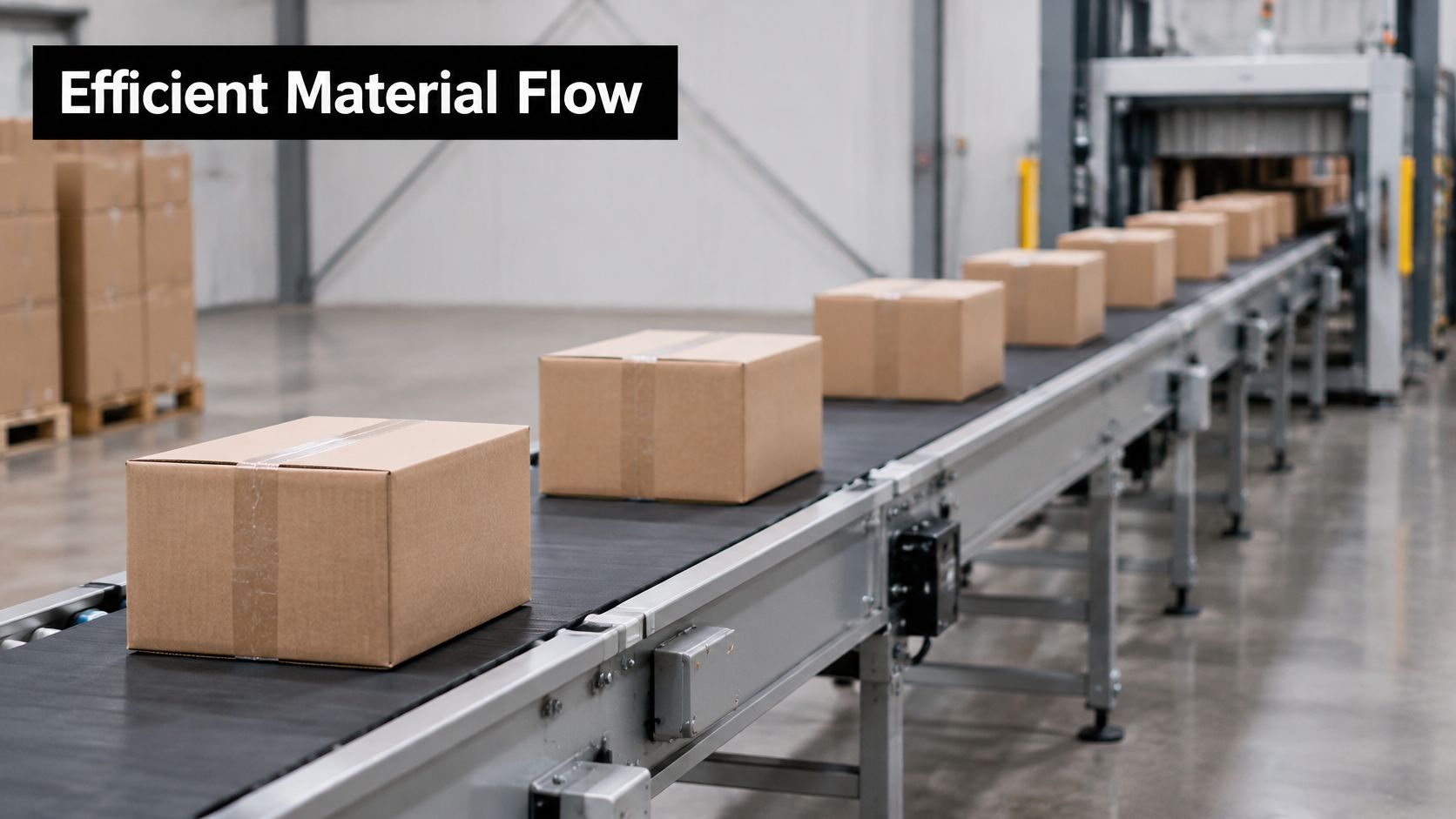
Identification on a conveyor has one job: make the isolation point findable from the walkway. Mark drive motors, gearboxes and isolation switches with the same asset number that appears in the maintenance system, and repeat that number at each pull-cord station so nobody shuts down the wrong line 60 metres away.
Practical rule: if a contractor can't identify the correct isolation point within 30 seconds of reaching the line, the labelling has failed, whatever the register says.
Linking identifiers to failure history pays. At Rio Tinto Coal Australia, a reliability review of a P&H 4100 electric rope shovel combined corrective maintenance with remote health monitoring and a revised truck operator changeover process, raising mean time between failures by 31% and lifting annualised material movement by 2.7 million metric tonnes at a project cost of AU$0 (Komatsu). The same discipline applies to the equipment feeding a conveyor: each asset tied to its configuration, failure history and operating metrics rather than wearing a label that leads nowhere.
Belt tracking and idler inspection belong on a fixed schedule, and spare idlers plus splice kits on site shorten the bad days. Tensioning matters more than most operators expect, and the mechanics of how belt tensioners prevent slippage are worth understanding before the next splice, not after it.
4. Hydraulic Press
A hydraulic press multiplies a small input force into a very large output force through pressurised fluid acting on a piston. Automotive body panel stamping, forging steel components for heavy machinery and composite moulding in aerospace all depend on that controlled force. The same stored energy that makes a press useful is what makes it unforgiving.
Labels on a press have a harder life than on almost any other machine. Hydraulic oil, washdown and constant hand contact attack adhesives. Safe Work Australia's dangerous goods code recommends additional AS 1319 compliant signs where a risk assessment identifies a need for prominent warnings, and states that safety equipment exposed to dangerous goods should be compatible with those substances or suitably protected from them (Safe Work Australia). Treat that as a materials decision. A vinyl label sitting under a weeping fitting will be gone in a season.
The trade-off: a bolted stainless plate takes an hour to fit and outlasts the press. A printed sticker takes two minutes and gets redone at every shutdown.
- Frame markings: force rating, stroke limits and the safety devices fitted, permanently marked and legible from the operating position rather than from a crouch.
- Shift-start checks: light curtains and two-hand controls get verified at every shift start, and the result goes on the asset record, not on a clipboard that disappears.
- Hydraulic health: hoses, seals and fittings get inspected on a route, and fluid cleanliness is maintained with proper filtration and oil sampling.
5. Industrial Centrifugal Pump
A centrifugal pump adds kinetic energy to a fluid with a rotating impeller, then converts that energy into pressure as the fluid leaves the casing. It's the most widely used pump type in industry for good reasons: simple construction, a wide flow range, and years of continuous duty when it's matched to its duty point. Cooling water circulation in power generation, chemical transfer in process plants and municipal water and wastewater pumping are all standard work for it.
Matching to the duty point is the whole game. A pump oversized for the job runs out along its curve, wastes energy and eats bearings. A pump undersized for it cavitates and destroys itself.
The tag is part of the isolation procedure
Say a plant runs two duty pumps and one standby on a common header, all three in a row, all three painted the same grey. The only thing standing between an operator and the wrong valve is a durable valve tag that matches the isolation drawing.
- Asset number and duty data: pumps, motors and isolation valves carry the asset number plus flow, head and fluid, so a replacement is specified correctly the first time.
- Duty and standby status: mark which unit is lead, which is lag and which is standby. It changes, and the tags should be the thing that announces it.
- Condition monitoring: vibration and bearing temperature readings catch early failure, and they only mean something if the reading is attached to the right asset number.
Variable frequency drives let the pump match output to demand instead of running flat out against a throttled valve, and that saving shows up on the energy bill every month.
6. Three-Phase Induction Motor
Australian manufacturing consumed 52,461.4 gigawatt-hours of electricity in 2017–18 and spent approximately $5.4 billion on it, making it the largest electricity-consuming industry among those measured by the ABS (ABS energy use release). Most of that electricity turns into rotation, and most of that rotation comes from three-phase induction motors driving pumps, fans, compressors, conveyors and machine tools.
The motor is the workhorse precisely because it's boring. A rotating magnetic field from the three-phase supply drags the rotor around, there are no brushes to change, and a premium efficiency design runs for decades with bearing lubrication and clean cooling air.
What goes on the motor tag
- Nameplate data, repeated externally: rated power, voltage, speed and IE class, so nobody has to remove a guard and squint at a corroded nameplate to order a replacement.
- Bearing lubrication interval: recorded against running hours, because a motor on a 24-hour duty needs grease far more often than the same frame size on day shift.
- Circuit and isolation reference: the switchboard and circuit breaker number, which is the detail contractors need.
Select IE3 or better for continuous duty, and use soft starters or variable speed drives to cut inrush current. Sites pairing motor upgrades with on-site generation should keep one numbering scheme across both, or the renewable energy equipment register and the motor register end up with two names for the same asset.
7. Industrial Boiler
A boiler works under pressure, so it carries a heavier identification burden than any rotating machine on site. An industrial boiler produces steam or hot water by burning fuel or using electric elements to transfer heat into water. Boilers supply process heat, sterilisation, drying and space heating, which puts them in food processing and pasteurisation, hospital sterilisation, chemical plants and district energy schemes.
Identifying the asset is the easy part. Tracking it through inspection is where the work sits. Pressure equipment needs inspection in line with the applicable Australian standards, including the AS 4343 hazard classification, so safety valves, gauges and shut-off valves get labelled with inspection dates and operating limits. A documented water treatment programme prevents the scale and corrosion that shorten a boiler's life, and the treatment records belong on the same asset file as the inspection tags.
Confined space signage is a legal requirement
Hazard marking matters most at the access points. The model Work Health and Safety Regulations require the person conducting the business or undertaking to erect compliant signs at confined spaces, and each sign must identify the space it covers (Safe Work Australia model WHS Regulations).
Required: a sign at a boiler access hatch identifies the confined space. The word "Danger" alone does not meet the requirement.
Tank access points, pits and ducts on the same site fall under the same rule. Test low-water cut-offs and other safety devices on a fixed schedule, and record the result against the asset rather than in a folder nobody opens.
8. Rotary Screw Air Compressor
Compressed air is the most expensive utility on most sites and the least watched. A rotary screw compressor compresses air continuously between two interlocking helical rotors, which gives steadier output, lower vibration and less noise than a reciprocating machine. That's why it supplies pneumatic tools, automation equipment, paint spraying and process control across automotive assembly, food and beverage packaging lines and paint finishing shops.
Leak audits are the highest-return maintenance task in the compressed air system. A leaking coupling or a failed drain trap runs the compressor harder all day and shows up on the power bill rather than on any work order.
Marking the air system end to end
- Air receivers: pressure rating, inspection date and the vessel's registration details on a permanent plate, because a receiver is pressure equipment, not a tank.
- Filters and dryers: element change dates and pressure ratings, so the service interval is visible without opening a manual.
- Isolation and drains: every isolation valve and drain point numbered, which turns a Saturday morning air lockout into a two-minute job.
If demand swings across shifts, a variable speed drive earns its cost quickly. Intake filters get cleaned or replaced on schedule, because a choked filter pulls against the element and costs more than the filter ever will. Anyone who has replaced a seized compressor element knows the arithmetic.
9. Electric Counterbalance Forklift
Fleets grow in waves, and the average site ends up with three vintages of forklift bought under three different managers. Australian manufacturing turnover rose 14.2% year on year from September 2024 to September 2025, while total new capital expenditure rose 6.9% over the same period (ABS industry indexes). Faster turnover means a mixed fleet is the normal state, not a temporary one.
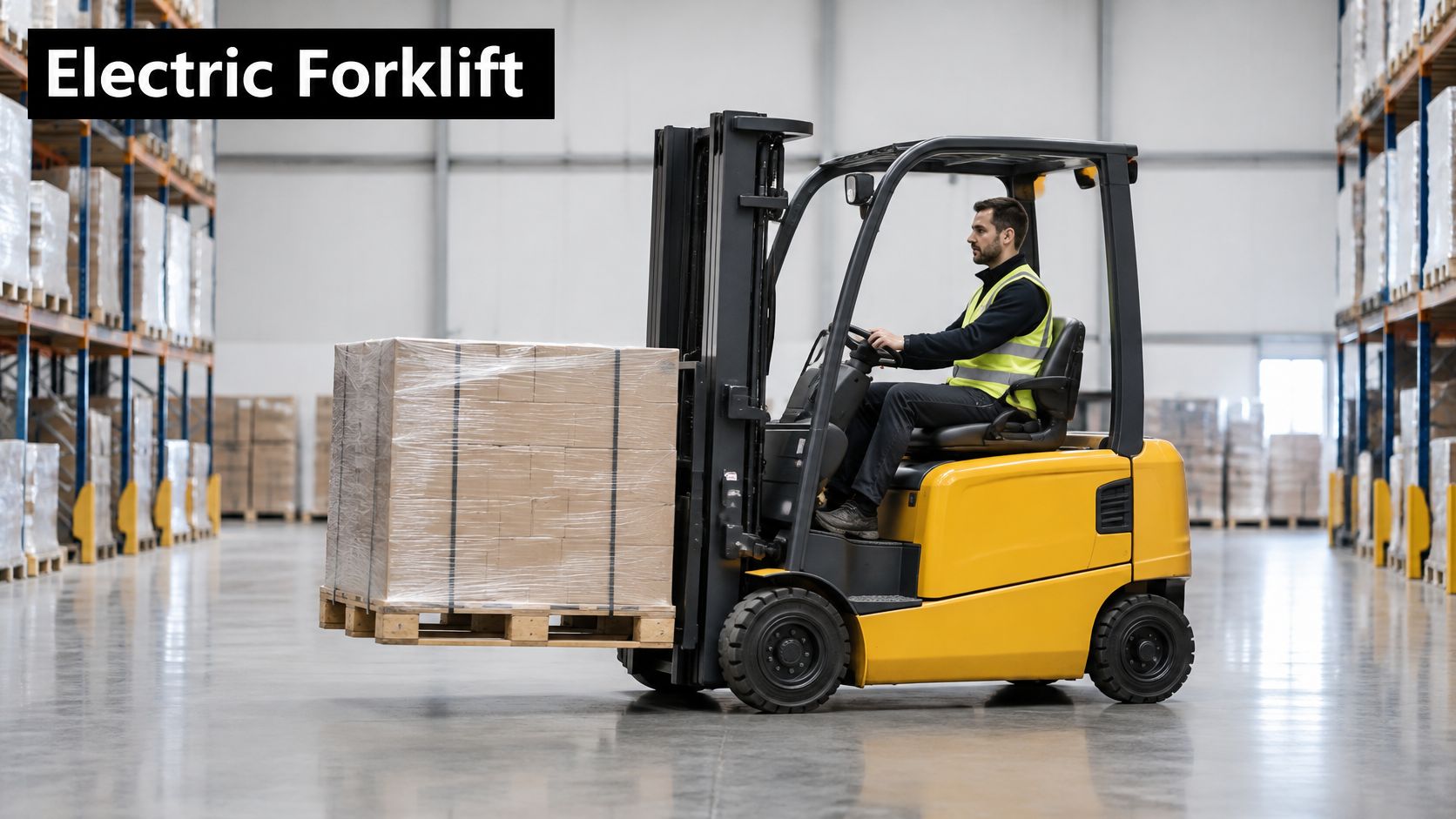
An electric counterbalance forklift lifts and transports palletised or bulk loads using a mast and forks, with a counterweight at the rear to balance the load. Zero tailpipe emissions and quieter operation make it the default choice for distribution centres, manufacturing plants and cold stores. Pallet movement in retail warehouses, machine loading on the floor and cold storage work in food logistics all depend on them.
Identification that survives a shared fleet
Unit numbers belong on the overhead guard and on the counterweight, readable from both sides, so a driver reporting a fault quotes a number rather than "the yellow one". Load capacity plates get checked for legibility at every pre-operation inspection, along with brakes, forks, horn and lights. Charging zones are marked clearly, and the charging schedule is planned so a shift doesn't start with three flat batteries.
Operator refresher training records attach to the unit number, not just to the person. When an auditor asks which trucks a driver has been assessed on, that record should answer in seconds.
10. Industrial Laser Engraving and Marking System
A marker sits at the end of the asset decisions the other nine machines create: what the asset is called, how its service history is found, and which hazards must be obvious before someone works on it. An industrial laser marking system focuses a beam to permanently mark, engrave or cut metals, plastics and coated surfaces, steered by galvanometer scanners or gantry motion under software control. It puts serial numbers, barcodes, QR codes, safety signage and asset labels where abrasion, chemicals, heat and UV would remove printed marks.
How the marking process works
The laser source generates a concentrated beam. Fibre lasers mark most metals by localised heating that changes surface colour or leaves a raised or engraved mark; CO2 lasers suit organic materials, plastics, glass and coated substrates by vaporising or altering the top layer. Software converts artwork or data into beam paths, and the controller sets power, speed and frequency. Higher power and slower passes give depth; faster, lighter passes give contrast and cycle time. The practical trade-off is permanence against throughput, and edge definition against heat input on thin or coated parts.
Evright Industrial, a division of evright.com, runs production on Trotec Laser machines for asset labelling, safety signage and industrial engraving, with sampling before production and materials chosen for the plate's working environment.
The case is operational. A NSW hospital audit found biomedical equipment service-history systems inefficient and inadequate for maintenance planning, monitoring and reporting (NSW Audit Office). Better identification and tracking of short-dated supplies reduces expired stock and cuts the labour spent reconciling carts and storerooms.
- Match the laser to the material: fibre for metals, CO2 for plastics and organics, then a sample run on the actual substrate before a batch.
- Standardise the numbering: asset numbers and barcode formats that drop straight into the maintenance system, so a scan opens the record rather than a translation table.
- Mark the hazard, not only the asset: isolation points, hot surfaces and stored energy need labels sized and placed for the working distance.
- Specify for exposure: coatings and materials rated for UV, chemical washdown or outdoor service, chosen for where the tag will live.
For sites bringing marking in-house, industrial etching and marking equipment covers the hardware side; for marked plates and labels, the decision ends at material, data format and placement.
How each industrial equipment example compares on marking needs
| Item | Primary Industries | Key Marking Need | Typical Safety Labels |
|---|---|---|---|
| CNC Machining Center | Aerospace, automotive, medical, general engineering | Identify fixtures, tools, and workpiece stations | Moving parts, pinch points, eye protection, machine guarding |
| Industrial Robotic Arm | Automotive, food and beverage, manufacturing | Mark robot cells, emergency stops, and isolation points | Restricted access, robot movement hazard, emergency stop, isolation point |
| Belt Conveyor System | Mining, manufacturing, logistics, ports | Label emergency stops, pull-cords, motors, and isolation points | Pinch points, entanglement hazard, emergency stop, lockout point |
| Hydraulic Press | Automotive, heavy machinery, aerospace | Display force ratings and safety information | Crush hazard, keep hands clear, guard requirements, force rating |
| Industrial Centrifugal Pump | Power generation, chemical processing, water and wastewater | Identify pumps, motors, and isolation valves | Rotating machinery, pressure hazard, hazardous fluid, isolation point |
| Three-Phase Induction Motor | Mining, manufacturing, commercial buildings | Display motor ratings and identify assets | Electrical hazard, rotating parts, isolation point |
| Industrial Boiler | Food processing, healthcare, chemical manufacturing | Mark operating limits, valves, gauges, and inspection details | High pressure, hot surfaces, operating limits, safety valve |
| Rotary Screw Air Compressor | Automotive, food and beverage, manufacturing | Label pressure ratings and service information | High pressure, hot surfaces, isolation point, hearing protection |
| Electric Counterbalance Forklift | Warehousing, manufacturing, cold storage | Display load capacity and identify charging zones | Load capacity, pedestrian warning, battery charging hazard |
| Industrial Laser Engraving and Marking System | Manufacturing, utilities, healthcare, asset management | Apply durable asset IDs, barcodes, and safety signage | Laser radiation, eye protection, restricted access, fume extraction required |
Turning Equipment Examples Into a Marking Plan
Build the asset register first. Every machine on the floor gets a unique identifier before commissioning, not after its first breakdown, and that identifier is the thread running through the maintenance history, the isolation procedure and the spare parts list. A register built after the fact always inherits the gaps the floor already had.
Then decide the mark. Indoors, dry and hand-cleaned means a laser-etched anodised aluminium plate will do the job. Washdown, chemical exposure, outdoor UV or constant vibration means stainless, bolted rather than glued, with the marking cut into the surface instead of printed onto it. If a label has to survive a caustic wash cycle, the adhesive is the weak point, not the text.
Group hazard labels by the risk they carry rather than by the machine they sit on. Stored energy, pinch points, pressure, confined space and electrical isolation are the five groups that cover most plant, and each one gets a check at shift start. That turns sign maintenance from a yearly clean-up into a routine that catches a missing label within a shift.
Keep the standards close. AS 1319 sizing applies to the viewing distance you have, not the distance you'd like, and confined space signage carries a legal requirement rather than a recommendation. Where a site has mixed vintages of the same machine, the older unit is usually the one with the faded plate and the missing isolation tag, so audit the old assets first.
Evright Industrial, a division of evright.com, has served Australian manufacturing, mining and health clients from facilities in Adelaide and South East Queensland. The team can be contacted by phone on 08 8231 2746 to start a project, and the same sampling process applies whether the job is ten plates or ten thousand. Mark the asset before it fails, and the search on a Tuesday afternoon never happens.
Evright Industrial produces laser-engraved asset labels, equipment ID plates and safety signage for manufacturing, electrical, mining and healthcare sites, using Trotec Laser machines, and can mark customer-supplied items after a sampling run on your own materials. Send us a photo of the machine and the conditions it works in, and we'll advise on the right material and marking method, whether that's stainless for a washdown area or a plate for a switchboard door. Visit Evright Industrial to see the range, or call 08 8231 2746 to talk through your asset register.
Recent Comments