

The most repeated advice on arc flash label requirements in Australia is that a durable DANGER ARC FLASH HAZARD label on the switchboard door finishes the job. It doesn't, and the failure is quiet. A worker reads a label with no incident energy, no arc-flash boundary and no date, assumes someone has assessed the board, and opens it.
Treat the label as a controlled record instead. Every value on it traces to an incident-energy study, to a named asset and to a revision date. When those three stop agreeing, the label becomes a restriction on access, not a permission to work.
The label itself matters less than the chain behind it. A well-engraved sign carrying stale values is more dangerous than a plain one carrying none, because it looks authoritative.
Which Standard Applies and Why There Is No Single Label Template
Australia has no single national label template, and none is coming. The label is a risk control inside a wider safety process. What it can carry depends on the assessment for that asset, not on a drawing shared between sites.
The principal standard is AS/NZS 4836:2023. It sets minimum procedures, safety requirements and recommendations for work on or near low-voltage and extra-low-voltage electrical installations. Its scope names arc blast, arc flash, electric shock and electrocution, so it bears directly on how equipment is assessed and marked. It tells you how to assess and control the hazard. The label is one output of that work.
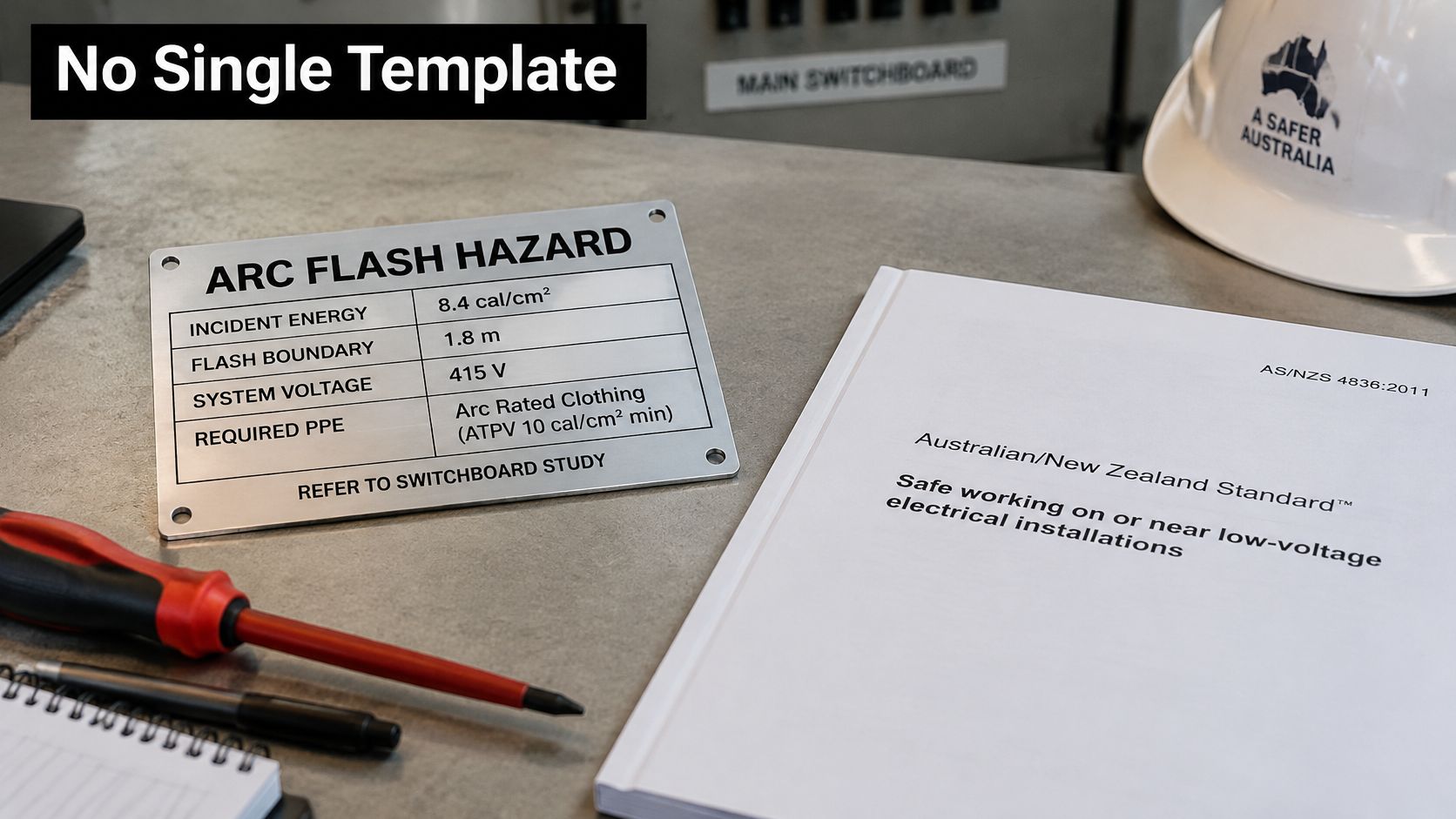
That split matters when you buy the plate. A supplier offering a "compliant arc flash label" off the shelf is offering a blank structure. The structure cannot know the fault level, the clearing time or which study revision still applies to the board.
The editions and the 3 m line
The standard has been revised over successive editions. Confirm the edition your state regulator cites before you draft a field list. The wording you will be audited against is the edition that regulator adopts for low-voltage and extra-low-voltage work, and a field copied from an older edition can fail that check even when the engraving is clean. The wider set of electrical equipment safety standards is where the marking requirements sit alongside the working rules.
Queensland shifted the boundary of what counts as energised work from 1 January 2025. Electrical work on or near energised electrical equipment was broadened to include work within 3 m of an exposed energised part. WorkSafe Queensland states that such work is generally prohibited unless prescribed circumstances apply, and that PCBUs and workers must de-energise and isolate equipment before work. The isolation or connection point must be marked or labelled, unobstructed and capable of quick operation. A hazard label on the door does not authorise live work inside that zone.
Treat the printed set as a controlled record. Each value traces to a study, a named asset and a revision date. When those three stop agreeing, the label is out of date: restrict access or replace it. Do not leave it in service as a work instruction.
Why a copied label is a hazard
Sizing a label from the voltage alone, or lifting it from another site's template, breaks that record. A 415 V board's hazard depends on the fault level behind it, the protection clearing time, the working distance and the enclosure. It does not depend on the number printed on the front of the switchboard. Importing another site's values makes a board look assessed when nothing has been calculated for it.
A label that looks authoritative and carries another site's numbers is worse than a blank panel. The blank panel makes a worker stop.
Four checks before anything goes to print:
- Confirm the edition your state regulator cites for low-voltage and extra-low-voltage work.
- Identify the equipment class, since LV and ELV equipment carry different working rules.
- Check the 3 m line, and whether any planned task falls within 3 m of an exposed energised part.
- Name the study each label value is drawn from, and the date it was issued. If that date no longer matches the current study for the asset, hold the order and restrict the task.
A label supports isolation, hazard recognition and the pre-task decision. It is not permission to work live. A site that treats it that way has the control backwards.
Data Fields Every Compliant Arc Flash Label Needs
A label's numbers don't originate on the label. They come from a documented incident-energy assessment, and the A.G. Coombs advisory note on safe working around electrical equipment sets out what that assessment has to establish: prospective fault level, voltage, working distance, incident energy in cal/cm², arc-flash boundary and the minimum PPE required.
The chain runs in one direction. Fault level and protection clearing time give the arcing duration, the working distance sets how much of that energy reaches a person, and the result lands as incident energy in cal/cm². From there you derive the arc-flash boundary and the PPE category. Higher fault current, a slower trip or a shorter working distance all push the number up, and the PPE and exclusion distance move with it.
The register that keeps a label honest
Every electrical-infrastructure component should hold its own record: the study revision, the scenario it was calculated for, and the values that went onto the label. A.G. Coombs recommends an arc-flash register for each component, with labels that communicate the calculated values to the competent person before the enclosure is opened. That register is what lets you answer an inspector's question about a label fitted six years ago. Without it, the label is an orphan.
The field set below is what a usable label carries. Anything missing from an installed label is a question for whoever holds the study.
| Field | What it tells the worker | Source of the value |
|---|---|---|
| Equipment or switchboard name | Which asset the PPE and boundary apply to | Asset register and single-line diagram |
| Nominal voltage | Voltage level of the energised parts | Study and equipment nameplate |
| Work activity or state | Whether the door is open or closed, and what task is being done | Study scenarios |
| Incident energy at working distance | Heat exposure in cal/cm² at the stated distance | Incident-energy analysis |
| Arc-flash boundary | Distance inside which arc-rated PPE is needed | Incident-energy analysis |
| Minimum safe working distance | Distance to keep from energised parts | Study or applicable standard |
| PPE requirement or category | Clothing and equipment to wear for that activity | Study result |
| Hazard or risk category | Whether the label is a warning or a danger label | Risk assessment |
| Assessment or analysis date | When the values were calculated | Study report |
| Revision date | Whether the label matches the current installation | Change record |
| Danger and shock symbols | Hazard recognition consistent with AS 1319 | Label template |
The revision date does the heaviest work of those eleven fields. It's the entry that lets an inspector, a supervisor or an electrician check whether the label still describes the board in front of them, rather than the board as it was at commissioning.
One rule sits above the table. The label is a control derived from the risk assessment, and it never replaces de-energisation, isolation or the use of competent electrical workers.
Label Classes, Ratings and Sizing
Before artwork, know which class the study result lands in. The class decides the wording, the colour convention and how the sign should be read on the approach.
SA Water's engineering standard draws the split most utility work follows. Category 1 incident energy takes a warning label. Category 2 and above takes a danger label, and the danger label on an incomer section carries an instruction not to access it while energised. Read that instruction as a prohibition, not as a PPE recommendation, because the two get confused on site constantly.
Class before artwork. Decide whether the sign warns or prohibits, then decide what it says.
Ratings come next. Incident energy is quoted in cal/cm² at the stated working distance, and the PPE requirement follows from that value and the arc-flash boundary. Record the class and the value together. A Category 2 result needs a danger label whatever the template looks like, and a new study can move a board from warning to danger without anything visible changing on the equipment.
Some water and network utilities also work with a Type 1 and Type 2 naming convention, applied by equipment rating as well as by energy level, so there the label class can be set by the rating alone.
Sizing is the part nobody documents. The standards don't fix a label dimension, so confirm the size with whoever specifies the installation, then test it the practical way: stand at arm's length in the light you'll have and check you can read the incident energy, the boundary, the units and the symbols without stepping closer. If you can't, the label is too small regardless of what it says.
These classes set the placement and case decisions that follow.
Switchboard Cases That Change the Label Requirement
A switchboard's rating alone does not determine its arc-flash label. Configuration, access conditions and the study results all matter, so apply the relevant utility or safety guidance to the actual equipment.
Queensland guidance recommends an arc-flash study for electrical equipment rated above 800 A. Treat the 800 A threshold in the Queensland guidance as a planning trigger, not proof that lower-rated equipment presents no hazard. Assess the equipment and its operating conditions before setting the label data.
For industrial switchboards, the Australian Energy Council guideline identifies fields including the bus or equipment name, voltage, work activity or condition, incident energy, arc-flash boundaries and PPE requirements for different activities and switchboard states. Sydney Water's technical specification for arc flash specifies details such as nominal voltage, assessment date, incident energy at the working distance, boundary, minimum safe working distance and PPE for each work activity. The values should remain traceable to the assessed equipment and its operating state.
| Case | Label requirement | Threshold or reference |
|---|---|---|
| Equipment rated above 800 A | Arc-flash study before labelling | 800 A, Queensland guidance |
| Equipment above 32 A with incident energy below 1.2 cal/cm² | Type 1 or Type 2 label still applies | 32 A and 1.2 cal/cm², Seqwater specification |
| Incident energy in Category 1 | Warning label | SA Water engineering standard |
| Incident energy in Category 2 and above | Danger label, with no access to incomer sections while energised | SA Water engineering standard |
| Physically separated incomer and non-incomer sections | Separate label for each section where separation limits arc propagation | Seqwater specification |
| Multi-incomer switchboard | Label at each incoming tier | Utility specifications |
| DC battery systems from 24 V to 220 Vdc | Labelling where workers may access internal compartments or remove covers | Energex standard |
| Door open versus door closed | Separate PPE and boundary values for each state | Victorian self-audit material |
| Study older than the installation or missing | Investigate and update before relying on the label | Update the assessment before relying on the label |
Door position can change the assessed exposure. If opening the door changes the protection response or arcing time, record the relevant PPE and boundary values for each state rather than relying on one averaged result.
A load change during consumer unit upgrades during home renovations can also prompt a review of protection settings and fault levels. For Australian switchboards, assess any such changes against the installation's actual study and configuration.
For board identification beyond arc-flash hazards, switchboard labelling requirements provide related guidance.
Label Placement and Durability Checks
A technically correct label still fails if it's in the wrong place. The worker makes the hazard decision on the approach, before touching the door, so the label has to be in view at that moment.
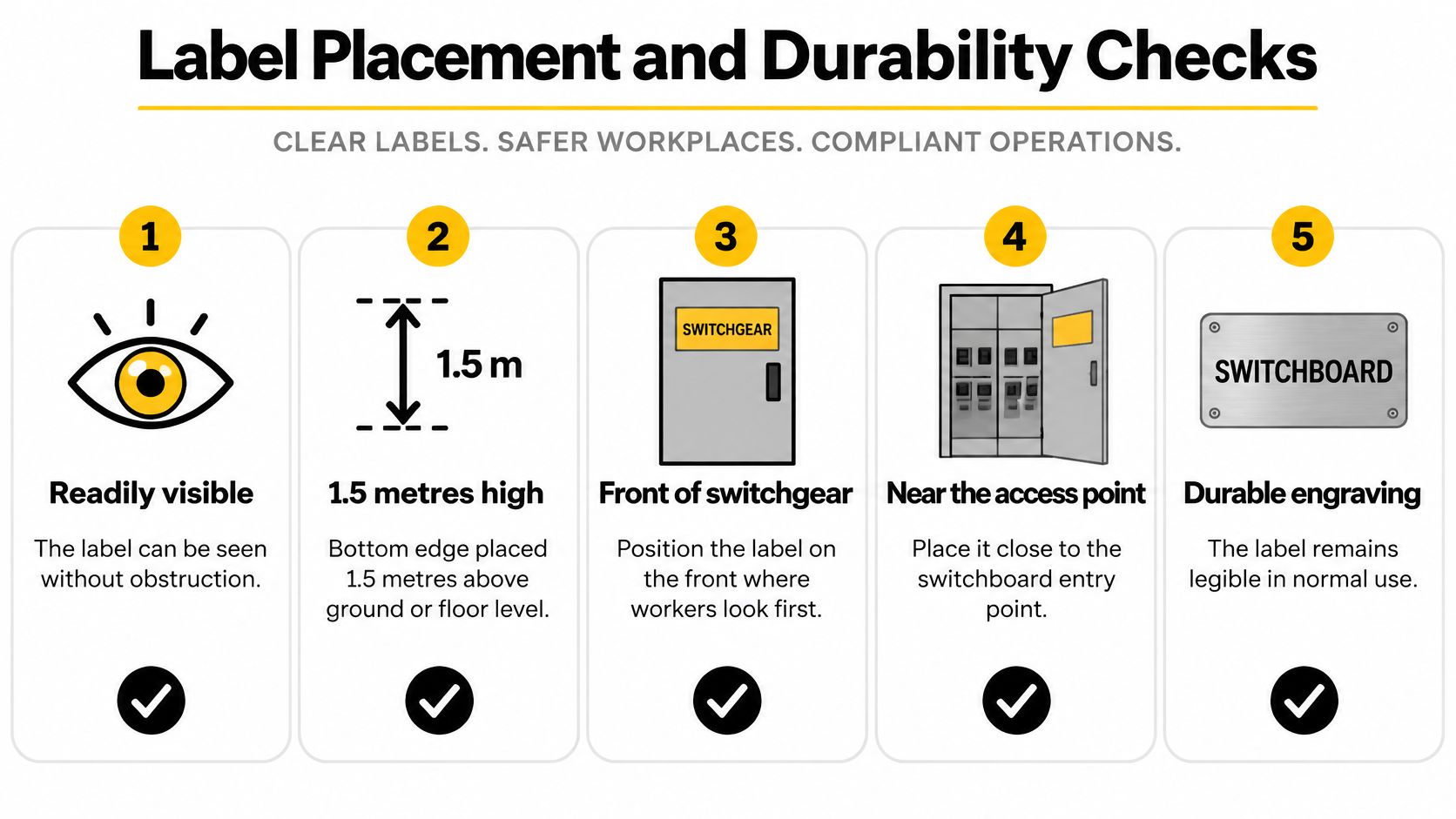
Seqwater's power system modelling and arc flash analysis specification requires labels to be readable and, where practical, positioned with their bottom edge 1.5 metres above floor level. It also requires a separate label for physically separated incomer and non-incomer sections where the separation is enough to limit arc propagation, which is the point where placement follows the electrical configuration rather than a single rule applied everywhere.
Placement rules that hold on most industrial sites:
- Front of the switchgear, near the incomer. The hazard information has to be readable before the enclosure is opened, not after.
- Entrances and protective enclosures. PPE information belongs where people enter the area, not only on the board.
- Each incoming tier on a multi-incomer board. One label at the main incomer leaves the second supply unmarked.
- Outside face, never behind the door. A label mounted inside arrives too late to change the decision.
Durability is the second half of the same test. The marking has to hold its contrast under site lighting and keep calculated values, units and symbols legible through cleaning agents, heat and UV for the life of the equipment. Engraving depth matters because repeated wiping wears a shallow mark faster than a deep one, and a half-faded boundary figure is a hazard in itself. Where a board sits in a washdown area, chemical resistant labels are made for exactly that exposure.
Test an installed label by wiping it with the cleaner the site uses, then reading it from the working position. If a value becomes ambiguous, replace the label.
A Compliant Engraved Label in Practice
A 415 V main switchboard incomer label is a controlled record, not a warning graphic. Build it in reading order. Symbols come first, because recognition happens before anyone reads a word.
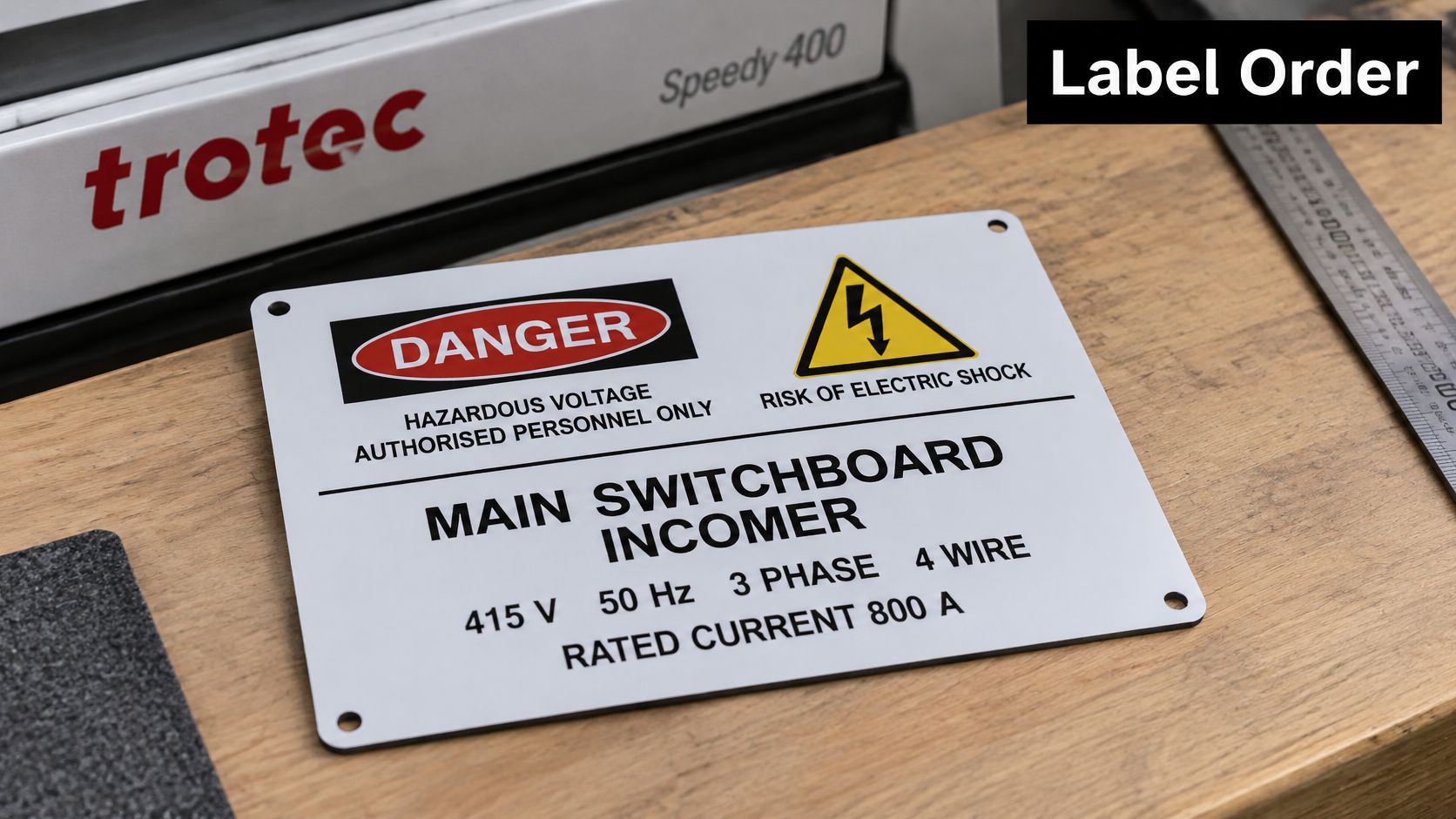
The top band carries the danger and shock symbols. Below that, the equipment name and nominal voltage, so the worker confirms the asset they're standing at. Then two blocks, one for door closed and one for door open. Each block lists the work activity, the incident energy calculated at the working distance stated in the site study, the arc-flash boundary from that same study, the minimum safe working distance, and the PPE category the study assigns. Hazard category, analysis date and revision date close the label. Every calculated value has to trace to that named asset, that study and that revision date. If the asset or the dates do not match the board in front of you, treat the label as out of date: restrict the work and replace the label rather than trust the numbers.
Leave those calculated entries blank until the site study fills them. A designer's draft with plausible-looking numbers is the most dangerous document in the process, because someone will print it.
Keep each line short and separated. A label is read at arm's length in poor light, sometimes through a face shield, and a dense paragraph of small text won't be read at all. Two columns, generous spacing and consistent units do more for compliance than extra wording.
Laser marking alters the surface of stainless steel or anodised aluminium and leaves a contrast mark in the material itself. There's no ink to fade and no adhesive to lift. That finish holds the contrast. It does not keep the numbers current once the study behind them changes.
Laser marking in production runs like this:
I'd refuse to release a label that cannot name its study, its asset and its revision date. Order, spacing and finish only matter after those three are fixed.
When to Relabel, Investigate or Restrict Access
A breaker swapped years ago can leave a stainless plate looking perfect and the numbers wrong. Permanence is the easy part. Currency decides whether the label is still a controlled record or a durable mistake.
Victorian duty holders are expected to identify hazards, assess exposure, put controls in place and review them. The guideline on arc flash hazard management says assessments should cover scenarios such as doors open or closed and protection operation, and should be revised when equipment or conditions change. That review is what ties each printed value to a study, an asset and a revision date.
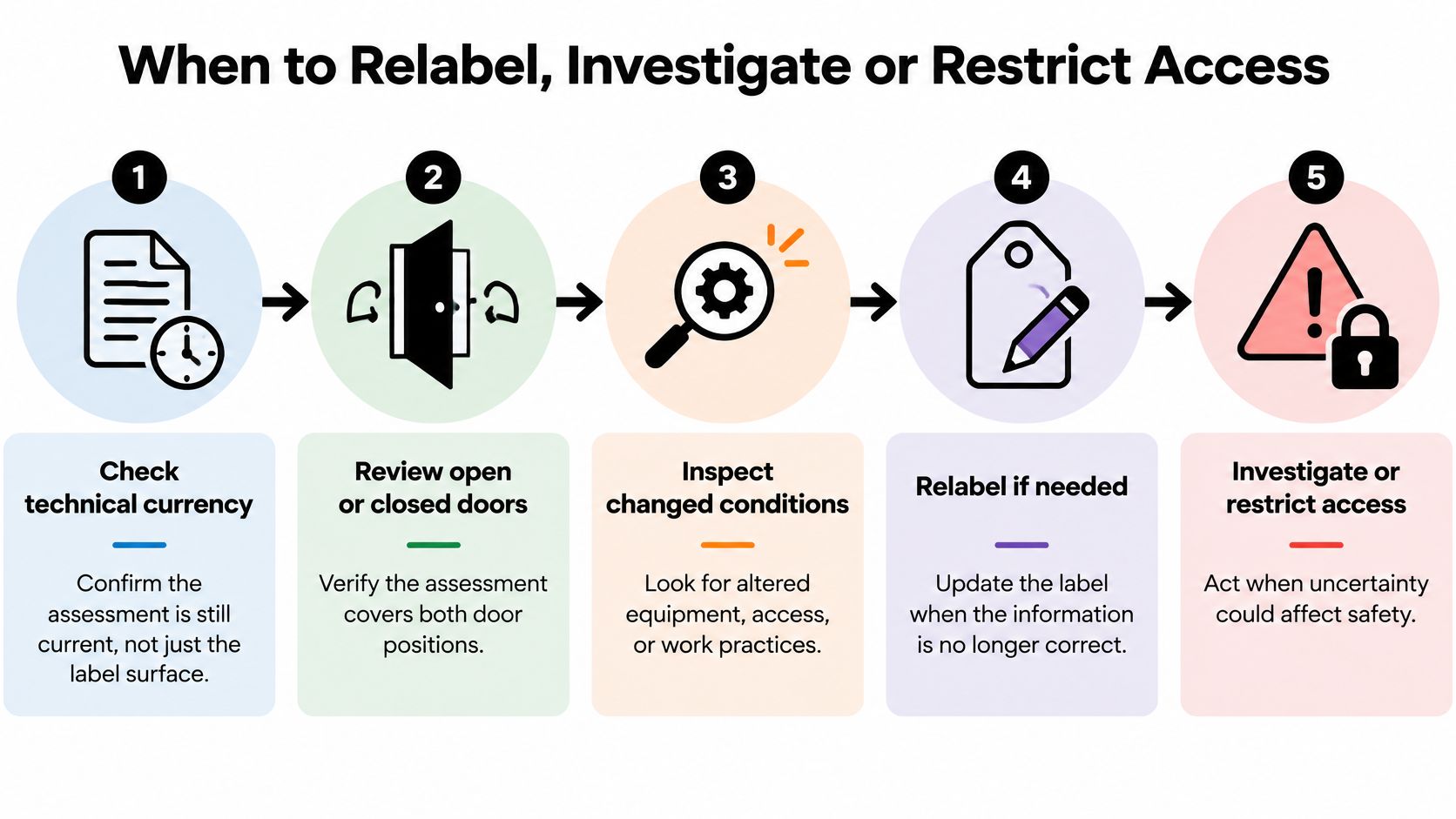
The decision path I'd use:
- Check coverage. Does the study cover the current configuration, the protection settings and both door states?
- Check the equipment. A new breaker, altered settings, a new cable run, an added generator or a busbar change all invalidate values downstream.
- Keep and record. If the study is current and the label matches it, leave the label and log the review date.
- Recalculate and relabel. If anything has changed or the study has aged out, commission a new incident-energy assessment and mark from the new values.
- Restrict access. If no reliable study exists, prohibit energised work and treat the equipment as unlabelled until the assessment is done.
Step five is the one sites skip, because restricting access interrupts production. It is also the only defensible position when you cannot show where a number came from.
Protection behaviour sits at the centre of this. A device that clears slowly raises incident energy on every board downstream. Engineers working through repeated trips learn to separate a ground fault from a short circuit, and breaker troubleshooting with On Time Home Services covers that distinction, which matters here: a board that trips under fault is a board whose label values need checking.
Confirm the Label Data Before You Order
Five checks before a label order leaves your desk:
- Current study values for each switchboard section, not one set applied to a whole board.
- Every value mapped to a field in the data table, with nothing invented to fill a gap.
- Placement confirmed on the front of the switchgear, near the incomer, at the height your specifying authority requires.
- Revision date set to the date of the latest change, not the date of the original study.
- Marking tested for legibility after cleaning and under the lighting the board has.
Then the process itself. Laser engraving uses a focused beam to alter the surface of the material, leaving a permanent contrast mark, so there's no ink or adhesive to break down in a switchroom. Machines of the Trotec Laser type do this work, and the same approach marks almost any material a switchboard plate or asset tag is made from. More detail on the service is at evright.com.
Before a full production run, test the material and the marking finish. We run a sampling service so you can compare substrates and finishes, and you're welcome to visit the production facility to see the marking run. Send the study values and the label draft together, and the material gets tested against the actual content rather than a generic sample. Phone 08 8231 2746 or email sales@evright.com to arrange it.
Evright Industrial produces laser-engraved and laser-marked labels for switchboards, asset plates and safety signage, marked from the study values you supply rather than a generic template. If you're working through arc flash label requirements for a site and want the marking side settled, send us the data fields and we'll test the material and finish before production. Visit Evright Industrial to see the industrial engraving work.
Recent Comments