

You're standing in a hot plant room with a maintenance job ready to start. The paper asset sticker on the switchboard has curled away, the adhesive has collected dust, and the only person who remembers the number isn't on shift. Before anyone can trust the work order, someone has to work out which board they're looking at.
That's the practical test for industrial label printing. The mark has to remain readable in its working environment, and the identifier has to lead to the right information. A sharper print won't solve a weak adhesive, and an indestructible plate won't fix a duplicated asset number.
What Industrial Label Printing Must Survive
The failed switchboard sticker probably looked fine when someone applied it. The text was sharp, the barcode scanned, and the adhesive felt secure against a clean panel. None of those checks established what would happen after heat, cleaning and maintenance access.
Industrial label printing means producing identification that stays with equipment, cables, chemicals and parts through the conditions those items encounter. Unlike office print, it has a job beyond looking legible on the day it's produced. Someone may need to read it through a torch beam, scan it with a scratched handheld device, or inspect it after a wash-down.
Australian Bureau of Statistics figures for 2023–24, reproduced in the Ai Group performance and outlook report, record 25,994 people employed at the end of June and about A$6.740 billion in sales and service income in the broader printing industry, but those totals neither isolate industrial labels nor measure the asset-label market.
Start with the failure on site
For the switchboard, the immediate problem is lost identity. For a chemical container, it could be an unreadable warning. On a pump, a damaged code might stop the technician finding the correct service history.
A surviving mark must still perform its assigned duties:
- Identify the item: Distinguish this asset, cable or component from similar equipment nearby.
- Communicate the hazard: Keep the warning visible where the person doing the work will encounter it.
- Connect to a record: Carry an identifier that matches the maintenance, inspection or compliance information.
Don't assume every label needs all these functions. A temporary production tote needs a different specification from a permanent equipment plate.
Write the conditions before choosing the machine
Walk the location with the people who clean and maintain it. Check whether the surface gets hot, whether oil reaches the edges, and whether workers drag hoses or tools across the proposed marking position.
Record the cleaning product, the surface finish and the available scanning distance. Include awkward details, such as a curved housing or a plate hidden behind an access door, because those details affect whether the finished mark can be used.
Practical rule: Specify what the label must survive before specifying how it should look.
The main choices are direct thermal, thermal transfer and laser marking, including fibre and MOPA machines from Trotec Laser. Choose between them by the environment and the information that must remain available years later, not by the highest dots per inch.
Direct Thermal Thermal Transfer and Laser Compared
Industrial marking methods for asset labels
| Method | How the mark is made | Typical substrates | Service expectation | Usual failure |
|---|---|---|---|---|
| Direct thermal | Heated printhead darkens a coated face; no ribbon | Coated paper and short-life synthetic films | Months to about two years indoors, away from heat and sun | Coating fades, darkens or abrades |
| Thermal transfer | Wax, wax-resin or resin ribbon is melted onto the label | Paper, polypropylene, polyester, vinyl | Often several years with resin on polyester if the bond holds | Adhesive lift, edge peel, ribbon smear or chemical attack |
| Fibre or MOPA laser from Trotec | Beam alters the substrate; no marking consumables or tool contact | Stainless steel, anodised aluminium, steel, brass, titanium, ABS, polycarbonate, polyamide | Life of the part when contrast and code grade hold | Wrong wavelength, low contrast or marking confined to a removable coating |
Use direct thermal for short indoor service, thermal transfer when a film label can stay bonded, and laser when identification needs to remain with the part. Treat the service expectations in the table as selection guidance, not a warranty for an untested installation.
When to leave direct thermal behind
Direct thermal uses heat-sensitive media. The printhead darkens the coated face without transferring ink from a ribbon, which makes it straightforward for short-life shelf, dispatch and tote identification.
The difficulty is that the face remains sensitive after printing. Heat and sunlight can change the background or weaken the distinction between the printed bars and the surrounding label. Rubbing can damage the coating too.
Say a tote label only needs to identify material moving between sheltered workstations. Direct thermal may be entirely sensible. Move that same label beside a hot motor or into an outdoor holding area, and the original selection no longer fits the job.
Resolution isn't durability. Even 600 dpi won't rescue a fading thermal coating or stop an adhesive-backed label peeling away.
When thermal transfer earns its place
Thermal transfer melts material from a ribbon onto the label face. Wax, wax-resin and resin ribbons serve different combinations of face stock and exposure, so the ribbon and label need to be selected together.
For plant identification, resin on polyester is a useful starting point. It can provide durable printed information while retaining the convenience of a flexible film label.
The weak point may be somewhere else in the assembly. Oil can reach an edge, a textured powder coat can reduce contact, or repeated flexing can work the label loose.
Before rejecting thermal transfer, inspect the whole construction:
- Face and ribbon: Check that the image resists the actual cleaner or process chemical.
- Adhesive and surface: Confirm the bond on the production finish, not just on a smooth sample sheet.
- Edges and protection: Consider an overlaminate where rubbing threatens the print, without assuming it will prevent lifting.
A tougher ribbon doesn't compensate for poor surface preparation. Equally, a strong adhesive doesn't protect unsuitable printed information from chemical attack.
When laser becomes the better fit
Laser marking avoids the ribbon-and-film assembly. The operator sets the process to alter the chosen substrate, which makes it useful when a separate label would be vulnerable or difficult to retain.
Trotec Laser Australia describes GS1-compliant linear and two-dimensional barcodes on stainless steel, anodised aluminium, steel, brass, titanium, ABS, polycarbonate and polyamide, with SpeedMark software supporting barcode generation for industrial traceability applications.
That capability is relevant when the production task includes serial numbers as well as fixed text. The operator needs a controlled way to generate the identifier, position it and reproduce the required code structure.
Fibre and MOPA systems aren't interchangeable recipes for every material. The marking process still needs to achieve usable contrast without damaging the component.
Circle the row whose likely failure you can control at your site. Then specify the face material, attachment and test conditions before committing to production.
How Laser Marking Writes into the Material
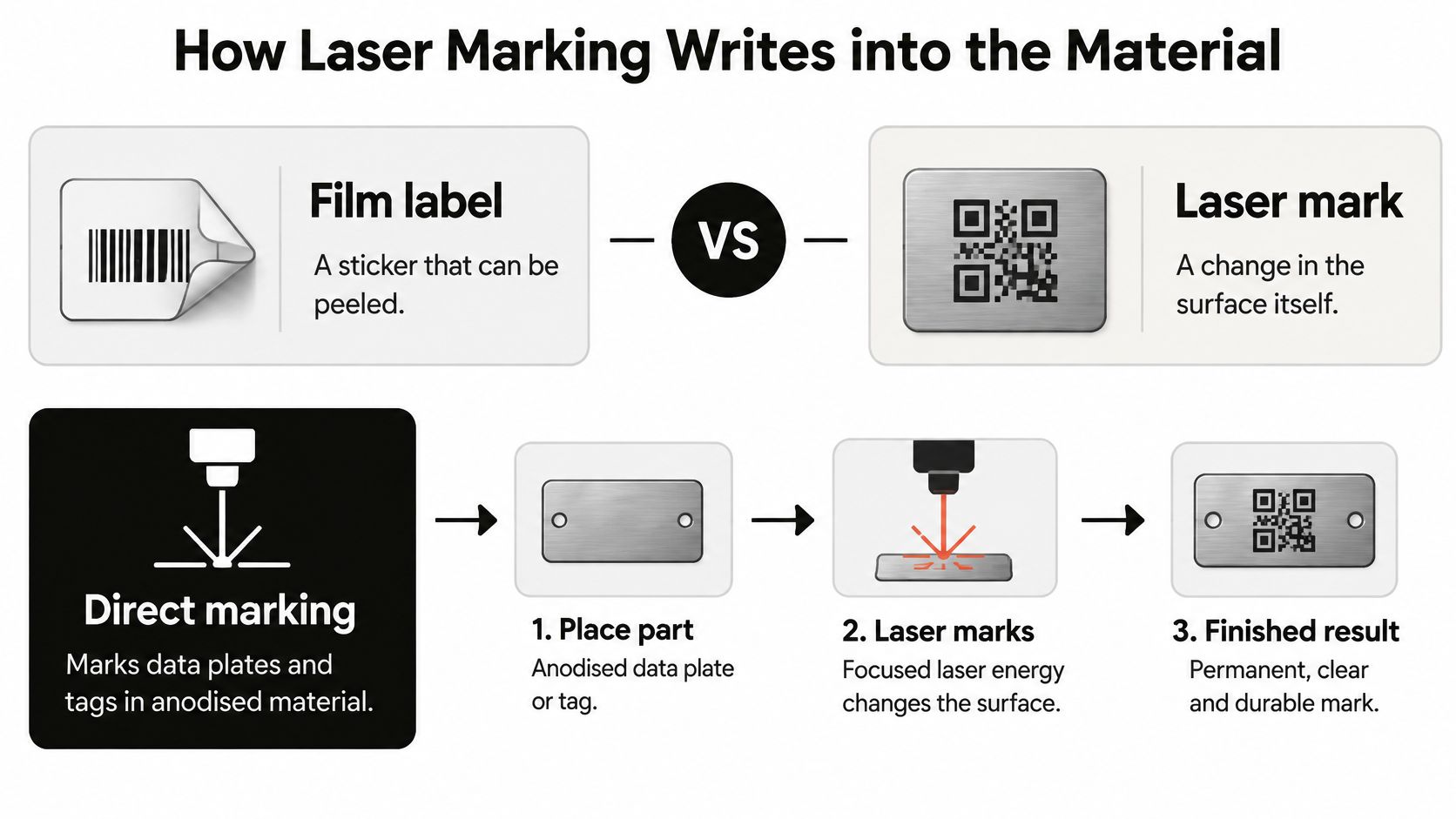
A film label is a sticker that can be peeled. A laser mark is closer to a tattoo, because the process changes the surface itself rather than placing a printed carrier over it.
The analogy has limits, but it explains the important mechanical difference. On a directly marked component, there's no adhesive edge for oil to creep underneath.
The diagram shows that distinction between an attached carrier and a changed surface.
Different surfaces produce different marks
Trotec Laser's engraving guidance describes direct marking of data plates and tags in anodised aluminium, plastic and other metals, commonly using a fibre laser, without marking consumables, physical contact or tool wear.
The visible result isn't always an engraved groove. The operator chooses a process appropriate to the material and the required appearance.
- Colour change or annealing: On suitable stainless steel, controlled heating can create contrast without cutting a deep recess.
- Material removal: Engraving removes surface material to produce a bright or dark mark, according to the material and finish.
- Anodised-layer alteration: On anodised aluminium, the process alters the surface layer to create a contrasting identifier.
Consider a data plate beside a maintenance access point. Workers wipe it, brush it with gloves and occasionally catch it with a tool. A suitable laser process removes the risk of the printed carrier lifting, although the plate itself still needs secure attachment.
Repeating a mark in production
Laser marking can also be part of an automated manufacturing process rather than a separate bench task. Trotec's industrial marking guidance describes production-line and robot-cell integration, an InMarker range intended for short cycle times, and a SpeedMarker 330 with a 100-watt MOPA fibre laser, high-speed galvanometer and Ruby software.
In a production scenario, a fixture holds the component in a repeatable position. The operator selects the approved job, confirms the identifier source and checks the finished mark before releasing the batch.
The scanner matters here as much as the visual appearance. A mark that looks dark to a person may still have poor contrast under the scanner's illumination.
Data plates, legal identification markings, functional marks and part traceability each need their own acceptance criteria. A decorative finish isn't automatically suitable for a machine-readable code.
A permanent-looking mark isn't an accepted mark until the intended reader can use it.
Limits to settle during sampling: the substrate must accept the laser wavelength, painted and powder-coated faces need a tested recipe, and the code must scan after the expected exposure. Establish those limits before approving the material or connecting production output to live records.
Substrates and Finishes for Long Service
Treat the label as a small component, not a graphic. Its face, finish and attachment all have to suit the location, just as a seal or cable gland does.
A workbench comparison helps make those physical differences visible.
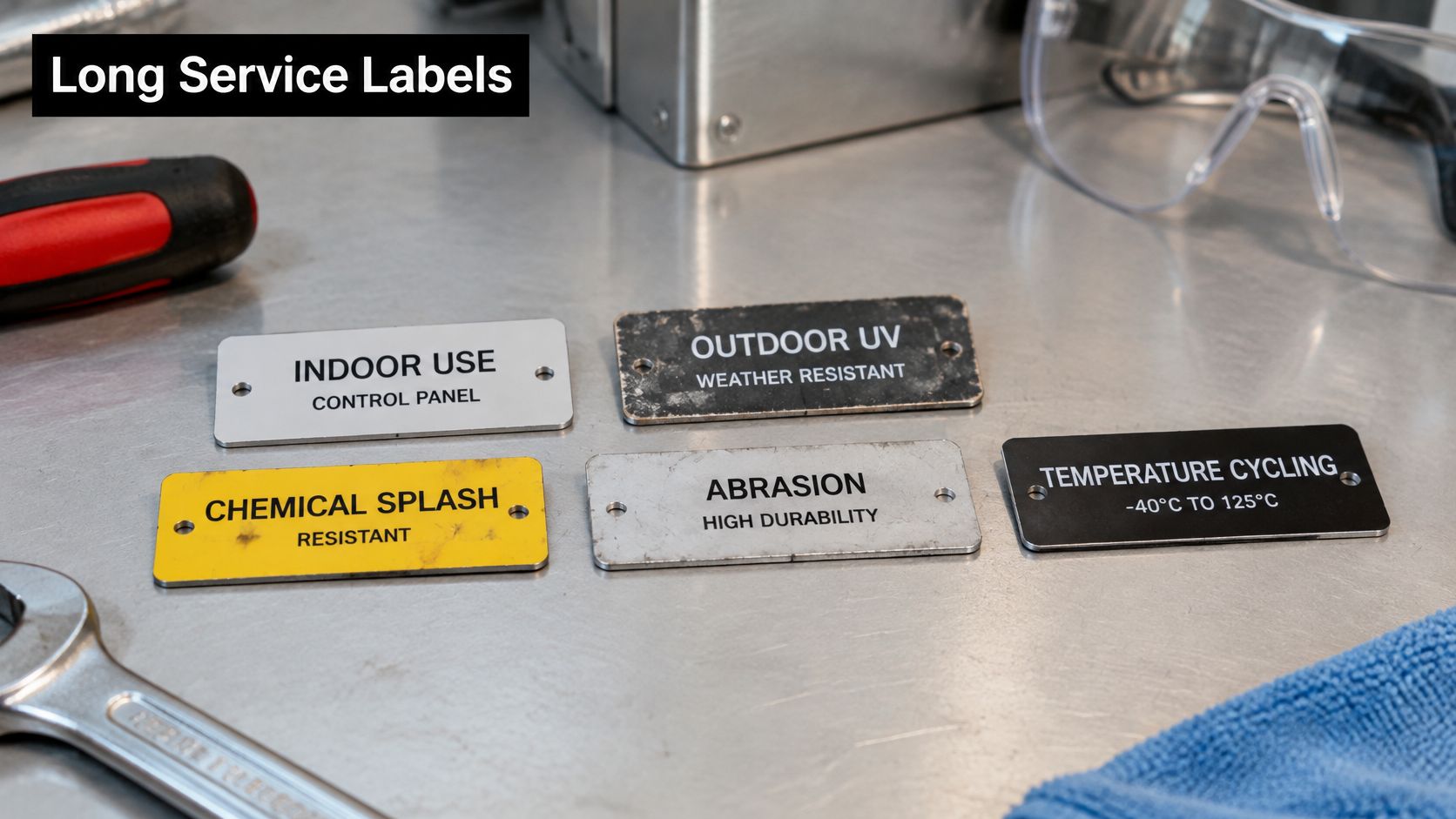
Substrate by environment for asset labels
| Environment | Recommended face | Replacement-waste note |
|---|---|---|
| Indoor panels | Polyester with resin ribbon | Can serve for years if the bond and edges hold; film can still lift |
| Outdoor UV | Laser-marked anodised aluminium plate | Rivets or screws remove adhesive as the weak link and can reduce replacement |
| Chemical splash | Stainless steel with laser colour change | Can replace film that the site's cleaners would attack |
| Abrasion and handling | Laser-marked steel or stainless steel | Direct marking avoids a separate printed film; test the actual surface finish |
| Temperature cycling | Anodised aluminium or steel plate | Check attachment and contrast after cycling before approving production |
| Repeated sterilisation | Direct-marked engineering plastic, such as ABS, polycarbonate or polyamide | Can avoid a separate plate assembly, but the exact polymer must tolerate the sterilisation process |
Choose for the exposure, not the material name
Polyester is a practical film-label starting point for many indoor panels and some outdoor locations. Its suitability still rests on the ribbon, adhesive, surface preparation and exposure.
Anodised aluminium makes a useful high-contrast plate where mechanical fixing is available. Stainless steel is worth evaluating around aggressive cleaning, while brass may be appropriate where a traditional plate is specified.
Engineering plastics need particular care. ABS, polycarbonate and polyamide aren't blanket approvals for sterilisation, chemical contact or heat. Test the actual grade and marking finish against the process the part will encounter.
For splash locations, use the chemical-resistant labels guide to frame the specification around the chemical, contact conditions and cleaning method, rather than ordering a vaguely chemical-proof label.
This video provides additional visual context for the marking process.
Count replacement waste as well as material
A recyclable sticker that needs repeated replacement may create more waste than a durable metal marker. A permanent plate, however, may combine metal, adhesive, coatings or an embedded chip that complicates recovery.
Australian packaging policy targets discussed in the Senate report on stronger packaging reform include reusable, recyclable or compostable packaging, 70 per cent recycling or composting of plastic packaging, and 50 per cent average recycled content. Those are packaging-policy measures, not a universal specification for an equipment safety plate.
Compare service life, replacement frequency, material mix and compliance risk at the actual location. Also decide whether maintenance staff can remove the plate for refurbishment or separate its materials at disposal.
Mark a sample, then scratch, solvent-wipe and weather it under controlled, representative conditions. Keep an untouched reference alongside it, and lock the production file only when the exposed sample remains readable and securely attached.
Compliance Marks That Must Stay Readable
A neat plate can still be unsuitable if the mark is undersized, easily removed or based on obsolete chemical information. Compliance depends on the applicable framework, not on choosing a durable material.
The table separates required content from the production checks needed to preserve it.
Australian label duties that affect durability
| Context | What must be shown | Durability and placement |
|---|---|---|
| Telecommunications customer equipment and cabling | Compliance label, commonly the RCM or an approved digital alternative where allowed; supplier records maintained separately | Durable, at least 3 mm high, hard to remove and readily accessible; packaging placement only where direct application is impractical and conditions are met |
| Radiocommunications devices | RCM on qualifying devices | Accessible to the user, durable and at least 3 mm high |
| Workplace hazardous chemicals | Identity, composition information, GHS classification information, pictograms, signal word, hazard and precautionary statements, relevant emergency or disposal guidance | Preserve legibility under expected exposure; control artwork against the current SDS |
| GHS 7 changeover | Current GHS 7 content for newly manufactured or imported hazardous chemicals | Relevant supply requires GHS 7 labels from 1 January 2023; legacy GHS 3 files aren't interchangeable |
| Unsafe electrical equipment | Warning against inadvertent use; danger tags with clear warnings, relevant dates and signatures | Tags should be durable and securely fixed |
Size and permanence aren't artwork preferences
The Australian compliance framework summarised in the Department of Industry annual report material requires applicable telecommunications and radiocommunications RCM markings to be durable and at least 3 millimetres high, with accessibility requirements; telecommunications labels must also be permanent or difficult to remove or obliterate.
Don't shrink a regulated mark to fit an existing plate layout. Change the layout or confirm whether a permitted alternative applies.
Packaging placement isn't a general escape route for inconvenient artwork. Where direct application is impractical because of the item's size or physical nature, the relevant placement and visibility conditions still need checking.
For electrical installations, the switchboard labelling requirements guide helps organise the equipment-identification questions. In healthcare, MedQAIR's resource on medical device electrical safety provides useful context for the safety work surrounding identification and inspection, rather than replacing the applicable labelling rules.
Chemical artwork needs controlled release
Safe Work Australia's hazardous-chemical label guidance explains that labels communicate classification information under the GHS approach. That makes the current chemical identity and hazard information the starting point for artwork, not an old label pulled from a shared folder.
Safe Work Australia's GHS 7 information sheet states that GHS 7 applies to newly manufactured or imported workplace hazardous chemicals and that suppliers must provide compliant labels for relevant products from 1 January 2023.
An obsolete pictogram or precautionary statement can't be corrected by printing it more clearly. Introduce an approval checkpoint whenever the formulation, supplier, hazard classification or SDS changes.
- Match the file: Confirm product identifier, hazard category, pictogram set and SDS revision.
- Inspect the output: Check text at the intended viewing distance and verify any machine-readable code.
- Test the assembly: Check adhesion and information retention after representative splash, abrasion and temperature exposure.
There isn't a single national plate specification that covers every industrial application. The responsible person needs to identify the applicable duty, preserve the required information and retain the approval record.
Asset Labels Tied to Maintenance Records
Say a stainless plate still scans after a decade in service. The scan opens a pump record, but the technician discovers another pump carries the same number, while neither record identifies the current owner or overhaul history.
The plate has survived. The identification system has failed.
Set the information rules before drawing the artwork. Decide who issues identifiers, how uniqueness is checked and what happens when a part is repaired, refurbished or moved.
Give the identifier a defined owner
Use a permanent identifier for the asset, rather than encoding a location that changes whenever equipment moves. Keep location, service status and custodian in the record unless there's a specific operational reason to mark them physically.
Write down who may re-identify a refurbished part. Otherwise, a workshop can unintentionally create a new asset while the maintenance team continues recording work against the old one.
Food Standards Australia's food traceability guidance identifies records such as suppliers, customers, products, transaction dates, batch or lot details, quantities and related production information. For an industrial asset system, map the relevant fields into the asset register, maintenance platform or ERP rather than trying to squeeze the entire history into the code.
- Identifier rules: Prevent duplicate allocation and define replacement-label authority.
- Code format: Choose a GS1 linear barcode or two-dimensional code that the site's devices can read.
- Offline behaviour: Confirm what the crew can retrieve without connectivity and how later updates synchronise.
For the distinction between fixed printed content and a changeable online destination, CertSeal's explanation of updatable QR codes for digital badges is a useful comparison. For plant assets, retain control of the destination and preserve the permanent identifier even when software changes.
A rail example that joins the part and the record
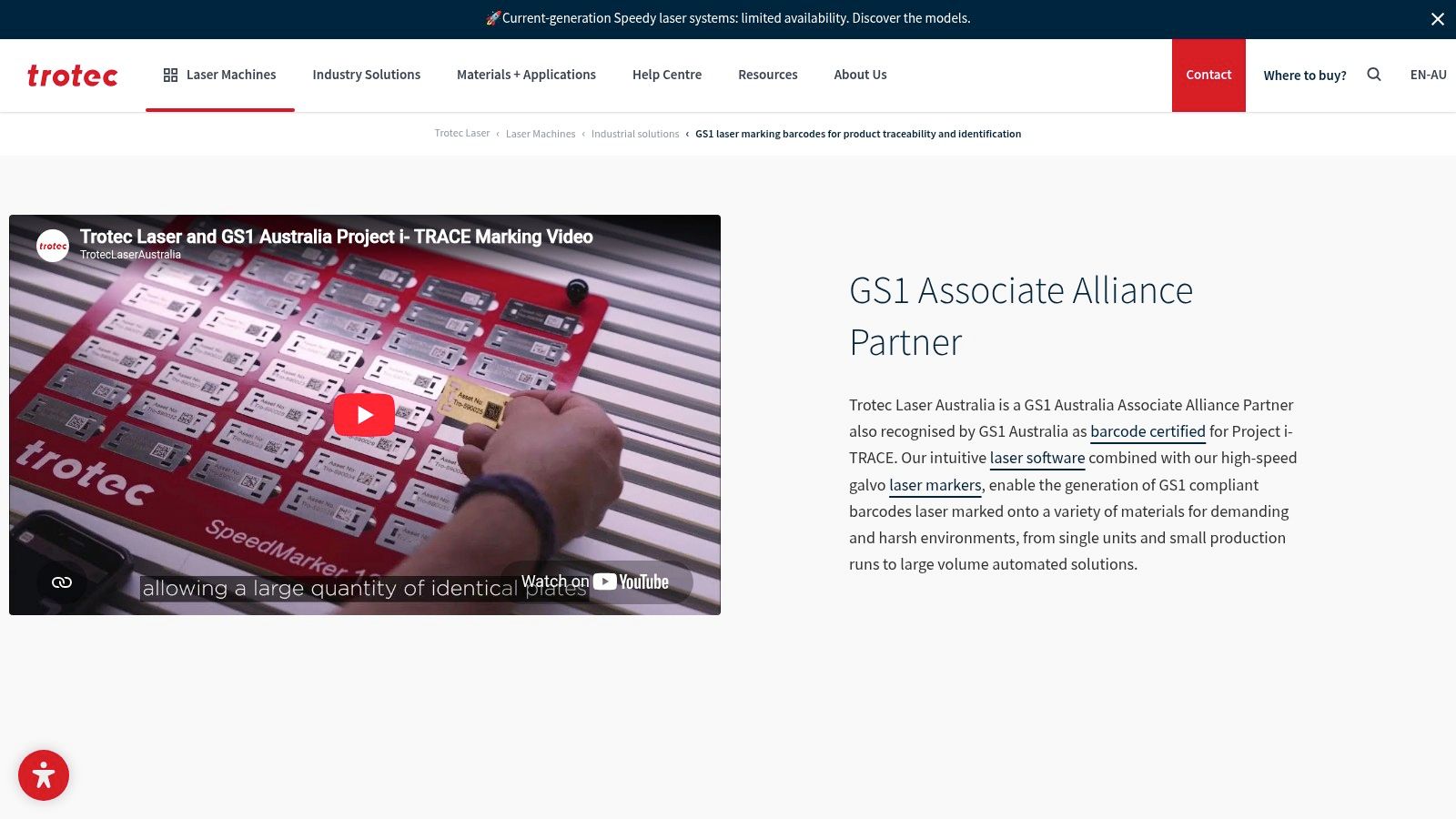
Trotec's account of Project i-TRACE describes the Australasian rail initiative with GS1 Australia, where unique barcode identifiers connect parts and components to digital records for traceability, maintenance and asset management, reducing manual entry.
The same account describes direct marking of barcodes, DataMatrix codes and serial numbers on metals, engineering plastics, painted surfaces and powder-coated surfaces. Keeping the identifier on the component reduces reliance on a swappable tag, provided the marked surface itself remains with the asset.
The Trotec Laser machine imagery below illustrates industrial marking equipment, rather than a mechanical printing press.
The same relationship matters for medical Unique Device Identification, where cleaning and sterilisation mustn't break identification. For switchboards and essential-services equipment, the plate must remain consistent with the current drawing and equipment schedule.
Use an asset tagging and tracking system specification to document that complete workflow. As a practical pilot, mark ten samples, scan them with the devices the crew carries, and confirm that each opens exactly one correct record, including when connectivity is unavailable.
Brief the Mark Before You Order
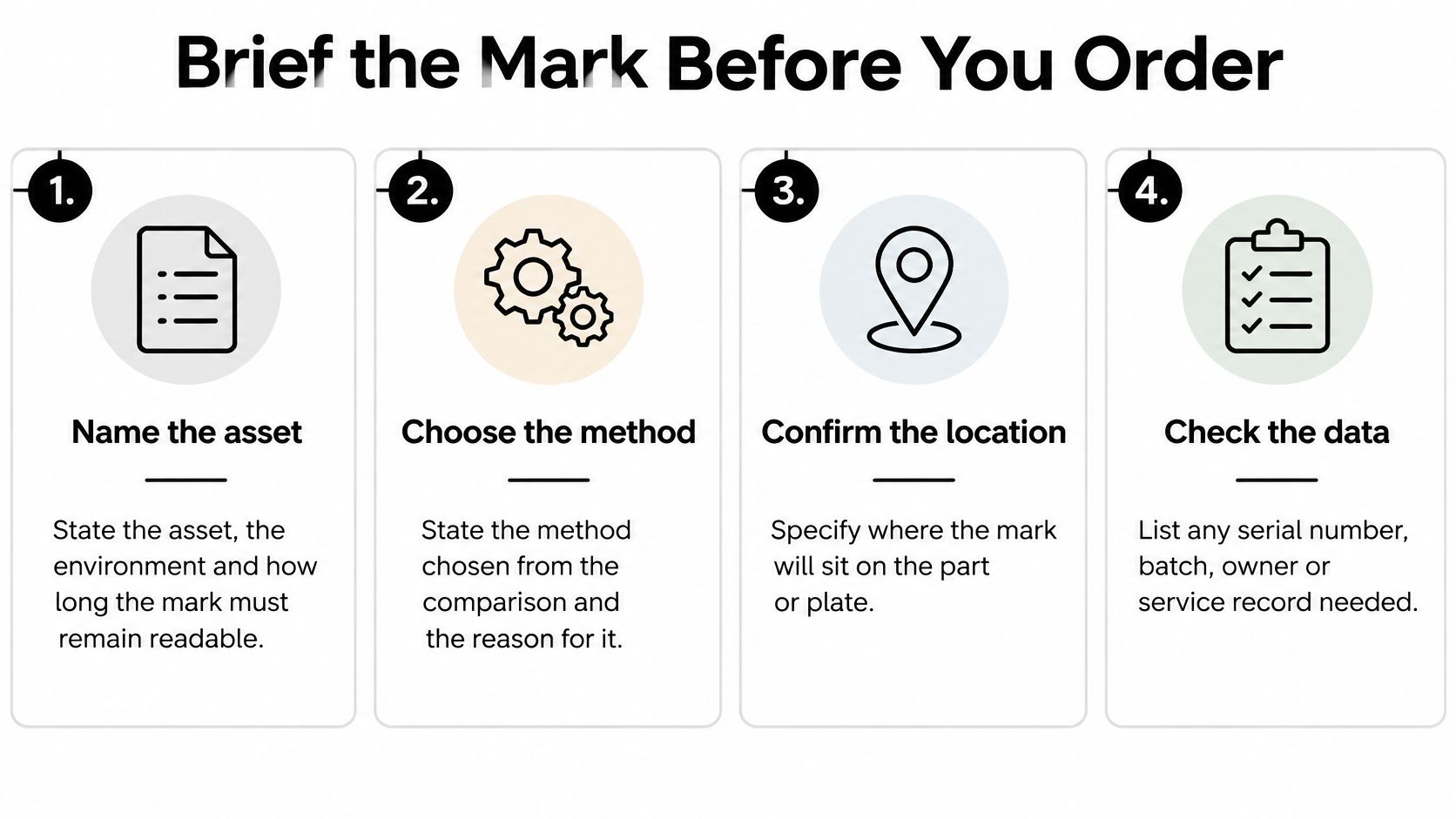
A useful marking brief gives production staff enough information to challenge a weak specification before making it permanent. Copy the following into an email and fill in the site-specific details.
Name the asset and environment. Describe the equipment, proposed marking location, exposure and required readable life. Include the cleaner, surface finish and any heat, wash-down or sterilisation conditions.
Choose the method and substrate. State whether you're considering direct thermal, thermal transfer or laser marking, and why. For a separate plate, specify how it will be attached and whether the fixing points are already available.
Supply the exact information. List the characters, barcode type and destination system. Provide the approved data file rather than asking someone to retype serial numbers from photographs.
Attach the compliance duty. Identify the applicable marking requirement and approval authority. For chemical artwork, include the controlled file and matching SDS revision; for equipment marks, provide the approved layout and placement constraints.
Request a marked sample. Agree on scratch, solvent, exposure and scan checks before the full run. Assess the sample on the actual surface or customer-supplied part wherever possible.
Assign responsibility after repair. Name the person authorised to replace a damaged mark or re-identify a refurbished component. Specify what happens to the old record and identifier.
The checklist below provides a compact reminder for the person assembling the order.
Approve the sample before the run
Evright Industrial is the industrial division of evright.com, which was established in 1966. We mark plates, tags and customer-supplied parts using Trotec Laser machines, placing the identifier in or on the material rather than relying on a printed film that can lift.
Start through the laser-engraving and asset-labelling enquiry route at evright.com. Your dedicated project manager coordinates the material choice, schedule and samples for approval before production starts.
Our sampling service lets you compare materials and marking finishes. Samples carry a small fee that's redeemable against the larger production invoice, and customer-supplied items go through a full sampling and testing programme before production.
Approval gate: A correct-looking sample isn't enough. Confirm the marked information, physical performance and connection to the live record.
A normal turnaround is seven business days for a regular order. Larger production runs are scheduled according to quantity and the physical materials involved, including size and material type.
Call 08 8231 2746, email sales@evright.com, or use the contact form to start the conversation. Send the six-point brief with a failed site label where available, and don't approve production until the sample scans into the correct live record.
Evright Industrial offers laser-engraved asset labels, equipment plates and customer-supplied part marking for industrial identification. Visit Evright Industrial with your marking brief and a failed label from site so we can help assess the material, finish and sample before the production run.
Recent Comments