
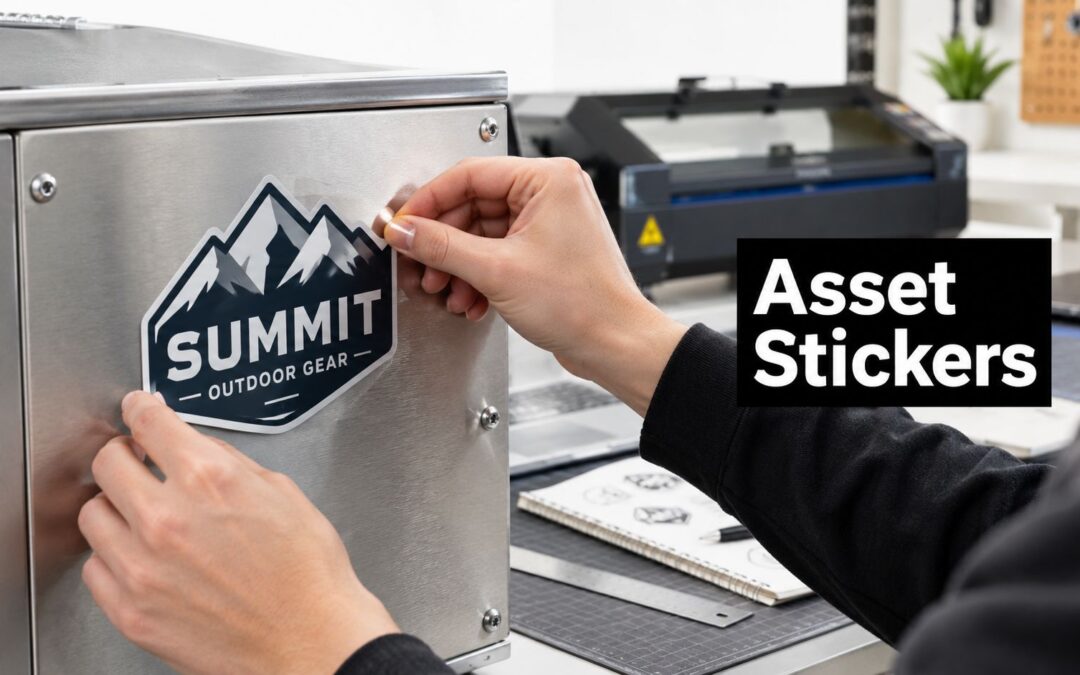
An asset sticker can look perfect when it leaves the workshop and still fail on site. A logo may fade under direct sun, a barcode may become unreadable after repeated cleaning, or the adhesive may lift from a dusty switchboard. Once that happens, the physical label no longer connects reliably with the asset register, maintenance history, or audit record.
The right approach treats design, material selection, application, and data management as one system. Asset stickers with logo should establish ownership while carrying a unique identifier, barcode, or QR code that remains usable throughout the equipment lifecycle. Trotec Laser machines support this work by producing precise, consistent marks across suitable industrial materials, giving designers a practical route from brand artwork to durable identification.
Why Quality Matters for Your Asset Stickers
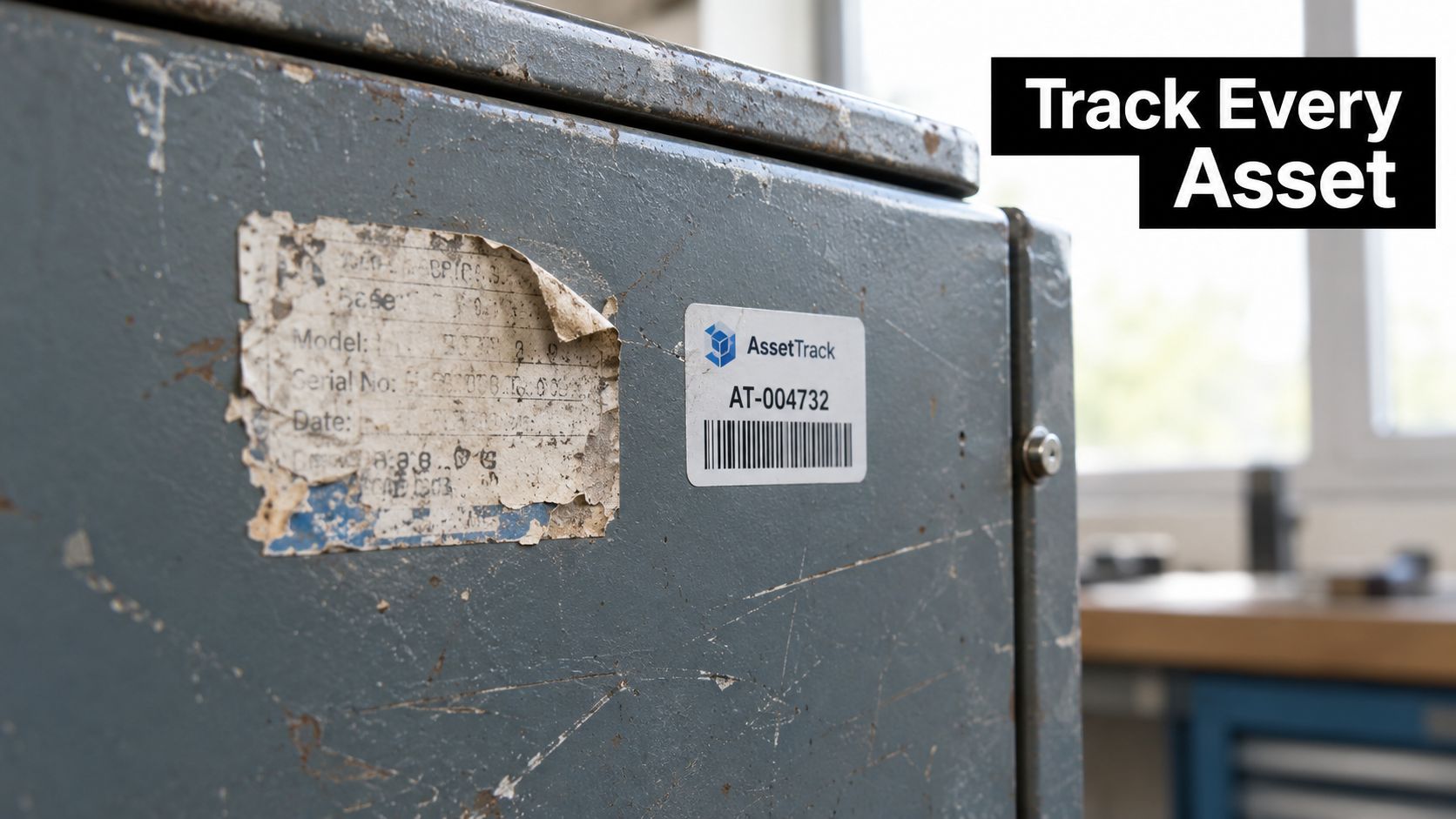
A site manager usually notices a weak label at the worst possible time. During an audit, a technician finds a plant item with a peeling sticker and has to compare faded text against a spreadsheet. In a cleaning-heavy area, a logo disappears before the asset number does. Outdoors, ultraviolet exposure attacks the printed face, while abrasion and pressure washing gradually remove the information people need to scan.
A label failure creates more than a cosmetic problem. If the identifier can't be read, staff may struggle to reconcile the item with its CMMS record, maintenance schedule, calibration information, or location. Australian asset governance reflects this connection between the physical label and the digital record. The University of Sydney's standard requires installed assets to receive an equipment code and have their details recorded in a CMMS, with barcode identification also used for internal building spaces, as outlined by Australian asset labelling guidance.
Branding has a job to do
A logo isn't the primary control on an industrial label, but it can make ownership and site responsibility immediately visible. That matters when contractors, departments, or service providers share equipment. The logo should support the identifier rather than compete with it.
A reliable layout generally gives priority to:
- Unique asset code: The human-readable identifier should remain clear at a glance.
- Barcode or QR code: The machine-readable element should have enough contrast and quiet space to scan.
- Organisation mark: The logo should be recognisable without reducing the size of the operational information.
- Optional contact detail: Use this only where it supports recovery or service requests.
Australian asset-tracking materials describe barcode and QR labels as part of maintenance, calibration, lockout/tagout, and pre-start records, rather than simple branding devices. MapTrack's asset management information illustrates why a professional label needs to connect the object to its operational history.
Trotec Laser machines are particularly useful when the design must remain sharp across repeated production runs. Laser marking and engraving can create clean edges, consistent positioning, and high contrast when the material and process are matched correctly. The result isn't just a better-looking sticker. It's a physical control that helps a team identify equipment, verify records, and maintain a dependable audit trail.
For practical planning around identifier structure, placement, scanning, and lifecycle records, use these asset tracking best practices.
Preparing Your Artwork and Logo Files
Production problems often begin in the design file. A logo that looks crisp on a screen may contain thin strokes, embedded raster images, or small text that won't survive reduction onto an industrial label. Prepare the artwork for the marking process before you request a quotation or approve a proof.
Start with clean vector artwork
Supply the logo as vector artwork wherever possible. Formats such as AI, EPS, or vector PDF allow the production team to scale outlines without introducing the soft edges associated with a low-resolution bitmap. Convert fonts to outlines or include the correct font files, then inspect the result at the intended label size.
Remove unnecessary effects. Transparency, gradients, shadows, and complex clipping masks may not translate predictably to a laser workflow. A simplified one-colour version of the logo is often more useful than a detailed brand presentation file, particularly where the mark will be engraved or applied to a dark substrate.
Keep these checks in the artwork handover:
- Artwork scale: Design at the intended finished size so thin lines and counters can be judged realistically.
- Stroke weight: Avoid hairline details that may close up or disappear during marking.
- Clear space: Leave separation between the logo, asset code, and barcode.
- Version control: Name the approved file clearly and remove superseded artwork from the production folder.
Make the code easy to scan
The asset code is usually more important than the logo. Use a logical identifier that matches the organisation's asset register, then place the same value in human-readable text near the barcode or QR code. Don't compress the code into a crowded corner just to preserve a large logo.
Contrast is equally important. Dark metals and glossy plastics can reduce visual separation, so choose a marking method and material that create a stable contrast between the code and its background. A designer should assess the result as a technician will see it, under site lighting and from the normal approach angle.
Text sizing also needs a safety perspective. For safety signs governed by AS 1319, one Australian guide gives viewing-distance relationships of 5 mm per metre for uppercase text, 4 mm per metre for lowercase text, and 25 mm per metre for pictograms, with a 50% increase where lighting is poor or the line of sight is indirect, as described in this Australian safety sign sizing guide. Those figures apply to safety signage, not every asset sticker, but the principle is valuable: text and symbols must be sized for the distance and conditions in which people use them.
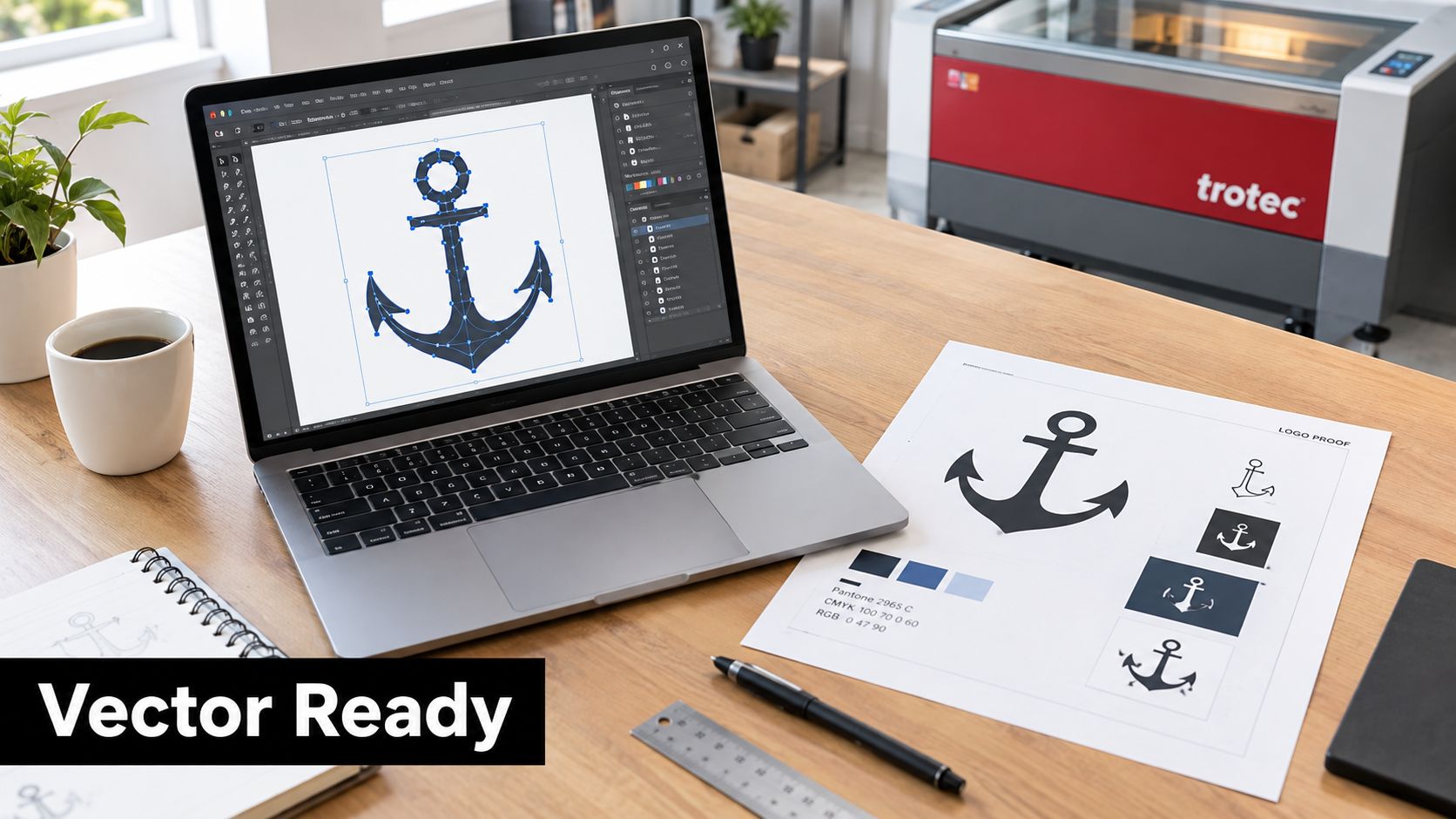
Before production, request a design review that checks the barcode, logo, text, margins, material colour, and attachment position together. A design consultation for industrial labelling can identify conflicts before they become a batch of unusable labels.
Choosing the Right Material and Adhesive
Material selection should follow the asset's environment, not the appearance of the sample on a desk. A label for an indoor electrical cabinet has different demands from one fixed to mining equipment, a plant trailer, or a medical device exposed to disinfectants.
For many tools, plant items, and field assets, hard-laminated polyester or polycarbonate provides a sensible balance of durability, appearance, and cost. Australian supplier guidance describes this construction as a cost-effective outdoor option with around 5+ years of service life, provided the substrate is suitable and the label is applied correctly, as explained in this Australian asset tag material guide.
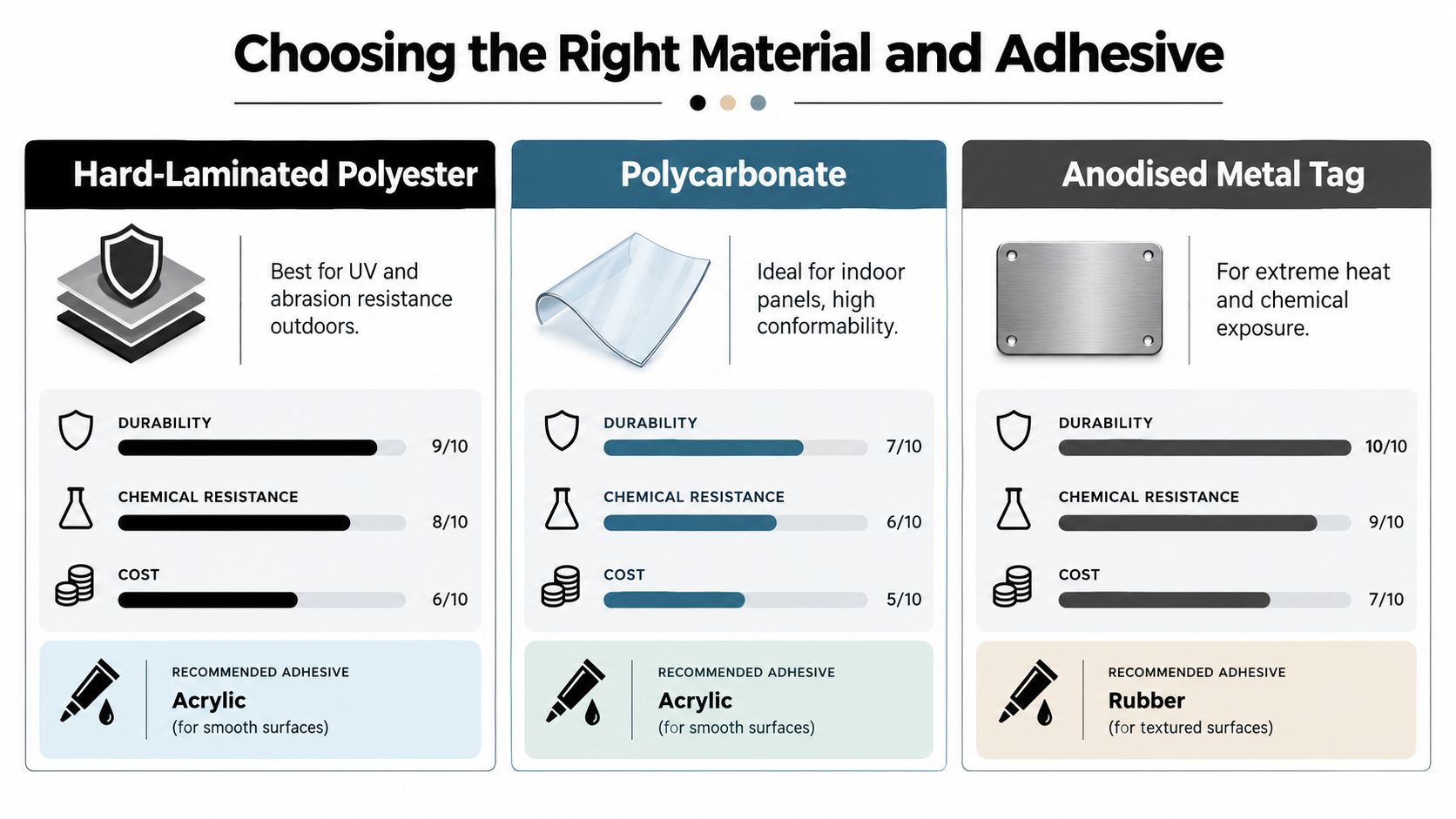
Compare the common options
| Material | Practical strengths | Main limitations | Suitable use |
|---|---|---|---|
| Hard-laminated polyester | Good resistance to outdoor abrasion and UV when properly sealed | Can be a poor choice for severe impact or extreme heat | General plant, tools, cabinets, and field equipment |
| Polycarbonate | Tough, visually clean, and useful where some conformability is needed | Requires careful testing against the site's cleaning chemistry | Indoor panels, equipment housings, and curved surfaces |
| Anodised aluminium | Scratch resistant, stable in harsh exposure, and suitable for permanent identification | Usually carries a higher upfront cost and may require mechanical fixing | Outdoor assets, chemicals, mining, and high-abrasion locations |
For higher-risk conditions, anodised aluminium or stainless steel is the safer benchmark. Australian guidance describes anodised aluminium with embedded graphics as highly scratch resistant, with black print remaining virtually unaffected by UV. Metal labels are also described with an expected life of about 20 years and resistance to temperatures of up to 350°C, depending on the product and application, according to this metal asset label selection guidance.
Adhesive performance depends on preparation
Industrial acrylic adhesive works well on clean, dry steel, aluminium, powder-coated metal, hard plastic, fibreglass, and painted surfaces. It won't compensate for oil, dust, moisture, loose paint, or a rough surface that prevents full contact.
Clean the application area with isopropyl alcohol, allow it to dry, and apply the label with firm, even pressure. Plan for the adhesive to build strength after application. Guidance for these industrial labels reports that the bond reaches close to maximum strength after 72 hours, so don't expose a newly applied sticker to aggressive washing, immersion, or heavy handling immediately.
Healthcare requires a separate validation step. Labels may encounter autoclaves, alcohol wipes, disinfectants, steam, and repeated ward cleaning, so a material that performs well outdoors may not be suitable in a sterilised environment. Request a sample and test it with the actual cleaning process before rolling it out across equipment, as recommended in this Australian hospital equipment tracking guide.
The cheapest label is only economical if it stays legible and attached. For an exposed or audit-sensitive asset, compare the purchase cost with the labour involved in finding, removing, replacing, and re-registering failed labels.
Meeting Australian Standards and Codes
A logoed asset sticker sits inside a larger control system. The sticker identifies the physical item, while the asset register holds its location, ownership, maintenance history, and status. If those two records don't match, the label has failed its operational purpose even if the printing still looks attractive.
The University of Sydney provides a clear Australian example. Its Asset Identification and Labelling Standard requires every installed asset to have a unique equipment code, with asset details recorded in the CMMS. It also requires spatial barcode identification labels for internal building spaces listed in the space database. This is not decorative branding. It is structured identification that supports consistent records across a large facility, as documented in the University of Sydney asset identification standard.
Separate asset identification from safety communication
A company logo and asset code shouldn't be confused with a safety sign. AS 1319:1994 governs signs used to regulate safety behaviour, warn about hazards, and provide emergency or fire-protection information. ACT WorkSafe explains that the standard doesn't prescribe one material or nominal size for every sign. The sign must be suitable for its intended application, and employees must understand its purpose, as set out in this ACT WorkSafe signage guidance.
AS 1319 uses seven safety sign categories distinguished by colour and shape:
- Danger: Indicates a serious hazard.
- Prohibition: Shows an action that isn't allowed.
- Mandatory: Specifies an action that must be taken.
- Warning: Draws attention to a hazard.
- Emergency or safe condition: Identifies a safe route, facility, or condition.
- Fire: Identifies firefighting equipment or information.
- Hazchem or dangerous goods: Communicates dangerous goods risks.
An asset sticker may sit beside one of these signs, but it shouldn't imitate a safety category unless it has been designed for that purpose. Keep the company mark and tracking code visually distinct from mandatory safety information.
Build the label around the record
Before artwork is finalised, decide which system owns the identifier. Confirm the code format, the barcode or QR data, the asset location, and the person responsible for updating the record. South Australia's TS0133 specification distinguishes an Asset Location Label from an Asset Identification Label, and requires labels to be permanently fixed and visible from the normal access position. It also describes mechanical fastening with screws or stainless steel cable ties for applicable tag formats, as detailed in this South Australian asset marking specification summary.
That distinction matters. Adhesive is convenient for smooth surfaces, but a tag on a vibrating, textured, hot, or frequently handled asset may need a mechanical fixing method instead.
The Proofing and Ordering Workflow
A production-ready file is only the beginning. The safest ordering process tests the label as an object, not just as an image on a screen.
1. Submit the artwork
Send the approved vector logo, identifier format, barcode or QR data, finished dimensions, preferred material, and application details. Include photographs of the target surface if the asset has curvature, texture, welds, rivets, or a powder-coated finish.
2. Review the digital layout
Check the spelling, code sequence, logo proportions, colour contrast, barcode quiet zone, and mounting position. A digital review should also confirm whether the intended marking process is engraving, laser marking, or a printed and laminated construction.
3. Request a physical proof
A physical proof exposes problems that a PDF can't show. Scan the actual barcode, handle the sample, view it under normal site lighting, and place it on a representative asset. If the sticker is for a healthcare or cleaning-heavy environment, use the actual wipes, disinfectants, or sterilisation process during the trial.
4. Approve the material and fixing
Confirm the face material, adhesive, laminate, edge finish, and any holes or cable-tie points. Clean the trial surface with IPA and observe whether the label conforms properly. Don't approve a batch until the attachment method suits the asset.
5. Release the bulk order
Once the sample passes, approve the production file and agree on the serialisation range, packaging, delivery point, and inspection process. Keep the approved proof with the asset register documentation so future replacements follow the same specification.
Trotec Laser machines support consistent engraving and marking across repeat jobs, but the machine can't correct an incorrect identifier or unsuitable material. The operator still needs the right artwork, substrate, settings, and inspection criteria.
The production approach at evright.com combines supplied artwork with material selection, laser processing, finishing, and quality checks. That workflow is useful when a project needs a logo, serialised codes, barcodes, or QR codes to remain consistent across a larger asset programme.
Before delivery, inspect a sample from the production batch rather than relying only on the approved artwork. Check that the code scans, the human-readable text matches the database, the logo is positioned consistently, and no edges or fixing points interfere with application.
Ensuring Long-Term Durability
Long-term performance comes from matching four decisions: material, marking method, adhesive, and application procedure. A sealed polyester or polycarbonate label may suit general outdoor equipment, while anodised aluminium or stainless steel is more appropriate where impact, chemicals, heat, or aggressive cleaning threaten legibility.
Inspect labels during routine maintenance rather than waiting for an audit. Look for lifted corners, scratched codes, fading, chemical staining, and blocked barcode areas. If a label begins to fail, replace it before the physical identifier separates from the digital record.
A logo should remain professional, but scannability and traceability come first. Trotec Laser technology helps create precise, repeatable results, while correct artwork preparation and site testing determine whether the finished label works in practice.
Evright Industrial provides custom asset labels and laser engraving with company logos, serial numbers, barcodes, and QR codes for industrial, electrical, healthcare, and infrastructure applications. Visit Evright Industrial to discuss the material, fixing method, artwork, and proofing process for your next asset labelling project.
Recent Comments