
A lot of people only notice signage when it fails.
An emergency stop label goes chalky and hard to read. A switchboard legend curls at the edge. An outdoor asset tag turns brittle after too much sun. Then a routine task takes longer, a technician second-guesses the right panel, or an audit turns into a scramble through the workshop looking for identification that should have been obvious.
That's usually the point where laser engraved plastic signs move from “nice to have” to operational requirement. In Australian conditions, durability isn't a styling choice. It's part of safe work, clear asset identification, and keeping markings readable long after installation day.
Why Your Operations Need Reliable Signage
A busy site can tolerate many things. It can't tolerate uncertainty around identification.
On a manufacturing floor, the problem often starts small. A printed machine label gets wiped with the wrong cleaner. A vinyl warning decal lifts at the corner. A pump tag fades just enough that the next person has to lean in close and guess. None of that sounds dramatic in isolation. In practice, it slows maintenance, increases rework, and creates avoidable risk around lockout, servicing, and emergency response.
Outdoor work is harsher again. Essential services teams, electrical contractors, and infrastructure crews deal with UV, dust, moisture, abrasion, and repeated handling. If a label depends on surface ink or adhesive alone, it usually becomes the weak point in the system.
Where weaker labels usually fail
- Exposure to sun: Outdoor labels lose contrast and become difficult to read.
- Cleaning and chemicals: In plant rooms and healthcare settings, surface-printed information can degrade.
- Abrasion from daily use: Tool contact, gloves, and routine maintenance wear down the message.
- Adhesive failure: Once an edge lifts, dirt and moisture finish the job.
This is why laser engraved plastic signs are so useful. The identification is part of the material, not just sitting on top of it. For asset labels, switchboard legends, warning panels, room signs, and equipment IDs, that difference matters.
Practical rule: If the sign carries safety, service, or compliance information, assume it will be handled harder and cleaned more often than anyone expects.
There's also a broader shift in buyer behaviour. In 2022, the Australian digital signage market experienced year-on-year growth of over 38% in value shipments, reflecting wider adoption of modern signage solutions, including engraved formats, according to Australian signage market figures. That growth tells you something useful. Buyers aren't just replacing signs. They're upgrading expectations around legibility, lifespan, and presentation.
Reliable signage is part of everyday commerce and site safety, which is why this short piece on signage as a critical part of commerce and life resonates with so many operations teams. Good signage reduces friction. Great signage keeps doing its job when conditions are rough.
Choosing The Right Plastic Substrate
The material decides how well the sign survives. The engraving method only gets you part of the way there.
I'd group plastic substrates the way operations people buy them. Not by chemistry first, but by use case. You need one material for a clean indoor panel, another for a sun-exposed asset tag, and another when tactility and long-term industrial readability matter more than finish.
Good, better, best by environment
For basic indoor identification, lower-cost plastics can work well enough if the sign won't face harsh cleaners, heat, or constant contact. For mixed environments, modified acrylic laminates are usually the safer choice because they balance appearance with durability. For more demanding industrial use, UV-stable engraving laminates and traffolyte-style products are often the better fit.
A good example is TroLase, which Trotec Laser describes as a modified acrylic double-colour plastic with a thin top layer over a contrasting core. When engraved, the core colour is revealed, which is why it works so well for clear, high-contrast signs in both indoor and outdoor use, as shown on Trotec Laser's TroLase material page.
Plastic Substrate Comparison for Laser Engraving
| Material | Best For | UV Stability | Cost Index |
|---|---|---|---|
| ABS laminate | Indoor machinery labels, control panels | Moderate for sheltered use | Lower |
| Modified acrylic laminate such as TroLase | General signage, door signs, asset labels, branded plates | Good | Medium |
| Traffolyte style laminate | Electrical labels, industrial equipment IDs, safety tags | Strong when specified for outdoor use | Medium to higher |
| Acrylic sheet | Display signage, backplates, premium visual finish | Varies by grade | Medium |
| Polycarbonate-based industrial plastics | Impact-prone environments where specified appropriately | Good when UV-stable grade is selected | Higher |
The table is a buying shortcut, not a substitute for sample testing. Two sheets can look similar on a screen and perform very differently once they're engraved, cleaned, drilled, and mounted.
How to match material to the job
For operations managers, the key questions are simple:
- Will this sign live outdoors? If yes, choose a UV-stable material first, then select colour contrast.
- Will staff wipe it with chemicals? If yes, avoid anything that depends on a printed top surface.
- Does it need fine detail or barcodes? Choose a substrate that engraves crisply, not one that melts or fuzzes.
- Is impact or flex a concern? Review the substrate's mechanical behaviour before you lock in a material.
If you're comparing engineering plastics for more specialised applications, this overview of mechanical and thermal Delrin properties is worth reading because it highlights how strength, heat behaviour, and dimensional stability affect part performance. Even when Delrin isn't the final sign material, that way of thinking helps buyers ask better questions about the plastics they specify.
For many standard industrial signage jobs, laser engraved acrylic signs are a practical middle ground because they offer strong contrast, a tidy finish, and reliable engraving behaviour without overcomplicating the procurement decision.
The Laser Engraving Process Explained
A laser engraved sign looks simple when it's finished. The process behind it is precise.
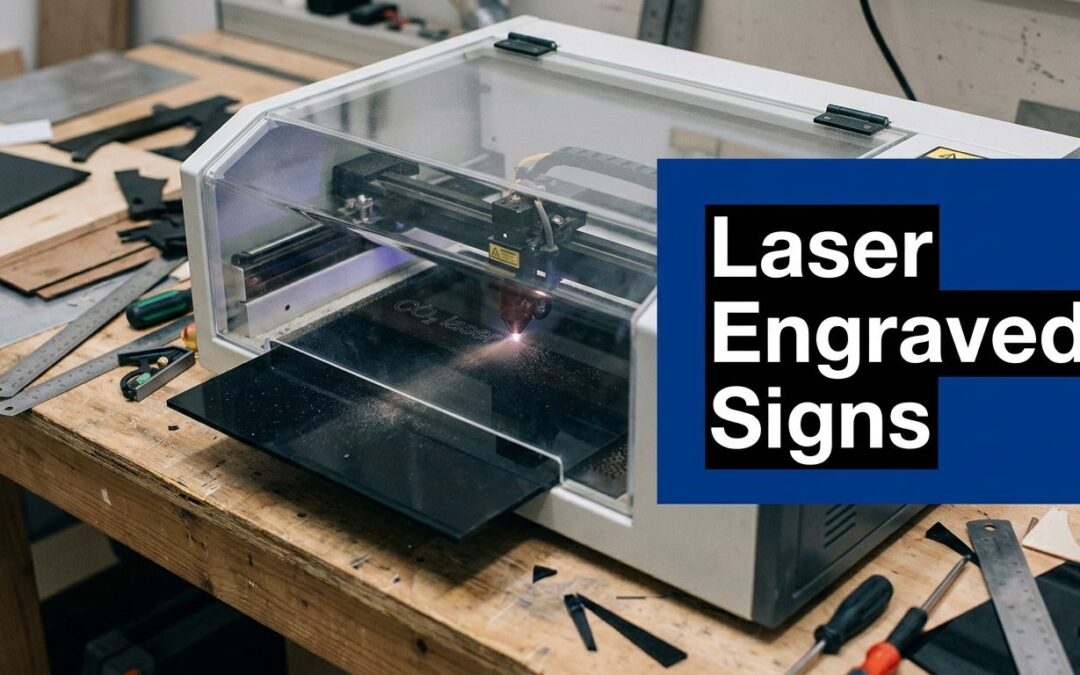
With a Trotec Laser machine, the goal is to remove or alter the top surface in a controlled way so the message stays sharp and permanent. On laminate plastics, the beam exposes the contrasting core. On other plastics, it creates a visible etched mark by changing the surface itself.

What the beam is actually doing
For Australian industrial use, laser-engraved plastic signs made from UV-stable materials achieve permanent legibility by chemically altering the polymer surface to create high-contrast marks that withstand abrasion, chemicals, and UV exposure without fading, as outlined by Photo Etch on plastic labels and tags. That's why engraved information tends to last where printed surfaces don't.
On CO2 systems, the wavelength is well suited to many common engraving plastics. The machine applies energy exactly where needed, which lets operators produce very fine text, logos, serials, and barcodes with clean edges when the material is compatible.
Raster first, vector second
Most professional sign jobs use two different motion types.
Raster engraving fills the design. Think text, symbols, logos, and solid areas. The laser moves back and forth across the panel and engraves the required content.
Vector cutting handles the outline. It traces the final contour so the sign is cut cleanly to shape, including holes, radiused corners, or custom profiles.
That sequence is easy to miss if you only look at the finished sign, but it matters. The Trotec Speedy 400 is demonstrated producing signage with raster engraving followed by vector contour cutting, which creates consistent depth and tone in multi-layer plastics, as shown in this Trotec Speedy 400 signage workflow demonstration.
A practical production setup also depends on the right file prep, material handling, and machine calibration. Shops offering plastic engraving services usually work from vector artwork for outlines and structured artwork layers for engraved content so the machine processes the sign in the correct order.
Why settings matter more than people think
A good engraving result isn't just about having a capable machine. The settings have to suit the sheet.
For laminate plastic signs on a standard 80 W CO2 laser, one documented starting point is an effect level of 60 to 90% and 100% speed in a single pass, with one pass typically sufficient for TroLase materials, according to Trotec Ruby guidance for engraving plastic signs. That doesn't mean one recipe fits every workshop. It means professional engraving starts with known parameters, then gets refined around the actual substrate and finish required.
A short machine demo makes the workflow easier to visualise:
The cleanest sign work usually comes from disciplined setup, not aggressive power.
Designing for Durability And Clarity
A sign can be accurately engraved and still fail if the design is weak.
Most readability problems come from decisions made before production starts. Low contrast. Overly thin fonts. Text packed too tightly. A panel that looks elegant on screen but disappears under workshop lighting. In industrial settings, the design brief has to prioritise fast recognition over aesthetics.
Start with contrast and type
High contrast wins. Black on white, white on black, and yellow on black remain popular because they work hard in mixed light and at a glance. Engraving laminates make this easier because the contrast is built into the sheet itself.
Font choice matters just as much. Sans-serif faces usually perform better for equipment labels, legends, safety markers, and asset tags because strokes stay cleaner at smaller sizes. Decorative fonts belong on display pieces, not on a compressor panel that someone needs to read while wearing gloves and safety glasses.
Use this checklist during design approval:
- Choose contrast first: Don't select colours because they match branding if the sign's job is identification.
- Keep fonts simple: Uniform strokes hold up better in small engraved characters.
- Leave breathing room: Crowded labels are harder to scan and easier to misread.
- Test the smallest text: If the smallest line isn't readable on a sample, increase size before production.
Depth, finish, and environmental fit
For Australian industrial use, UV-stable engraved plastics keep their legibility because the marking method creates high-contrast information that withstands abrasion, chemical exposure, and sun without fading. That makes material selection a design decision, not just a purchasing one.
The tactile side matters too. Some jobs benefit from a deeper, more pronounced engraved feel, especially where users identify controls by touch or where shadows improve readability. Other jobs need fine surface detail for barcodes, serial numbers, or compact legends. The right outcome depends on how the sign will be used, cleaned, and viewed.
Workshop advice: Design for the worst day on site, not the day the sign leaves production.
Practical layout rules that hold up
A durable layout usually follows a few common-sense rules:
- Put the most important information first. Equipment ID, hazard type, or directional cue should dominate the panel.
- Separate categories visually. Use spacing, line breaks, and hierarchy instead of decorative borders.
- Keep symbols familiar. Safety graphics only help when workers recognise them instantly.
- Consider mounting method early. Hole positions, adhesive areas, and edge clearance can all affect the final design.
If the sign is outdoors, assume glare, dirt, and weathering. If it's in healthcare, assume regular cleaning. If it's on mobile equipment, assume vibration and knocks. Design that survives those conditions usually looks slightly more conservative on the artwork proof. That's not a flaw. It's the reason the sign still reads properly later.
Key Applications And Compliance In Australia
Laser engraved plastic signs earn their keep where information must stay put.
That includes switchboards, machine labels, equipment identification, room signs, wayfinding, dangerous goods markers, and public facility signage. In Australia, though, the practical discussion can't stop at application. Compliance sits alongside durability, especially for safety signage and regulated environments.

Where engraved plastics work well
A single engraving method can support very different sectors when the material and design are chosen properly.
- Manufacturing sites: Machine IDs, lockout references, barcode plates, asset tags, warning plates.
- Electrical work: Switchboard legends, panel schedules, circuit identifiers, service labels.
- Healthcare facilities: Room identification, equipment labels, departmental signage, utility markers.
- Commercial and public buildings: Wayfinding, office door plates, amenities signage, information plaques.
- Government and infrastructure: Durable notices, facility identifiers, long-term asset marking.
The appeal is straightforward. Engraved information is hard to peel off, rub off, or misplace. That's useful in every one of those categories.
The AS 1319 question buyers should ask
One issue doesn't get enough attention. Compliance ambiguity under AS 1319.
A frequently overlooked question in Australian laser engraving is whether the engraving process changes a plastic safety sign's compliance with required luminance or contrast ratios. Suppliers often offer laser-engraved safety labels, but they rarely state whether engraving affects those requirements, as noted on PM Plastics' laser engraving page discussing AS 1319 ambiguity.
That matters because safety signage is not just a fabrication job. It's a communication control. If the finished sign no longer meets the required visual standard after engraving, the material may be durable but still problematic from a compliance point of view.
What to verify before ordering safety signs
If the sign forms part of a safety system, ask these questions before approval:
- Has the supplier confirmed post-engraving contrast suitability? Don't assume the base sheet colour tells the whole story.
- Is the selected plastic appropriate for the installation environment? Indoor compliance doesn't automatically transfer outdoors.
- Will cleaning, UV, or wear change the sign's readability? Long-term legibility matters during audits.
- Does the job require tactile or accessibility elements? Some public-facing applications need additional consideration beyond standard visual signage.
An experienced fabricator adds value, not by vaguely saying a sign is “compliant”, but by identifying where the specification needs confirmation and where the standard applies differently depending on sign function.
A safety sign should never be approved on appearance alone. Verify the finished result, not just the artwork.
Maintenance And Lifetime Cost Considerations
The cheapest sign on day one often becomes the most expensive sign over time.
Procurement teams know this pattern well. A low-cost printed label gets approved because the upfront spend is small. Then it fades, peels, or scuffs off. Someone orders a replacement, sends a technician back to site, removes the old label, cleans the surface, re-fits the new one, and updates records if identification changed or went missing. The replacement cycle keeps repeating.
Upfront price versus operating cost
Laser engraved plastic signs usually cost more than the flimsiest alternatives at the start. That part is obvious. What gets missed is the labour attached to every failure.
A sign replacement isn't just a material purchase. It can involve:
- Maintenance time: A technician has to locate, remove, and reapply identification.
- Downtime or disruption: Access may need to be scheduled around operations.
- Admin overhead: Purchase orders, approvals, stock control, and documentation all add friction.
- Risk cost: A missing or unreadable label can delay servicing or create uncertainty on site.
When buyers look at signage through a total-cost lens, permanence becomes easier to justify. The best value often comes from installing the sign you won't need to revisit for the life of the asset, or close to it.
Maintenance is usually simple
Most engraved plastic signs don't need special treatment. Basic cleaning with methods suited to the substrate is normally enough. The key is to avoid treating all plastics the same. Some panels tolerate more aggressive cleaning than others, which is another reason material selection matters at the beginning.
The wider principle applies across facilities management as well. Good wayfinding and identification reduce service inefficiency and unnecessary maintenance activity, which aligns with broader thinking around Waymap's venue cost reduction strategies. The signage itself is only one line item. Significant savings come from fewer avoidable interventions and less confusion in the built environment.
Where cheap signage loses money
Printed and adhesive-only options can still make sense for temporary uses, but they're poor choices for permanent industrial identification.
Common failure points include:
- Edge lift in heat or moisture.
- Surface wear from cleaning or contact.
- Colour fade in outdoor exposure.
- Smudging or partial information loss at exactly the wrong point on the label.
If a label carries only temporary project information, that trade-off may be acceptable. If it identifies a critical panel, medical device, isolator, or fixed asset, it usually isn't.
The lifetime cost question is simple. Are you buying a sign, or are you buying a replacement schedule?
How To Select Your Engraving Partner
A maintenance manager usually notices the supplier problem after installation, not at quote stage. The signs arrive looking acceptable, then six months later the legend is hard to read, the fixing method is wrong for the surface, or the safety colours miss the intent of AS 1319 once they are out on site. At that point, the job is no longer about unit price. It is about rework, site access, and risk.
Choosing an engraving partner is a specification decision. A good supplier asks where the sign will be used, what the substrate is being fixed to, whether the area is exposed to UV, washdown, chemicals, or abrasion, and whether the message falls under Australian safety signage requirements. In coastal plants, food production, mining, and outdoor utilities work, those details change the material and engraving method.

What to check before you place an order
Start with their questions. If the supplier jumps straight to artwork and quantity, they are probably treating industrial signage like a print job.
Check for these points:
- Machine capability: They should be running laser equipment suited to accurate cut edges, small text, repeatability, and clean engraving on industrial plastics, including detailed batch work.
- Material judgement: They should explain the trade-off between laminated engraving stock, acrylic, and other plastics in plain terms. For example, a tidy indoor directory panel is a different job from a UV-exposed asset label in regional Australia.
- AS 1319 awareness: If the sign has a safety function, they should be comfortable discussing colour intent, legibility, headings, symbol use, and where engraved plastic signs fit within a wider site compliance program.
- Mounting and environment: Adhesive, screws, stand-off fixing, rivets, and mechanical fastening all have different failure points. The right choice depends on heat, moisture, surface condition, and vandal exposure.
- Production control: Ask how they handle artwork setup, proofing, material selection, batch matching, and final inspection. Consistency matters when you are ordering one panel today and fifty matching labels next quarter.
- Relevant experience: Hospitals, councils, manufacturers, and mines do not buy signage for the same reasons. A supplier should understand the reading distance, cleaning regime, and compliance pressure in your sector.
What a reliable workflow looks like
A reliable process is straightforward, but it is disciplined.
It starts with application review. The supplier checks the use, dimensions, text size, substrate, fixings, and any compliance constraints before production begins. Then they confirm the plastic grade, engraving method, and layout details that affect legibility in the field, not just on a proof.
After that comes production and inspection. Edges should be clean. Engraved fill or contrast should be consistent. Part numbering, orientation, hole placement, and pack-out should make sense for the installer. Those details separate a supplier who understands industrial work from one who only knows how to produce attractive samples.
Evright Industrial handles industrial engraving and asset labelling work using Trotec-based production methods, with jobs typically moving from consultation and artwork review through material selection, production, quality checks, and dispatch. That kind of workflow reduces avoidable errors, especially on repeat orders and mixed batches.
Signs of a weak supplier
Poor suppliers leave clues early.
- They recommend the same plastic for every job.
- They cannot explain how engraved legend contrast will perform after UV exposure or regular cleaning.
- They avoid questions about AS 1319 or treat compliance as the client's problem alone.
- They do not ask where the sign will be installed or how it will be fixed.
- They handle a machine label, a switchboard tag, and a decorative plaque as if the same specification will do.
The right partner specifies for the actual site condition. In Australia, that means accounting for hard sun, temperature swings, salt air, aggressive washdowns, and the compliance expectations attached to safety communication. A sign that looks good on dispatch day is not the benchmark. A sign that stays readable, correctly identified, and fit for purpose over time is.
Recent Comments