
You're usually looking at these signs when something has already gone wrong. A plant walk picks up a faded valve tag. A contractor can't read an equipment label without getting a torch on it. A safety sign is still physically attached to the wall, but the message has lost contrast, the fixings are stained, and nobody wants to defend it during an audit.
That's where laser engraved acrylic signs stop being a cosmetic purchase and become an operational one. In industrial settings, the sign has to survive cleaning, handling, sunlight, coastal air, and constant visual exposure. It also has to stay legible when someone is moving fast and making decisions around equipment, access, hazards, or maintenance.
Australian demand for visible signage has been moving in that direction for a while. In 2022, the Australian digital signage market recorded year-on-year growth of over 38% in value shipments, reflecting stronger demand for visible communication tools across retail and industrial use, according to Australian signage market figures. On the ground, that tracks with what project managers already know. Better signage reduces friction. Poor signage creates rework, confusion, and compliance exposure.
The Critical Role of Precision Signage in Industry
A maintenance crew is standing at an outdoor switchboard in Port Hedland. The panel is still in service, the labels are still attached, and half of them are no longer clear enough to trust. After enough UV exposure, salt in the air, washdowns, and heat cycling, a sign can remain physically present while failing its actual job.
Industrial signage is judged in service, not at installation.
On Australian sites, that distinction matters more than many generic signage guides admit. Inland heat, coastal salt exposure, aggressive cleaning regimes, and direct sun all shorten the life of printed surfaces and low-grade substrates. If the sign is marking an isolator, identifying a chemical line, or showing a mandatory instruction, fading and edge breakdown are not cosmetic defects. They create delay, rework, and audit risk.
Precision signage needs to do three practical things well:
- Identify assets without ambiguity. Equipment tags, panel labels, valve markers, and location identifiers need to stay legible across years of use.
- Support safe decisions under time pressure. Operators and contractors need clear warnings, instructions, and directional information at a glance.
- Maintain consistency across a facility. Serial references, naming conventions, and visual hierarchy need to match from one board, room, or plant area to the next.
That is why engraved signage keeps getting specified for industrial work. The message is cut into or permanently altered on the material surface, rather than sitting on top as ink or film. In practice, that gives operations teams a better chance of keeping text readable after routine contact, cleaning, and environmental exposure.
Compliance is part of the same discussion. On Australian sites, sign selection is tied to legibility, colour contrast, symbol use, and placement requirements under AS 1319. A sign that technically exists but is hard to read, poorly contrasted, or degraded by weather can still become a problem during a site inspection or incident review. Good signage reduces interpretation. That is the standard to design to.
I see the same pattern on external plant, loading areas, desalination assets, and coastal facilities. The first failure is rarely dramatic. Contrast drops. Fine text softens. Corners stain around fixings. Then someone replaces one label with a different format, and the site loses consistency as well as durability.
For teams treating signage as long-term site infrastructure rather than a fit-out item, signage as a critical part of commerce and life is a useful reference. The commercial point is straightforward. Analysts cited in Australian signage market figures report that 76% of consumers agree signage is an important part of the shopping experience. Industrial facilities are different environments, but the underlying lesson still applies. People place more trust in a site when its visual communication is clear, current, and consistently maintained.
Understanding Laser Engraved Acrylic Sign Technology
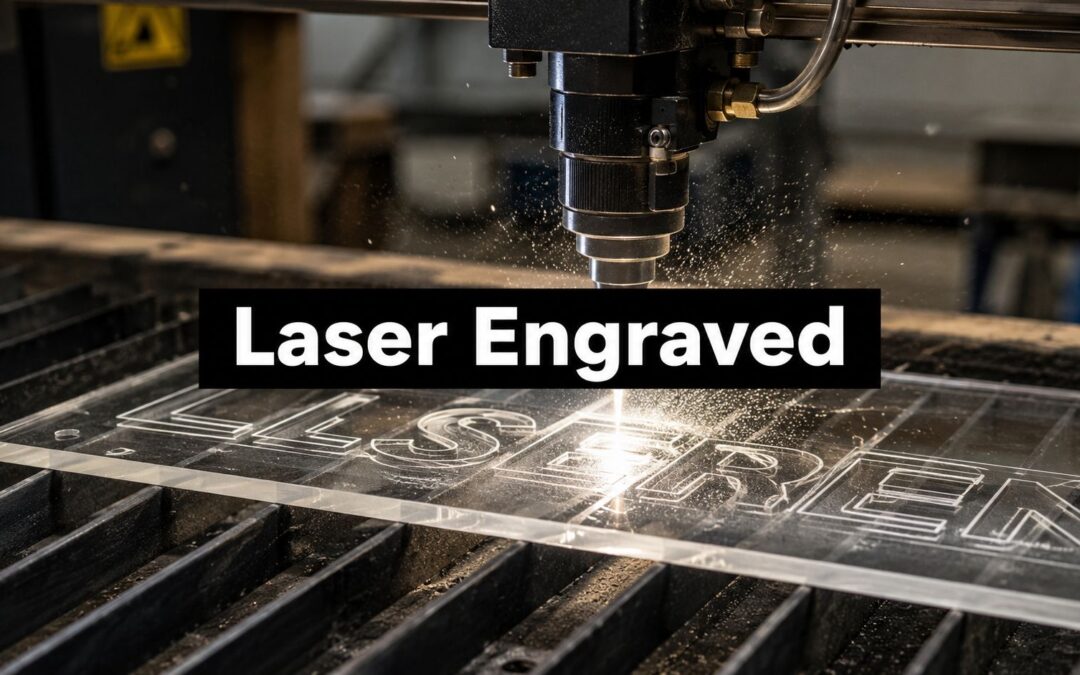
Laser engraved acrylic signs work because the mark is formed with heat and precision, not adhesive and ink. A Trotec Laser system directs a controlled beam onto the acrylic surface, and that energy changes or removes material in exactly defined areas. The result is a crisp, permanent mark with sharp edges and consistent repeatability.

How the process actually works
The process resembles machining with light. Instead of a cutter contacting the panel, the beam follows the artwork path and alters the acrylic surface with no physical tool pressure on the face. That matters when you want fine text, logos, serial sequences, or repeated parts that all need to match.
The workflow usually looks like this:
- Artwork is prepared digitally. Vector files are ideal because linework, text, icons, and cut paths stay precise.
- The acrylic is selected and cleaned. Surface contamination causes avoidable defects, especially on clear or polished stock.
- The Trotec Laser engraves and, if required, cuts the panel. The same system can handle detailed marking and shaped profiles.
- Edges and faces are finished. Depending on the application, that may include flame polishing, deburring, paint fill, or hardware fitting.
- Each sign is checked against the proof. Text alignment, edge quality, hole placement, and legibility should all be verified before dispatch.
Where laser beats printing and vinyl
Printing is useful for short-term graphics and high-colour visuals. Vinyl can be practical for temporary applications. Neither is my first choice for industrial identification where permanence matters.
Laser engraving has several practical strengths:
- Fine detail holds up well: small legends, line diagrams, and machine labels stay clean if the file is built correctly.
- Batch consistency is strong: repeat sets of tags, plaques, and safety labels can be produced with minimal variation.
- Tamper resistance is better: the mark cannot be peeled off as a surface layer.
- Material options are broader: you can specify clear, coloured, opaque, reverse-engraved, or layered acrylic depending on the use case.
Practical rule: If the sign will be handled, cleaned, mounted outdoors, or relied on for identification during maintenance, choose a process that changes the substrate itself.
The capability of the machine also matters. Trotec Laser CO2 machines can cut acrylic sheet material up to 30 mm thickness, which opens up heavier exterior signs and more rigid fabricated pieces for demanding conditions, as outlined by Trotec Laser acrylic cutting specifications.
For teams comparing material options and engraving methods, plastic engraving services gives a practical overview of where acrylic fits against other industrial substrates.
What affects the final result
Three things usually decide whether a sign looks professional or average:
| Factor | What works | What causes problems |
|---|---|---|
| Artwork | Clean vectors, proper line weights, sensible text sizes | Low-resolution files, outlines not converted, crowded layouts |
| Material | Acrylic chosen for the environment and finish required | Generic stock used without considering UV, impact, or mounting |
| Setup | Correct focus, speed, power, and support during cutting | Overheating, rough edges, haze, or inconsistent engraving depth |
On a production floor, laser technology isn't just about appearance. It's about controlling detail, repeatability, and service life.
Choosing the Right Acrylic for Durability and Impact
The biggest material mistake I see is treating acrylic as one product. It isn't. You can laser engrave different acrylic grades, but they won't all behave the same way in service, especially once the sign goes outdoors or near salt-laden air.

Cast versus extruded acrylic
For industrial work, the cast versus extruded choice is often more important than the graphic itself.
| Material type | Typical strength in use | Common compromise |
|---|---|---|
| Cast acrylic | Cleaner engraving, better visual finish, more suitable where presentation and durability matter | Higher material cost |
| Extruded acrylic | Can be suitable for lower-demand or budget-sensitive jobs | More prone to less refined engraving behaviour and finish limitations |
Cast acrylic generally gives a better engraved result. The mark tends to look cleaner and more controlled, especially on detailed work. If the sign is client-facing, permanently mounted, or expected to hold up outdoors, that's usually where I'd start.
Extruded acrylic still has a place. For internal labels, short-run identifiers, or applications where the panel won't face heavy exposure, it can be adequate. The problem comes when a low-cost internal specification gets pushed into a harsher environment without changing the material.
Australian conditions change the specification
Generic guides often prove inadequate. They talk about acrylic as if Melbourne indoors, coastal NSW, and exposed Queensland infrastructure are the same environment. They're not.
According to guidance on engraved acrylic durability in Australian conditions, 68% of Australian industrial signage fails within 3 years due to photodegradation and salt corrosion. That figure should change how you specify signs for external plant, marine-adjacent sites, transport corridors, and sun-exposed service areas.
If the sign is going into a harsh Australian environment, focus on these decisions:
- Choose UV-stabilised acrylic: standard acrylic may look fine on delivery and still degrade too early in strong sun.
- Review coastal exposure early: salt doesn't just attack metal hardware. It affects the whole assembly, including mounting details and panel finish.
- Increase thickness where needed: a thicker panel can improve rigidity and reduce flexing at fix points.
- Think about edge condition: polished edges look good, but edge treatment should suit the environment and the way the panel will be cleaned or mounted.
- Specify hardware with the panel: a durable sign paired with poor fixings is still a poor sign system.
In Australian exterior work, the material decision often matters more than the engraving decision.
Matching material to application
Different jobs call for different acrylic constructions.
For example:
- Manufacturing plant asset labels: opaque or laminated acrylic often works well where contrast and machine readability matter more than visual depth.
- Healthcare wayfinding and room signs: clear or reverse-engraved acrylic can give a cleaner architectural finish, provided cleaning compatibility is considered.
- Memorial plaques: cast acrylic with carefully controlled engraving and edge finishing gives a refined result with less maintenance than many painted alternatives.
- Outdoor service identification: thicker UV-stable stock with conservative mounting layouts usually outperforms thin decorative panels.
The right acrylic doesn't just make the sign last longer. It reduces replacement cycles, avoids avoidable maintenance, and protects readability where the sign is used.
Design and Compliance for Australian Standards
A sign can be beautifully made and still fail the job if it doesn't meet the relevant standard. In industrial work, compliance isn't a finishing touch. It's part of the specification from the first draft.
Why AS 1319 changes the design brief
For Australian industrial facilities, AS 1319 shapes how safety signs should communicate. In practical terms, that means colour use, contrast, text legibility, symbol selection, and placement aren't just design preferences. They affect whether the sign works under scrutiny and whether it communicates quickly on site.
The compliance risk is not theoretical. Data shows 74% of Australian HVAC and electrical contractors face compliance penalties due to non-standard signage, based on Australian laser engraved signage compliance guidance. That's a sharp reminder that buying a sign and specifying a compliant sign are different tasks.
A proper design review should ask:
- Can the sign be read at the actual viewing distance?
- Does the colour contrast suit the hazard category and background?
- Is the wording direct enough for a fast read in a noisy work area?
- Will mounting height and placement keep it visible after installation?
- Does the final panel still comply once fixings, frames, or adjacent equipment are added?
What works in audit-ready signage
Most compliance problems start before production. The artwork is crowded. The panel is too small. The installer places it where conduit, doors, or shadow lines reduce visibility.
Good industrial sign design tends to be restrained. It prioritises hierarchy, contrast, and legibility over decoration.
Here's a practical comparison:
| Design choice | Usually works | Often fails |
|---|---|---|
| Text layout | Short message, clear hierarchy, adequate spacing | Dense wording, all caps blocks, poor line breaks |
| Contrast | Strong foreground-to-background difference | Decorative colour choices with weak readability |
| Panel sizing | Sized for distance and context | Sized to save material rather than suit the site |
| Placement | Visible on approach and during operation | Hidden behind doors, rails, pipework, or equipment |
Site check: Always review the sign in relation to its final mounting point, not as a PDF on a screen.
There's also a broader project lesson here. Builders and contractors already understand how site presentation affects perception, handover quality, and trust. The same logic behind effective site signage for winning projects applies in industrial settings too. Clear, consistent signage tells people the work has been thought through.
Professional review beats DIY templates
DIY templates often ignore real-world conditions. They don't account for panel size changes, machine labels with limited space, reflective backgrounds, or mixed indoor-outdoor use across one facility. That's why professional review matters.
One practical option for teams that need compliant industrial signage is custom safety signs in Australia, particularly where the job requires artwork refinement, production alignment, and installation intent to stay consistent.
Compliance should be designed in at the start. It's much cheaper there than after a failed inspection or replacement run.
Laser Engraved Signs in Action Case Examples
The easiest way to judge laser engraved acrylic signs is to look at where they solve a specific operational problem.

Manufacturing and plant identification
A manufacturing site usually needs more than one sign type. It needs machine tags, line identifiers, switch labels, storage markers, and sometimes external asset plates. Laser engraved acrylic works well here because the same production method can generate a consistent family of labels across different sizes and mounting methods.
On the floor, the value is clarity. Maintenance staff don't want decorative panels. They want labels they can read during shutdowns, fault-finding, and routine servicing.
Electrical and essential services
Electrical contractors often need equipment identification that survives cabinet access, routine cleaning, and ongoing service work. For this type of job, laser engraving is useful because text stays crisp and the panel can be matched to switchboard layouts, control gear, and service routes.
This is also where disciplined layout matters. If the sign has to carry circuit references, isolation instructions, or equipment IDs, the engraving process can hold fine character detail that many temporary labels struggle to maintain over time.
A short production example helps show what a modern Trotec workflow looks like in practice:
Healthcare, public buildings, and memorial use
Healthcare facilities care about legibility, cleaning compatibility, and visual order. Wayfinding signs, room identifiers, and equipment labels all need a finish that looks organised without becoming fragile. Acrylic suits that environment because it can be produced in a clean architectural style while still allowing permanent marking.
Memorial plaques are a different kind of application, but they show another strength of the process. Families and planners usually want detail, permanence, and a tidy finish. Laser engraving handles names, dates, motifs, and dedications with a level of control that suits commemorative work.
Some of the most effective engraved signs are the least dramatic. They do their job quietly for years.
Reception and front-of-house signage
Reception signage may look less demanding than industrial identification, but it still benefits from the same precision. Reverse-engraved clear acrylic, spacer-mounted panels, and polished edges can present a professional front while keeping the message permanent and easy to maintain.
The common thread across all these examples is simple. Laser engraved acrylic signs work best when the sign is expected to remain readable, consistent, and serviceable long after installation day.
The Production Process and Long-Term Maintenance
A good signage job runs smoothly when the client, designer, and production team all understand the sequence. Most avoidable delays come from unclear artwork, missing installation details, or material decisions made too late.
From quote to finished sign
A typical production process for laser engraved acrylic signs follows a straightforward path:
Project brief
Start with the actual use case. Is it external asset identification, internal room signage, safety labelling, or a plaque? The application determines the material, thickness, finish, and mounting approach.Artwork review
Production teams check text size, line quality, symbol clarity, and cut paths. If the file was built for print rather than engraving, it often needs refinement before it's usable.Material selection
During material selection, environmental exposure, cleaning method, fixings, and visual finish should be locked in. If the sign is going outdoors, that decision can't be left until after the proof is approved.Proof approval
The proof should show dimensions, layout, spelling, hole positions, corner treatment, and any reverse engraving or paint fill notes. This step protects everyone.Laser production and finishing
The Trotec Laser handles engraving and cutting. After that, the signs are cleaned, checked, and prepared for dispatch or installation.
What clients should provide early
The fastest projects usually have these details sorted upfront:
- A clear sign schedule: names, quantities, sizes, and intended locations
- Usable artwork: vector logos, correct spelling, and any mandatory symbols
- Mounting intent: adhesive, screws, stand-offs, rails, or inserts
- Environmental notes: indoor, outdoor, washdown, chemical exposure, or coastal air
If one of those items is missing, the production team can still help, but the risk of rework goes up.
Approval should cover more than the words on the sign. It should cover how the sign will live once it leaves the bench.
Keeping acrylic signs looking right
Maintenance isn't complicated, but bad cleaning habits shorten the life of a good sign.
Use a soft cloth and a cleaner suitable for acrylic. Avoid harsh abrasive pads, aggressive solvents, and rough dry wiping on dusty surfaces. Those habits can scratch the face and dull the finish even when the engraving itself remains intact.
A few maintenance rules go a long way:
- Clean gently: lift dust before wiping so grit doesn't drag across the panel.
- Check fixings periodically: loose hardware creates movement, and movement leads to stress around holes.
- Replace damaged mounts before the sign is affected: the panel often survives longer than the adhesive pad or low-grade fixing.
- Inspect exterior signs as part of routine site checks: catching sealant failure or hardware corrosion early protects the panel.
Long-term value comes from treating signage like installed equipment, not like packaging. If the specification is right and the maintenance is basic but consistent, acrylic signs can stay readable and presentable for years.
Your Partner for Durable and Compliant Industrial Signage
The full value of laser engraved acrylic signs comes from getting three decisions right at the same time. Use the right machine, choose the right acrylic, and design for the actual site conditions and compliance requirements. Miss any one of those, and the sign may still look fine on day one while underperforming later.
A Trotec Laser gives you the control needed for sharp text, repeatable production, and clean cut quality. The acrylic choice determines whether the sign is suited to UV exposure, coastal air, internal cleaning regimes, or presentation-heavy environments. The design stage determines whether the sign remains readable, useful, and compliant once installed.
That's also why return on investment in signage isn't only about unit price. It's about avoiding repeat orders caused by preventable failure. It's about reducing confusion around assets and equipment. It's about making sure safety and identification signs stay legible when somebody needs them.
For teams that need a production partner rather than just a shop that runs files, Evright Industrial provides laser engraving and asset labelling services built around industrial applications including equipment identification, safety signage, and plaques. The division sits within evright.com, where nearly six decades of engraving experience underpin how the work is produced. In practical terms, that means the process starts with the application, then matches the material, artwork, and production method to suit it.
If the sign has to last, be readable, and stand up to scrutiny, laser engraved acrylic is often the right call. The important part is specifying it properly.
Need signage that won't become a maintenance issue six months after installation? Evright Industrial works with industrial, healthcare, contractor, government, and memorial clients across Australia on precision laser engraving, asset labelling, and durable acrylic signage. If you've got a schedule, drawing set, or even a rough concept, send it through and get the job assessed against the application, environment, and compliance needs before production starts.
Recent Comments