
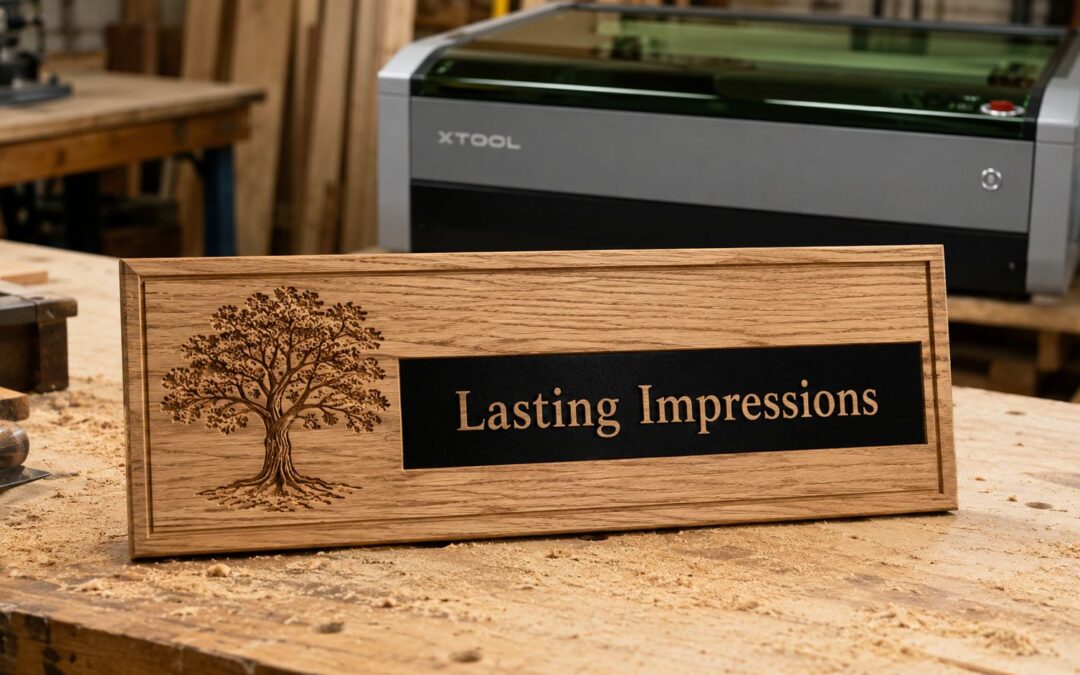
A memorial planner once brought in an old timber plaque from a garden seat. The names were still there if you caught the light at the right angle, but the surface had moved, the finish had failed, and the message had almost disappeared.
That's the difference between a plaque that merely looks good on handover day and one that still reads cleanly years later. In wood plaque engraving, durability starts long before the machine turns on.
The Enduring Power of a Well-Crafted Plaque
A good plaque has two jobs. It has to carry meaning, and it has to keep carrying it when the environment gets difficult.
In practice, that means the same craft can serve very different settings. One plaque may sit inside a reception area, marking a donor wall or opening ceremony. Another may be mounted in a workshop, a plant room, or a public memorial site where dust, handling, sunlight, and moisture all test the material. The wording matters, but so do the timber choice, engraving method, surface prep, and finish.

What failure looks like in real use
The weak plaques are easy to spot. Lettering fills with grime because the recess is ragged. Fine text softens because the grain was too open for the design. Corners lift because the board wasn't stable. A decorative finish looked warm in the showroom, then yellowed or wore unevenly in service.
The strong ones behave differently. The engraving is crisp. Logos stay recognisable. Edges remain clean. The finish supports the wood rather than hiding it.
A plaque isn't judged when it leaves the bench. It's judged after weather, touch, cleaning, and time have had their turn.
That's why hobby-level advice often falls short for commercial or permanent work. A home workshop can produce attractive pieces, but permanent identification and memorial applications demand tighter control. The plaque has to read well from day one and still read well later, when nobody remembers how carefully it was made.
Why permanence matters
Facilities managers usually care about legibility, replacement cycles, and consistency across a site. Memorial planners care about dignity, tone, and longevity. Those concerns overlap more than people expect. In both cases, a plaque fails when the inscription becomes hard to read or the material starts to look neglected.
Wood still has a place in that work because it carries warmth that metal and plastic often don't. It suits commemorative installations particularly well, and it can also serve selected branded or architectural environments where a synthetic finish would feel out of place. For readers thinking more broadly about presentation and permanence in display work, this piece on Denver art installation for collectors is a useful reference on how materials and mounting decisions affect long-term perception.
Craft matters more than sentiment
Wood plaque engraving works when the craft matches the use case. A polished board with shallow decorative marking may suit a gift item. It won't automatically suit a hospital donor plaque, a civic memorial, or a plant asset marker. The difference lies in disciplined production, stable materials, and an engraving process that doesn't compromise the timber while creating detail.
That's where professional laser work has changed the standard.
Laser vs Rotary Engraving The Core Techniques
Rotary engraving cuts wood with a spinning tool. Laser engraving marks it with concentrated light. Both remove material, but they behave very differently once detail, repeatability, and timber movement enter the conversation.
The simplest way to explain it is this. Rotary is carving. Laser is controlled burning. If you're choosing a plaque for serious use, that distinction matters.

Where rotary still has a place
Rotary engraving can produce a tactile cut and a traditional carved feel. On some timber plaques, especially where the design is bold and depth matters more than fine resolution, that can be appropriate. It also suits work where a machined groove is part of the visual language.
But rotary has limits on wood. The cutter physically contacts the surface, so grain direction, knots, and timber softness can affect the result. Fine text can fuzz at the edges. Splintering becomes a risk on less cooperative boards. Small logos and delicate serifs need more caution than many buyers realise.
Why laser usually wins for professional plaque work
Laser engraving avoids the contact problem. The beam doesn't push fibres aside with a bit. It removes material with precision, which is why detailed branding, smaller type, and cleaner edge definition are easier to achieve consistently.
For industrial and permanent memorial settings, three advantages stand out:
- Detail control: Small lettering, line work, and intricate marks reproduce more faithfully.
- Reduced surface stress: Because the process is non-contact, there's less risk of tearing fibres or bruising the face.
- Cleaner repeatability: Once the file and material are dialled in, repeat jobs stay consistent across a batch.
The gap widens when you move beyond basic flat engraving. With Trotec Laser systems, relief work becomes practical in a controlled production environment rather than an experimental one.
Practical rule: If the plaque includes fine text, a corporate mark, or a requirement to match multiple units, laser is usually the safer production choice.
A useful reference for industrial applications is this overview of industrial engraving systems in Australia, especially where wood plaques sit alongside other durable identification products in the same facility.
Trotec and multi-level relief engraving
Professional plaque work isn't limited to a surface mark. Relief engraving can create depth variation and a more sculpted result when the design calls for it. Trotec documents a specific process for relief engraving on wood using a Trotec Speedy360 (80W): the graphic is engraved with 3–4 passes at low speed (v=30%) and high performance (p=100%), followed by 1–2 post-passes at high speed (v=100%) and reduced power (p=60%) to clear smoke residue in one workflow, as detailed in Trotec's guidance on relief engraving on wood.
That matters because it shows what a production-grade system can do beyond simple dark marking. You can build layered depth while keeping the work controlled and presentable.
What doesn't work well
Some buyers assume any engraving method will do if the timber looks premium enough. It won't. A poor rotary setup on an open-grain board can look rough even when the wood itself is expensive. A weak laser setup can leave excessive residue and soft contrast.
The process has to suit the design, and the machine has to suit the process. For demanding plaque work, especially where consistency matters, that's why laser has become the default standard.
Choosing the Right Wood and Finish
The wood decides more of the final result than most clients expect. Two plaques can carry the same artwork on the same laser and still come out very differently because the timber reacts differently to heat, depth, and finishing.
If you're commissioning wood plaque engraving for a serious application, choose the substrate by use case first and appearance second. That order avoids a lot of disappointment.
For crisp detail and a refined indoor look
When the job is an office plaque, donor recognition piece, or presentation board, a smoother and more even face usually gives the cleaner result. Fine grain helps small text and logos read properly. It also makes finishing easier because the surface doesn't fight the clear coat.
Lighter, more uniform timbers often show engraved contrast better than busy or heavily figured boards. A dramatic grain can look impressive on a blank board, then interfere with readability once names and dates are added.
If you're comparing species and general woodworking characteristics, it's useful to check out The Knotty Lumber Co. for a broad overview of how timber families differ before you narrow the shortlist for engraving.
For cleaner production and stable presentation
Engineered timber has a place in plaque work when consistency matters. In the Australian market, Trotec Laser specifies that untreated poplar plywood sheets produce significantly less residue during laser cutting and engraving than traditional plywood, which is why they're often preferred for clean, durable plaques and asset labels in industrial and memorial use, according to Trotec material guidance published via IndustrySearch.
That “less residue” point matters in production. Less residue usually means less post-cleaning, less staining around engraved detail, and a more controlled finish. It's one reason some engineered panels outperform more decorative natural boards on practical jobs.
Wood Selection Guide for Engraving
| Wood Type | Hardness | Grain | Engraving Contrast | Best Use Case |
|---|---|---|---|---|
| Fine-grain hardwood | Medium to high | Tight and even | Usually strong and controlled | Indoor commemorative plaques, donor boards, corporate displays |
| Open-grain hardwood | High | Pronounced | Can be attractive but less precise on small detail | Larger-format plaques, rustic presentation pieces |
| Softwood | Low to medium | Variable | Often uneven if resin or grain is active | Decorative indoor plaques where fine precision isn't the priority |
| Untreated poplar plywood | Moderate | Consistent face | Clean, production-friendly result | Industrial labels, memorial plaques, repeat jobs |
| Decorative figured timber | Varies | Visually active | Can compete with text | Feature plaques with bold, simple layouts |
Finish isn't decoration alone
A finish has two jobs on a plaque. It protects the surface, and it controls how the engraved area is perceived.
A poor finish can flatten contrast or pool unevenly in the engraving. A good finish supports readability and gives the timber a stable, cared-for appearance. For indoor plaques, a clear coating often does the work neatly if the board has been prepared properly. For exposed locations, the finish needs to match the environment and the maintenance reality.
Consider these trade-offs before approving a sample:
- Natural look: Good for warmth and authenticity, but it may need more careful maintenance.
- Film-forming clear coat: Adds visible protection and can sharpen presentation, but application quality matters.
- Heavy stain: Can look rich, though it may reduce engraved contrast if pushed too dark.
Choose timber for how it behaves under engraving, not just how it looks on the rack.
What I'd avoid for permanent work
Boards with obvious movement, resin bleed, patch repairs, or inconsistent veneer faces create trouble. So do highly textured surfaces when the layout includes fine serif text or seals with thin lines. In plaque work, a slightly plainer board that engraves cleanly will almost always outlast a visually dramatic one that fights the process.
Design and File Preparation for Flawless Results
Most plaque problems blamed on engraving start in the artwork. A laser can only follow the information it's given, and wood will expose sloppy file prep very quickly.
The shortest explanation is this. Vector files are instructions. Raster files are pictures. For logos, line art, borders, and text, instructions are better.
Start with production-ready artwork
If the plaque includes a company logo, emblem, or detailed line drawing, supply a vector file wherever possible. That usually means artwork prepared so curves, lines, and shapes remain clean at any scale. A low-resolution image copied from a website might look acceptable on screen, then break down once it's engraved into timber.
Text should also be converted properly before production. If a font substitutes or shifts, spacing changes and line breaks can move. On a memorial plaque, that's not a cosmetic issue. It's a remake.
Here are the file rules that save the most time:
- Use vector for logos and text: It gives the machine a precise path.
- Convert type to outlines: That prevents font mismatch problems.
- Keep line work strong enough: Hairline detail that looks elegant on screen may vanish into grain.
- Simplify photographic elements: High-contrast artwork engraves more predictably than muddy tonal images.
A practical pre-production resource for weak artwork is this guide on how to convert image to line art. It's useful when a client only has a bitmap image but the design needs to become cleaner and more machine-friendly.
Surface prep and machine setup still matter
Good artwork doesn't rescue a poorly prepared board. For high-quality laser engraving on wood plaques, the face should be sanded with 220 grit sandpaper so the surface is smooth enough to support an even clear coat without dry spots. One commonly cited setup for a 6×8 inch plaque uses a fill interval of 18 mm, jog speed of 3,000 mm/s, dwell time of 5 ms per dot, and laser power at 82%, with the head positioned just above the plaque on the Z-axis for focus, as shown in this wood plaque laser setup demonstration.
Those settings aren't a universal recipe. They're a reminder that plaque engraving is a controlled process, not a one-button task. Timber species, moisture, coating, and artwork density all change what the operator should do.
Design choices that read well on wood
Wood isn't paper and it isn't acrylic. It has grain, colour variation, and a surface character that can either support or undermine the message.
What usually works:
- Bold hierarchy: Name first, secondary text smaller, decorative elements restrained.
- Clear contrast: Dark engraved areas on a lighter board are easier to read.
- Spacing that breathes: Tight layouts feel crowded once the wood adds visual texture.
What often causes trouble:
- Thin script fonts: Elegant on screen, weak in timber.
- Over-detailed crests: Fine internal lines can close up.
- Busy backgrounds: They compete with names, dates, and wording.
For memorial projects in particular, wording and layout have to work together. This collection of memorial plaque wording examples is a practical reference for balancing inscription length with a plaque size that still reads clearly.
The cleanest plaques usually come from restraint. Fewer elements, better spaced, with artwork built for the material.
Proofing before production
Before approval, check three things on the proof. Confirm spelling. Confirm hierarchy. Confirm actual scale.
Many clients review only the text and forget the physical reading distance. A line that appears large on a monitor may feel cramped once mounted on a wall, bench, or plinth. That's why experienced engravers proof for use, not just for appearance.
Durability Sustainability and Maintenance
A plaque that lasts has to meet three tests at once. It needs to stay legible, it needs to come from a supply chain you can stand behind, and it needs maintenance that a real site manager or family member will do.
Too many conversations stop at appearance. For permanent work, that's the wrong place to stop.

Durability starts with realistic conditions
An indoor board in a climate-controlled foyer has an easier life than a plaque near an entry, garden, workshop, or public walkway. The mistake is treating those environments as if they ask the same thing from timber.
Wood moves. Finishes age. Dust and moisture settle into low points. A professionally engraved plaque handles those conditions better because the material, engraving depth, and coating are chosen with the site in mind. That's why industrial-grade practice matters even for commemorative work. The same discipline that protects an equipment label also improves the life of a memorial plaque.
Sustainability has moved from optional to expected
Sustainability claims around wood plaques are often too vague. Buyers are told timber is “responsibly sourced” without being shown anything useful about origin, certification, or supply chain visibility.
That gap matters in Australia. One published review of the plaque market notes that 78% of Australian consumers demanded eco-transparent suppliers in 2025, and 63% of Australian industrial clients required sustainable material certifications for asset labelling contracts, while major local plaque vendors generally didn't publish supply-chain data for their wood sources, as discussed in this review of custom plaque sustainability gaps.
For facilities teams, councils, and memorial planners, the practical takeaway is simple. Ask direct questions.
- Timber origin: Is it Australian sourced, imported, or unspecified?
- Certification: Can the supplier confirm recognised sustainability credentials where relevant?
- Material disclosure: Do they identify the actual plaque substrate, or just call it “wood”?
- Process transparency: Can they explain how finishing and production choices reduce waste?
Sustainability in plaque work isn't a slogan. It's the ability to answer basic sourcing questions without hesitation.
Maintenance that actually gets done
The best maintenance plan is one people will follow. Complicated care instructions usually get ignored.
For most professionally finished timber plaques, sensible care looks like this:
- Dust gently: Use a soft dry cloth rather than anything abrasive.
- Keep moisture off the face: Don't leave water to sit on the surface or around fixings.
- Avoid harsh cleaners: Strong chemicals can dull or soften the finish.
- Inspect periodically: If the coating starts to fail, deal with it early before the timber is exposed for too long.
In public or industrial settings, placement matters too. A covered location, thoughtful mounting detail, and avoidance of unnecessary direct exposure can add far more life than any last-minute surface product.
The real measure of value
A cheap plaque that needs early replacement isn't economical. A beautiful plaque with unknown timber provenance may create procurement problems later. A sustainable plaque that can't withstand handling hasn't solved the whole problem either.
The right result sits in the overlap. It looks appropriate, performs under its actual conditions, and comes with material choices a buyer can justify.
Commissioning Your Project with Evright Industrial
By the time a plaque reaches production, most of the important decisions have already been made. The engraving method, timber stability, file quality, finish strategy, and installation environment all affect whether the final piece holds up or starts declining early.
That's one reason specialist production matters in Australia's timber supply chain context. The Australian Fabricated Wood Manufacturing industry generated $1.7 billion in 2025-26, declined at an annualised rate of 1.1% over the previous five years, and comprised exactly 103 businesses under ANZSIC code C1490, according to IBISWorld's industry profile. In a market where raw wood supply remains substantial but selection and sourcing need more care, plaque buyers benefit from working with a team that understands both material behaviour and production discipline.

What a competent commissioning process looks like
A sound brief covers more than wording and dimensions. It should identify where the plaque will live, how it will be mounted, what level of detail the artwork requires, and whether the client needs one-off presentation quality or repeatable batch consistency.
That's where Evright Industrial fits the discussion as a practical option for Australian plaque and identification work. The division focuses on precision engraving and asset labelling, including timber plaque applications, and it operates within the broader heritage of Evright's industrial engraving work on wood in Adelaide. The broader company background also matters. evright.com is the parent heritage brand behind the industrial division, and that structure is straightforward in practice: the main business carries the long-standing engraving expertise, while the industrial arm applies that capability to durable identification, signage, and plaque work for commercial and institutional settings.
What clients should bring to first contact
The fastest jobs usually come from the clearest briefs. If you want a plaque quoted and produced properly, bring these details early:
- Application details: Indoor, sheltered outdoor, exposed outdoor, or industrial interior.
- Artwork files: Vector logos where available, plus any wording locked for spelling and hierarchy.
- Material preference: Timber species if you have one, or a description of the look you want.
- Mounting intent: Wall, plinth, bench, stand-off, or display easel.
For readers who want a quick view of laser-based engraving capability in motion, this short video gives useful visual context before a formal brief is prepared.
Why the details matter
Plaques are small projects with very little room for error. A slight issue in timber movement, artwork quality, or finish selection is obvious because the whole purpose of the object is to be looked at closely.
That's why experienced production teams ask more questions up front than clients expect. They're not slowing the job down. They're removing the reasons plaques fail.
If you need wood plaque engraving that's built for real-world use, not just showroom appearance, speak with Evright Industrial. The team can help assess material choice, engraving method, artwork readiness, and durability requirements so the finished plaque suits its setting and holds up over time.
Recent Comments