

You're usually looking at asset tags when something has already gone wrong.
A barcode won't scan during stocktake. A serial number has worn away on a washdown line. A contractor can't confirm which panel was serviced last because the label has curled, faded, or disappeared. At that point, the problem isn't the tag alone. It's the break in traceability, accountability, and maintenance history.
That's why custom metal asset tags deserve more care at specification stage than they often get. In Australian conditions, the right tag has to do more than stay attached. It has to remain legible, machine-readable, and audit-ready across years of UV, heat, vibration, abrasion, cleaning, and handling.
Why Your Asset Tracking Fails Without the Right Tag
Most asset tracking failures start small. A printed label loses contrast. Adhesive lets go on a warm enclosure. A QR code becomes patchy after repeated cleaning. Operations teams then work around it manually, and that's where costs build up. People re-enter numbers, guess equipment identity, or delay maintenance until someone can verify the asset in another system.

A tag is part of the control system
A durable tag isn't just a label. It's the physical link between the asset in front of you and the record inside your maintenance, finance, or compliance system. When that link fails, every downstream process gets weaker.
That matters even more because metal isn't some specialist edge case. The global asset tags market was estimated at USD 2.0 billion in 2025 and is projected to reach USD 3.4 billion by 2035, implying a 5.6% CAGR, with metal asset tags forecast to hold a 47.8% share according to Future Market Insights' asset tags market analysis. For Australian buyers, that points to metal as the mainstream durability-focused choice, not an upgrade for rare situations.
If you're reviewing systems rather than just labels, this practical guide to implementing effective asset tracking is worth a look. It helps frame tags as one part of a broader tracking process, not a standalone purchase.
Where cheap tags fail first
In practice, failures usually come from one of four mistakes:
- Wrong material: A tag stock that can't handle UV, solvents, abrasion, or salt exposure.
- Wrong marking method: A surface print or shallow mark that looks fine on dispatch day but degrades in service.
- Wrong data layout: Tiny codes, crowded text, or poor contrast that slows scans and invites manual workarounds.
- Wrong attachment: A sound metal tag fixed badly to the asset, which is common on vibrating or irregular surfaces.
Practical rule: If the tag can't survive the environment for the life of the asset, it's a consumable, not an identification system.
Operations managers often focus on initial piece price. The better question is whether the tag will still work when the asset is due for inspection, relocation, revaluation, service, or disposal. If the answer is uncertain, the specification is incomplete.
For a broader view of system design, asset tracking best practices for industrial operations gives a useful starting point for aligning labels, workflows, and accountability.
Choosing Your Metal and Marking Method
Material choice should follow environment, cleaning regime, and expected service life. In Australia, that usually means balancing UV, heat, abrasion, corrosion, and the need for long-term contrast.
Material comparison that actually matters
The fastest way to make a poor choice is to ask only what the tag is made of. The better question is what the tag needs to survive.
| Material | Best For | Durability | Cost |
|---|---|---|---|
| Anodised aluminium | General industrial assets, indoor-outdoor equipment, barcode and QR applications | Strong resistance to weathering and good long-term readability when properly marked | Moderate |
| Stainless steel | Chemical exposure, washdown areas, coastal sites, harsh handling | Excellent for corrosion resistance and physical abuse | Higher |
| Brass | Decorative or presentation-focused identification where appearance matters | Good in the right setting, but usually not the first choice for hard industrial tracking | Higher |
Anodised aluminium is often the most practical starting point for industrial asset programs. It gives you a clean surface for machine-readable data and works well where weight, cost control, and long service life all matter. Stainless steel becomes the stronger option when tags face aggressive cleaners, saline air, or repeated impact.
Brass still has a place, but usually in applications where appearance is part of the brief. For mainstream tracking of plant, tools, infrastructure, or medical equipment, it's less common than aluminium or stainless.
Marking method decides whether the data survives
The tag metal matters. The mark matters just as much.
For extreme Australian UV and heat, metal tags meeting AS 1319 are essential. Standard polymer labels can fail in 6 to 12 months, while photo-anodised aluminium tags retain 95% readability for over 20 years, reducing relabelling costs in harsh mining environments by up to 78%. That's the difference between a tag that remains part of your system and one that creates repeat work.
Laser processing proves its value. On modern Trotec Laser systems, the advantage isn't just speed. It's control. You can produce clean, repeatable serials, barcodes, QR codes, and logos with tight consistency across a batch, which matters when procurement needs standardisation across multiple sites.
A neat-looking tag isn't enough. If contrast drops or edges blur, scanners start failing long before a person says the tag looks unreadable.
Laser marking also avoids reliance on surface inks in applications where washdown, handling, or outdoor exposure would gradually remove printed information. When buyers compare options, they should ask how the mark is formed, not just how the sample looks on day one.
For buyers weighing long-life identification options, these engraved metal labels for industrial use show the kinds of formats typically specified for permanent equipment marking.
Designing a Tag for Legibility and Scanning
A durable blank tag with poor layout still creates workarounds. Good design keeps both humans and scanners moving quickly, even years after installation.

Start with the minimum useful data set
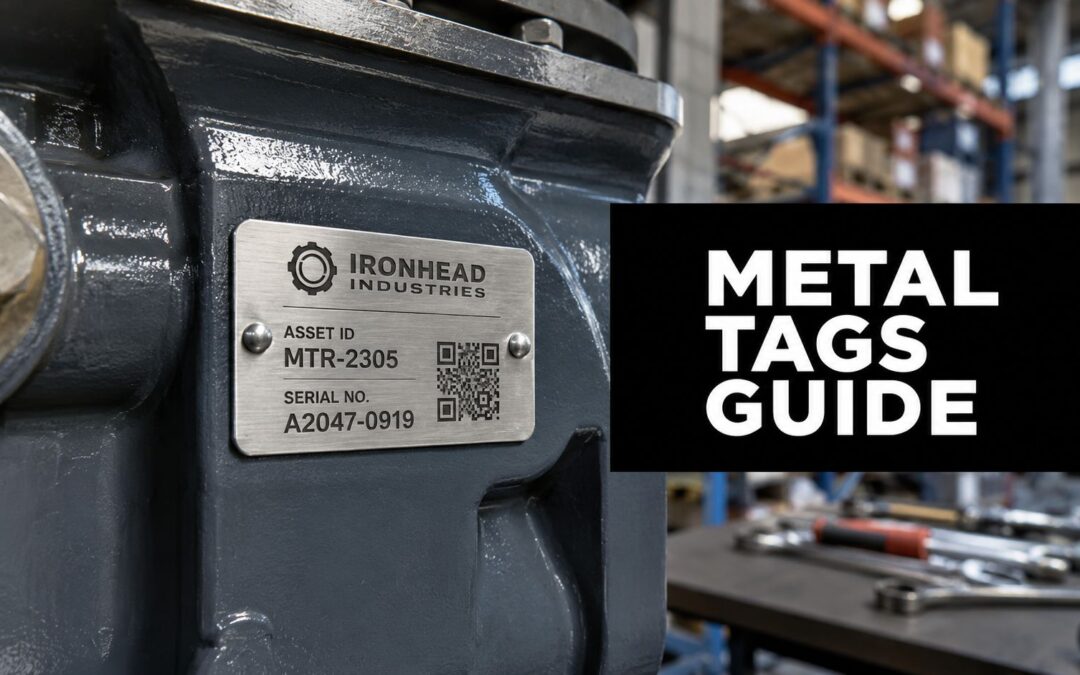
Australian guidance commonly treats the company name or logo, a unique asset ID or serial number, and a barcode or QR code as the minimum useful content for an asset tag, with optional fields such as department or location, purchase date, warranty information, and assigned user or team, as outlined in Metal Marker Manufacturing's guide to asset tags. That structure matters because the tag acts as a practical digital footprint, linking the physical item to your asset system.
That minimum data set works because it serves two users at once. A person can visually confirm the asset. A scanner can pull the record quickly without keying errors.
Layout choices that help in the field
The best tag layouts usually follow a simple hierarchy:
- Top line for identity: Company name or logo helps field teams recognise ownership immediately.
- Centre for human-readable ID: The serial or asset number should be easy to read without rotating the equipment awkwardly.
- Scannable zone with breathing room: Barcode or QR code needs clear space around it and shouldn't be crowded by borders or dense text.
- Secondary fields only if useful: Department, room, maintenance group, or warranty details should only be added if they support real workflows.
Crowding is a common mistake. Buyers often want every possible field on a small tag. The result is tiny text, compressed codes, and inconsistent scanning. It's usually better to put the permanent identifier on the tag and keep changeable operational detail in software.
Design for use, not for artwork approval
A tag approved in a PDF proof can still fail in the field if the asset is curved, greasy, shadowed, or mounted at knee height behind a guard. Scanning success depends on more than the code type. Placement, contrast, and access all matter.
If you're also assessing where newer technologies fit into a broader identification strategy, Overton Security's security technology insights offer a useful perspective on when machine-readable labels, NFC, or other layers may make sense together.
Keep permanent data on the tag. Keep variable data in the system. That separation usually gives better legibility and fewer redesigns later.
Secure Attachment Options for Harsh Environments
A perfectly specified tag still fails if the fixing method doesn't match the asset. This is one of the most common oversights in industrial tagging programs.
Public guidance on metal tags notes that placement and attachment are critical because rigid tags can loosen or fail if the mounting method is mismatched to the surface or operating conditions. That's especially relevant in Australian environments where vibration, washdown, thermal cycling, and outdoor exposure all punish weak fixing choices, as discussed in GoCodes' metal asset tags guide.
Adhesive, fasteners, or weld
Each attachment method has its place.
Adhesive backing
Adhesive works best on smooth, clean, stable surfaces where the substrate and service temperature suit the adhesive system. It's often chosen for neat appearance and fast application. It's less forgiving on textured coatings, oily equipment, or assets that cycle heavily between hot and cold.
Rivets or screws
Mechanical fastening is usually the safer option where equipment vibrates, gets pressure-washed, or sees rough handling. It also gives procurement teams more confidence on long-life assets because retention doesn't depend solely on surface preparation.
Welding
Welded attachment suits specific metal assets in severe environments, but it has to be selected carefully. Heat, coating damage, and installation practicality all need review before it's specified.
Match the fixing to the failure mode
The right way to choose is to ask what will try to remove the tag.
- Vibration: Use mechanical retention where movement is constant.
- Frequent washdown: Avoid fixings that rely on marginal surface prep.
- Outdoor heat and cold cycles: Allow for expansion, contraction, and adhesive stress.
- Coated or treated surfaces: Check whether the finish supports bond strength or whether drilling is safer.
Surface condition matters more than buyers expect. A premium tag applied to dusty, oxidised, or poorly cleaned equipment can fail long before the metal or marking does.
For assets that also involve corrosion-protection decisions, this background on hot zinc spray and protective metal finishing is useful context. It highlights why substrate condition and protective treatment can influence downstream mounting choices.
Meeting Compliance and Audit Requirements
A tag that works for daily identification can still fail an audit. Compliance requires more than durability in the general sense. It requires legibility and traceability that hold up under inspection, cleaning, and time.

Engraving depth is not a cosmetic detail
For compliance with AS/NZS 4024 safety standards, laser engraving depths of at least 0.15mm are required on metal tags. CSIRO data shows depths below 0.1mm fade in coastal zones within 3 years, while 0.15mm+ markings maintain 90% contrast for over 15 years, which is exactly why QR codes and serial numbers remain readable through long service intervals.
That single specification changes how a tag performs in practical use. A shallow mark may pass a visual check when new, but once you add humidity, salt, abrasion, or strong cleaning routines, contrast drops and scan reliability follows. Compliance teams then end up with a tag that technically exists but no longer supports traceability.
Audit-ready tags share a few characteristics
Buyers who need tags to survive audits should insist on:
- Permanent machine-readable data: QR codes or barcodes must remain scannable after years of exposure, not just after installation.
- Clear human-readable backup: Auditors and technicians still need a visible serial or asset ID if scanning is awkward.
- Stable data structure: Consistent field order across sites reduces confusion during inspections.
- Material matched to cleaning and environment: Especially important in healthcare, infrastructure, utilities, and coastal operations.
Compliance failures often start as readability failures. If the identifier can't be read quickly and confidently, the asset record loses credibility.
The practical issue isn't whether a tag looked compliant at purchase. It's whether it still supports identification at the next audit cycle, after maintenance history has accumulated and multiple teams have handled the equipment.
If your team is also reviewing the administrative side of asset control, this overview of fixed asset management fundamentals is a useful companion to the physical tagging side.
Custom Metal Asset Tags in Action
Specification gets easier when you map it to a real operating environment. The right choice looks different on a factory floor, in a hospital plant room, or on remote infrastructure.
Manufacturing plant with mixed indoor and outdoor equipment
A manufacturing site usually needs fast visual identification, reliable scan performance, and tags that hold up around oils, handling, and routine cleaning. In that setting, anodised aluminium often suits general machinery, tool control, and production assets where a clean barcode or QR code matters.
The common mistake is overloading the tag with too much information. Plants get better results when the tag carries the permanent asset ID and machine-readable code, while service intervals and job history stay in the maintenance system.
Healthcare and sterilisation-adjacent environments
Hospitals and healthcare facilities put tags through repeated cleaning and strict identification processes. Here, the focus shifts from simple durability to legibility after chemical exposure and regular handling. Stainless steel is often the better call where cleaners are aggressive or where a tag has to retain a professional finish over a long service life.
The useful discipline in healthcare is consistency. If every ward, plant area, and equipment class uses the same data structure, audit work becomes more straightforward and staff spend less time confirming whether they've scanned the right item.
Utilities, infrastructure, and remote field assets
Remote assets demand a different mindset. Access is harder, relabelling is expensive, and environmental exposure is harsher. Tags need to remain identifiable after prolonged sun, dust, weather, and physical contact from tools or maintenance crews.
In these jobs, attachment choice becomes just as important as material. A durable stainless or aluminium tag fixed poorly to a vibrating enclosure still creates call-backs. Procurement teams get the best outcome when they specify material, marking method, data layout, and fixing as one package rather than treating the tag itself as the only decision.
Your Ordering Checklist and How We Work
Before ordering custom metal asset tags, get these points clear internally:
- Material selection: Aluminium for broad industrial use, stainless steel for tougher chemical or coastal exposure, brass where presentation matters.
- Marking method: Specify permanent laser marking suitable for long-term readability.
- Data layout: Include the essential identifier set and avoid crowding the tag.
- Size and shape: Match the available mounting area and scanning distance.
- Attachment method: Choose adhesive, rivets, screws, or welding based on surface and environment.
- Compliance needs: Confirm whether the asset must meet site, safety, or audit requirements over a long service period.

At Evright, we translate your specifications into durable, precision-made asset tags. Our process is simple: you provide your requirements using our checklist, and our team provides expert guidance. We then use our industry-leading Trotec laser systems to create your tags, ensuring perfect quality and rapid turnaround. It all starts at evright.com, where nearly six decades of engraving excellence supports every project.
If you're ready to specify Evright Industrial for custom metal asset tags, start with the environment, not the unit price. A tag that stays legible, attached, and scannable for the life of the asset will save far more than it costs.
Recent Comments